


Product name: 11-Oxomogroside V
Synonym name: 11-O-Mogroside V
Catalogue No.: BP0019
Cas No.: 126105-11-1
Formula: C60H100O29
Mol Weight: 1285.43
Botanical Source: Siraitiae fructus
Physical Description:
Type of Compound: Triterpenoids
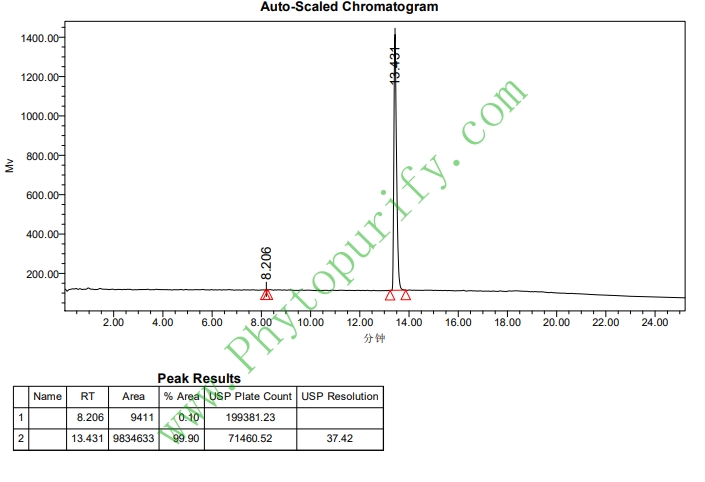
Purity: 95%~99%
Analysis Method: HPLC-DAD or/and HPLC-ELSD
Identification Method: Mass, NMR
Packing: Brown vial or HDPE plastic bottle
Storage: Store in a well closed container, protected from air and light. Put into refrigerate or freeze for long term storage.
Whenever possible, you should prepare and use solutions on the same day. However, if you need to make up stock solutions in advance, we recommend that you store the solution as aliquots in tightly sealed vials at -20℃. Generally, these will be useable for up to two weeks.
The product could be supplied from milligrams to grams
Inquire for bulk scale.
Chengdu Biopurify Phytochemicals Ltd. is a leading company in the research, development, manufacture and marketing of High Quality Phytochemicals and Extracts(especially Active Ingredients from Traditional Chinese Medicine,TCM), Natural Active Pharmaceutical Ingredients worldwide.
The main services:
A. Supply active ingredients and reference standards of TCM, from mgs to kgs scale
B. Custom extraction and purification, target Herb Active Ingredients
C. Custom synthesis and semi-synthesis for Natural Active Ingredients
D. CR(contract research), CM(contract manufacture) and PD(process development) services from lab scale, pilot scale to commercial scale(GMP is also available)
E. TCM compounds library for drug screen,more than 3000 compounds available, many of them are rare and unique.
HPLC of 11-Oxomogroside V
Storage conditions:Short-term storage at 2~8℃, long-term storage at -20 ~ -80℃
473.5100
.9413
.9414
1.0096
.4071
.4690
Low
64.2268
7.4600
No
No
No
No
No
No
0.0
Yes
No
No
Yes
11-O-Siraitia grosvenorii V (CAS No. 126105-11-1) is a natural triterpene glycoside compound derived from Siraitia grosvenorii (commonly known as "Buddha fruit"). As a traditional Chinese medicine and natural sweetener, Momordica grosvenorii has attracted much attention due to its rich triterpene glycosides. 11-O-siraitin V, as one of the important active ingredients, has gradually attracted attention in the field of natural product pharmacology in recent years, especially in the prevention and treatment of metabolic diseases such as hyperlipidemia.
Hyperlipidemia, as a common metabolic disease, is an important risk factor for atherosclerosis and cardiovascular disease. Although existing lipid-lowering drugs have significant effects, long-term use has side effects and drug resistance issues, prompting researchers to constantly seek safe and effective natural product alternatives or adjuvant treatment options. Because of its unique chemical structure and multi-target regulation, 11-O-neneneba arhat fruit glycoside V shows good lipid lowering potential and better safety, and has become a hot spot in pharmacological activity research.
This article will systematically review the chemical structure and physicochemical properties, plant origin and extraction methods, pharmacological activity and mechanism of action, pharmaceutical evaluation and pharmacokinetic characteristics of 11-O-siraitin V. In combination with the current research progress, the clinical application prospect and development direction of 11-O-siraitin V in the treatment of hyperlipidemia will be discussed.
11-O-Siraitoside V is a triterpene steroidal glycoside with the molecular formula of C_60H_102O_30 and molecular weight of 1285.4310. Its structural feature is that based on the triterpene mother nucleus of Siraitia grosvenorii, the 11 hydroxy group is oxidized to form a ketone (11 oxo), and multiple glycosyl units are connected through glycosidic bonds. The LogP value of this compound is 0.9413, indicating its moderate lipophilicity, which facilitates cell membrane penetration but is not overly hydrophobic. The TPSA (polar surface area) is 473.5100, indicating that its molecular polarity is high and may affect its oral absorption and bioavailability.
The water solubility parameter is 1.0096, which shows that 11-O-neneneba arhat fruit glycoside V has good water solubility, which is conducive to preparation development and in vivo distribution. The low penetration ability of the blood-brain barrier suggests its limited role in the central nervous system, reducing the risk of central side effects. The negative result of hERG channel inhibition experiment indicates a low risk of cardiac toxicity. The Ames mutagenicity test result is 0.0, indicating that the compound has no significant genetic toxicity and is relatively safe.
In conclusion, the physicochemical properties of 11-O-siroside V support its use as a candidate molecule for oral administration, and it has a good safety basis.
11-O-Siraitia grosvenorii glycoside V mainly exists in the fruits of Siraitia grosvenorii, especially in the exocarp and pulp of mature fruits. As a unique rare plant in southern China, Siraitia grosvenorii has traditionally been used for clearing heat, moistening lung, relieving cough, resolving phlegm and producing natural sweeteners.
Common methods for extracting 11-O-siraitin V include:
Water extraction method: The dried powder of Siraitia grosvenorii was extracted with hot water to extract the water-soluble triterpene glycoside mixture. This method is easy to operate, but there are many impurities in the extract, which require subsequent purification.
Alcohol extraction method Using ethanol or methanol as solvents, combined with ultrasound assisted extraction, to improve the extraction efficiency of triterpenoid glycosides. The alcohol extract contains a significant amount of non-polar impurities, making purification difficult.
Column chromatography separation: Through multi-step chromatographic techniques such as silica gel column, reversed-phase C18 column and gel filtration column, combined with high performance liquid chromatography (HPLC) monitoring, high-purity 11-O-siraitin V was purified.
Supercritical CO2 extraction In recent years, supercritical CO_2 extraction technology has been used for the green extraction of Siraitia grosvenorii components, which has the advantages of strong selectivity and no solvent residue, but the equipment cost is high.
The optimization of extraction processes mainly focuses on improving yield, purity, and reducing costs, while also considering the stability of active ingredients. In the future, combined with modern separation technologies such as molecular imprinting technology and membrane separation technology, it is expected to realize the efficient industrial extraction of 11-O-siroside V.
The pharmacological activity of 11-O-siraitin V mainly focuses on its regulatory effect on metabolic diseases, especially hyperlipidemia. Multiple in vitro and in vivo experiments have shown that this compound has significant potential for lipid-lowering, antioxidant, anti-inflammatory, and liver function protection.
Lipid-lowering effect
Studies on animal models show that 11-O-siraitin V can significantly reduce the levels of serum total cholesterol (TC), low-density lipoprotein cholesterol (LDL-C) and triglyceride (TG), while increasing the content of high-density lipoprotein cholesterol (HDL-C). Its lipid-lowering effect is similar to that of Western statins, but the side effects are significantly lower.
Antioxidant effect
By activating NFE2L2 (nuclear factor red blood cell 2 related factor 2) signaling pathway, 11-O-siraitin V enhances the activity of antioxidant enzymes in vivo, reduces lipid peroxidation damage, protects vascular endothelial cells, and delays the progression of atherosclerosis.
anti-inflammatory effect
This compound can inhibit the inflammatory response mediated by STAT3 (signal transducer and activator of transcription factor 3), reduce the expression of pro-inflammatory cytokines such as IL-6 and TNF - α, alleviate chronic inflammation, and promote lipid metabolism balance.
Liver protection
11-O-siraitin V can improve liver steatosis, promote lipid metabolism and energy balance, and alleviate the pathological damage of nonalcoholic fatty liver disease (NAFLD) by regulating HSD11B1 (11 β - hydroxysteroid dehydrogenase 1) and SIRT1 (silent information regulator 2 related enzyme 1) signal pathways.
Other functions
Some studies have pointed out that 11-O-siraitin V may also affect cell metabolism and proliferation by regulating HIF1A (hypoxia inducible factor 1 α) and TOP1 (topoisomerase 1) and other targets, and has potential anti-tumor activity, but the related mechanism needs further exploration.
The mechanism of 11-O-siraitin V in the treatment of hyperlipidemia involves multiple signal pathways and multiple molecular targets, which reflects the regulatory characteristics of its multiple targets and mechanisms.
PTPN1 (protein tyrosine phosphatase 1B)
PTPN1 is a negative regulator of insulin signaling, and inhibiting its activity can improve insulin resistance. 11-O-siraitin V can enhance insulin signal transduction, promote lipid metabolism and glucose homeostasis by inhibiting PTPN1 activity.
STAT3
As a key transcription factor in inflammation and metabolic regulation, the overactivation of STAT3 is closely related to lipid metabolism disorders. 11-O-siraitin V inhibits STAT3 phosphorylation, reduces the release of inflammatory mediators, and alleviates adipose tissue inflammation.
ABCB1 (ATP binding cassette transporter B1)
ABCB1 is involved in the transport of cholesterol and drug metabolism, and its expression is regulated by 11-O-siraitin V, which contributes to cholesterol excretion and elimination of toxic substances in the body.
IDH1 (isocitrate dehydrogenase 1)
IDH1 plays a role in cell energy metabolism. 11-O-siraitin V can improve abnormal lipid metabolism and promote fatty acid oxidation by regulating the activity of IDH1.
NFE2L2
NFE2L2 is the main regulator of cellular antioxidant defense. 11-O-siraitin V activates NFE2L2 signaling pathway, induces the expression of antioxidant enzymes, and alleviates oxidative stress injury.
TOP1
TOP1 is involved in the regulation of DNA topology. The regulation of 11-O-siraitin V may affect cell proliferation and gene expression, and indirectly regulate metabolic status.
HIF1A
HIF1A regulates the adaptation of cells to hypoxic environment, and 11-O-siraitin V affects the metabolic adaptation and inflammatory response of adipose tissue by regulating HIF1A.
HSD11B1
HSD11B1 catalyzes the production of active glucocorticoids and participates in adipose tissue metabolism. 11-O-siraitin V inhibits HSD11B1 activity and reduces glucocorticoid mediated fat accumulation.
NR1H4 (farnesol X receptor, FXR)
NR1H4 regulates bile acid metabolism and lipid homeostasis, and 11-O-siroside V activates NR1H4, which helps to improve abnormal cholesterol metabolism.
SIRT1
SIRT1 acts as a deacetylase, regulating energy metabolism and inflammatory response. 11-O-siroside V activates SIRT1, promotes fatty acid oxidation and mitochondrial function, and inhibits fat production.
To sum up, 11-O-siraitin V plays multiple protective roles by synergistically regulating the above targets, improving the disorder of lipid metabolism, reducing inflammation and oxidative stress.
The pharmaceutical evaluation of 11-O-siraitin V shows that it has good potential for drug development:
Molecular weight and structural complexity The molecular weight of 1285.4310 is relatively large and the structure is complex, which may affect oral absorption and bioavailability. However, its good water solubility helps alleviate solubility issues.
Fat solubility (LogP)Moderate lipophilicity of 0.9413 is beneficial for membrane penetration and supports its distribution in the body.
Polarized surface area (TPSA)A higher TPSA may indicate absorption limitation, but it can be improved through formulation optimization.
Blood-brain barrier penetrability Low, reducing the risk of adverse reactions in the central nervous system.
Cardiotoxicity (hERG inhibition)Negative, with high safety.
Genotoxicity (Ames test)Negative, good genetic safety.
In terms of pharmacokinetics, existing studies have shown that:
After oral administration, 11-O-siroside V was stable in the gastrointestinal tract, but the absorption was slow, and the peak plasma concentration appeared for a long time.
Mainly metabolized by the liver, with some excreted through the kidneys.
Moderate half-life in the body, supporting daily dosing regimen.
Metabolites are mostly glycosylated hydrolysis products and redox metabolites, and their activity and safety need further evaluation.
In the future, strategies such as structural modification and nanocarriers are needed to enhance its bioavailability and targeting, and optimize its pharmacokinetic performance.
As a natural triterpene glycoside, 11-O-siroside V, with its multi-target regulation and good safety, shows a broad clinical application prospect, especially in the field of auxiliary treatment of hyperlipidemia and related metabolic diseases.
Treatment of hyperlipidemia: Based on its significant lipid-lowering, anti-inflammatory and antioxidant effects, 11-O-siraitin V is expected to be used as a new natural lipid-lowering drug or health care product ingredient to meet the needs of some patients for natural and safe lipid-lowering products.
Non alcoholic fatty liver disease (NAFLD): By regulating liver lipid metabolism and inflammatory reaction, 11-O-siraitin V may improve the pathological status of NAFLD and delay disease progression.
Cardiovascular protection Antioxidant and anti-inflammatory effects help prevent atherosclerosis and reduce the risk of cardiovascular events.
Potential for combination therapy Can be used in combination with existing lipid-lowering drugs to achieve synergistic effects, reduce drug dosage and side effects.
However, the clinical development of 11-O-siroside V still faces challenges, including insufficient bioavailability, complex pharmacokinetic characteristics and insufficient clinical effectiveness verification. In the future, it is necessary to strengthen research in the following areas:
Pharmacokinetic and toxicological evaluation of the system.
Large scale, multicenter clinical trials have been conducted to validate its efficacy and safety.
Optimization of formulation process to improve oral absorption and targeting.
Structural modification and derivative development to enhance drug efficacy and pharmacokinetic performance.
Explore its potential applications in other metabolic diseases and tumors.
11-O-Siraitin V, as an important triterpene glycoside active ingredient in Siraitia grosvenorii, shows significant pharmacological activity and good safety in the prevention and treatment of hyperlipidemia and related metabolic diseases by virtue of its unique chemical structure and multi-target regulatory mechanism. Its multidimensional mechanism of action covers lipid metabolism regulation, anti-inflammatory and antioxidant effects, and energy metabolism improvement, reflecting the advantages of natural product multi-target therapy.
Although there are still deficiencies in pharmacokinetics and clinical validation, with the continuous advancement of extraction and purification technology, drug design and clinical research, 11-O-siroside V is expected to become a new star in the development of natural drugs, providing more safe and effective treatment options for patients with hyperlipidemia and metabolic syndrome. Future research needs to focus on in-depth mechanism analysis, clinical translation, and formulation innovation, promoting its transition from laboratory to clinical application and benefiting patients.
