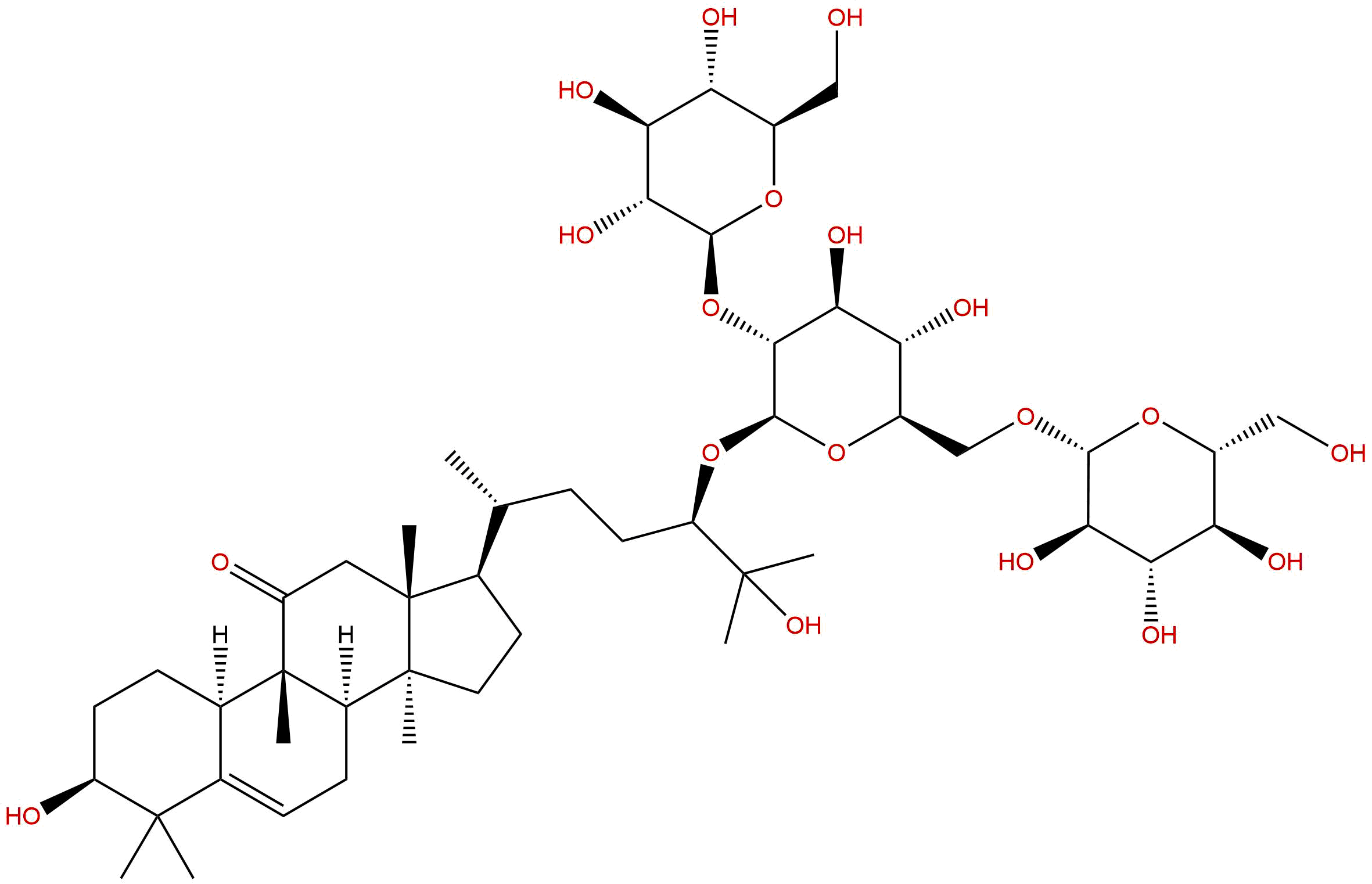
Product name: 11-O-Mogroside IIIA1
Synonym name:
Catalogue No.: BP4819
Cas No.:
Formula: C48H80O19
Mol Weight: 961.149
Botanical Source: Siraitiae fructus
Type of Compound: Triterpenoids
Purity: 95%~99%
Analysis Method: HPLC-DAD or/and HPLC-ELSD
Identification Method: Mass, NMR
Packing: Brown vial or HDPE plastic bottle
Storage: Store in a well closed container, protected from air and light. Put into refrigerate or freeze for long term storage.
Whenever possible, you should prepare and use solutions on the same day. However, if you need to make up stock solutions in advance, we recommend that you store the solution as aliquots in tightly sealed vials at -20℃. Generally, these will be useable for up to two weeks.
The product could be supplied from milligrams to grams
Inquire for bulk scale.
For Reference Standard and R&D, Not for Human Use Directly.
Storage conditions:Short-term storage at 2~8℃, long-term storage at -20 ~ -80℃
379.4000
-2.5000
-2.8000
No
.3000
No
Negative
11-O-neneneba mogroside III A1 (11-O-mogroside IIIA1) is a traditional medicinal plant monk fruit Cucurbitane type triterpenoid saponins isolated from Siraitia grosvenorii. As one of the important members of Siraitia grosvenorii glycosides family, it is not only the core component that gives Siraitia grosvenorii a unique high sweetness, but also a hot molecule in the field of natural product pharmacy and functional food research due to its potential biological activity. Although its specific CAS number, molecular formula, molecular weight and other basic data are not complete in the public database, it is inferred from the structure of its similar compounds that it is a highly oxidized tetracyclic triterpene derivative and an 11 position oxygen glycoside isomer of Arhat fruit glycoside IIIA1.
Momordica grosvenorii, also known as "fairy fruit", originated in Guangxi, China. It has a medicinal history of hundreds of years in the folk. It is often used to moisten the lungs, stop coughing, clear heat and moisten the intestines. Modern research reveals that its sweetness mainly comes from a series of mogrosides, which are hundreds of times sweeter than sucrose, but hardly provide calories, so they are widely used in the food industry as natural sugar substitutes. However, in addition to being used as sweeteners, Arhat fruit glycosides also exhibit anti-inflammatory, antioxidant, anti diabetes, anti-cancer and other pharmacological activities, which have aroused great interest of researchers. 11-O - Arhat fruit glycoside III A1, as one of the aglycones with specific structure, is in its initial stage of research, but is gradually expanding from the single cognition of "sweet ingredients" to the direction of "active lead compounds with multiple biological functions". This article aims to systematically review the existing information of the compound and provide professional interpretation from the perspectives of chemistry, pharmacology, and drug properties, in order to provide a clear scientific reference for researchers in related fields.
11-O - Arhat fruit glycoside III A1 is the aglycone isomer of Arhat fruit glycoside III A1 (Mogaside III A1). According to the naming convention, "11-O -" indicates that its glycosidic bond is connected to the 11th carbon atom of the aglycone. Arhat III A1 is one of the sweet glycosides with high content in Siraitia grosvenorii itself. Its aglycone is mogrol, which is connected with multiple glucose groups. Therefore, the basic skeleton of 11-O - Arhat fruit glycoside III A1 should be cucurbitane type triterpenoid, and the C-11 hydroxyl group of its aglycone mogrol is connected with the sugar chain (presumably mainly glucose unit) by an oxygen glycoside bond.
Due to the lack of detailed molecular formula and molecular weight data for this compound, we can make reasonable inferences based on its homologues. It is known that the molecular formula of mogroside V is C60H102O29, and the molecular weight is about 1287. The sugar base of Arhat fruit glycoside III A1 is less than that of Arhat fruit glycoside V. Therefore, the molecular weight of 11-O - arhat fruit glycoside III A1 is likely to be between 800-1000 Da, and the molecular formula correspondingly contains C, H, O elements, and the proportion of oxygen atoms is high. These compounds are usually white or off white amorphous powders, soluble in polar solvents such as water, methanol, ethanol, etc., and difficult to dissolve in low polarity organic solvents such as ether and chloroform. Its aqueous solution has an extremely sweet taste, with a slightly sweet aftertaste and no obvious bitterness.
From a theoretical calculation perspective, such polyhydroxy and polysaccharide based saponin compounds have the following typical physicochemical characteristics:
- High Polarity The molecule contains a large number of hydroxyl and sugar groups, leading to its Topological Polarity Surface Area (TPSA) Extremely large, usually much larger than 140 Å ², which strongly affects its membrane permeability and in vivo distribution.
- Strong hydrophilicity: Its Lipid water partition coefficient (LogP) Expected negative values (such as -2 to -5) indicate high hydrophilicity and difficulty in penetrating biofilms composed of lipid bilayers (such as the blood-brain barrier BBB).
- Multiple hydrogen bond donors/acceptors There are a large number of groups in the molecule that can serve as hydrogen bond donors (OH) and acceptors (O), which are crucial for their interaction with biological targets, but may also affect their oral absorption.
These inherent chemical properties determine the pharmacokinetics behavior of 11-O - Arhat fruit glycoside III A1 in vivo, and are directly related to the evaluation of its pharmaceutical potential.
The only natural source of 11-O - Arhat fruit glycoside III A1 is monk fruit(Siraitia grosvenorii (Swingle) C. Jeffrey)。 Momordica grosvenorii is a perennial vine of Cucurbitaceae, which is mainly distributed in Guangxi, Guangdong, Hunan, Jiangxi and other provinces and regions in southern China. Guilin, Guangxi, is recognized as a genuine area with a long history of cultivation.
In the traditional Chinese medicine theory, Momordica grosvenorii is cool in nature, sweet in taste, and belongs to the lung and large intestine meridians. Its dried fruit is included in the Pharmacopoeia of the People's Republic of China and has Clearing heat and moistening lungs, promoting throat and opening sounds, smoothing intestines and promoting bowel movements The efficacy. It is commonly used in clinical practice to treat symptoms such as lung heat and dry cough, sore throat and loss of voice, intestinal dryness and constipation. Luohanguo is often drunk in water as a health drink for cooling, detoxification, fluid production and thirst quenching. This application has a history of hundreds of years and has accumulated rich practical experience, providing evidence for its safety and certain effectiveness.
Modern phytochemical studies have confirmed that the medicinal and sweet activities of Siraitia grosvenorii mainly focus on its fruit, especially its pulp. It contains up to 1% mogroside. At present, more than 50 cucurbitane triterpenoid saponins have been isolated and identified. According to the number of glucose groups connected to their aglycones, they are mainly divided into Arhat II E, III, III A1/A2, IV, V, VI and other series. 11-O-neneneba arhat fruit glycoside III A1 is a member of this complex metabolic network. The content and proportion of different glycoside types are significantly affected by variety, origin, harvesting period, and processing technology. Traditionally, medicinal materials were prepared by sun drying or drying, while modern technologies such as water extraction, ethanol extraction and resin purification were used to produce siraitia grosvenorii glycoside extracts on a large scale as natural sweeteners. The in-depth study of 11-O - Arhat fruit glycoside III A1 is based on the full recognition of its traditional value of plant origin and the systematic analysis of modern chemical components.
Although there are relatively few independent and systematic pharmacological studies on 11-O - Arhat fruit glycoside III A1, as a core member of the Arhat fruit glycoside family, its biological activity can be reasonably inferred and prospected based on the extensive research results of the family compounds. At present, the database shows that there is a lack of "target information" and "related disease" data for this compound, which reflects the current situation that basic research on this compound still needs to be further explored. However, by analyzing the known activities of Arhat III A1 and other Arhat (such as mogroside V) with highly similar structures, we can outline their potential action spectrum and mechanism.
1. Core pharmacological activity inference:
- Anti inflammatory and immune regulatory activity This is one of the most concerned activities of Arhat fruit glycosides. Studies have shown that siraitin V can significantly inhibit the production of nitric oxide (NO), prostaglandin E2 (PGE2) and proinflammatory cytokines (such as TNF - α, IL-1 β, IL-6) in macrophages induced by lipopolysaccharide (LPS). Its mechanism of action and inhibition Nuclear factor kappa B (NF - κ B) and Mitogen activated protein kinase (MAPK) The activation of signaling pathways is closely related. NF - κ B is a core transcription factor that regulates inflammatory responses, while the MAPK family (such as p38, JNK, ERK) is involved in cellular stress and inflammatory responses. 11-O - Arhat fruit glycoside III A1 may interfere with these key inflammatory signal nodes through a similar way, thus playing an anti-inflammatory role. This applies to its application Chronic inflammatory diseases Theoretical possibilities have been provided for conditions such as asthma, arthritis, and inflammatory bowel disease.
- Antioxidant and anti-aging activity: Siraitin has strong free radical scavenging ability. They can directly eliminate DPPH and ABTS free radicals, and enhance the intracellular antioxidant defense system, such as upregulating the activity of superoxide dismutase (SOD) and glutathione peroxidase (GSH Px), and reducing the level of malondialdehyde (MDA). Oxidative stress is a common pathological basis for aging and various chronic diseases, such as neurodegenerative diseases and cardiovascular diseases. Therefore, 11-O-neneneba arhat fruit glycoside III A1 may protect cells from oxidative damage through antioxidant pathway.
- Anti diabetes and metabolic regulation activity: Arhat fruit glycoside has been proved to improve insulin resistance and reduce blood sugar. The mechanism may involve: activation Adenosine activated protein kinase (AMPK) Pathway, AMPK is the "master switch" of cellular energy metabolism, which can promote glucose uptake and fatty acid oxidation; Protect the function of pancreatic beta cells; And regulate gene expression related to glucose and lipid metabolism. These functions suggest that it is Type 2 diabetes It has potential in the prevention and management of its complications.
- anticancer activity Preliminary studies have shown that some of Arhat fruit glycosides can inhibit the proliferation and induce apoptosis of lung cancer, liver cancer, colon cancer and other cancer cell lines. The potential mechanisms include blocking the cell cycle (such as G1 phase arrest), inducing mitochondrial pathway apoptosis, inhibiting tumor cell migration and invasion, etc. Although its activity intensity is usually weaker than classical chemotherapy drugs, its natural and low toxicity makes it worth exploring in the field of cancer chemoprevention or adjuvant therapy.
- Pulmonary protective activity This is highly compatible with the traditional application of "moistening the lungs and stopping cough". Studies have shown that siraitin can alleviate pulmonary fibrosis induced by smoke or bleomycin, inhibit airway inflammation and mucus hypersecretion, and its mechanism is related to regulating Nrf2/HO-1 antioxidant pathway and inhibiting TGF - β 1/Smad fibrosis promoting pathway.
2. Scientific explanation of the mechanism of action:
The material basis for Arhat fruit glycosides to play the above multi target and multi pathway activities lies in their unique chemical structure. Cucurbitane type glycosides have a certain rigid hydrophobic plane and can be embedded into the hydrophobic pockets of certain proteins; The abundant sugar chains and hydroxyl groups in the periphery provide a strong hydrogen bonding network, enabling it to specifically bind to polar regions of cell membrane receptors, enzymes, or signaling proteins. For example, its anti-inflammatory effect may be achieved through direct or indirect interaction with the inhibitory protein I κ B kinase (IKK) or p65 subunit of NF - κ B; Its metabolic regulatory effect may be related to direct conformational activation of AMPK.
For 11-O - Arhat fruit glycoside III A1, the connection mode of its 11 position oxygen glycoside bond may subtly change the spatial conformation, polarity and interaction mode with the target protein of the whole molecule, resulting in differences in its activity intensity and selectivity from Arhat fruit glycoside III A1. This is precisely the value of studying the structure modification and structure-activity relationship of natural products. Future research needs to use molecular docking, surface plasmon resonance (SPR) and other technologies to directly explore the binding ability of 11-O - Arhat fruit glycoside III A1 to the above putative targets (such as IKK, AMPK), and verify its functional dependence through gene knockout/knockdown experiments, so as to clarify its unique mechanism of action.
Drug efficacy assessment aims to predict the likelihood of a compound developing into an oral medication. In combination with the general properties of known Arhat fruit glycosides and Lipinski Five (Ro5) and other standards, we made a theoretical evaluation of 11-O-nenenebb arhat fruit glycoside III A1.
Lipinski's Five Rules Analysis:
This rule is an empirical rule for evaluating the pharmacological properties of oral medications, requiring compounds to meet at least three of the following criteria:
1. Molecular weight (MW)<500 Da: It is estimated that the MW of 11-O - Arhat fruit glycoside III A1 is much greater than 500 Da (presumably>800 Da),not conform to。
2. Lipid water partition coefficient (LogP)<5 Due to its high hydrophilicity, LogP is expected to be negative, much less than 5,Comply with。
3. The number of hydrogen bond donors (HBDs) is less than 5 The molecule contains multiple hydroxyl groups on glycosides and glycosides, and the HBD number is likely to exceed 10,not conform to。
4. The number of hydrogen bond acceptors (HBAs) is less than 10 There are numerous ether bonds and hydroxyl oxygen groups in the molecule, and the number of HBA is expected to exceed 15,not conform to。
Obviously, 11-O - Arhat fruit glycoside III A1 seriously violates the three items (MW, HBD, HBA) in the Lipinski rule. This clearly indicates that,It faces enormous challenges in the development of traditional small molecule oral drugs Its drug like properties are poor.
Interpretation of specific pharmacological parameters:
- Absorption The enormous molecular weight, extremely high polarity (high TPSA), and abundant hydrogen bonds result in its Oral bioavailability is expected to be extremely low These compounds are difficult to penetrate the intestinal epithelial cell membrane through passive diffusion. Its absorption may depend on specific transporters in the intestine (such as the glucose transporter SGLT1, which may transport its glucose portion), but its efficiency is limited and it is susceptible to hydrolysis metabolism by gut microbiota (degradation into aglycones or secondary glycosides).
- Distribution High hydrophilicity makes it difficult to cross most biological membranes. its The blood-brain barrier (BBB) penetration is almost zero Therefore, it is unlikely to directly target the central nervous system. Mainly distributed in blood and extracellular fluid, with weak ability to enter the interior of tissue cells.
- Metabolism As a glycoside compound, it is a natural substrate for gut microbiota enzymes (such as β - glucosidase) and is easily hydrolyzed in the colon to produce the glycoside mogrol. Glycoside lipid solubility is enhanced, which may be absorbed and further undergo liver metabolism (such as hydroxylation and binding reactions). The systemic exposure of the prototype drug in the body may be very low.
- Excretion The prototype and its metabolites may be mainly excreted through the kidneys (via urine) and bile (via feces).
- Toxicity: Based on the long-term edible and medicinal history of Momordica grosvenorii, and its safety certification as a food additive (GRAS status), the whole of Arhat grosvenorii glycosides Very low acute toxicity Genetic toxicity and subchronic toxicity studies have also shown its good safety. 11-O - Arhat fruit glycoside III A1, as a member, is expected to have a high safety window. But this still requires standardized toxicological studies to confirm for that specific compound.
Conclusion and Strategy:
To sum up, 11-O - Arhat fruit glycoside III A1 itself Not suitable for development as a conventional oral system drug delivery However, this does not mean that its medicinal value is denied. Its development strategy can shift towards:
1. As a prodrug After hydrolysis in the intestine, the absorbed aglycones or other metabolites may be the true active form.
2. Local administration or intestinal local effects Develop formulations for treating intestinal inflammatory diseases (such as ulcerative colitis) by utilizing their low absorption properties to maintain high concentrations in the affected area.
3. structural optimization Improve its drug properties through chemical modifications such as sugar simplification and esterification to increase lipid solubility, but be careful to preserve its activity.
4. Functional Foods and Health Products This is currently the most mature direction. Utilizing its high sweetness, low calorie content, and potential health benefits (anti-inflammatory, antioxidant) as a functional sweetener or health supplement ingredient, it exerts a chronic disease prevention effect through long-term dietary supplementation.
Research Status:
At present, the research on 11-O - Arhat glycoside III A1 is still at a very preliminary stage. The publicly available literature on this compound as a single research object is extremely limited. Most of the studies focused on the total extract of Siraitia grosvenorii or the higher content of Siraitoside V, IV, etc. The lack of existing data (as shown at the beginning of this article) precisely reflects the gaps in its isolation and purification, structural confirmation, activity screening, and mechanism research as a single chemical entity. This is both a challenge and an opportunity. With the progress in the separation and identification technology of natural products (such as high-performance preparative liquid chromatography, LC-MS/MS), and people's increasing interest in the trace active ingredients in Momordica grosvenorii, it is expected to obtain high-purity 11-O - Arhat grosvenorii III A1 standard in the future, so as to start systematic pharmacological and pharmacodynamic research.
Application prospects:
1. As a characteristic natural sweetener ingredient: In the food industry, the sweetness characteristics (sweetness, onset time, aftertaste) of different Arhat fruit glycosides are slightly different. Clarifying the sensory characteristics of 11-O - Arhat fruit glycoside III A1 will help to develop a compound sweetener with better taste.
2. Deeply explore its unique biological activity Due to its structural differences from known active glycosides, it may have specific activity that has not yet been discovered. For example, does the unique glycosidic bond at position 11 endow it with stronger ability to resist a specific inflammation or regulate a specific metabolic pathway? This requires comparative studies through cell and animal models.
3. A key link in the study of structure-activity relationships: The effects of the number of glycosyl groups and the connecting positions (such as position 3, 11 and 24) on the activity of Arhat fruit glycoside family were systematically studied. 11-O-nenenebb arhat fruit glycoside III A1 is an important structural node. This type of research can provide key information for designing more active and superior cucurbitane triterpenoid derivatives.
4. Develop specific products for intestinal health Combining its low oral absorption and potential anti-inflammatory activity, it can be explored for the preparation of probiotics or specialty foods that improve intestinal barrier function and alleviate colitis.
Future research directions:
- Basic research level The primary task is to complete the separation, purification, and complete structural confirmation (including absolute configuration) of the compound, and to supplement its basic physicochemical parameters.
- Active screening level: Carry out in vitro high-throughput screening for inflammation, metabolism, oxidative stress and other related targets, and conduct "head to head" comparison with Arhat fruit glycoside III A1, etc. to find its activity characteristics.
- Mechanism research level Using chemical biology methods such as affinity fishing and proteomics to identify the molecular targets directly involved and elucidate their specific signaling pathways.
- Application development level Evaluate its stability in the food system, explore its synergistic effects with prebiotics and probiotics, and develop new functional foods.
In conclusion, 11-O - Arhat III A1, as a member of Siraitia grosvenorii, a valuable medicinal plant resource, has shown great health value despite the lack of data. To carry out in-depth research on it will not only help to fully reveal the material basis for the efficacy of Siraitia grosvenorii, but also may open up a new path for the development of new natural source functional factors or drug lead compounds. In the context of advocating nature and health, such research has both scientific significance and practical value.
Batch can search by a CAS number,one per line