


Synonym name:
Catalogue No.: BP0041
Cas No.: 80952-71-2
Formula: C36H62O9
Mol Weight: 638.872
Botanical Source: Panax ginseng
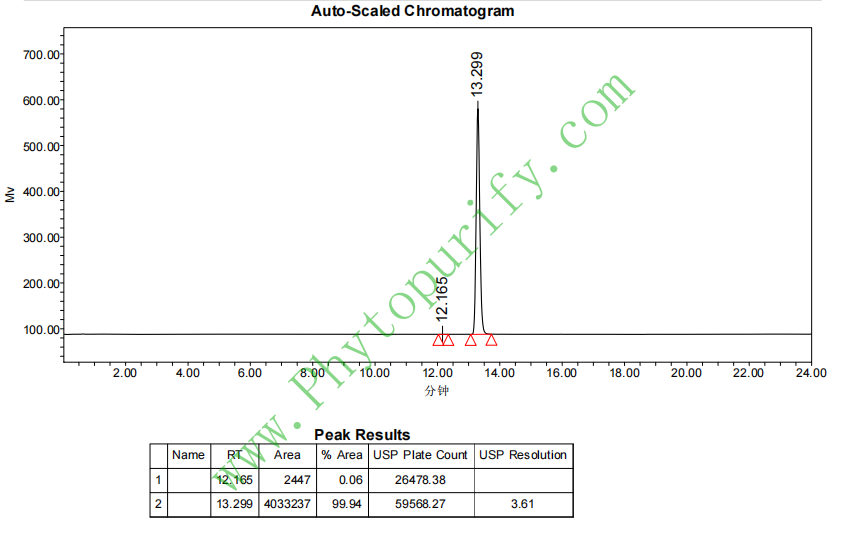
Purity: 95%~99%
Analysis Method: HPLC-DAD or/and HPLC-ELSD
Identification Method: Mass, NMR
Packing: Brown vial or HDPE plastic bottle
Can be supplied from milligrams to grams. Inquire for bulk scale.
For Reference Standard and R&D, Not for Human Use Directly.
Description:
(20R)-Ginsenoside Rh1 exhibits various pharmacological activities including vasorelaxation, antioxidation, anti-inflammation, and anticancer.
References:
Japanese Journal of Pharmacognosy, 1985, 39:123-5.
Pharmacological Study on Panax ginseng C.A. MEYER V. : Effects of Red Ginseng on the Experimental Disseminated Intravascular Coagulation (4). On Ginsenoside-Rg3, Rh1 and Rh2
METHODS AND RESULTS:
20S, 20R ginsenoside Rg3, 20S, 20R ginsenoside Rh1, and ginsenoside Rh2 isolated from red ginseng were investigated for their effect on blood platelet aggregation and thrombin-induced conversion of fibrinogen to fibrin in vitro.
CONCLUSIONS:
20S, 20R ginsenoside Rg3 inhibited collagen- and ADP-induced blood platelet aggregation. 20S ginsenoside Rg3, 20S, 20R ginsenoside Rh1 inhibited the thrombin-induced conversion of fibrinogen to fibrin.
HPLC of 20(R)-Ginsenoside Rh1
Storage conditions:Short-term storage at 2~8℃, long-term storage at -20 ~ -80℃
160.0700
3.5833
3.5833
.0113
.6949
.3096
Low
73.3254
5.5310
No
No
No
No
No
No
0.0
Yes
No
No
No
Natural products, as an important source of drug discovery, play an irreplaceable role in the history of human disease prevention and treatment. Ginseng(Panax ginseng C. As a traditional precious Chinese medicinal herb, the core active ingredient of A. Mey., ginsenosides, has always been a hot topic in modern pharmacological research. There are various types of ginsenosides, which can be classified into damaane type, oleanane type, and octreone type based on their glycoside skeleton. Among them, damaane type saponins are considered to be the main material basis for ginseng to exert the effects of "tonifying qi and strengthening the pulse". 20 (R) - Ginsenoside Rh1 (CAS number: 80952-71-2) is an important member of the dammarane type triterpenoid saponin family, belonging to rare ginsenosides. It is usually derived from the biotransformation or processing degradation of the original ginsenoside (such as Rg1) in vitro and in vivo. Compared with the common 20 (S) - isomer, the 20 (R) - isomer has a relatively low content in nature, but its unique stereochemical structure often endows it with differentiated biological activity.
In recent years, with the prevalence of metabolic diseases (such as obesity, type 2 diabetes, nonalcoholic fatty liver, etc.) worldwide, finding safe and effective prevention strategies has become a major scientific challenge. Traditionally, ginseng and its extracts have accumulated rich practical experience in improving energy metabolism and enhancing insulin sensitivity. In this context, 20 (R) - ginsenoside Rh1 is increasingly receiving widespread attention in the pharmacology community due to its significant potential in regulating glucose and lipid metabolism, improving insulin resistance, anti-inflammatory and antioxidant effects. Its function involves multiple key targets closely related to metabolic regulation, such as AMPK, PTPN1, STAT3, NFE2L2, HIF1A, etc., suggesting that it may exert therapeutic benefits through synergistic effects of multiple targets and pathways. This article aims to systematically review the chemical properties, plant sources, pharmacological activities, mechanisms of action, medicinal properties, and application prospects of 20 (R) - ginsenoside Rh1 in the field of metabolic diseases, in order to provide comprehensive scientific references for the in-depth research and development of this compound.
20 (R) - Ginsenoside Rh1 is a triterpenoid saponin with a molecular formula of C36H62O9 and a molecular weight of 638.8830. Its basic skeleton is a damaane type tetracyclic triterpene, and its specific structural features are as follows: the C-20 position of the glycoside (protopanaxatriol, PPT) is in the R configuration, which is the key chiral center that distinguishes it from the 20 (S) - ginsenoside Rh1. The sugar chain is partially connected to the C-6 hydroxyl group of the aglycone by a glucose group, forming a monosaccharide chain structure. The difference in the C-20 stereoconfiguration may lead to significant differences in biological activity by affecting the spatial matching between the molecule and the active pocket of the target protein, reflecting the decisive role of chiral centers in pharmacological activity in natural products.
In terms of physicochemical properties, the calculated LogP of 20 (R) - ginsenoside Rh1 is approximately 3.58, indicating its lipophilicity. Its topological polar surface area (TPSA) is 160.07 Å ², reflecting the strong polarity brought by multiple hydroxyl and sugar groups in the molecule. The water-soluble data (approximately 0.0113 mg/mL) indicates that it belongs to a poorly soluble compound, which to some extent limits its bioavailability. Based on its molecular weight, LogP, and TPSA parameters, it is preliminarily judged that the compound has a low ability to penetrate the blood-brain barrier and mainly acts on the peripheral system. In terms of preliminary safety prediction indicators, the hERG inhibition risk is negative, and the Ames test prediction value is 0.0, indicating a low potential risk of cardiac and genetic toxicity, providing a favorable preliminary safety profile for its further development.
20 (R) - Ginsenoside Rh1 has minimal content in fresh ginseng roots and mainly exists as a degradation or transformation product of other ginsenosides. Its direct plant source is still plants of the Panax genus in the Araliaceae family, such as ginseng(Panax ginseng)And American ginseng(Panax quinquefolius L.)。 In the processing of ginseng, especially in the preparation of red ginseng (by steaming and drying), the original ginsenosides such as Rg1, Re, etc. undergo hydrolysis, deglycosylation, and isomerization reactions, resulting in the generation of various rare ginsenosides including 20 (R) - ginsenoside Rh1, which relatively increases their content in red ginseng.
At present, the main ways to obtain 20 (R) - ginsenoside Rh1 include:
1. Direct extraction and separation from plant raw materials Ginseng (especially red ginseng) is extracted using solvents such as methanol or ethanol, and then separated and purified using techniques such as macroporous adsorption resin column chromatography, silica gel column chromatography, high-performance liquid chromatography (HPLC), and preparative liquid chromatography. Due to the presence of 20 (S) - isomer, chiral separation technology is required in the separation process to obtain high-purity 20 (R) - isomer products, which is technically difficult and costly.
2. Biotransformation method This is currently the most promising large-scale preparation method. Using microorganisms (such as bacteria, fungi) or enzymes (such as β - glucosidase) to specifically hydrolyze and isomerize abundant ginsenoside precursors (such as ginsenoside Rg1), and directionally convert them into 20 (R) - ginsenoside Rh1. This method has mild conditions, good selectivity, and can improve yield and purity by optimizing the strain, enzyme species, and reaction conditions.
3. Chemical synthesis and semi synthesis Starting from inexpensive and readily available glycosides or saponins, glycosylation and chiral center construction are carried out through chemical means. The complete synthesis route is cumbersome, while semi synthesis (such as selective acid hydrolysis or alkaline treatment of ginsenoside Rg1) may produce more by-products, and the stereoselective control of the 20 (R) - configuration is a key challenge.
The biotransformation method is considered the mainstream direction for achieving large-scale production of 20 (R) - ginsenoside Rh1 in the future due to its high efficiency, environmental friendliness, and good stereoselectivity.
Numerous in vitro and in vivo pharmacological studies have shown that 20 (R) - ginsenoside Rh1 has a wide range of biological activities, particularly prominent in the field of metabolic diseases.
1. Regulating glucose and lipid metabolism and improving insulin resistance In insulin resistant liver and adipocyte models, 20 (R) - ginsenoside Rh1 significantly promotes glucose uptake and reduces intracellular lipid accumulation. In diet induced obese (DIO) mice or db/db diabetes model mice, the compound can effectively reduce fasting blood glucose, improve glucose tolerance, reduce serum insulin level and insulin resistance index (HOMA-IR) assessed by homeostasis model, while reducing liver steatosis and serum triglyceride and total cholesterol levels.
2. Anti inflammatory and immune regulatory effects Chronic low-grade inflammation is one of the core pathological processes of metabolic diseases. Research has shown that 20 (R) - ginsenoside Rh1 can inhibit the excessive production of pro-inflammatory factors such as nitric oxide (NO), prostaglandin E2 (PGE2), tumor necrosis factor - α (TNF - α), and interleukin-6 (IL-6) in macrophages stimulated by lipopolysaccharide (LPS) or palmitic acid. Its anti-inflammatory effect helps to improve adipose tissue inflammation and systemic inflammatory status.
3. Anti oxidative stress This compound can alleviate oxidative stress damage induced by high sugar, hydrogen peroxide, or fatty acids, increase the activity of antioxidant enzymes such as superoxide dismutase (SOD) and glutathione peroxidase (GPx) in cells, reduce the levels of reactive oxygen species (ROS) and malondialdehyde (MDA), and protect cells from oxidative damage.
4. Other activities In addition, the study suggests that 20 (R) - ginsenoside Rh1 may have potential activities such as neuroprotection, anti-tumor effects (by affecting targets such as STAT3 and TOP1), drug transport effects (interacting with ABCB1), and regulatory hormone binding globulin (SHBG). However, its pharmacological effects outside the metabolic field still need further exploration.
The pharmacological effects of 20 (R) - ginsenoside Rh1 are not achieved through a single target, but through a complex molecular network whose core mechanism is closely related to key signaling pathways regulating energy metabolism, inflammation, and oxidative stress.
1. AMPK (PRKAA1) pathway activation AMP activated protein kinase (AMPK) is a core regulator of cellular energy metabolism. 20 (R) - Ginsenoside Rh1 has been shown to activate AMPK, phosphorylate and inhibit its downstream target acetyl CoA carboxylase (ACC), reduce the production of acetyl CoA, and promote fatty acid oxidation; Meanwhile, activating AMPK can also upregulate the membrane translocation of glucose transporter 4 (GLUT4), promoting glucose uptake. This is one of the core mechanisms by which it improves insulin resistance and regulates lipid metabolism.
2. Inhibit PTPN1 (protein tyrosine phosphatase 1B)PTPN1 is a negative regulator of the insulin receptor signaling pathway. This compound can inhibit the activity of PTPN1, thereby enhancing tyrosine phosphorylation of insulin receptor substrate (IRS), promoting activation of PI3K/Akt signaling pathway, and ultimately improving insulin sensitivity.
3. Regulating STAT3 and NF - κ B signaling Signal transducer and activator of transcription factor 3 (STAT3) is an important node connecting inflammation and metabolism. 20 (R) - Ginsenoside Rh1 can inhibit abnormal activation of STAT3 and downregulate the expression of downstream pro-inflammatory and pro fibrotic genes. At the same time, it can also inhibit the activation of the nuclear factor kappa B (NF - κ B) pathway and reduce the release of inflammatory mediators.
4. Activate the Nrf2 (NFE2L2)/HO-1 antioxidant pathway Nuclear factor E2 related factor 2 (Nrf2) is the central regulator of antioxidant response. This compound can promote the transfer of Nrf2 from the cytoplasm to the nucleus, enhance its binding to antioxidant response elements (ARE), upregulate the expression of phase II detoxifying enzymes such as heme oxygenase-1 (HO-1) and quinone oxidoreductase 1 (NQO1), and antioxidant proteins, thereby systematically enhancing the cell's antioxidant defense ability.
5. Regulating HIF1A (hypoxia inducible factor 1 α)Hypoxia like conditions often exist in environments with metabolic disorders. 20 (R) - Ginsenoside Rh1 may affect processes such as glycolysis and angiogenesis by regulating the stability or activity of HIF1A, but its specific role in metabolic diseases remains to be elucidated.
6. Interaction with other targets This compound may also affect the production of inflammatory mediator leukotrienes by inhibiting lipoxygenase (ALOX15), or interact with protein kinase C (PRKCA), topoisomerase I (TOP1), sex hormone binding globulin (SHBG), and drug efflux pump P-glycoprotein (ABCB1), which together form the pharmacological basis of its multi-target and multi pathway effects.
Although 20 (R) - ginsenoside Rh1 exhibits good pharmacological activity, its pharmacological development still faces challenges, mainly due to its poor solubility and oral bioavailability.
Absorption, Distribution, Metabolism, and Excretion (ADME):
- absorb As insoluble saponins, their oral absorption is usually poor. The gut microbiota may hydrolyze its glycosylation to produce glycosides (PPT) or smaller metabolites, which may be absorbed and contribute to partial activity, but also result in low exposure levels of the prototype drug.
- distribution Due to its high polarity and molecular weight, it is predicted that its tissue distribution is mainly concentrated in organs with abundant blood flow, such as the liver and kidneys, while the amount entering the central nervous system through the blood-brain barrier is very small, consistent with its predicted "low" blood-brain barrier permeability.
- Metabolism The liver is its main metabolic site and may undergo phase I metabolism (such as hydroxylation) and phase II binding reactions (such as glucuronidation and sulfation). The degradation of gut microbiota is also an important metabolic pathway.
- excretion The prototype drug and its metabolites may be mainly excreted through bile and urine.
Optimization strategy for drug properties:
In order to improve its bioavailability and therapeutic efficacy, researchers are exploring various formulation strategies:
1. Nano delivery system Such as liposomes, nanoemulsions, polymer nanoparticles, solid lipid nanoparticles, etc. These nanocarriers can effectively enhance the solubility of drugs, protect them from gastrointestinal degradation, and improve oral absorption by enhancing intestinal lymphatic transport or prolonging retention time.
2. Prodrug strategy By chemically modifying the hydroxyl group of 20 (R) - ginsenoside Rh1, lipophilic or targeted prodrugs are prepared to improve their membrane permeability and release the original drug through hydrolysis in vivo.
3. Crystal Engineering By preparing eutectic, amorphous solid dispersions, etc., the solid form of the drug can be changed to improve its dissolution rate and apparent solubility.
4. Combined administration Combined with absorption enhancers (such as certain surfactants) or other natural products with synergistic effects, it may also improve its overall efficacy.
At present, there is still relatively limited preclinical pharmacokinetic research data on the 20 (R) - ginsenoside Rh1 system, and in-depth ADME research and formulation development are key steps towards its clinical application.
Based on its clear pharmacological activity and multi-target mechanism of action, 20 (R) - ginsenoside Rh1 has broad development prospects in the following fields:
1. Prevention and treatment of metabolic diseases This is its most core application direction. It is expected to be developed as an innovative drug or functional food/health product for the treatment of type 2 diabetes, non-alcoholic fatty liver disease (NAFLD)/non-alcoholic steatohepatitis (NASH), obesity and its related complications (such as insulin resistance, dyslipidemia). The synergistic effect exerted through multiple targets such as AMPK, PTPN1, Nrf2 may have more advantages than single target drugs, especially in improving metabolic inflammation and oxidative stress.
2. Structural optimization as a lead compound Using it as the parent nucleus, optimizing its pharmacokinetic properties (such as increasing solubility, bioavailability, targeting) or enhancing its activity towards specific targets through structural modifications (such as glycosylation modification, side chain modification) can lead to the development of more clinically valuable derivatives.
3. Components of combination therapy Considering the complexity of metabolic diseases, 20 (R) - ginsenoside Rh1 can be used in combination with existing first-line hypoglycemic or lipid-lowering drugs (such as metformin, statins), which may produce synergistic effects, reduce side effects, or delay drug resistance.
Challenges faced and future research directions:
- Structure Activity Relationship and Isomer Differences A more systematic comparison of the differences in activity, target affinity, and pharmacokinetics between the 20 (R) - and 20 (S) - configurations is needed to clarify their advantages.
- Systematic and in-depth preclinical research Standardized pharmacological evaluations (validated in more animal models), toxicological studies (acute toxicity, long-term toxicity, reproductive toxicity, etc.), and detailed pharmacokinetic studies are required to provide sufficient basis for clinical trials.
- Application of advanced delivery technology Modern formulation technology must be utilized to solve the bottleneck problem of low bioavailability.
- Deep analysis of the mechanism of action Using chemical biology methods such as affinity fishing and molecular probes to more accurately identify its direct target and elucidate the integrated biological effects of its multi-target network regulation.
- Clinical trial validation Ultimately, its safety and effectiveness need to be validated through rigorous human clinical trials.
20 (R) - Ginsenoside Rh1, as a rare triterpenoid saponin with a specific stereoconfiguration in ginseng, has become a star molecule in the research of natural product anti metabolic diseases due to its significant pharmacological activities in regulating glucose and lipid metabolism, anti-inflammatory, antioxidant and other aspects. It precisely intervenes in the core pathological processes of metabolic diseases through a synergistic network composed of multiple key targets such as AMPK, PTPN1, STAT3, and Nrf2, reflecting the therapeutic concept of natural product multi-component and multi-target synergistic effects. Despite its challenges in terms of solubility and oral bioavailability, modern medicinal chemistry and pharmaceutical technologies such as nanodelivery and structural modification provide powerful tools for optimizing its drug properties. In the future, with in-depth research on its structure-activity relationship, mechanism of action, and pharmacokinetic properties, as well as the successful development of efficient delivery systems, 20 (R) - ginsenoside Rh1 has great potential to move from the laboratory to clinical practice, providing a new treatment option derived from traditional wisdom for metabolic disease patients, and also providing a valuable paradigm for modern research and development of other natural active ingredients.
