


Synonym name: Puerariaglycoside 1
Catalogue No.: BP0064
Cas No.: 117060-54-5
Formula: C21H20O10
Mol Weight: 432.381
Botanical Source: Root of Pueraria lobata
Purity: 95%~99%
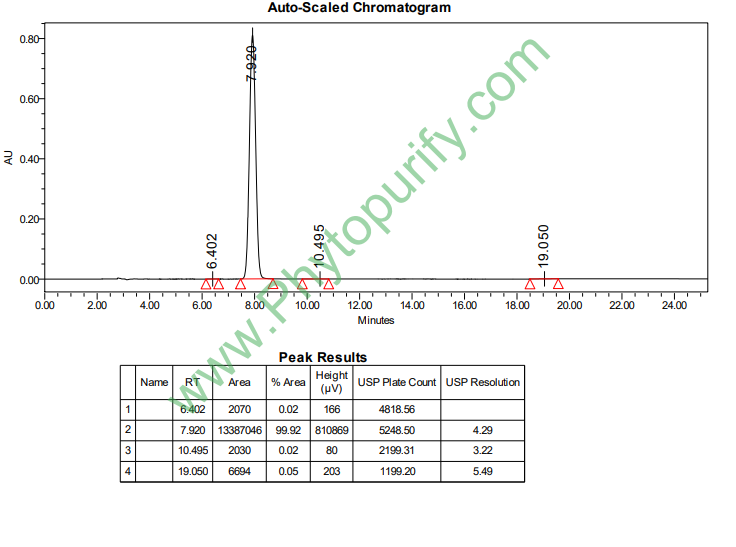
Analysis Method: HPLC-DAD or/and HPLC-ELSD
Identification Method: Mass, NMR
Packing: Brown vial or HDPE plastic bottle
Can be supplied from milligrams to grams.
For Reference Standard and R&D, Not for Human Use Directly.
Inquire for bulk scale.
HPLC of 3'-hydroxyPuerarin
Storage conditions:Short-term storage at 2~8℃, long-term storage at -20 ~ -80℃
194.2600
-1.0000
-1.5000
Low
No
No
No
No
No
No
3 '- HydroxyPuerarin (CAS number 117060-54-5), as an important natural flavonoid compound, has received widespread attention in the field of natural product pharmacology in recent years due to its unique chemical structure and diverse biological activities. This compound mainly exists in the traditional Chinese medicine Pueraria lobata and is a hydroxyl derivative of Puerarin, with high water solubility and biological activity. With the in-depth study of its pharmacological mechanism, 3 '- hydroxypuerarin has shown potential therapeutic value in multiple fields such as cardiovascular and cerebrovascular diseases, metabolic syndrome, and neurodegenerative diseases.
This article aims to provide a systematic review of the chemical structure and physicochemical properties, plant sources, and extraction methods of 3 '- hydroxypuerarin, with a focus on its pharmacological activity and mechanism of action. By combining its pharmacological parameters and pharmacokinetic characteristics, it explores its clinical application prospects and future research directions, providing theoretical basis and reference for scientific research and drug development in related fields.
3 '- Hydroxypuerarin is an isoflavone compound with the molecular formula C21H20O10 and a molecular weight of 432.38. Its structural feature is the introduction of a hydroxyl group at the 3 'position on the flavonoid skeleton, which is one more hydroxyl group than puerarin, giving it stronger polarity and water solubility. Its LogP value is -1.0, indicating low lipid solubility and good water solubility, which is beneficial for its absorption and distribution in the body.
The molecular surface area (TPSA) is 194.26 Å ² and the number of hydrogen bond acceptors is 10, indicating that the molecule has strong hydrogen bond forming ability, which is of great significance for its binding to biomolecule targets and its biological activity. Its physicochemical properties determine its pharmacokinetic behavior and drug properties in vivo. Its low fat solubility and high polarity make it difficult to pass through the blood-brain barrier (BBB), which needs to be considered in the application of neurological diseases.
3 '- Hydroxypuerarin is mainly found in the leguminous plant Pueraria lobata, especially in the roots where the content is relatively high. As a traditional Chinese medicinal herb, kudzu root has a long history and is widely used in traditional Chinese medicine to treat cardiovascular and cerebrovascular diseases as well as metabolic abnormalities. As one of the active ingredients in kudzu root, the optimization of extraction, separation, and purification techniques for 3 '- hydroxypuerarin is of great significance for further studying its pharmacological effects and developing new drugs.
Traditional extraction methods often use ethanol or methanol aqueous solutions for extraction, combined with ultrasound assisted extraction or microwave-assisted extraction techniques to improve extraction efficiency and purity. Subsequently, separation and purification were carried out using liquid-liquid partitioning, column chromatography (silica gel, C18 reverse phase column), and other methods. High performance liquid chromatography (HPLC) and mass spectrometry (LC-MS) are widely used for the qualitative and quantitative analysis of 3 '- hydroxypuerarin, ensuring the quality control of the extract.
In recent years, green extraction techniques such as supercritical CO2 extraction and enzyme assisted extraction have gradually been applied to the extraction of this compound, aiming to improve yield, reduce solvent usage and environmental impact, and provide technical support for industrial production.
3 '- hydroxypuerarin has a variety of pharmacological activities, including cardiovascular and cerebrovascular protection, antioxidant, anti-inflammatory, anti diabetes and neuroprotection.
Numerous in vitro and in vivo experiments have shown that 3 '- hydroxypuerarin exerts significant cardiovascular and cerebrovascular protective effects by improving endothelial function, inhibiting platelet aggregation, and regulating blood lipid levels. It can lower blood pressure, improve coronary artery blood flow, alleviate ischemia-reperfusion injury, reduce myocardial cell apoptosis, and demonstrate potential anti myocardial ischemia and cerebral ischemia effects.
3 '- Hydroxypuerarin has strong free radical scavenging ability, significantly increasing the activity of intracellular antioxidant enzymes such as superoxide dismutase and glutathione peroxidase, and reducing oxidative stress damage. At the same time, the compound exerts anti-inflammatory effects by inhibiting the nuclear factor kappa B (NF - κ B) signaling pathway, reducing the expression of pro-inflammatory cytokines such as TNF - α and IL-6, and helping to alleviate chronic inflammation related diseases.
3 '- Hydroxypuerarin can improve insulin resistance, promote glucose metabolism, and lower blood sugar levels. By activating AMPK signaling pathway, it can regulate lipid metabolism and alleviate fatty liver and obesity related metabolic abnormalities, which shows the potential to treat type 2 diabetes and metabolic syndrome.
Although 3 '- hydroxypuerarin has low blood-brain barrier permeability, it exhibits anti apoptotic and antioxidant effects in neural cell models, can alleviate neuroinflammation, protect neurons from oxidative damage and excitotoxicity, suggesting its potential application in neurodegenerative diseases such as Alzheimer's disease and Parkinson's disease.
The multi-target mechanism of action of 3 '- hydroxypuerarin is the basis for its broad pharmacological activity. Mainly involving the following molecular targets and signaling pathways:
By inducing the Nrf2 ARE signaling pathway, enhancing the intracellular antioxidant defense system, promoting glutathione synthesis and antioxidant enzyme expression, reducing reactive oxygen species (ROS) production, and protecting cells from oxidative damage.
Inhibiting the activation of the NF - κ B signaling pathway, blocking the transcription of pro-inflammatory cytokines, reducing the release of inflammatory mediators, and alleviating inflammatory responses. In addition, it exerts anti-inflammatory effects by inhibiting the MAPK pathway, regulating cytokine expression.
Regulating nitric oxide (NO) synthesis and improving vasodilation function; Prevent thrombosis by inhibiting platelet activating factor and thrombotic related enzymes; Regulating calcium ion channels to protect myocardial cell function.
Activate the AMPK signaling pathway, promote fatty acid oxidation and glucose uptake, inhibit gene expression related to fat production, improve insulin sensitivity, and regulate energy metabolism balance.
Reduce glutamate excitotoxicity by inhibiting the expression of neuronal apoptosis related proteins (such as Caspase-3); Regulate neurotransmitter levels in the brain and maintain stable neuronal function.
From the perspective of pharmacological parameters, the molecular weight of 3 '- hydroxypuerarin is moderate (432.38), but its LogP is -1.0, indicating strong hydrophilicity and low lipid solubility, which limits its oral absorption and ability to penetrate biofilms. Although high TPSA (194.26) and hydrogen bond receptor count (10) are beneficial for target binding, they are not conducive to blood-brain barrier penetration, explaining the limitations of their neurological applications.
In terms of safety, 3 '- hydroxypuerarin has no hepatotoxicity, cardiotoxicity, or hERG channel inhibition, and the Ames mutagenicity test is negative, demonstrating good safety and low toxicity, laying the foundation for clinical application.
Pharmacokinetic studies have shown that the oral bioavailability of this compound is low, mainly absorbed through the intestine, widely distributed in the body but difficult to enter the central nervous system. The metabolic pathway mainly involves phase II metabolism in the liver (such as glucuronic acid binding and sulfation), and the metabolites have certain activity. Excretion is mainly through the renal and biliary pathways.
To improve its bioavailability and targeting, modern formulation technologies such as nanocarriers, liposomes, and drug co crystals have been proposed, and some research has made preliminary progress.
3 '- Hydroxypuerarin, as a natural active ingredient, has shown broad clinical application prospects due to its multi-target and multi mechanism pharmacological effects. Its potential in the prevention and treatment of cardiovascular and cerebrovascular diseases is particularly prominent, especially in diseases such as hypertension, coronary heart disease, and cerebral ischemia, with good therapeutic and adjuvant therapeutic value.
In addition, the research on anti diabetes and metabolic syndrome provides new ideas for its application in the field of chronic metabolic diseases. Although its blood-brain barrier permeability is limited, improvements in drug carrier technology have the potential to expand its application in neurodegenerative diseases.
Future research should focus on the following aspects:
In depth mechanism research Using multi omics techniques to analyze its functional network, identify key targets and signaling pathways, and guide precise medication.
Pharmacokinetic optimization Develop new drug delivery systems to enhance oral bioavailability and tissue targeting, especially for delivery to the central nervous system.
Safety and Toxicological Evaluation Conduct long-term toxicology and preclinical safety studies to ensure the safety of clinical applications.
Clinical trial design Based on existing pharmacological evidence, design reasonable clinical trials to verify its efficacy and safety, and promote its clinical translation.
Combination therapy research Explore synergistic effects with other drugs or natural products to enhance therapeutic efficacy and reduce side effects.
3 '- Hydroxypuerarin, as a hydroxyl derivative of puerarin, has important research value in the field of natural product pharmacology due to its unique chemical structure and diverse biological activities. Its multiple pharmacological effects, including cardiovascular and cerebrovascular protection, antioxidant and anti-inflammatory effects, metabolic regulation, and neuroprotection, provide new ideas and potential drug candidates for the treatment of various diseases.
Although there are certain challenges in its medicinal properties, such as insufficient bioavailability and blood-brain barrier permeability, with the development of modern pharmaceutical formulation technology and in-depth mechanism research, 3 '- hydroxypuerarin is expected to become an important direction for the development of natural product drugs. Future systematic research and clinical validation will be the key to driving it from the laboratory to clinical applications.
In summary, 3 '- hydroxypuerarin not only enriches the pharmacological knowledge system of isoflavone natural products, but also provides a solid scientific foundation and broad prospects for the application of natural products in modern medicine.
