


Synonym name: Puerariaglycoside 3
Catalogue No.: BP0067
Cas No.: 117047-07-1
Formula: C22H22O10
Mol Weight: 446.408
Botanical Source: Pueraria lobata
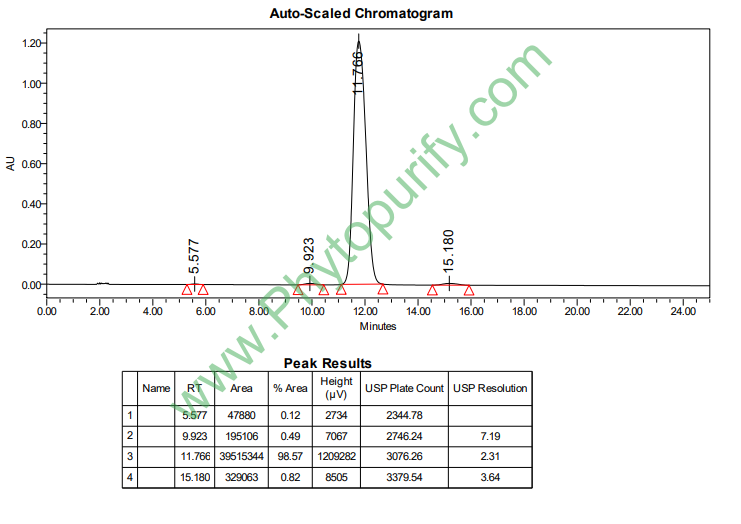
Purity: 95%~99%
Analysis Method: HPLC-DAD or/and HPLC-ELSD
Identification Method: Mass, NMR
Packing: Brown vial or HDPE plastic bottle
Can be supplied from milligrams to grams.
For Reference Standard and R&D, Not for Human Use Directly.
Inquire for bulk scale.
Description:
3'-Methoxypuerarin shows neuron protection activity, it can protect hippocampal neurons against ischemia/reperfusion injury by inhibiting apoptosis. 3'-Methoxypuerarin has antioxidant activities, it shows ONOO(-) scavenging activity and weak NO· and O(2)(-) scavenging activities.
References:
Arch. Pharm. Res., 2012, 35(5):823-37.
Anti-inflammatory and antioxidant activities of constituents isolated from Pueraria lobata roots.
In order to evaluate the anti-inflammatory and antioxidant activities of Pueraria lobata roots and its active components, in vitro inhibitory activities against lipopolysaccharide (LPS)-induced nitric oxide (NO) production, inducible nitric oxide synthase (iNOS), cyclooxygenase-2 (COX-2) protein expression, and tert-butylhydroperoxide (t-BHP)-induced reactive oxygen species (ROS) generation in RAW 264.7 cells, as well as in vitro scavenging activities against 1,1-diphenyl-2-picrylhydrazyl (DPPH), peroxynitrite (ONOO(-)), nitric oxide (NO·), superoxide anion (·O(2)(-)) and total ROS, and inhibitory activities against ONOO(-)-mediated tyrosine nitration, were determined.
METHODS AND RESULTS:
Repeated column chromatography was performed to isolate four known compounds from the anti-inflammatory and antioxidant EtOAc fraction: daidzein; genistein; puerarin; (+)-puerarol B-2-O-glucopyranoside; four known compounds from the anti-inflammatory n-hexane fraction: lupenone; lupeol; puerarol; coumestrol; seven known compounds from the antioxidant n-BuOH fraction: allantoin; 3'-hydroxypuerarin; daidzein 8-C-apiosyl-(1→6)-glucoside; puerarin; genistin; 3'-Methoxypuerarin; daidzin. Among these compounds, lupenone and lupeol reduced NO production, as well as iNOS and COX-2 protein levels in LPS-stimulated RAW 264.7 cells. Furthermore, lupeol showed significant inhibitory activity against intracellular ROS generation by t-BHP. Meanwhile, 3'-hydroxypuerarin showed marked ONOO(-), NO·, total ROS scavenging activities, and weak ·O(2)(-) scavenging activity, while 3'-Methoxypuerarin showed ONOO(-) scavenging activity and weak NO· and O(2)(-) scavenging activities, suggesting that existence of the 3'-hydroxyl group in puerarin plays an important role in the scavenging of ONOO(-), NO·, and total ROS, as well as inhibiting the ONOO(-)-mediated tyrosine nitration mechanism.
CONCLUSIONS:
These results indicate that P. lobata roots and its constituents may be a useful therapeutic and preventive approach to various inflammatory diseases and oxidative stress-related disease.
Chinese Journal of Physiology, 2010, 53(2):136-40.
Protection by 3'-methoxypuerarin of rat hippocampal neurons against ischemia/reperfusion injury.
3'-Methoxypuerarin (3'-MOP) is an isoflavone extracted from radix puerariae. The aim of this study was to investigate the role and the mechanism of 3'-MOP in the protection of hippocampal neurons against cerebral ischemia/reperfusion (I/R) injury in rats.
METHODS AND RESULTS:
I/R injury was induced by a modified four-vessel occlusion model. Rats were randomly divided into an I/R group, an I/R + 3'-MOP group and a control group. Histological changes in the neurons of the hippocampal CA1 region were observed with hematoxylin and eosine (H&E) staining. The apoptotic neurons in the hippocampal CA1 area were counted with the terminal deoxynucleotidyl transferase-mediated dUTP nick-end labeling (TUNEL) staining.
CONCLUSIONS:
The results showed that compared with the I/R group, 3'-MOP increased the number of surviving neurons in the hippocampal CA1 region (P < 0.001) and markedly reduced the number of apoptotic pyramidal neurons (P < 0.001) after I/R injury. In conclusion, 3'-MOP can protect hippocampal neurons against I/R injury by inhibiting apoptosis.
HPLC of 3'-MethoxyPuerarin
Storage conditions:Short-term storage at 2~8℃, long-term storage at -20 ~ -80℃
189.6700
.9800
Low
Unknown
Unknown
No
Unknown
Unknown
Unknown
Unknown
3 '- MethoxyPuerarin (CAS number 117047-07-1) is an important natural flavonoid compound belonging to the Puerarin and its derivative family. As one of the active ingredients in the traditional Chinese medicine Pueraria lobata, 3 '- methoxypuerarin has attracted much attention in traditional medicine due to its diverse biological activities. In recent years, with the continuous development of natural product pharmacology, this compound has shown significant potential in antioxidant, anti-inflammatory, cardiovascular and cerebrovascular protection, and has become an important candidate molecule for the development of natural medicines.
This article aims to systematically review the chemical structure and physicochemical properties, plant sources and extraction methods, pharmacological activity and mechanism of action, pharmacological evaluation and pharmacokinetic characteristics of 3 '- methoxypuerarin, explore its clinical application prospects and future research directions, and provide reference for scientific research and drug development in related fields.
The molecular formula of 3 '- methoxypuerarin is C21H2O11, with a molecular weight of 446.40. Its structure is based on the isoflavone skeleton, with a typical double benzene ring structure (A, B rings) and an oxygen heterocyclic ring (C ring). The 3 'hydroxyl group is replaced by a methoxy group, giving it unique chemical properties. The topological polar surface area (TPSA) of this compound is 189.67 Å ², and the number of hydrogen bond acceptors reaches 10, indicating its strong hydrophilicity and ability to form numerous hydrogen bonds. The LogP value is 0.98, indicating that its lipid solubility is moderate, with both water solubility and lipid solubility characteristics, which is beneficial for in vivo distribution.
From a pharmacological perspective, the physicochemical properties of 3 '- methoxypuerarin determine its absorption, distribution, and metabolic behavior in vivo. A higher number of TPSA and hydrogen bond receptors usually indicates limited transmembrane ability and low blood-brain barrier permeability (Blood Brain Barrier: Low), which means its role in the central nervous system may be limited. In addition, existing data indicate that the compound has no hepatotoxicity, cardiotoxicity, or hERG channel inhibitory activity, and has good safety. However, the Ames mutagenicity test results are not yet clear.
3 '- methoxypuerarin is mainly found in the leguminous plant Pueraria lobata and its related species. As a traditional Chinese medicinal herb, kudzu root is widely distributed in China, Japan, South Korea, and Southeast Asia. The roots of this plant are rich in flavonoids, among which 3 '- methoxy puerarin, as a methoxy derivative of puerarin, has a relatively low content, but its biological activity has attracted high attention from researchers.
The methods for extracting 3 '- methoxypuerarin mainly include solvent extraction, ultrasound assisted extraction, and high-performance liquid chromatography (HPLC) separation and purification. The commonly used solvents are ethanol, water, or their mixed solvent systems. The extraction process generally starts with crude extraction, followed by separation and purification through column chromatography (such as silica gel column, reverse phase column). Ultrasound assisted extraction technology has been widely used for the extraction of isoflavones from Pueraria lobata due to its high efficiency, energy saving, and mild characteristics. During the purification process, HPLC and LC-MS techniques were used for qualitative and quantitative analysis to ensure the purity and structural identification of 3 '- methoxypuerarin.
With the advancement of separation technology, research on biosynthetic pathways has gradually deepened, providing a theoretical basis for artificial synthesis and semi synthesis, and is expected to achieve large-scale production of this compound.
The pharmacological activity research of 3 '- methoxypuerarin mainly focuses on its antioxidant, anti-inflammatory, cardiovascular and cerebrovascular protection, and metabolic regulation aspects.
Oxidative stress is a key factor in the occurrence and development of various diseases. Research has shown that 3 '- methoxypuerarin can effectively scavenge free radicals, inhibit lipid peroxidation, and enhance the activity of intracellular antioxidant enzymes such as superoxide dismutase (SOD) and glutathione peroxidase (GPx). Its antioxidant effect not only protects cells from oxidative damage, but also reduces inflammatory reactions, exerting multiple protective effects.
Inflammatory response plays an important role in various chronic diseases. 3 '- Methoxypuerarin reduces inflammatory cell infiltration and regulates immune response by inhibiting the expression of pro-inflammatory factors such as TNF - α, IL-6, IL-1 β. Both in vivo and in vitro experiments have confirmed that it can significantly reduce the levels of inflammatory markers, alleviate tissue damage, and demonstrate good anti-inflammatory potential.
Puerarin and its derivatives have wide applications in the prevention and treatment of cardiovascular and cerebrovascular diseases. 3 '- Methoxypuerarin plays a protective role in cardiovascular and cerebrovascular function by dilating blood vessels, improving microcirculation, inhibiting platelet aggregation, and suppressing endothelial cell apoptosis. Animal model studies have shown that this compound can alleviate ischemia-reperfusion injury, reduce myocardial cell necrosis rate, and improve cardiac function indicators.
Some studies suggest that 3 '- methoxypuerarin has potential in regulating blood glucose and lipid metabolism. It can improve insulin resistance and reduce blood lipid level by regulating insulin signaling pathway and expression of lipid metabolism related enzymes, and is expected to become a new natural drug for adjuvant treatment of metabolic syndrome and diabetes.
The biological effects of 3 '- methoxypuerarin involve multiple signaling pathways and molecular targets, mainly including:
This compound can activate the Nrf2 (nuclear factor erythroid 2-related factor 2) signaling pathway, promote the expression of downstream antioxidant enzymes, and enhance cellular antioxidant defense capabilities. Nrf2, as an important transcription factor in cells, its activation helps to resist oxidative stress-induced cell damage.
3 '- Methoxypuerarin reduces the transcription of pro-inflammatory genes and the release of inflammatory factors by inhibiting the NF - κ B signaling pathway. In addition, it can also regulate the MAPK (mitogen activated protein kinase) pathway, alleviate inflammatory reactions, and protect tissues from inflammatory damage.
This compound promotes NO production, dilates blood vessels, and improves hemodynamics by regulating endothelial nitric oxide synthase (eNOS) activity. At the same time, by inhibiting the expression of apoptosis related proteins (such as Caspase-3), myocardial cell apoptosis is reduced and myocardial function is protected.
3 '- methoxypuerarin can activate the AMPK (5' AMP activated protein kinase) signaling pathway, promote glucose uptake and fatty acid oxidation, and improve metabolic abnormalities. In addition, it is possible to regulate lipid metabolism and inflammatory response by modulating the expression of PPAR γ (peroxisome proliferator activated receptor gamma).
From the perspective of medicinal properties, 3 '- methoxypuerarin exhibits good safety and moderate drug compatibility. Its LogP value is 0.98, indicating that it has suitable lipid solubility and is beneficial for oral absorption. High TPSA and hydrogen bond receptor numbers suggest strong polarity, which may limit its ability to pass through cell membranes, especially with low blood-brain barrier permeability, limiting its application in the central nervous system.
Toxicological studies have shown that the compound has no significant hepatotoxicity or cardiotoxicity, and does not inhibit hERG channels, reducing the risk of arrhythmia. The Ames mutagenicity test data is still lacking and further supplementation is needed to evaluate its genetic toxicity.
In terms of pharmacokinetics, existing research is relatively limited. Preliminary in vivo experiments have shown that 3 '- methoxypuerarin is absorbed quickly after oral administration, but its bioavailability is limited, which may be related to its polarity and first pass effect. The metabolic pathway mainly involves the phase I and phase II enzyme systems of the liver, which generate various metabolites. Excretion is mainly completed through bile and urine. In the future, it is necessary to conduct systematic pharmacokinetic and metabolic studies, optimize dosing regimens and dosage form designs.
3 '- Methoxypuerarin has demonstrated broad clinical application potential due to its multi-target and multi pathway pharmacological activities. Its therapeutic value in cardiovascular and cerebrovascular diseases, metabolic syndrome, chronic inflammation, and oxidative stress-related diseases is worthy of further exploration.
At present, kudzu root and puerarin compounds have a certain application basis in clinical practice, but clinical research on 3 '- methoxypuerarin as a monomer component is still in its infancy. Future research should focus on:
In addition, with the help of modern molecular biology and medicinal chemistry techniques, in-depth analysis of its mechanism of action and target network will provide theoretical support for the drug development of 3 '- methoxypuerarin.
3 '- Methoxypuerarin, as a natural flavonoid compound with rich biological activity, has shown significant potential in cardiovascular and cerebrovascular protection, anti-inflammatory and antioxidant effects, and metabolic regulation. Its unique chemical structure and good safety have laid the foundation for the development of new drugs. Although clinical research and pharmacokinetic data are currently insufficient, with further research and technological advancements, 3 '- methoxypuerarin is expected to become an important candidate drug in the field of natural product pharmacology.
Future research should focus on elucidating the pharmacological mechanisms of the system, optimizing drug formulations, and conducting clinical validation to promote their transition from laboratory to clinical applications, benefiting a wide range of patients. As an important resource for drug discovery, the study of 3 '- methoxy puerarin not only enriches the scientific connotation of isoflavone drugs, but also provides new ideas for natural medicine innovation.
