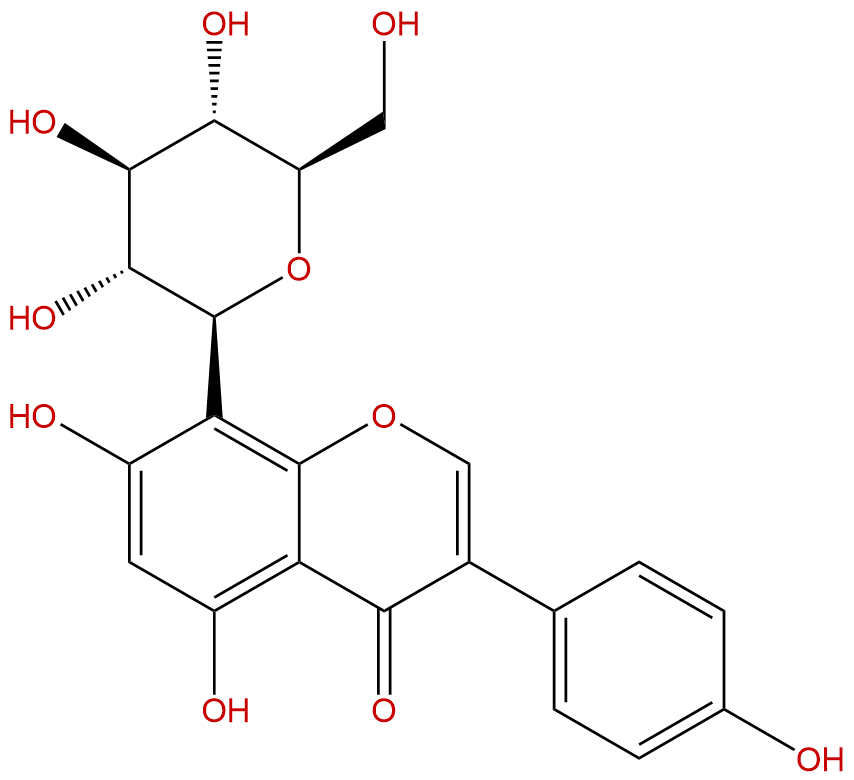


Product name: Genistein 8-C-glucoside
Synonym name:
Catalogue No.: BP2095
Cas No.: 66026-80-0
Formula: C21H20O10
Mol Weight: 432.381
Botanical Source: Puerariae lobatae radix
Type of Compound: Flavonoids
Purity: 95%~99%
Analysis Method: HPLC-DAD or/and HPLC-ELSD
Identification Method: Mass, NMR
Packing: Brown vial or HDPE plastic bottle
Storage: Store in a well closed container, protected from air and light. Put into refrigerate or freeze for long term storage.
Whenever possible, you should prepare and use solutions on the same day. However, if you need to make up stock solutions in advance, we recommend that you store the solution as aliquots in tightly sealed vials at -20℃. Generally, these will be useable for up to two weeks.
The product could be supplied from milligrams to grams
Inquire for bulk scale.
For Reference Standard and R&D, Not for Human Use Directly.
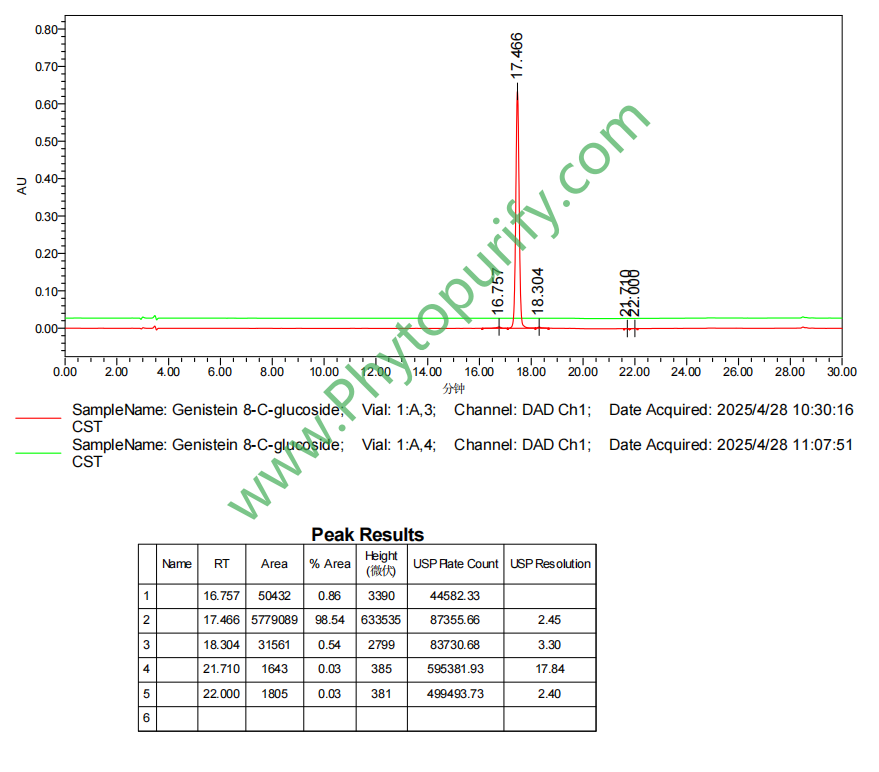
HPLC of Genistein 8-C-glucoside
Storage conditions:Short-term storage at 2~8℃, long-term storage at -20 ~ -80℃
181.0500
-.0256
-.1382
1.0368
.6537
.4671
Low
80.4813
4.0048
Yes
No
No
No
Yes
Yes
1.2
Yes
Yes
Yes
No
Genistein 8-C-glucoside (G8CG) is a naturally occurring flavonoid glucoside that has attracted widespread attention in the field of natural product pharmacology in recent years due to its unique chemical structure and significant biological activity. G8CG, as the C-8 glucoside form of genistein, retains the polyphenolic structural characteristics of the parent nucleus and is linked to glucose molecules through C-C bonds, endowing it with high water solubility and biological stability. Research has shown that G8CG has the ability to induce mitochondrial membrane depolarization and cell apoptosis, and has potential therapeutic value in various disease models such as osteoporosis.
Osteoporosis, as a metabolic bone disease characterized by reduced bone mass and microstructural damage to bone tissue, seriously threatens the quality of life and health of the elderly population. The existing drugs often have side effects or limited efficacy, which makes natural products an important source for finding new bone protectants. G8CG exhibits a multi-target mechanism of regulating bone remodeling by modulating bone metabolism related targets such as estrogen receptor (ESR1), matrix metalloproteinase 9 (MMP9), vitamin D receptor (VDR), and key transcription factors for bone formation, RUNX2 and SP7, demonstrating promising application prospects.
This article provides a systematic review of the chemical structure and physicochemical properties, plant sources, and extraction methods of G8CG. It delves into its pharmacological activity and mechanism of action, and combines drug evaluation and pharmacokinetic data to explore its potential in the clinical treatment of osteoporosis and related diseases. The aim is to provide theoretical support and reference for subsequent basic and clinical research.
Genistein 8-C-glucoside (CAS number: 66026-80-0) has a molecular formula of C21H20O10 and a molecular weight of 432.3810. Its structure is based on the isoflavone core of genistein, and glucosides are connected in the form of C-C bonds through C-8 carbon atoms, which is different from common O-glycosidic bonds, endowing the molecule with strong chemical stability and resistance to enzymatic hydrolysis.
In terms of physicochemical properties, the LogP value of G8CG is -0.0256, indicating its strong hydrophilicity. Combined with its high polar surface area (TPSA 181.05 Å ²) and water solubility (1.0368 mg/mL), it suggests that the compound has good water solubility, which is beneficial for absorption after oral administration. The low permeability of the blood-brain barrier suggests limited distribution in the central nervous system, reducing the risk of central side effects. The hERG channel inhibition test result was negative, indicating a low risk of cardiac toxicity. The Ames test value is 1.2, indicating a low risk of genotoxicity and meeting the preliminary requirements for safe drug use.
Structurally, the flavonoid core of G8CG contains multiple hydroxyl groups, endowing it with strong antioxidant capacity, while the presence of glucose groups increases the molecule's hydrophilicity and bioavailability. The C-8 glucosidic bond exhibits stability in vivo metabolism that differs from traditional O-glycosides, which may affect its metabolic pathway and the duration of drug efficacy.
G8CG is mainly found in various leguminous plants, especially in soybeans (Glycine max), plants of the genus Zygomycota, and some traditional Chinese medicinal materials. As a natural flavonoid glucoside, although the content of G8CG is not as high as its parent lignin, its stable structure and unique biological activity make it a research focus.
Traditional extraction methods usually use alcohol solvents (such as methanol and ethanol) to extract plant dry powder, combined with ultrasound assisted extraction or microwave-assisted extraction techniques, which can improve extraction efficiency. The extract was concentrated, liquid-liquid partitioned, and purified by column chromatography, and finally identified for purity and structure by high performance liquid chromatography (HPLC) and mass spectrometry (MS). In recent years, supercritical CO2 extraction and membrane separation technologies have gradually been applied to the extraction of G8CG, aiming to improve the purity and yield of extraction while reducing the use of organic solvents, in line with the principles of green chemistry.
The optimization of extraction process mainly focuses on solvent system selection, extraction temperature and time, pH regulation, etc., to ensure the stability of G8CG and the maximum retention of active ingredients. It is worth noting that the C-8-C-glucoside bond of G8CG is relatively stable and not easily hydrolyzed. During the extraction process, strong acid and alkali conditions should be avoided to prevent structural damage.
G8CG has been extensively studied in the field of anti osteoporosis. In vitro experiments have shown that G8CG can significantly promote the proliferation and differentiation of osteoblasts (such as MC3T3-E1), enhance alkaline phosphatase (ALP) activity, and promote the formation of mineralized nodules. In animal models, G8CG significantly improves bone density and strength by regulating bone metabolism balance, inhibiting osteoclast activity, slowing down bone loss.
At the molecular level, G8CG activates the estrogen receptor alpha (ESR1), mimicking the bone protective effect of estrogen and promoting the expression of bone formation related genes. Its inhibitory effect on matrix metalloproteinase 9 (MMP9) helps to reduce bone matrix degradation. The regulation of vitamin D receptor (VDR) further promotes the balance of calcium and phosphorus metabolism and enhances bone mineralization. Transcription factors RUNX2 and SP7 (Osterix), as key regulatory factors of bone formation, are upregulated under the action of G8CG, promoting the differentiation of osteoblasts into mature bone cells. The expression of osteoclast related genes such as CTSK (Cathepsin K) is inhibited, reducing bone resorption. The regulatory balance between TNFRSF11B (Osteoprotegerin) and SOST (Sclerostin) further stabilizes the bone metabolism environment.
G8CG has the ability to induce depolarization of mitochondrial membranes in various tumor cells and trigger intracellular apoptotic signaling pathways. The mechanism of action involves activating the mitochondrial pathway, promoting the release of cytochrome c, activating the caspase cascade reaction, and ultimately leading to programmed cell death. This characteristic demonstrates the potential of G8CG in anti-tumor research, especially in the selective induction of apoptosis in tumor cells.
As a polyphenolic compound, G8CG exhibits significant antioxidant capacity, capable of scavenging free radicals and reducing oxidative stress damage to cells. Its anti-inflammatory effect is achieved by inhibiting the expression of inflammatory factors such as TNF - α and IL-6, reducing tissue inflammation, and indirectly promoting bone tissue repair and regeneration.
The biological activity of G8CG mainly depends on its interactions with multiple molecular targets, forming a complex signal regulatory network.
G8CG simulates the structure of estrogen, binds to ESR1, activates receptor-mediated gene transcription, promotes the expression of bone formation related proteins, and inhibits bone resorption. This mechanism is similar to selective estrogen receptor modulators (SERMs), which protect bone while reducing the risk of side effects in tissues such as the breast and uterus.
MMP9 is involved in the degradation and remodeling of bone matrix. The inhibition of MMP9 by G8CG reduces excessive degradation of bone matrix and protects the structural integrity of bone tissue.
VDR regulates calcium and phosphorus metabolism as well as bone mineralization processes. G8CG enhances bone strength by regulating VDR activity, promoting calcium ion absorption and bone mineral deposition.
RUNX2 and SP7 are key transcription factors for osteoblast differentiation. G8CG promotes its expression, facilitates the transformation of precursor cells into mature bone cells, and promotes bone matrix synthesis and mineralization.
G8CG inhibits CTSK expression and reduces bone resorption activity of osteoclasts. By regulating the balance of TNFRSF11B (osteoprotegerin) and SOST (osteocalcin), maintaining bone metabolism homeostasis and preventing bone loss.
G8CG induces mitochondrial membrane depolarization, activates endogenous apoptotic pathways, promotes cytochrome c release, initiates caspase cascade reaction, and induces cell apoptosis. This mechanism is particularly important in the selective killing of tumor cells.
The pharmacological parameters of G8CG indicate that it has good potential for drug development. The molecular weight is 432.3810, which is moderate and within the ideal range for oral small molecule drugs. The LogP value is close to zero, indicating a good balance between hydrophilicity and lipophilicity, which is beneficial for distribution and absorption in the body. A higher TPSA value suggests stronger polarity, which may limit some cell membrane permeability, but helps target the aqueous environment.
Low blood-brain barrier permeability reduces the risk of central nervous system side effects. HERG channel inhibition is negative and has high safety. The Ames test results are good and the risk of genotoxicity is low.
In terms of pharmacokinetics, the C-8-C-glucoside bond of G8CG is stable, and its metabolism in vivo is relatively slow, which may prolong its half-life and increase its bioavailability. It has good water solubility and is beneficial for oral absorption, but its high polarity may limit intestinal penetration, and further research is needed on its intestinal transport mechanism and first pass effect.
At present, there is limited pharmacokinetic data on G8CG in vivo. In the future, a systematic evaluation of its absorption, distribution, metabolism, and excretion (ADME) characteristics, especially the activity and safety of its metabolites, is needed.
Based on the multi-target mechanism of G8CG in anti osteoporosis and inducing cell apoptosis, its clinical application prospects are broad. As a natural flavonoid glucoside, G8CG has both bone protection and anti-tumor potential, and is expected to become a candidate drug for bone metabolism diseases and related malignant tumors.
Future research should focus on:
System Pharmacology and Mechanism Research In depth analysis of the interaction network between G8CG and key targets of bone metabolism, revealing the molecular mechanism of its regulation of bone remodeling, and conducting mechanism verification using multi omics techniques.
Pharmacokinetic and pharmacodynamic studies Improve the characteristics of ADME in vivo, clarify its bioavailability, metabolic pathways, and duration of drug efficacy, and provide a basis for dosage form design and administration plan.
safety evaluation Conduct long-term toxicology, genotoxicity, and carcinogenicity studies to ensure the safety of clinical applications.
Preclinical animal model validation Using multiple animal models of osteoporosis, evaluate the efficacy and dose dependence of G8CG, and optimize treatment plans.
Clinical trial design Based on sufficient preclinical data, conduct early clinical trials to verify their safety and efficacy, and advance the drug development process.
In addition, the potential of G8CG in anti-inflammatory, antioxidant, and anti-tumor fields is also worth further exploration, which may expand its indications and promote the development of joint treatment strategies in multiple disease fields.
Dye lignin-8-C-glucoside, as a natural isoflavone glucoside with unique structure and rich biological activity, exhibits significant anti osteoporosis and induction of cell apoptosis ability. Its multi-target regulation of key factors in bone metabolism, combined with good pharmacological parameters, provides strong support for the development of new bone protectants. Although the pharmacokinetics and clinical data in vivo are not yet complete, its safety and multiple biological activities make it a hot topic in natural product pharmacology research and drug development.
In the future, through systematic mechanism research, pharmacokinetic optimization, and clinical validation, G8CG is expected to become an emerging drug for the treatment of osteoporosis and related diseases, contributing significantly to improving patients' quality of life. The multi-target and multi mechanism characteristics of natural products also provide new ideas for the comprehensive treatment of complex diseases. The in-depth research of G8CG will promote the integrated development of natural medicine science and precision medicine.
