Introduction/Overview
Natural products, as an important treasure trove for drug discovery and development, play an irreplaceable role in the long history of human fight against diseases. Isoflavones are widely present in leguminous plants and have become a hot topic in pharmacological research due to their diverse biological activities, such as antioxidant, anti-inflammatory, and cardiovascular protection. Pueraria root(Pueraria lobata As a traditional Chinese medicine, the core active ingredient Puerarin in (Willd.) Ohwi has been extensively studied. However, there are still a series of glycosylated derivatives of puerarin in kudzu root, which may have unique or stronger pharmacological activities and are worth further exploration. Mirificin (also known as Puerarin apioside, CAS number: 103654-50-8) is one example. This compound is a glycoside formed by the combination of puerarin and apiose. Early studies have revealed its activity in inhibiting tyrosinase (IC50=12.66 μ M), suggesting its potential application value in skin pigmentation related diseases. In recent years, with the development of network pharmacology, molecular docking, and experimental verification technologies, the role of puerarin in anti-inflammatory, especially in cardiovascular inflammatory diseases such as myocarditis, has gradually entered the field of researchers. Its function involves regulating multiple key inflammatory targets, including tumor necrosis factor (TNF), prostaglandin endoperoxide synthase 2 (PTGS2/COX-2), nuclear factor kappa B1 (NFKB1), interleukin-6 (IL-6), and interleukin-1 β (IL-1B). This article aims to systematically review the chemical structure, plant origin, pharmacological activity, mechanism of action, pharmacological properties, and application prospects of celery sugar puerarin in diseases such as myocarditis, in order to provide scientific basis for the deep development and clinical application of this natural product.
Chemical structure and physicochemical properties
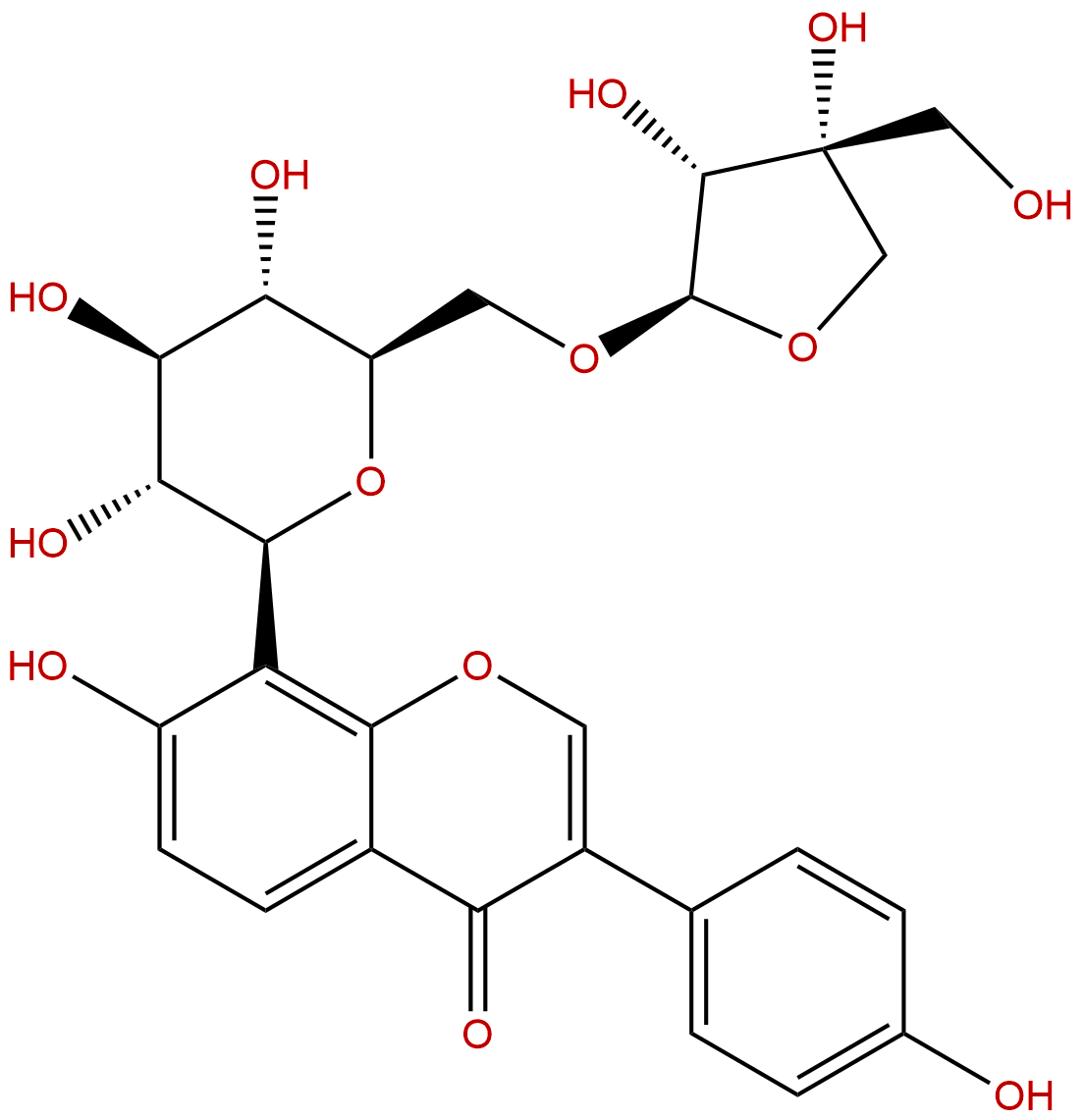
Celery sugar puerarin is an isoflavone carbon glycoside compound, with the chemical name 7-hydroxy-3- (4-hydroxyphenyl) -8- [(2S, 3R, 4S, 5S) -3,4-dihydroxy-5- [[(2R, 3R) -2,3,4-trihydroxy-4- (hydroxymethyl) butoxy] methyl] oxapentan-2-yl] oxy-4H-benzopyran-4-one. Its molecular formula is C26H28O13 and its molecular weight is 548.4970.
Structurally, the apiose unit of apiose is connected to puerarin (8-C-glucosyl-7,4 '- dihydroxyisoflavone) as the parent nucleus at the 4' 'position of its glucose group through a glycosidic bond. This unique disaccharide structure (glucose celery sugar) is a key characteristic that distinguishes it from puerarin and other kudzu isoflavone glycosides, and deeply affects its physicochemical properties and biological activity.
The drug properties related parameters calculated based on its chemical structure show that its lipid water partition coefficient (LogP) is -0.4566, indicating that the compound has good hydrophilicity. The topologically polar surface area (TPSA) is as high as 219.7400 Å ², which is closely related to the presence of multiple hydroxyl and sugar structures in its molecule, indicating that it has more hydrogen bond donor and acceptor sites. The water solubility value is 1.2476 (usually measured in mg/mL or log mol/L, indicating good solubility), further confirming its excellent hydrophilic properties. These physicochemical properties determine that the absorption, distribution, metabolism, and excretion (ADME) behavior of celery sugar puerarin in organisms may tend towards the characteristics of hydrophilic compounds. For example, oral bioavailability may face challenges, but it is beneficial for its dissolution and distribution in body fluids.
Plant sources and extraction methods
Celery sugar and puerarin are mainly derived from leguminous plants of the Pueraria genus, especially Pueraria root(Pueraria lobata)And also belong to closely related plants. In kudzu root, it usually coexists with isoflavones such as puerarin, daidzein, and genistein, but the content is relatively low and belongs to trace components. Its content is influenced by factors such as plant origin, harvesting season, medicinal parts (usually roots), and storage conditions.
Solvent extraction method is commonly used to extract celery sugar and puerarin from plant materials. Due to its high polarity, commonly used extraction solvents include methanol, ethanol, water, or alcohol water mixed solutions in different proportions. For example, using a 50% -70% ethanol aqueous solution for heating reflux or ultrasound assisted extraction can effectively extract celery sugar puerarin from kudzu root powder. Modern technologies such as microwave-assisted extraction and pressurized liquid extraction have also been applied to improve extraction efficiency and shorten time.
After concentration, the extract needs to be further separated and purified to obtain high-purity celery sugar puerarin. Conventional purification strategies include:
1. Macroporous adsorption resin chromatography Using the adsorption characteristics of resins (such as AB-8, D101, HP-20, etc.) for isoflavone components, gradient elution was performed with water and different concentrations of ethanol to preliminarily enrich the fraction containing celery sugar and puerarin.
2. Silica gel column chromatography The gradient elution using a mixed solvent system of chloroform methanol water is a classic method for separating structurally similar isoflavone glycosides.
3. Reversed phase preparative high-performance liquid chromatography (RP-HPLC)This is the most effective method to obtain high-purity celery sugar puerarin. Usually, a C18 chromatographic column is used, with methanol water or acetonitrile water (often containing a small amount of formic acid or acetic acid to adjust pH) as the mobile phase for elution. The target peak is monitored and collected by a UV detector (usually with maximum absorption at 250-280 nm).
4. High Speed Counter Current Chromatography (HSCCC)As a liquid-liquid distribution chromatography technique that does not require a solid phase carrier, it is suitable for preparing quantitative separations and has unique advantages in separating glycosides from natural products.
The purified compound needs to be structurally confirmed by nuclear magnetic resonance (NMR, including 1H-NMR, 13C-NMR, 2D-NMR), mass spectrometry (MS), and chromatographic data compared with standard samples (such as HPLC retention time, UV spectroscopy).
Pharmacological activity research
Although the pharmacological activity research of celery sugar puerarin is not as extensive as that of puerarin, existing evidence suggests that it has multifaceted biological activity potential.
-
Tyrosinase inhibitory activity This is one of the earliest reported activities of celery sugar puerarin. Tyrosinase is a key enzyme in melanin biosynthesis, and its excessive activity is associated with pigmentation diseases such as melasma and senile plaques. Celery sugar puerarin can inhibit the enzyme activity in a dose-dependent manner, with an IC50 value of 12.66 μ M. The inhibitory mechanism may be related to its ability to competitively bind to the active center of the enzyme through its isoflavone core structure, or to its interaction with copper ions. This activity suggests that celery sugar puerarin has potential applications in the development of skin whitening agents or the treatment of pigmentary skin diseases.
-
anti-inflammatory activity This is currently the most promising direction for pharmacological research on celery sugar and puerarin, especially in the field of cardiovascular and cerebrovascular inflammation. Myocarditis is a disease characterized by inflammation and necrosis of myocardial cells, and excessive and persistent inflammatory response is the key to causing myocardial damage and subsequent heart failure. Network pharmacology predictions and preliminary in vitro experiments have shown that apigenin has potential regulatory effects on multiple core targets related to myocarditis, such as TNF - α, IL-6, IL-1 β, COX-2 (PTGS2), and NF - κ B (NFKB1). In the lipopolysaccharide (LPS) - induced macrophage (such as RAW264.7) inflammation model, apigenin may significantly inhibit the excessive production of inflammatory factors (NO, TNF - α, IL-6). In animal models of myocarditis (such as viral or autoimmune myocarditis), it may exert cardioprotective effects by reducing myocardial tissue inflammatory infiltration, lowering serum myocardial injury markers (such as troponin, CK-MB), and inflammatory cytokine levels.
-
antioxidant activity Isoflavones generally have the ability to scavenge free radicals. The phenolic hydroxyl group in the structure of celery sugar and puerarin is the chemical basis for its antioxidant activity. It may alleviate oxidative stress damage by directly clearing reactive oxygen species (ROS) and reactive nitrogen species (RNS), or enhancing the activity of endogenous antioxidant enzymes in cells such as superoxide dismutase (SOD) and glutathione peroxidase (GSH Px). In pathological processes such as myocarditis and ischemia-reperfusion injury, oxidative stress and inflammatory response promote each other, and the antioxidant effect of apigenin and its anti-inflammatory activity may have a synergistic protective effect.
-
Potential neuroprotective and cardiovascular protective activities: Based on the clear role of puerarin, its parent nuclear compound, in improving cardiovascular and cerebrovascular circulation and protecting nerve cells, and the anti-inflammatory and antioxidant properties of apiose puerarin itself, it is speculated that it may also have improvement potential for cerebral ischemia, Alzheimer's disease, atherosclerosis and other diseases, but this needs more direct experimental evidence to support.
Mechanism of action and molecular targets
Celery sugar and puerarin exert pharmacological effects, especially anti-inflammatory effects, involving multidimensional regulation of multiple signaling pathways and molecular targets, reflecting the characteristic of natural product "multi-target" action. The core mechanism of action for inflammatory diseases such as myocarditis may revolve around the following targets and pathways:
-
Inhibition of NF - κ B signaling pathway NF - κ B is a core transcription factor that regulates inflammatory responses. Under the stimulation of LPS, TNF - α, and other factors, the I κ B kinase (IKK) complex is activated, leading to the phosphorylation and degradation of inhibitory protein I κ B, thereby releasing NF - κ B (such as p50/p65 dimer, encoded by NFKB1 for p50) into the nucleus, initiating the transcription of numerous inflammatory genes such as TNF, IL6, IL1B, PTGS2, etc. Research has shown that celery sugar puerarin may inhibit the activation of IKK or the degradation of I κ B α, prevent the nuclear translocation of NF - κ B, and thus widely suppress the expression of downstream inflammatory mediators at the transcriptional level.
-
Regulating the MAPK signaling pathway The mitogen activated protein kinase (MAPK) pathway, including ERK, JNK, and p38 MAPK, plays an important role in cellular stress and inflammatory responses. The activation of these pathways can further phosphorylate and activate transcription factors (such as AP-1), synergistically promoting the production of inflammatory factors with NF - κ B. Celery sugar puerarin may interfere with the transmission of inflammatory signals by inhibiting the phosphorylation of p38 MAPK and JNK.
-
Targeting key inflammatory target proteins:
- TNF-αAs a initiating factor in the inflammatory cascade, apigenin may inhibit its production through upstream signaling or interfere with its binding to receptors.
- IL-6 and IL-1 βAs important pro-inflammatory cytokines, their expression is regulated by the NF - κ B and MAPK pathways. Celery sugar puerarin indirectly reduces its synthesis and release by inhibiting the upstream pathway.
- COX-2 (PTGS2)It is the rate limiting enzyme for prostaglandin E2 (PGE2) synthesis and is strongly induced during inflammation. Celery sugar puerarin downregulates COX-2 expression by inhibiting pathways such as NF - κ B, thereby reducing the production of pro-inflammatory prostaglandins.
- NLRP3 inflammasome In diseases such as myocarditis, activation of NLRP3 inflammasome can lead to caspase-1-mediated maturation and release of IL-1 β and IL-18. There are studies suggesting that puerarin and its derivatives may inhibit the assembly and activation of NLRP3 inflammasomes. It is worth exploring whether puerarin has a similar effect.
-
Anti oxidative stress mechanism In addition to directly scavenging free radicals, apigenin may activate the nuclear factor E2 related factor 2 (Nrf2) signaling pathway. Nrf2 is a key transcription factor regulating antioxidant response elements (ARE), which can induce the expression of phase II detoxifying enzymes and antioxidant proteins such as heme oxygenase-1 (HO-1) and quinone oxidoreductase 1 (NQO1), thereby enhancing the antioxidant defense ability of cells.
In summary, celery sugar puerarin may inhibit pro-inflammatory signals such as NF - κ B and MAPK through a network of "multi-target multi pathway" effects, while possibly activating protective signals such as Nrf2, jointly exerting anti-inflammatory, antioxidant, and organ protective effects.
Evaluation of drug properties and pharmacokinetics
Although celery sugar puerarin has shown promising pharmacological activity, its potential as a drug still requires systematic pharmacological evaluation.
Analysis of drug properties parameters based on calculations and preliminary experiments:
* Five rules for classifying drugs Its molecular weight (548.5) slightly exceeds the standard of 500, with a large number of hydrogen bond donors (about 8) and hydrogen bond acceptors (13), and a low LogP value (-0.46). This indicates that it may not fully comply with the traditional "beyond Rule of 5" compounds, which are common in natural product glycosides, suggesting that its oral absorption may face challenges.
* Absorption and distribution High TPSA and hydrophilicity (low LogP, good water solubility) are beneficial for its dissolution in aqueous environments, but not conducive to its passive transmembrane diffusion, especially through absorption by intestinal epithelial cells in the lipid bilayer. Its blood-brain barrier permeability is predicted to be 'low', which is consistent with most polar macromolecular compounds, indicating that it may not easily enter the central nervous system.
* Metabolism and Safety The inhibitory prediction of hERG is' no ', which is a positive signal indicating a lower risk of potential cardiac toxicity (inducing long QT syndrome). The Ames test value is 1.2 (usually expressed as mutation rate, less than 2 is considered negative), indicating that it may not have direct genetic toxicity. However, these are only predictions or preliminary data and require rigorous in vitro and in vivo experimental validation.
Prospects of Pharmacokinetic (PK) Research:
At present, there are very limited research reports on the pharmacokinetics of celery sugar and puerarin system. It can be inferred from the pharmacokinetic characteristics of its parent compound puerarin and similar isoflavone glycosides:
1. absorb After oral administration, its glycosidic structure may resist gastric acid hydrolysis to some extent, but upon arrival in the intestine, it will be partially hydrolyzed by glycosidase secreted by gut microbiota, which may remove celery sugar or the entire sugar chain, producing puerarin or daidzein. Therefore, its oral bioavailability may be the combined contribution of the prototype drug and metabolites, and the absorption rate of the prototype drug may not be high. The use of nano formulations, phospholipid complexes, cyclodextrin inclusion and other formulation technologies to improve its solubility and membrane permeability is a potential strategy for enhancing its oral bioavailability.
2. distribution Due to its high polarity, its distribution volume is expected to be small, mainly distributed in tissues rich in blood and extracellular fluid, such as the heart, liver, kidneys, etc., while its distribution in adipose tissue and the brain is limited.
3. Metabolism In addition to gut microbiota metabolism, it may undergo II binding reactions (such as glucuronidation and sulfation) in the liver, which is the main metabolic pathway for most phenolic compounds. The metabolic enzyme spectrum (such as which CYP450 isoenzymes are involved) needs to be studied and clarified.
4. excretion Polar metabolites are mainly excreted through the kidneys in urine, and some prototype drugs may also be excreted through bile.
A comprehensive pharmacokinetic study, including ADME processes in different animal models, absolute bioavailability determination, tissue distribution research, etc., is a necessary path to promote the development and application of apigenin.
Clinical application prospects and prospects
As a natural flavonoid glycoside with clear anti-inflammatory and antioxidant activities, the clinical application prospects of celery sugar and puerarin mainly focus on inflammation related diseases, especially in the field lacking specific therapeutic drugs.
-
Myocarditis and inflammatory cardiomyopathy This is the most promising direction. The current treatment for myocarditis mainly relies on supportive therapy and immunosuppression, lacking targeted and effective drugs. Celery sugar puerarin inhibits excessive inflammatory response and oxidative stress through multiple targets, and is expected to become a new type of adjuvant therapy for reducing acute myocardial injury, preventing inflammation chronicity, and transforming into dilated cardiomyopathy. It can be explored as an injection for acute severe myocarditis or developed as an oral formulation for maintenance therapy in the chronic phase.
-
Skin pigmentary diseases: Based on its tyrosinase inhibitory activity, it can be developed as a topical preparation (such as cream, essence) for the treatment of chloasma, post inflammatory pigmentation, etc., as a functional cosmetic or dermatological external drug ingredient.
-
Other inflammatory diseases: Its broad-spectrum anti-inflammatory mechanism suggests that it may also be effective in other organ system inflammation, such as arthritis, neuroinflammation (such as cerebral ischemia-reperfusion injury, neuroinflammation at the early stage of Alzheimer's disease), atherosclerosis (as chronic vascular inflammation), etc. More preclinical studies are needed to validate these areas.
Challenges faced and future research directions:
* Research on the Material Basis and Metabolism of Drug Efficacy It is necessary to clarify whether the substance form that truly works in the body is the prototype drug or a metabolite (such as puerarin), which is crucial for understanding its mechanism of action and optimizing the formulation.
* Systematic pharmacodynamic and toxicological evaluation Systematic dose-response relationship, long-term toxicity, reproductive toxicity, and other studies need to be conducted in animal models that are closer to human diseases, such as viral myocarditis mouse models, to comprehensively evaluate their effectiveness and safety.
* Innovation in formulation technology To address the potential issue of poor oral absorption, it is necessary to strengthen the research and development of new drug delivery systems, such as nanocrystals, self microemulsions, prodrug modifications, etc., to improve their bioavailability and targeting.
* Deep analysis of the mechanism of action By utilizing molecular biology, proteomics, metabolomics, and other technologies, we can more accurately depict the signaling network of its effects and identify the protein targets it directly targets.
* Clinical translational research Based on sufficient preclinical research, gradually promote human pharmacokinetics and early clinical trials to explore its safety window and initial efficacy in patients.
Conclusion
Celery sugar puerarin, as a structurally unique flavonoid glycoside in kudzu root, is gradually moving from a "trace component" to the forefront of pharmacological research. Its clear tyrosinase inhibitory activity, especially in recent years, has revealed its important medicinal value in anti-inflammatory, especially in regulating complex signaling networks related to myocarditis. Despite facing challenges in drug formulation, such as poor oral absorption, this is precisely the area that modern pharmacy and medicinal chemistry can focus on addressing. By thoroughly elucidating its multi-target mechanism of action, systematically evaluating its pharmacokinetics and safety, and improving its delivery efficiency with advanced formulation technology, apigenin is expected to stand out from the treasure trove of traditional Chinese medicine and develop into a new candidate drug for treating inflammatory diseases such as myocarditis, or as a functional ingredient applied in the field of skin care. The continuous research on celery sugar and puerarin not only helps to explore the new value of natural products, but also provides new chemical tools and research perspectives for understanding the regulation of complex disease networks.