


Product Name: Senegenin
Synonym name: Tenuigenin; Tenuifolic acid
Catalogue No.: BP1286
Cas No.: 2469-34-3
Formula: C30H45ClO6
Mol Weight: 537.134
Botanical Source: Polygala senega. Derived from Presenegenin by treatment with HCl. Also from Polygala tenuifolia and Bredemeyera floribunda
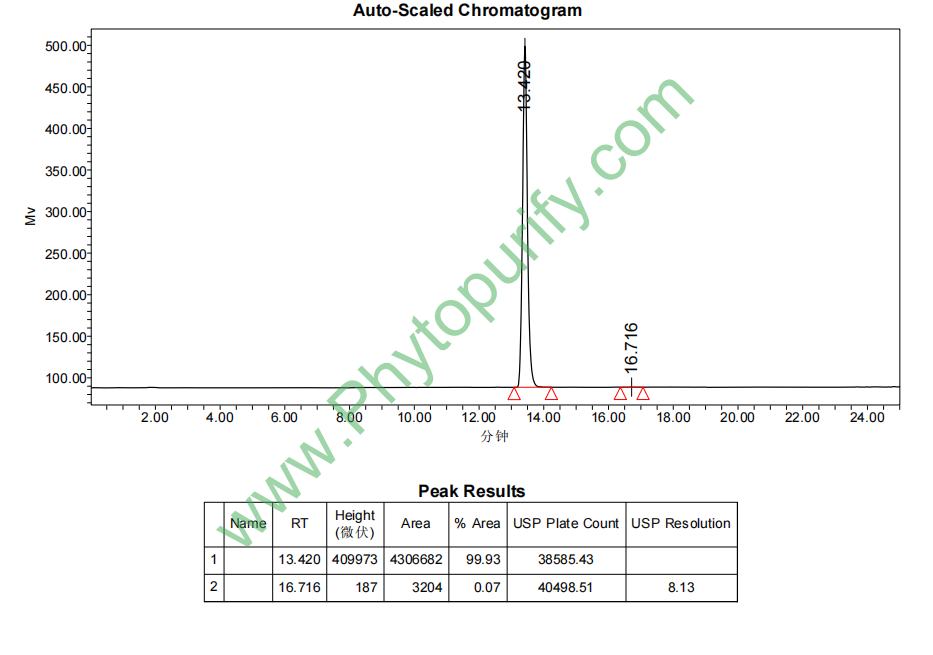
Purity: 95%~99%
Analysis Method: HPLC-DAD or/and HPLC-ELSD
Identification Method: Mass, NMR
Packing: Brown vial or HDPE plastic bottle
Can be supplied from milligrams to grams.
For Reference Standard and R&D, Not for Human Use Directly.
Inquire for bulk scale.
HPLC of Senegenin
Storage conditions:Short-term storage at 2~8℃, long-term storage at -20 ~ -80℃
Senegenin, CAS number 2469-34-3, is a 12 α - hydroxysteroid compound with significant neuroprotective activity. As an important active ingredient of traditional Chinese medicine Polygala tenuifolia Willd., saponins from Polygala tenuifolia Willd. have gradually received widespread attention in the prevention and treatment of neurodegenerative diseases. In recent years, with the rapid development of neuroscience and molecular pharmacology, the pharmacological effects and molecular mechanisms of Yuanzhi saponin have been deeply explored, demonstrating its potential therapeutic value in neurological diseases such as Alzheimer's disease (AD) and Parkinson's disease (PD).
This article provides a systematic review of the chemical structure and physicochemical properties, plant sources, and extraction methods of Yuanzhi saponin, with a focus on its neuroprotective pharmacological activities and mechanisms of action. Combined with pharmacological parameters and pharmacokinetic characteristics, it explores its clinical application prospects and future research directions, aiming to provide comprehensive and in-depth reference materials for researchers in the field of natural product pharmacology.
Yuanzhi saponins belong to 12 α - hydroxysteroids, with a molecular formula of C30H46O6 and a molecular weight of 537.1370. Its structural feature is the introduction of hydroxyl groups at position 12 of the steroid skeleton, giving it a unique spatial configuration and biological activity. The LogP value of Yuanzhi Saponin is 4.6503, indicating strong lipid solubility. Its TPSA (topological polar surface area) is 115.0600, indicating moderate polarity and certain cell membrane penetration ability.
Low water solubility (0.0137 mg/mL) suggests limited solubility in aqueous phase, which may affect its bioavailability. The low permeability of the blood-brain barrier (BBB) suggests its limited ability to directly enter the central nervous system, but this does not rule out its neuroprotective effect through indirect mechanisms. The hERG channel inhibition experiment showed a negative result, indicating that the risk of cardiac QT interval prolongation by Far Star Saponin is relatively low. The Ames mutagenicity test score is 0.3, indicating a low risk of genotoxicity and a good safety foundation.
Yuanzhi saponins mainly exist in the roots and rhizomes of the traditional Chinese medicine Yuanzhi. Yuanzhi is a perennial herbaceous plant widely distributed in northern and northeastern China. It is an important medicinal herb used in traditional Chinese medicine for strengthening the brain, improving intelligence, calming the heart, and calming the mind. As a deglycosylated form of saponins, yuanzhi saponins are usually obtained by hydrolyzing yuanzhi saponins.
The extraction method often uses organic solvent extraction combined with acid-base hydrolysis technology. Common processes include:
In recent years, the application of ultrasound assisted extraction and microwave-assisted extraction technologies has improved extraction efficiency and purity, reduced extraction time and solvent consumption, and provided technical support for the preparation of saponins from Polygala tenuifolia.
The pharmacological research of Yuanzhi Saponin mainly focuses on its neuroprotective effect, which has shown significant neuroprotective effects in various neurological disease models.
Yuanzhi saponin can alleviate neuronal damage, inhibit neuroinflammation, and protect neuronal survival. In vitro cell models have shown that Yuanzhi saponin can effectively resist oxidative stress-induced cell apoptosis and promote neuronal survival rate. In vivo experiments have shown that Yuan Zhi saponin can improve cognitive dysfunction and alleviate cerebral ischemia-reperfusion injury, demonstrating its good neuroprotective potential.
Yuanzhi saponins alleviate the pathological features of Alzheimer's disease by regulating β - amyloid (A β) metabolism and tau protein abnormalities. It can downregulate BACE1 enzyme activity, reduce A β production, promote APP non amyloid pathway metabolism, and reduce neurotoxic A β accumulation. In addition, Yuanzhi saponin inhibits excessive phosphorylation of tau protein and slows down the formation of neurofibrillary tangles.
Yuanzhi saponin activates the nuclear factor E2 related factor 2 (NRF2) signaling pathway, enhances cellular antioxidant defense ability, and reduces oxidative stress damage. At the same time, it inhibits the release of pro-inflammatory cytokines, reduces neuroinflammatory reactions, and protects the stability of the neural environment.
Yuanzhi saponin also exhibits inhibitory activity against acetylcholinesterase (ACHE), increases acetylcholine levels in the brain, and improves cognitive function. In addition, its regulation of apoptosis related protein CASP3 promotes the survival of nerve cells.
The neuroprotective effect of Yuanzhi saponin involves multiple signaling pathways and key molecular targets, and the specific mechanism is as follows:
Yuanzhi saponins upregulate the expression of anti apoptotic protein BCL2, inhibit the activity of pro apoptotic protein CASP3, reduce neuronal apoptosis, and maintain neuronal survival.
By inhibiting the activity of β - secretase BACE1, reducing the production of A β from APP cleavage, lowering the aggregation of neurotoxic A β, and alleviating the pathological progression of AD.
Yuanzhi saponin regulates the phosphorylation status of microtubule associated protein tau (MAPT), reduces the formation of neurofibrillary tangles, and protects the structural integrity of neurons.
SIRT1, as an important deacetylase, participates in regulating cellular metabolism and anti-inflammatory responses. Yuanzhi saponin activates SIRT1, promoting neuronal survival and functional recovery. Activation of the NRF2 pathway enhances the expression of antioxidant enzymes and resists oxidative stress.
Yuanzhi saponins regulate MAPK1 (ERK2) signaling, affecting cell proliferation, differentiation, and stress response, and promoting neuronal repair.
Yuanzhi saponin has inhibitory effects on ACHE, prolongs the action time of acetylcholine in synaptic cleft, and improves cognitive function.
In research related to Parkinson's disease, saponins from Polygala tenuifolia regulate SNCA expression, reduce abnormal aggregation of alpha synuclein, and protect dopaminergic neurons.
In summary, Yuanzhi saponin exerts a comprehensive neuroprotective effect through multi-target and multi pathway synergistic effects.
The pharmacological parameters of Yuanzhi saponins indicate that they have certain development potential, but there are also challenges.
The LogP value of Yuanzhi Saponin Yuan is 4.65, indicating its high lipid solubility, which is beneficial for penetrating lipid membranes, but its low water solubility (0.0137 mg/mL) limits its oral absorption. The low permeability of the blood-brain barrier suggests that its ability to directly enter the central nervous system is limited and may need to be improved through structural modifications or carrier systems.
At present, there is limited research on the in vivo metabolism of Yuanzhi saponin, and it is speculated that it may be metabolized by liver enzymes to form multiple metabolites. Further research is needed on metabolic stability and excretion pathways.
The hERG channel inhibition experiment showed a negative result, indicating a low risk of cardiac toxicity from Yuanzhi saponins. The Ames test score is 0.3, indicating a low risk of genotoxicity and a good safety foundation.
Due to poor water solubility and low BBB permeability, the bioavailability and central nervous system exposure of saponins from Polygala tenuifolia are limited. Strategies such as nanocarriers, liposome encapsulation, and structural modification have been proposed to improve its pharmacokinetic performance.
Yuanzhi saponin, as a natural steroid compound, has shown broad application prospects in the field of neurodegenerative diseases due to its multi-target neuroprotective mechanism.
Yuanzhi Saponin Yuan is expected to become a potential therapeutic drug for AD by inhibiting A β production, abnormal tau protein, and antioxidant and anti-inflammatory effects. Combined with existing drugs, it can be used as an adjuvant therapy to improve efficacy.
Regulating SNCA expression and antioxidant activity, making it potentially applicable in PD and other neuroinflammatory diseases.
Through ACHE inhibition and neuroprotection, Yuan Zhi saponin is expected to improve cognitive dysfunction and is suitable for elderly dementia and brain injury patients.
Yuanzhi saponin, as a natural product of 12 α - hydroxysteroid with multi-target neuroprotective effects, exhibits good pharmacological activity and safety. Its potential in the prevention and treatment of neurodegenerative diseases is becoming increasingly prominent, but there are still certain challenges in drug formulation and pharmacokinetics. In the future, through structural optimization and formulation innovation, it is expected to break through the limitations of the blood-brain barrier and achieve clinical translation. The pharmacological mechanism research and preclinical evaluation of the system will provide a solid foundation for the development of Yuanzhi saponin, and promote it to become an important model for the development of natural product drugs.
