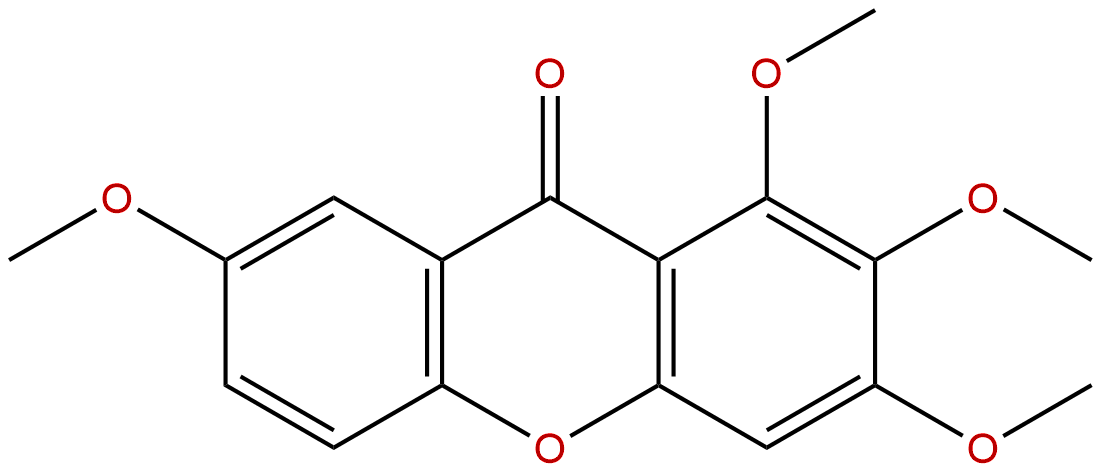


Product name: 1,2,3,7-tetramethoxyxanthone
Synonym name:
Catalogue No.: BP3007
Cas No.: 22804-52-0
Formula: C17H16O6
Mol Weight: 316.309
Botanical Source:
Physical Description:
Type of Compound:
Purity: 95%~99%
Analysis Method: HPLC-DAD or/and HPLC-ELSD
Identification Method: Mass, NMR
Packing: Brown vial or HDPE plastic bottle
The product could be supplied from milligrams to grams. Inquire for bulk scale.
We provide solution to improve the water-solubility of compounds, thereby facilitating the variety of activity tests and clinic uses.
For Reference Standard and R&D, Not for Human Use Directly.
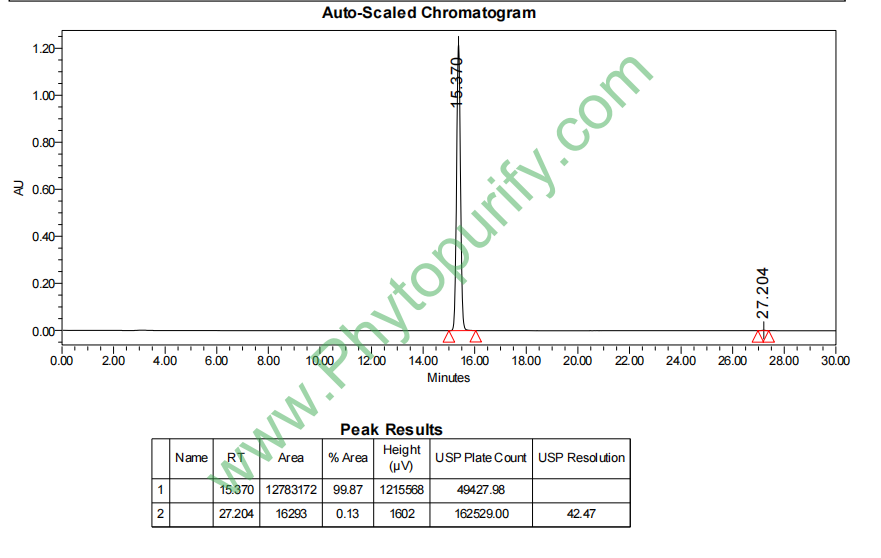
HPLC of 1,2,3,7-tetramethoxyxanthone
Storage conditions:Short-term storage at 2~8℃, long-term storage at -20 ~ -80℃
67.1300
2.4382
2.4382
.0036
3.8907
41.7080
High
82.9205
2.1709
Yes
No
Yes
No
Yes
No
1.5
Yes
No
No
Yes
Natural products have long been an important source of innovative drug discovery, among which mountain ketone compounds have attracted much attention due to their extensive and significant biological activities. 1,2,3,7-Tetramethoxyxanthone (TMX), as a natural ketone derivative with a specific methoxy substitution pattern, has a CAS number of 22804-52-0 and is gradually emerging from numerous phytochemicals. Modern pharmacological research has revealed that TMX exhibits multiple biological activities centered around antioxidant damage, which makes it highly valuable in addressing oxidative stress-related diseases such as neurodegenerative diseases, cardiovascular diseases, metabolic syndrome, and inflammatory diseases. Oxidative stress is a pathological state caused by an imbalance in the production and clearance of reactive oxygen species (ROS) in the body, and is a common pathological basis for many chronic diseases. Therefore, targeted regulation of oxidative stress pathways and enhancement of endogenous antioxidant defense systems have become important strategies for modern drug development. This article aims to systematically review the chemical properties, plant sources, pharmacological activities of TMX, especially its antioxidant mechanism based on key targets such as nuclear factor E2 related factor 2 (NRF2/NFE2L2), and explore its pharmacological properties and future development prospects in depth, in order to provide comprehensive scientific references for the in-depth research and potential drug development of this compound.
The molecular formula of 1,2,3,7-tetramethoxyshanone is C17H16O6, with a molecular weight of 316.3090. Its core structure is the ketone core, namely the benzo - γ - pyranone structure, which is composed of a benzene ring (A ring) coupled with a chromone ring (C ring). The characteristic of this compound is that its four methoxy groups (- OCH3) are respectively substituted at positions 1, 2, 3, and 7 of the parent nucleus. This highly methoxylated substitution mode has a decisive impact on its physicochemical properties and biological activity.
From the analysis of physical and chemical properties, the lipid water partition coefficient (LogP) of TMX is 2.4382, indicating its moderate lipophilicity, which facilitates its penetration of cell membranes and interaction with hydrophobic targets. Its topological polar surface area (TPSA) is 67.1300 Å ², which is relatively low, further confirming its good membrane permeability. However, its water solubility is poor, only 0.0036 mg/mL, which may pose challenges in formulation development and in vivo absorption. In the preliminary prediction of drug properties, TMX exhibits high blood-brain barrier permeability potential, which provides an important material basis for its application in central nervous system oxidative stress-related diseases such as Alzheimer's disease and Parkinson's disease. Preliminary safety screening shows that it has no significant inhibitory effect on hERG potassium channels (hERG inhibition: No), indicating a low potential risk of arrhythmia. The Ames test result is 1.5, indicating a low risk of mutagenicity under standard testing conditions, but further confirmation is needed in a more complete genotoxicity evaluation system.
1,2,3,7-Tetramethoxyketone is not widely distributed in all plants, but mainly exists in medicinal plants of specific families and genera, especially in plants rich in ketone components. According to literature reports, its main plant sources include:
1. Vine and yellow family plants Many plants in this family, especially Garcinia Genus (such as gamboge, mangosteen, etc.) is a treasure house of caryones. TMX is often isolated as a secondary metabolite of this type of plant.
2. Gentianaceae plants: Some Swertia Genus (such as Swertia) and Gentiana Plants belonging to the genus Gentiana also contain TMX or its analogues.
3. Yuanzhi family plants: Partial Polygala This component can also be detected in the roots or whole plants of the genus (Polygala).
The extraction and separation of TMX usually follow the conventional process of natural product chemistry. Firstly, organic solvents (such as methanol, ethanol, acetone) or alcohol water mixed solvents with different ratios are used to extract or reflux dry plant materials to obtain crude extracts. Subsequently, the crude extract was preliminarily separated using solvent partitioning methods (such as extraction with petroleum ether, ethyl acetate, and n-butanol in sequence), and TMX was mainly enriched in the moderately polar ethyl acetate fraction. Further purification depends on various chromatographic techniques, including silica gel column chromatography, gel column chromatography (such as Sephadex LH-20), high performance liquid chromatography (HPLC) or preparative thin layer chromatography (PTLC). Among them, reverse phase HPLC is often used for the final purification of monomer compounds due to its high resolution. Structural identification is accomplished through the combination of spectroscopic techniques such as nuclear magnetic resonance (NMR, including 1H-NMR and 13C-NMR), mass spectrometry (MS), infrared spectroscopy (IR), and ultraviolet spectroscopy (UV).
The pharmacological activity research of TMX mainly focuses on its powerful antioxidant and related protective effects, which have been validated in various in vitro and in vivo models.
1. Antioxidant activity
This is the core and fundamental activity of TMX. At the chemical level, TMX can effectively scavenge DPPH radicals, ABTS radicals, superoxide anions, and hydroxyl radicals. Its scavenging ability is related to the electron donating effect of methoxy groups, which enhances the stability of phenoxide radicals on the benzene ring. At the cellular level, TMX can significantly resist oxidative damage induced by hydrogen peroxide (H2O2), tert butyl hydroperoxide (t-BHP), or certain toxins such as paraquat. For example, in neural cell models such as PC12 cells and SH-SY5Y cells, TMX pretreatment can dose dependently increase cell survival rate, reduce lactate dehydrogenase (LDH) leakage, decrease excessive accumulation of intracellular ROS, and reduce the level of lipid peroxidation product malondialdehyde (MDA).
2. Neuroprotective effect
Based on its excellent antioxidant capacity and high blood-brain barrier permeability, TMX has significant potential in neuroprotection. In addition to combating chemically induced neuronal damage, studies have also found that TMX can alleviate β - amyloid (A β) - induced toxicity and reduce abnormal phosphorylation of tau protein in Alzheimer's disease cell models. In animal models, TMX has also been reported to improve learning and memory impairment induced by scopolamine or D-galactose, and its mechanism is closely related to reducing oxidative stress and inflammatory response in the hippocampus.
3. Anti inflammatory effect
Oxidative stress and inflammatory response are closely intertwined. Research has shown that TMX can not only directly eliminate free radicals, but also inhibit the production of inflammatory mediators. TMX can downregulate the expression of nitric oxide (NO), prostaglandin E2 (PGE2), as well as pro-inflammatory factors such as tumor necrosis factor - α (TNF - α) and interleukin-6 (IL-6) in macrophages stimulated by lipopolysaccharide (LPS), such as RAW264.7 cells.
4. Other potential activities
Preliminary studies also suggest that TMX may have anti-tumor, hepatoprotective, and cardiovascular protective activities. For example, in liver cell injury models, TMX has shown potential to counteract liver toxicity caused by acetaminophen or carbon tetrachloride, and its mechanism is also related to antioxidant and anti apoptotic effects.
The pharmacological effects of TMX, especially its core antioxidant damage effect, are not simply free radical scavenging, but mainly achieved by activating the endogenous antioxidant defense system of cells, in which the NRF2/KEAP1 signaling pathway plays a pivotal role.
1. Core target: NRF2/NFE2L2 signaling pathway
NRF2 is a key transcription factor that regulates cellular oxidative stress response. In the resting state, NRF2 binds to its cytoplasmic inhibitory protein KEAP1 and is degraded by ubiquitination. When stimulated by oxidants or electrophilic substances, the conformation of KEAP1 changes, releasing NRF2. NRF2 translocates to the nucleus and binds to antioxidant response elements (ARE), initiating the transcriptional expression of a series of downstream phase II detoxifying enzymes and antioxidant proteins.
TMX, as a small molecule compound, may possess electrophilic properties due to its methoxy group and ketone core in its structure. It can covalently modify key cysteine residues on KEAP1 protein or interfere with NRF2-KEAP1 interaction through other means, thereby stabilizing NRF2 and promoting its nuclear translocation and transcriptional activity. Activated NRF2 subsequently upregulates the expression of a series of key target genes:
* antioxidant enzyme Superoxide dismutase 1/2 (SOD1, SOD2), catalase (CAT), glutathione peroxidase 1 (GPX1). These enzymes work together to convert superoxide anions into hydrogen peroxide, which is further broken down into harmless water and oxygen.
* Detoxification/protective enzymes Heme oxygenase-1 (HMOX1). HMOX1 catalyzes the decomposition of hemoglobin into biliverdin, carbon monoxide, and iron ions. Bilibilin and its reduced product bilirubin are effective endogenous antioxidants, while carbon monoxide has anti-inflammatory and cell protective effects.
* Glutathione synthesis related enzymes For example, glutamate cysteine ligase catalyzes subunits and modifies subunits (GCLC, GCLM), increasing the synthesis of intracellular reduced glutathione (GSH), which is an important non enzymatic antioxidant.
2. Interaction with other signaling pathways
The role of TMX may not be limited to NRF2. Research has shown that its antioxidant and anti-inflammatory effects may also involve inhibition of the nuclear factor kappa B (NF - κ B) signaling pathway, reducing transcription of pro-inflammatory factors. In addition, it may activate the AMP activated protein kinase (AMPK) pathway and regulate signaling pathways related to cell survival, such as mitogen activated protein kinase (MAPK) and phosphatidylinositol 3-kinase/protein kinase B (PI3K/Akt), forming a multi-target, networked protective mechanism.
Although TMX exhibits excellent pharmacological activity, its potential as a drug still requires a systematic pharmacological evaluation.
Advantage:
1. Moderate molecular weight 316 Da meets the molecular weight requirements of the "Five Rules" for generic drugs.
2. Good membrane permeability Moderate LogP values and lower TPSA indicate good oral absorption potential and cell permeability.
3. Central nervous system penetrative potential Prediction of high blood-brain barrier permeability is its unique advantage in the treatment of neurological diseases.
4. Preliminary safety is good The absence of hERG inhibition and lower risk of Ames test laid the foundation for subsequent development.
Challenge:
1. Poor water solubility The main drawback is its extremely low water solubility (0.0036 mg/mL), which may lead to low oral bioavailability and difficulty in formulation. In the future, improvements will need to be made through formulation technologies such as making nanocrystals, cyclodextrin inclusion complexes, solid dispersions, or liposomes, or through prodrug modifications such as introducing water-soluble groups.
2. Lack of pharmacokinetic data At present, there are few reports on the in vivo pharmacokinetic studies of TMX systems, such as absorption, distribution, metabolism, and excretion, i.e. ADME properties. The key parameters such as oral absorption degree, plasma protein binding rate, major metabolic organs and pathways, half-life, and excretion mode urgently need to be clarified. Its methoxy structure may face demethylation metabolism, generating metabolites with different activities.
3. Insufficient validation of in vivo effectiveness: Most activity studies stay at the cellular level, and need to verify the dose effect relationship and long-term safety in more animal models closer to human diseases (such as transgenic Alzheimer's disease mice, atherosclerosis models, etc.).
Based on current research, the clinical application prospects of TMX mainly revolve around the disease field where oxidative stress is the core pathological mechanism.
1. Potential indications
* Neurodegenerative diseases As an NRF2 activator, TMX has great potential in the prevention or disease modification treatment of Alzheimer's disease, Parkinson's disease, amyotrophic lateral sclerosis, and other diseases. Its high BBB permeability is its key advantage.
* Ischemia/reperfusion injury In cardiovascular and cerebrovascular diseases such as myocardial infarction and stroke, the reperfusion process after restoring blood flow produces a large amount of ROS, leading to secondary tissue damage. The antioxidant and anti-inflammatory effects of TMX may alleviate such damage.
* Metabolic diseases Oxidative stress is the core driving factor in nonalcoholic fatty liver disease (NAFLD), diabetes and its complications (such as diabetes nephropathy, neuropathy). TMX may exert therapeutic effects by improving the oxidative status of the liver and target organs.
* Inflammatory diseases The pathological process of chronic obstructive pulmonary disease (COPD), arthritis, etc. is related to the vicious cycle of oxidation inflammation.
2. Future research directions and prospects
* In depth mechanism research Using gene knockout/knockdown techniques to clearly validate the necessity of NRF2 in the action of TMX in cell and animal models. Explore the direct interaction mode between TMX and target proteins such as KEAP1 using techniques such as molecular docking and surface plasmon resonance.
* Systematic pharmacokinetic study Conduct comprehensive in vivo ADME research to clarify its bioavailability, tissue distribution (especially brain tissue distribution), metabolite profile, and main excretion pathways.
* Formulation development To address the bottleneck of poor water solubility, actively develop new drug delivery systems to improve their solubility and bioavailability.
* structural optimization Conduct structural modification and structure-activity relationship studies using TMX as the lead compound. For example, exploring the effects of replacing methoxy groups at different positions with other functional groups (such as hydroxyl, halogen, nitrogen-containing heterocycles) on activity, selectivity, and drug formation, in order to obtain better candidate drugs.
* Exploration of combination therapy Exploring the combination use of TMX with existing therapeutic drugs (such as donepezil, memantine, or anti-inflammatory drugs in neurological disorders) may result in synergistic effects, reducing their respective dosages and side effects.
1,2,3,7-Tetramethoxy ketone, as a structurally unique natural ketone derivative, has shown remarkable potential in coping with various oxidative stress-related diseases due to its strong antioxidant damage resistance, especially by activating the NRF2/ARE signaling pathway to enhance the endogenous defense system. Its moderate molecular weight, good membrane permeability, and high blood-brain barrier permeability provide a favorable basis for its drug development. However, its poor water solubility and unclear systemic pharmacokinetic properties are currently the main obstacles to advancing towards drug development. Future research needs to continue efforts in deepening the mechanism of action, overcoming formulation challenges, obtaining key pharmacokinetic data, and conducting sufficient preclinical efficacy evaluations. With the gradual resolution of these scientific issues, TMX is expected to develop from a potential natural active molecule into a new candidate drug or health product raw material for treating neurodegenerative diseases, metabolic diseases, and other fields, contributing its unique value to human health.
