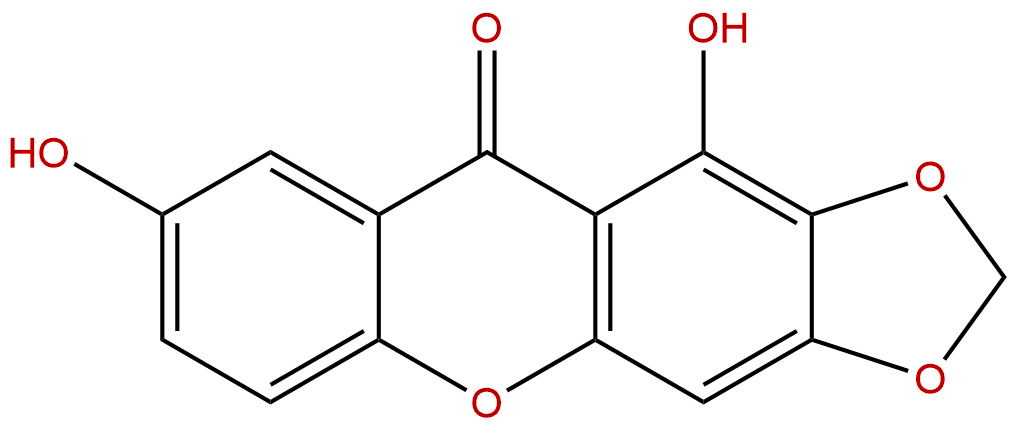


Product name: 1,7-Dihydroxy-2,3-methylenedioxyxanthone
Synonym name:
Catalogue No.: BP3010
Cas No.: 183210-63-1
Formula: C14H8O6
Mol Weight: 272.212
Botanical Source:
Physical Description:
Type of Compound:
Purity: 95%~99%
Analysis Method: HPLC-DAD or/and HPLC-ELSD
Identification Method: Mass, NMR
Packing: Brown vial or HDPE plastic bottle
The product could be supplied from milligrams to grams. Inquire for bulk scale.
We provide solution to improve the water-solubility of compounds, thereby facilitating the variety of activity tests and clinic uses.
For Reference Standard and R&D, Not for Human Use Directly.
Storage conditions:Short-term storage at 2~8℃, long-term storage at -20 ~ -80℃
89.1300
1.6840
1.5678
.0299
3.3508
12.5878
Low
88.5053
2.6087
Yes
No
No
No
Yes
Yes
1.5
Yes
Yes
Yes
No
Natural products have long been an important source of innovative drug discovery, among which mountain ketone compounds have attracted much attention due to their extensive and significant biological activities. As a member of the ketone family, 1,7-Dihydroxy-2,3-methylenedioxyxanthone (hereinafter referred to as the compound) has remarkable pharmacological properties due to its unique chemical structure, especially in the field of anti-inflammatory. Chronic inflammation is a common pathological basis for many major diseases, such as rheumatoid arthritis, neurodegenerative diseases, metabolic syndrome, and cancer. Although existing anti-inflammatory drugs (such as nonsteroidal anti-inflammatory drugs, glucocorticoids, and biologics) are widely used in clinical practice, the serious side effects caused by their long-term use (such as gastrointestinal injury, immune suppression, cardiovascular risk, etc.) have prompted the scientific community to continuously search for safer and more efficient new therapeutic agents. This compound provides an attractive lead structure for the development of novel anti-inflammatory drugs due to its multi-target and multi pathway properties. This article aims to systematically review the chemical properties, plant sources, pharmacological activities, molecular mechanisms of action, pharmacological evaluation, and clinical application prospects of this compound, in order to provide comprehensive scientific references for the in-depth research and potential drug development of this natural product.
The Chinese name of this compound is 1,7-dihydroxy-2,3-methylenedioxychalcone, and the English name is 1,7-Dihydroxy-2,3-methylenedioxyxanthone. Its CAS registration number is 183210-63-1. Its molecular formula is C ₁₄ H ₈ O ₆, and its molecular weight is 272.2120 g/mol.
From a chemical structure perspective, the compound has a basic parent nucleus of anthraquinone (oxanthrone). Shanketone is a tricyclic system composed of a benzene ring fused with a chromone ring. The structural feature of this compound lies in the specific positions of its substituents: there is a phenolic hydroxyl group (- OH) at the 1st and 7th positions of the parent nucleus, and the presence of these two hydroxyl groups is a key pharmacophore for its antioxidant and interaction with various enzymes or receptors. Of particular importance is the formation of a five membered cyclic structure between the 2nd and 3rd positions of the parent nucleus, bridged by a methylenedioxy group (- O-CH ₂ - O -). This methylenedioxy structure is common in natural products, which not only increases the rigidity of the molecule and affects its binding conformation with target proteins, but is also often associated with enhanced biological activity and improved metabolic stability.
The drug properties related parameters calculated based on its chemical structure show that its lipid water partition coefficient (LogP) is 1.6840, indicating that the compound has moderate lipophilicity, which is beneficial for its penetration of cell membranes, but has not reached the level of high lipophilicity that may cause cumulative toxicity. Its topological polar surface area (TPSA) is 89.1300 Å ², reflecting the surface area of polar atoms (mainly oxygen atoms) in the molecule. This value suggests that it has a certain membrane permeability, but its oral bioavailability may be limited. The water solubility parameter is 0.0299, indicating that the compound has low solubility in water and belongs to insoluble substances. This is a key issue that needs to be considered and addressed in the development of its formulation. Considering its moderate molecular weight, ideal LogP value, but poor water solubility, this compound meets the basic requirements of the Rule of Five and has the structural basis to become a lead compound for oral drugs.
1,7-dihydroxy-2,3-methylenedioxyshanone is mainly found in plants of the Clusiaceae family, including the Hypericum and Garcinia genera. These plants are often used in traditional medical systems to treat inflammation, infections, and wound healing. For example, extracts from certain plants of the Primula genus, such as Hypericum perforatum, have been extensively studied and contain various mountain ketone components, including this compound.
The extraction of this compound from plant materials is usually carried out using organic solvent extraction method. The common process involves crushing dried plant roots, stems, or leaves, followed by degreasing treatment with petroleum ether or n-hexane to remove non-polar impurities such as chlorophyll and wax. Subsequently, medium polarity solvents such as chloroform, ethyl acetate, or acetone are used for repeated leaching or reflux extraction, which can effectively dissolve the ketone components. After the crude extract is concentrated under reduced pressure, a paste rich in mountain ketone is obtained.
Further separation and purification rely on various chromatographic techniques. Silica gel column chromatography is commonly used for preliminary separation, using different ratios of petroleum ether ethyl acetate or chloroform methanol gradient elution. Due to the presence of phenolic hydroxyl groups in the compound, tailing may occur on the silica gel column, and sometimes a small amount of acid (such as formic acid) needs to be added to improve the separation efficiency. After obtaining the initial enriched fraction, high-performance liquid chromatography (HPLC), especially preparative HPLC, can be used to purify the final monomer compound with a reverse phase C18 column combined with methanol water or acetonitrile water system to obtain high purity. Structural identification is accomplished through modern spectroscopic techniques such as nuclear magnetic resonance (NMR, including ¹ H NMR, ¹ C NMR, 2D NMR), mass spectrometry (MS), as well as ultraviolet (UV) and infrared (IR) spectroscopy.
In recent years, in order to reduce the consumption of organic solvents and improve extraction efficiency, some green extraction techniques such as ultrasound assisted extraction, microwave-assisted extraction, and supercritical CO ₂ extraction have also been explored and applied in the extraction of mountain ketone compounds.
The core pharmacological activity of this compound is focused on its strong anti-inflammatory effect and has demonstrated other potential biological activities in related studies.
1. Anti inflammatory activity
A large number of in vitro and in vivo experiments have confirmed the excellent anti-inflammatory effect of this compound. In cell models, this compound can significantly inhibit the production of nitric oxide (NO) and prostaglandin E2 (PGE2) by macrophages (such as RAW 264.7 cells) induced by lipopolysaccharide (LPS) or other inflammatory stimuli, which are key effector molecules of inflammatory response. Its inhibitory effect is concentration dependent, and the half maximal inhibitory concentration (IC ₅₀) is usually at the micromolar level, demonstrating strong efficacy. In animal inflammation models, this compound can effectively alleviate paw swelling induced by carrageenan or Freund's complete adjuvant in rats, reduce acetic acid induced increased intra-abdominal capillary permeability in mice, and improve xylene induced ear swelling in mice when administered orally or intraperitoneally. These results indicate that the compound has good antagonistic effects on both acute and chronic inflammation.
2. Analgesic activity
Inflammation is closely related to pain. The anti-inflammatory effect of this compound naturally extends to the field of analgesia. Research has shown that it can significantly reduce pain responses in acetic acid-induced twisting experiments in mice (chemical stimulus pain model) and the second phase of formalin experiments (inflammatory pain stage). Its analgesic mechanism is not only related to anti-inflammatory effects, but may also involve direct regulation of specific ion channels on pain sensing neurons.
3. Neuroprotective potential
Given the central role of neuroinflammation in neurodegenerative diseases such as Alzheimer's disease and Parkinson's disease, the anti-inflammatory properties of this compound have attracted the interest of neuropharmacologists. Preliminary studies have shown that this compound can alleviate the overactivation of microglia induced by β - amyloid protein or LPS, inhibit their release of neurotoxic factors such as tumor necrosis factor - α (TNF - α) and interleukin-6 (IL-6), and protect neurons from inflammatory damage. This provides preliminary experimental evidence for its application in neurodegenerative diseases.
4. Other potential activities
In addition, some studies suggest that the compound may have certain antioxidant activity (scavenging free radicals) and weak antibacterial activity. But its main research value and advantages still focus on its multi-target anti-inflammatory effects.
The anti-inflammatory effect of this compound is not achieved through a single pathway, but acts on multiple key nodes in the inflammatory network, demonstrating the advantages of multi-target intervention. Its mechanism of action involves the regulation of inflammatory signaling pathways, inhibition of inflammatory mediators, and regulation of pain perception.
1. Inhibit the nuclear factor kappa B (NF - κ B) signaling pathway
NF - κ B is a core transcription factor that regulates the expression of inflammatory genes. This compound can inhibit the nuclear translocation of NF - κ B p65 subunit (RELA) induced by LPS. Its upstream action points may include inhibiting the activation of the I κ B kinase complex (IKK, especially the IKBKB subunit), thereby preventing the phosphorylation and degradation of I κ B α, causing NF - κ B to be retained in the cytoplasm and unable to initiate the transcription of inflammatory factors such as TNF - α, IL-6, and inducible nitric oxide synthase (NOS2).
2. Regulating the JAK/STAT signaling pathway
Interleukin-6 (IL-6) is an important pro-inflammatory cytokine, and its signaling is mainly conducted through the JAK/STAT pathway, especially the phosphorylation and activation of STAT3. This compound can effectively inhibit the production of IL-6 and downregulate the phosphorylation level of STAT3, thereby blocking the inflammatory amplification effect mediated by IL-6. This is of great significance for the treatment of diseases closely related to the overactivation of the IL-6/STAT3 pathway, such as rheumatoid arthritis.
3. Regulate inflammasome activity
The activation of inflammasomes such as NLRP3 leads to the activation of caspase-1 (CASP1), which in turn promotes the maturation and release of interleukin-1 β (IL-1 β) and IL-18. Research has shown that this compound can inhibit the activity of CASP1, which may interfere with the assembly and function of inflammasomes and alleviate their mediated excessive inflammatory response.
4. Inhibit inflammatory mediator synthase
This compound has an inhibitory effect on the expression or activity of cyclooxygenase-1 (PTGS1/COX-1) and inducible nitric oxide synthase (NOS2/iNOS). Inhibition of COX-1 can reduce the production of prostaglandin inflammatory mediators; Inhibiting iNOS can reduce the excessive production of NO, thereby alleviating tissue damage.
5. Adjust pain sensation ion channels
This compound may have a regulatory effect on transient receptor potential vanillic acid subtype 1 (TRPV1) and transient receptor potential anchor protein subtype 1 (TRPA1) channels. These two channels are key molecules that sense heat, chemical stimuli, and mediate inflammatory pain. By regulating the activity of these channels, the compound may directly intervene in the generation and transmission of pain signals, achieving a dual effect of anti-inflammatory and analgesic effects.
6. Inhibit key pro-inflammatory factors
This compound can significantly downregulate the expression and release of core pro-inflammatory cytokines such as TNF - α (TNF) and IL-6, directly inhibiting the inflammatory cascade reaction at the effector molecular level.
In summary, this compound forms a synergistic anti-inflammatory network by acting on multiple targets such as RELA (NF - κ B), IKBKB, STAT3, CASP1, PTGS1, NOS2, TNF, IL-6, TRPV1, and TRPA1, inhibiting inflammatory processes at multiple stages including signal transduction, transcriptional regulation, mediator synthesis, and pain perception.
Although the compound exhibits excellent pharmacological activity, its ability to develop into a drug depends on its pharmacological properties, namely "drug like" and pharmacokinetic properties.
1. Physical and chemical properties and drug like properties
As mentioned earlier, its molecular weight (272.2) and LogP (1.68) comply with the drug like rules, indicating that it has good membrane permeability potential. However, lower water solubility (0.0299) is the main physical and chemical barrier to its oral absorption. In the development of formulations, it may be necessary to use strategies such as solid dispersion, nanocrystals, cyclodextrin inclusion or salt formation to improve their solubility and bioavailability.
2. Preliminary pharmacokinetic prediction and challenges
At present, there are insufficient reports on the pharmacokinetic studies of this compound system, but preliminary analysis can be conducted based on its structure and similar compounds. The presence of multiple phenolic hydroxyl groups in its structure suggests that it may be prone to undergo phase II metabolic binding reactions (such as glucuronidation and sulfation) in vivo, leading to strong first pass effects and potentially lower oral bioavailability. Its topological polarity surface area (TPSA=89.13) and blood-brain barrier permeability are predicted to be "low", indicating that it may be difficult to freely enter the central nervous system through the blood-brain barrier. This is a challenge for treating central nervous system inflammation, but it may also reduce its potential side effects on the central nervous system. How to improve its brain targeting through structural modification or drug delivery system is a direction for future research.
3. Preliminary safety assessment
The preliminary in vitro safety screening results are relatively optimistic: its Ames test result is 1.5 (usually considered negative if the ratio is below 2), indicating that the compound did not show significant mutagenicity under the test conditions used and has a low risk of genetic toxicity. In addition, the hERG channel inhibition test result was negative, indicating that it may not have a significant risk of cardiac QT interval prolongation, which is an important cardiac safety advantage. Of course, a comprehensive safety assessment still requires systematic preclinical in vivo experiments such as acute toxicity, subchronic toxicity, and reproductive toxicity.
4. Metabolic stability
The phenolic hydroxyl and methylenedioxy groups in this compound are potential metabolic sites. Methylenedioxide may be metabolized by cytochrome P450 enzymes in certain situations, while phenolic hydroxyl groups are easily bound and metabolized. Therefore, its metabolic stability in the liver and intestines may be a key factor affecting its in vivo exposure and half-life. In the future, it may be necessary to modify the structure of such functional groups (such as making prodrugs or alkylating protection) to improve their metabolic stability.
1,7-dihydroxy-2,3-methylenedioxyshanone, as a multi-target anti-inflammatory natural lead compound, has broad clinical application prospects, but the transformation path is also full of challenges.
Potential application directions:
1. Treatment of inflammatory diseases The most direct application is the development of new drugs for the treatment of chronic inflammatory diseases, such as rheumatoid arthritis, osteoarthritis, inflammatory bowel disease (Crohn's disease, ulcerative colitis), and psoriasis. Its multi-target characteristics may be more effective in controlling complex inflammatory networks than single target drugs, and may reduce the occurrence of drug resistance.
2. Adjuvant therapy for neurodegenerative diseases Given its anti neuroinflammatory activity, this compound or its derivatives have the potential to be used as part of disease modifying therapies for Alzheimer's and Parkinson's diseases, protecting neurons by inhibiting excessive activation of microglia. Need to address the issue of blood-brain barrier permeability.
3. pain management By combining its anti-inflammatory and potential modulation of TRP channel analgesic mechanisms, novel non opioid analgesics can be developed for the treatment of inflammatory and neuropathic pain, avoiding the addictive and respiratory inhibitory risks of opioid drugs.
4. Cosmetics and functional food additives Its anti-inflammatory and antioxidant properties also make it have market potential in high-end skincare products (used to soothe sensitive skin, resist redness and swelling) or as a health food ingredient.
Challenges and future research directions:
1. Research on Structural Optimization and Structure Performance Relationship Systematically studying the effects of structural modifications (such as alkylation and esterification of hydroxyl groups, modification of parent nuclei) on activity, solubility, metabolic stability, and target selectivity, with the aim of obtaining derivatives with stronger activity and better drug properties.
2. Formulation development To address the issue of poor water solubility, advanced drug delivery systems such as nanomaterials, liposomes, microemulsions, etc. are developed to improve their oral bioavailability or achieve local targeted delivery (such as intra-articular injection therapy for arthritis).
3. Systematic pharmacokinetics and toxicology research Conduct a comprehensive preclinical ADME (absorption, distribution, metabolism, excretion) study and GLP compliant toxicological evaluation to clarify its in vivo processes, effective dose range, and safety window.
4. Deep analysis of the mechanism of action Using chemical biology methods such as probe molecules and proteomics to further accurately identify its direct target, elucidate the synergistic relationship between multiple targets, and provide a basis for structure based drug design.
5. Exploration of clinical translation After completing sufficient preclinical research, promote its entry into clinical trials to verify its safety, efficacy, and pharmacokinetic characteristics in humans.
1,7-dihydroxy-2,3-methylenedioxyketone is a natural ketone compound with distinct chemical characteristics and rich biological activity. It exhibits strong multi-target anti-inflammatory and analgesic potential by acting on multiple key targets related to inflammation and pain, such as NF - κ B, STAT3, COX-1, iNOS, TRP channels, etc. Despite facing challenges such as low water solubility and potentially rapid metabolism in drug development, it conforms to basic drug like rules and has a good preliminary safety evaluation result. With the continuous development of modern medicinal chemistry, pharmacy, and pharmacology technologies, through systematic structural optimization, formulation innovation, and in-depth mechanism research of this lead compound, it is expected to overcome existing shortcomings and develop it into a new drug for treating various inflammation related diseases. The study of this compound not only provides an excellent example for the drug development of natural products, but also deepens our understanding of the anti-inflammatory molecular network of mountain ketone compounds, which has important scientific significance and application value.
Batch can search by a CAS number,one per line
