| Catalog No | Package | Original Price | Price | Inventory | Quantity | Operating |
|---|---|---|---|---|---|---|
| BP3288-20mg | 20mg | $96.00 | Sign in |
|


Product name: O-Methylbroussochalcone B, 4'
Synonym name:
Catalogue No.: BP3288
Cas No.: 20784-60-5
Formula: C21H22O4
Mol Weight: 338.403
Botanical Source:
Physical Description: Yellow powder
Type of Compound: Chalcones
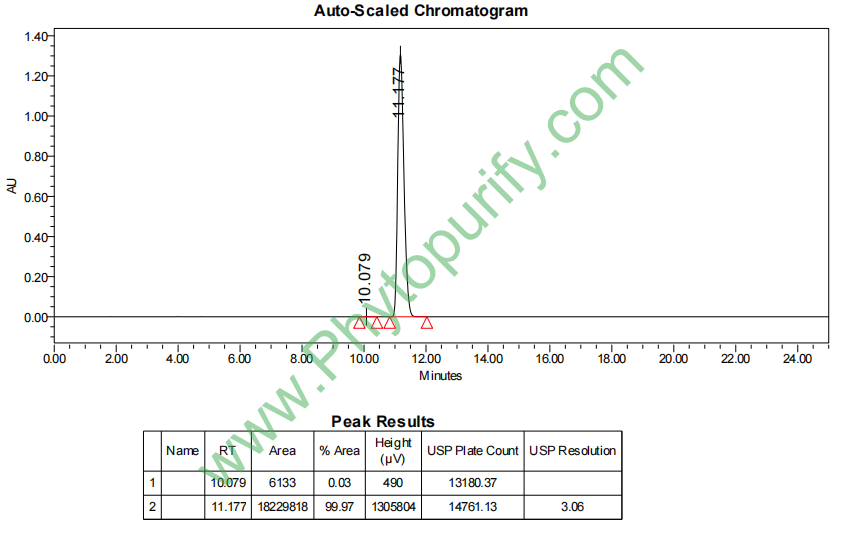
Purity: 95%~99%
Analysis Method: HPLC-DAD or/and HPLC-ELSD
Identification Method: Mass, NMR
Packing: Brown vial or HDPE plastic bottle
The product could be supplied from milligrams to grams. Inquire for bulk scale.
We provide solution to improve the water-solubility of compounds, thereby facilitating the variety of activity tests and clinic uses.
For Reference Standard and R&D, Not for Human Use Directly.
HPLC of O-Methylbroussochalcone B, 4'
Storage conditions:Short-term storage at 2~8℃, long-term storage at -20 ~ -80℃
66.7600
4.6539
4.6383
.0421
6.0373
18.3317
Low
92.2640
2.4545
Yes
No
Yes
No
Yes
No
0.0
No
Yes
Yes
Yes
Natural products have long been an important source of innovative drug discovery, and their structural diversity and wide range of biological activities provide valuable lead compounds for the treatment of various diseases. Chalcone compounds are a class of flavonoid precursors widely distributed in the plant kingdom. Their basic skeleton is 1,3-diphenylpropenone, which exhibits rich pharmacological activities due to its unique alpha, beta unsaturated ketone structure, including anti-inflammatory, antioxidant, anti-tumor, antibacterial, and neuroprotective effects. 4 '- O-Methylbrossochalcone B (OMB), CAS number 20784-60-5, is a structurally modified member of the chalcone family. As a trans chalcone, it introduces functional groups such as isoprene, hydroxyl, and methoxy at specific positions, which not only determine its physicochemical properties but also profoundly affect its biological activity. Although the research on OMB is still in a relatively early stage compared to some common chalcone derivatives, existing data suggests its potential application value in anti-inflammatory, anti-tumor, and metabolic regulation. This article aims to systematically review the chemical structure, plant origin, pharmacological activity, potential mechanism of action, pharmacological characteristics, and future development prospects of OMB, in order to provide comprehensive academic references for the in-depth research and development of this compound.
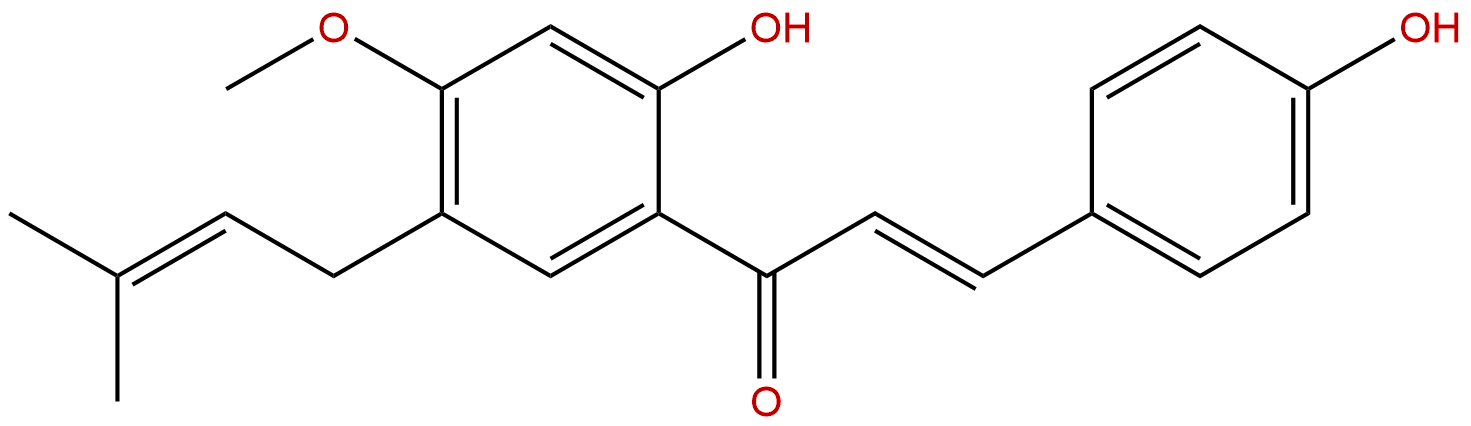
The molecular formula of 4 '- O-methylpsoralenone B is C20H22O4, with a molecular weight of 338.4030. Its chemical structure belongs to the typical trans chalcone skeleton (1,3-diphenyl-2-propen-1-one) and has the following specific substituents:
1. A-ring (left benzene ring)Replaced by a methoxy group (- OCH3) at position 4.
2. B ring (right benzene ring)Replaced by a hydroxyl group (- OH) at position 2 ', a methoxy group (- OCH3) at position 4' (which is also the origin of its name '4' - O-methyl '), and an isoprene group (- C5H9) at position 5'. The introduction of isoprene groups is a significant structural feature of this compound, which may enhance its lipid solubility and interaction ability with certain biological targets.
The α, β - unsaturated ketones (- CO-CH=CH -) in its structure are key pharmacophores that enable it to act as Michael reaction receptors, covalently or non covalently binding with biomolecules such as thiol or amino groups in proteins. This is an important molecular basis for many chalcones to exert biological activity.
According to the provided pharmacological parameters, OMB exhibits typical hydrophobic natural product characteristics:
* fat-soluble The calculated LogP value is 4.6539, indicating that the compound has high lipophilicity, which is consistent with its aromatic ring and isoprene group in the structure. High LogP values are usually beneficial for transmembrane permeability, but may also affect water solubility.
* Water solubility The predicted water solubility is 0.0421 mg/mL, belonging to the category of slightly soluble or insoluble, which poses challenges for its formulation development and may require improvement through strategies such as salt formation, inclusion complex formation, or nano formulation.
* Polar Surface Area The topological polar surface area (TPSA) is 66.76 Å ², which is relatively moderate and partially balances the impact of its high lipid solubility on membrane permeability.
* Blood-brain barrier penetrability The prediction shows that its blood-brain barrier penetration is "low", suggesting that it may not easily enter the central nervous system. This may be a favorable characteristic for the development of peripheral diseases, but it also limits its potential for use in central nervous system diseases.
* Preliminary safety Prediction shows no significant hERG potassium channel inhibitory activity (hERG inhibition: No), which reduces the potential risk of inducing QT interval prolongation in the heart. The Ames test predicted a value of 0.0, indicating that it may not have direct genetic toxicity, but these computer predictions need to be validated through experiments.
4 '- O-methylpsoralenone B is mainly isolated from Moraceae plants. The term 'psoralea' in its name suggests a possible association with the traditional Chinese medicine Psoralea corylifolia, but in reality, this compound is more commonly reported in Broussonetia plants, such as Broussonetia papyrifera. In addition, structurally similar chalcone derivatives have also been found in plants such as Morus.
The extraction and separation of OMB from plant materials typically follow the conventional process of natural product chemistry:
1. Extract Organic solvents are usually used to extract dried plant root bark, stem bark, or branches and leaves. Common solvents include methanol, ethanol, ethyl acetate, or combinations of solvents with different polarities, which use the principle of similar solubility to dissolve target compounds and a large amount of other secondary metabolites from plant tissues.
2. Rough classification The extract obtained by concentrating the extract is often preliminarily separated using liquid-liquid extraction method, such as extracting with solvents with increasing polarity such as petroleum ether, chloroform, ethyl acetate, n-butanol, etc. According to the LogP value of OMB, it may be mainly enriched in the moderately polar ethyl acetate or chloroform fractions.
3. Separation and Purification The roughly separated parts need to undergo a series of chromatographic techniques for fine separation. Silica gel column chromatography, Sephadex LH-20 gel column chromatography and high performance liquid chromatography (HPLC) are often used. Reverse phase HPLC (RP-HPLC) is a crucial step in obtaining high-purity OMB monomers due to its high resolution. During the separation process, thin layer chromatography (TLC) or HPLC is used for monitoring, and mass spectrometry (MS) and nuclear magnetic resonance (NMR, especially 1H-NMR and 13C-NMR) are combined for structural identification and purity confirmation.
Modern technologies such as high-speed countercurrent chromatography (HSCCC) can also be used for efficient preparation and separation of such compounds. Due to the usually low content of OMB in plants, the extraction and separation process needs to be optimized to obtain sufficient amounts for biological activity research.
Although there is limited specialized research literature on OMB, based on its chalcone core structure and reported analog activity, combined with preliminary studies, it can be inferred that it has potential activity in multiple pharmacological fields.
anti-inflammatory activity Chalcone compounds are recognized as anti-inflammatory agents. The phenolic hydroxyl groups and α, β - unsaturated ketones in the OMB structure are key to its anti-inflammatory effects. Research has shown that chalcone with a similar structure can significantly inhibit the excessive production of nitric oxide (NO) and prostaglandin E2 (PGE2) in macrophages (such as RAW 264.7) induced by lipopolysaccharide (LPS), by suppressing the expression of inducible nitric oxide synthase (iNOS) and cyclooxygenase-2 (COX-2). OMB may inhibit the activation of inflammatory signaling pathways such as nuclear factor kappa B (NF - κ B) and mitogen activated protein kinases (MAPKs) through similar pathways, thereby downregulating the expression of various pro-inflammatory cytokines (such as TNF - α, IL-1 β, IL-6).
Antitumor activity The α, β - unsaturated ketone structure allows chalcone to act as a Michael reaction receptor, interfering with various processes within cancer cells. OMB may exert anti proliferative effects through the following mechanisms:
antioxidant activity The 2 '- hydroxyl group on the OMB B ring is a potent hydrogen donor that can effectively scavenge free radicals such as DPPH and ABTS, and may activate intracellular antioxidant defense systems, such as the nuclear factor E2 related factor 2 (Nrf2) pathway, upregulate the expression of antioxidant enzymes such as heme oxygenase-1 (HO-1), and protect cells from oxidative stress damage.
Antibacterial and antimicrobial activity Partial chalcones have inhibitory effects on Gram positive bacteria, Gram negative bacteria, and even fungi. The structure of OMB may endow it with the ability to disrupt microbial cell membranes or inhibit key enzyme activities, but its specific antibacterial spectrum and mechanism remain to be studied.
Other potential activities: Based on the extensive activities of chalcones, OMB may also have research value in neuroprotection (against oxidative stress and neuroinflammation), anti diabetes (to improve insulin resistance), and bone health (which may affect osteoclast differentiation).
The exact molecular target of OMB has not been fully elucidated, but based on the commonality of chalcone compounds, its mechanism of action may involve multi-target interactions:
Inhibition of transcription factor NF - κ B NF - κ B is a core transcription factor in inflammation and tumorigenesis. OMB may inhibit the activity of I κ B kinase (IKK), prevent the phosphorylation and degradation of I κ B, and thus block NF - κ B in the cytoplasm, preventing it from entering the nucleus to initiate the transcription of pro-inflammatory and pro survival genes.
MAPK signaling pathway regulation OMB may regulate the phosphorylation levels of MAPKs such as p38, JNK, and ERK, which are involved in the regulation of cellular stress, inflammatory response, proliferation, and apoptosis.
Nrf2/ARE pathway activation As an electrophilic molecule, OMB may modify cysteine residues on Keap1 protein, causing Nrf2 to dissociate and translocate to the nucleus, binding to antioxidant response elements (ARE) to drive the expression of a series of phase II detoxifying enzymes and antioxidant proteins, which is the core mechanism of its antioxidant and cell protective effects.
Cell cycle and apoptosis related proteins OMB may upregulate pro apoptotic proteins (such as Bax, Bak), downregulate anti apoptotic proteins (such as Bcl-2, Bcl xL), and activate caspase-3, -8, -9. Meanwhile, it may affect the expression of cell cycle proteins (such as cyclin B1, CDK1) and cyclin dependent kinase inhibitors (such as p21).
Direct inhibition of enzymes Its α, β - unsaturated ketone structure may enable it to covalently or non covalently inhibit the activity of COX-2, iNOS, MMPs, and certain metabolism related enzymes (such as α - glucosidase).
Epigenetic targets Studies have shown that certain chalcones can regulate the activity of histone deacetylase (HDAC) or DNA methyltransferase (DNMT), and it is worth exploring whether OMB has such effects.
The introduction of isoprene groups may enhance the binding ability of OMB to certain hydrophobic protein pockets, potentially giving it unique selectivity towards specific targets such as certain kinases or G protein coupled receptors, which requires further molecular docking and target fishing studies (such as chemical proteomics) to reveal.
Preliminary evaluation of the pharmacological properties of OMB based on computational predictions and known characteristics of chalcone compounds:
At present, there is still a gap in the in vivo pharmacokinetic studies of the OMB system, such as blood concentration time curves, absolute bioavailability, tissue distribution, etc. in rats or mice. This is a key data gap that must be filled before it can move towards development.
The clinical application prospects of 4 '- O-methylpsoralenone B, as a structurally unique natural chalcone derivative, depend on the results of future in-depth research. Potential development directions include:
However, its development also faces challenges: 1) limited natural sources, requiring the development of chemical synthesis or biosynthetic methods to achieve large-scale supply; 2) The research on pharmacological effects and molecular mechanisms is still shallow and requires extensive cell and animal experiments for verification; 3) Complete preclinical pharmacokinetic and toxicological data are missing; 4) How to balance its multi-target characteristics (which may bring side effects) and selectivity is the key to drug design.
4 '- O-methylpsoralenone B is a unique member of the chalcone family with isoprene modification. Its chemical structure lays the foundation for its potential pharmacological activities in anti-inflammatory, antioxidant, anti-tumor, and other aspects. Although current research is still in its early stages, its demonstrated potential for biological activity is of great concern. The journey from natural products to candidate drugs is a long and rigorous one. Future research should focus on: thoroughly elucidating its exact pharmacological effects and molecular mechanisms of action in different disease models; Complete preclinical pharmacokinetic and safety evaluation of the system; Optimize its structure through rational medicinal chemical methods to overcome its physical and chemical properties defects and improve its therapeutic index. With the gradual deepening of these studies, OMB is expected to become a valuable lead compound, providing new ideas and candidate molecules for the development of novel drugs for the treatment of inflammation, tumors, and related metabolic diseases.
