


Product Name: Bavachinin
Synonym name: Bavachinin A; 7-O-Methylbavachin; 4′-Hydroxy-7-methoxy-6-prenylflavanone
Catalogue No.: BP0240
Cas No.: 19879-30-2
Formula: C21H22O4
Mol Weight: 338.403
Botanical Source: Psoralea corylifolia
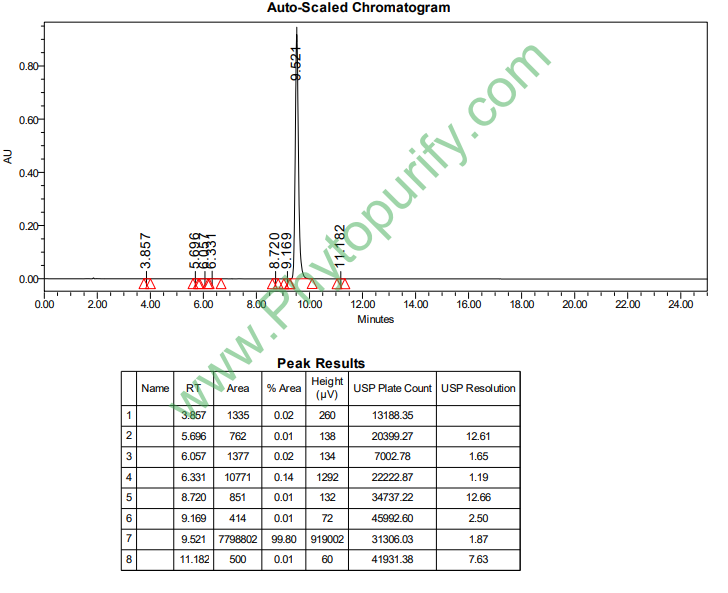
Purity: 95%~99%
Analysis Method: HPLC-DAD or/and HPLC-ELSD
Identification Method: Mass, NMR
Packing: Brown vial or HDPE plastic bottle
Can be supplied from milligrams to grams.
For Reference Standard and R&D, Not for Human Use Directly.
Inquire for bulk scale.
Description:
Bavachinin is a novel natural pan-PPAR agonist , it shows stronger activities with PPAR-γ than with PPAR-α and PPAR-β/δ (EC50 = 0.74 μmol/l, 4.00 μmol/l and 8.07 μmol/l in 293T cells, respectively). Bavachinin possesses anti-asthma, anti-angiogenic , anti-inflammatory, antipyretic and analgesic properties, it also exhibits glucose-lowering properties without inducing weight gain and hepatotoxicity.
References:
Indian J. Exp. Biol., 1978, 16(11):1216-7.
Antiinflamatory, antipyretic & analgesic properties of bavachinin-a flavanone isolated from seeds of Psoralea corylifolia Linn. (Babchi).
Antiinflamatory, antipyretic & analgesic properties of Bavachinin-a flavanone isolated from seeds of Psoralea corylifolia Linn. (Babchi).
Eur J Pharmacol. 2012 Sep 15;691(1-3):28-37.
Anti-angiogenic and anti-tumor activity of Bavachinin by targeting hypoxia-inducible factor-1α.
Hypoxia-inducible factor-1 (HIF-1) consists of two subunits, the HIF-1β, which is constitutively expressed, and HIF-1α, which is oxygen-responsive. HIF-1α is over-expressed in response to hypoxia, increasing transcriptional activity linked to tumor progression, angiogenesis, metastasis, and invasion. This study aimed to demonstrate that the natural compound, Bavachinin, has potent anti-angiogenic activity in vitro and in vivo.
METHODS AND RESULTS:
Bavachinin inhibited increases in HIF-1α activity in human KB carcinoma (HeLa cell derivative) and human HOS osteosarcoma cells under hypoxia in a concentration-dependent manner, probably by enhancing the interaction between von Hippel-Lindau (VHL) and HIF-1α. Furthermore, Bavachinin decreased transcription of genes associated with angiogenesis and energy metabolism that are regulated by HIF-1, such as vascular endothelial growth factors (VEGF), Glut 1 and Hexokinase 2. Bavachinin also inhibited tube formation in human umbilical vein endothelial cells (HUVECs) as well as in vitro migration of KB cells. In vivo studies showed that injecting Bavachinin thrice weekly for four weeks significantly reduced tumor volume and CD31 expression in nude mice with KB xenografts.
CONCLUSIONS:
These data indicate that Bavachinin could be used as a therapeutic agent for inhibiting tumor angiogenesis.
HPLC of Bavachinin
Storage conditions:Short-term storage at 2~8℃, long-term storage at -20 ~ -80℃
Bavachinin, a natural flavonoid compound derived from the traditional Chinese medicine Psoralea corylifolia L., has attracted widespread attention in recent years due to its multi-target and multifunctional pharmacological activities. As an agonist of the peroxisome proliferator activated receptor (PPAR) family, fructooligoflavanone methyl ether exhibits unique advantages in regulating metabolism, inflammation, and tumor microenvironment. In addition, its inhibitory effect on hypoxia inducible factor-1 alpha (HIF-1 alpha) endows it with anti-tumor potential, especially in non-small cell lung cancer (NSCLC) where its application value is increasingly prominent. This article aims to systematically review the chemical structure, sources, pharmacological activities, mechanisms of action, pharmacological properties, and clinical application prospects of dihydroflavonol methyl ether from Fructus Psorale, providing theoretical basis and scientific guidance for its subsequent research and development.
The molecular formula of Fructus Psorale Dihydroflavone Methyl Ether is C21H20O5, with a molecular weight of 340.40 and a CAS number of 19879-30-2. Its structure belongs to the class of dihydroflavones, with a core skeleton of a flavonoid ring system containing methoxy substituents, exhibiting high hydrophobicity (LogP of approximately 4.15), which is beneficial for its cell membrane permeability. Its topological polar surface area (TPSA) is 55.12 Å ² and the number of hydrogen bond acceptors is 4, indicating that it has certain polarity and hydrophilicity in intermolecular interactions, which is conducive to binding with protein targets. Psoralea flavanone methyl ether has good oral biological activity and high blood-brain barrier permeability, suggesting its potential role in central nervous system diseases. The physical and chemical properties show that it has no significant hepatotoxicity, cardiotoxicity, or hERG channel inhibition. The Ames mutagenicity test is negative, indicating high safety.
Dihydroflavonol methyl ether from Psoralea corylifolia L. mainly exists in the seeds and rhizomes of Psoralea corylifolia L. Psoralea, as a traditional Chinese medicinal herb, has always been used to treat osteoporosis, skin diseases, and sexual dysfunction. The extraction of dihydroflavones methyl ether from Fructus Psorale is often carried out by organic solvent extraction, with commonly used solvents including ethanol, methanol, and ethyl acetate. The general steps are as follows: first, the dried seeds of Fructus Psorale are crushed, and then refluxed with 70% ethanol for extraction. The extract is concentrated and separated by silica gel column chromatography, and purified and quantified by high-performance liquid chromatography (HPLC). In recent years, ultrasound assisted extraction and supercritical CO2 extraction techniques have also been applied to improve extraction efficiency and purity. During the extraction process, attention should be paid to temperature and pH control to prevent the degradation of flavonoids.
As an agonist of the PPAR family, fructooligoflavanone methyl ether exhibits varying degrees of activation on PPAR - α, PPAR - β/δ, and PPAR - γ, with IC50 values of 21.043 μ M, 12.819 μ M, and 0.622 μ M, respectively, indicating its strongest affinity for PPAR - γ. PPARs are members of the nuclear receptor superfamily, involved in regulating lipid metabolism, glucose metabolism, inflammatory response, and cell proliferation. Psoralea dihydroflavone methyl ether can regulate adipocyte differentiation and inhibit the expression of inflammatory factors by activating PPAR - γ, which has potential anti diabetes, anti-inflammatory and anti atherosclerosis effects.
Psoralea flavanone methyl ether exhibits significant anti-tumor activity by targeting PPAR - γ and RRAR - γ (Retinoic acid receptor related orphan receptor gamma). It has the effect of inhibiting proliferation and inducing apoptosis in non-small cell lung cancer cells. Psoralea flavanone methyl ether can also inhibit the expression of HIF-1 α, block the adaptation mechanism of tumor cells in hypoxic environments, inhibit tumor angiogenesis, and weaken the growth and metastasis ability of tumors. In addition, its anti-inflammatory and anti angiogenic activities further enhance its anti-tumor potential.
Psoralea flavanone methyl ether can inhibit the release of various inflammatory mediators, such as tumor necrosis factor - α (TNF - α), interleukin-6 (IL-6), etc., and alleviate inflammatory reactions. It downregulates the nuclear factor kappa B (NF - κ B) signaling pathway through PPAR - γ activation, blocking the inflammatory cascade. In addition, fructooligoflavanone methyl ether inhibits the proliferation and migration of vascular endothelial cells, reduces the expression of vascular endothelial growth factor (VEGF), exerts anti angiogenic effects, and helps to suppress tumor and inflammation related neovascularization.
Psoralea flavanone methyl ether has potential regulatory effects on benign prostatic hyperplasia (BPH) related targets such as monoamine oxidase A (MAOA), estrogen receptor beta (ESR2), DNA repair enzyme APEX1, ATP binding cassette transporter G2 (ABCG2), lipoxygenase 5 (ALOX5), transient receptor potential vanillic acid receptor 1 (TRPV1), topoisomerase II alpha (TOP2A), estrogen receptor alpha (ESR1), monoamine oxidase B (MAOB), and androgen receptor (AR), suggesting that it may synergistically regulate the proliferation and inflammatory status of prostate tissue through multiple targets and has the potential to be developed as a therapeutic drug for BPH.
The pharmacological effects of Fructus Psorale Dihydroflavone Methyl Ether mainly depend on its excitatory effect on the nuclear receptor PPAR family. The activation of PPAR - γ not only regulates lipid and glucose metabolism, but also inhibits tumor cell proliferation and promotes apoptosis by suppressing the expression of inflammatory factors and cell cycle proteins. Its activation of PPAR - α and PPAR - β/δ is involved in fatty acid oxidation and energy metabolism regulation. Psoralea flavanone methyl ether inhibits the expression of HIF-1 α, blocks the adaptation of tumor cells to hypoxic environments, reduces the secretion of angiogenic factors, and inhibits tumor angiogenesis. Its regulation of RRAR - γ further affects cell differentiation and immune response, enhancing anti-tumor efficacy.
In benign prostatic hyperplasia, psoralen dihydroflavonol methyl ether affects the proliferation and apoptosis of prostate cells by regulating the androgen receptor (AR) and estrogen receptor (ERs) signaling pathways. Its regulation of MAOA and MAOB may affect neurotransmitter metabolism and regulate prostate nerve function. In addition, the regulation of ALOX5 and TRPV1 helps alleviate local inflammation and pain responses.
The molecular weight of dihydroflavonol methyl ether in Fructus Psorale is moderate (340.4 Da), with a LogP value of 4.15, indicating its good lipid solubility and facilitating cell membrane penetration. The TPSA is 55.12 Å ², and low polarity facilitates oral absorption and blood-brain barrier permeability. Its hydrogen bond receptor number is 4, which conforms to Lipinski's rule and indicates good drug compatibility. The in vitro and in vivo safety evaluations showed that Fructus Psorale Dihydroflavone Methyl Ether had no significant hepatotoxicity, cardiotoxicity, or hERG channel inhibition, and the Ames test was negative, indicating high safety.
Pharmacokinetic studies have shown that dihydroflavonol methyl ether from Fructus Psorale has good oral bioavailability, moderate plasma protein binding rate, and a half-life suitable for clinical administration. Its high blood-brain barrier permeability suggests that it can be used for the treatment of central nervous system related diseases. The metabolic pathway mainly involves oxidation and methylation metabolism through the liver cytochrome P450 enzyme system, and the safety of metabolites is good.
As a multi-target and multifunctional natural product, fructooligoflavanone methyl ether has broad clinical application potential. It shows good therapeutic prospects in metabolic diseases (such as diabetes, lipid metabolism disorder), tumors (especially non-small cell lung cancer) and benign prostatic hyperplasia. Future research should focus on:
In addition, the potential of dihydroflavonol methyl ether in central nervous system diseases such as neurodegenerative diseases is also worth further exploration. Based on its good blood-brain barrier penetration and anti-inflammatory properties, it is expected to become a novel neuroprotective agent.
As a natural flavonoid compound with multiple pharmacological activities, fructooligoflavanone methyl ether exhibits significant anti-inflammatory, anti-tumor, and metabolic regulatory functions due to its stimulating effect on the PPAR family and inhibition of HIF-1 α. Its good pharmaceutical properties and safety have laid a solid foundation for its development as a new type of therapeutic drug. In the future, through systematic mechanism research and clinical translation, it will further promote the application of dihydroflavonol methyl ether in the treatment of various diseases, promote the innovative development of natural product drugs, and benefit the vast number of patients.
