


Synonym name: Corylifolin
Catalogue No.: BP0239
Cas No.: 19879-32-4
Formula: C20H20O4
Mol Weight: 324.376
Botanical Source:
Purity: 95%~99%
Analysis Method: HPLC-DAD or/and HPLC-ELSD
Identification Method: Mass, NMR
Packing: Brown vial or HDPE plastic bottle
Can be supplied from milligrams to grams.
For Reference Standard and R&D, Not for Human Use Directly.
Inquire for bulk scale.
Description:
Bavachin is a phytoestrogen that activates the estrogen receptors ERα and ERβ with EC50s of 320 and 680 nM, respectively. It is a cholesterol acyltransferase inhibitor, may have therapeutic potential for type 2 diabetes by activating insulin signaling pathways. Bavachin can stimulate the genetic expression of VEGF in PB,and directly help the fracture healing, and potentially protect cartilage from inflammation-mediated damage in joints of osteoarthritis patients through decreasing IL-1β-induced activation of IKK-IκBα-NF-κB signaling pathway. Bavachin has suppressive effects against pigmentation by melanin in the skin.
References:
Int J Mol Sci. 2016 Apr 8;17(4):527.
Bavachin from Psoralea corylifolia Improves Insulin-Dependent Glucose Uptake through Insulin Signaling and AMPK Activation in 3T3-L1 Adipocytes.
The fruit of Psoralea corylifolia L. (Fabaceae) (PC), known as "Bo-Gol-Zhee" in Korea has been used as traditional medicine. Ethanol and aqueous extracts of PC have an anti-hyperglycemic effect by increasing plasma insulin levels and decreasing blood glucose and total plasma cholesterol levels in type 2 diabetic rats.
METHODS AND RESULTS:
In this study, we purified six compounds from PC and investigated their anti-diabetic effect. Among the purified compounds, Bavachin most potently accumulated lipids during adipocyte differentiation. Intracellular lipid accumulation was measured by Oil Red-O (ORO) cell staining to investigate the effect of compounds on adipogenesis. Consistently, Bavachin activated gene expression of adipogenic transcriptional factors, proliferator-activated receptorγ (PPARγ) and CCAAT/enhancer binding protein-α (C/EBPα). Bavachin also increased adiponectin expression and secretion in adipocytes. Moreover, Bavachin increased insulin-induced glucose uptake by differentiated adipocytes and myoblasts. In differentiated adipocytes, we found that Bavachin enhanced glucose uptake via glucose transporter 4 (GLUT4) translocation by activating the Akt and 5'AMP-activated protein kinase (AMPK) pathway in the presence or absence of insulin.
CONCLUSIONS:
These results suggest that Bavachin from Psoralea corylifolia might have therapeutic potential for type 2 diabetes by activating insulin signaling pathways.
Journal of Emergency in Traditional Chinese Medicine, 2014, 23(9):1585-8.
Effect of Brain Injury and Bavachin on 5-HT and VEGF of Rats with Tibial Fracture.
To observe the influence of brain injury and Bavachin on 5-HT and VEGF during the healing of rats′ tibial fracture.
METHODS AND RESULTS:
42 healthy male SD rats were selected and randomly divided into 7groups.For normal control group,blood was drawn on the third day.For the other groups,blood was drawn on postoperative day 3,7,14,21,28,and 35.And then centrifuged supernatant was acquired to determine the amount of VEGF and 5-HT by ELISA.(1) 5-TH:The concentration in the brain injury group and facture +brain injury group peaked in the first week,before it gradually declined in the following week.It reached a plateau 3 weeks later.Comparisons between the three fracture + Bavachin groups(all three doses) and the fracture group in one and two weeks have shown no significance(P 0.05).(2)VEGF:The concentrations in all treatment groups were higher than those in the control group.The concentration in fracture + brain injury group was higher than that in fracture group or brain injury group.After a week,the concentration of VEGF was in direct proportion to those of the Bavachin in the 3 facture + Bavachin groups.5 weeks later,they headed to similar concentration.
CONCLUSIONS:
The brain injury can induce increased VEGF content in peripheral blood to promote fracture healing.Bavachin in the blood can stimulate the genetic expression of VEGF in PB,and directly help the fracture healing.Also,the high does and the middle dose have better healing efficacy.At the beginning of brain injury,5-HT increases and is released into the cerebrum capillaries,accelerating the healing of fracture.However later 5-HT goes through the blood cerebrospinal fluid barrier and its concentration in the nervous centralis declines,resulting in the slowdown of fracture healing.Bavachin has no significant influence on the 5-HT concentration during the fracture healing.
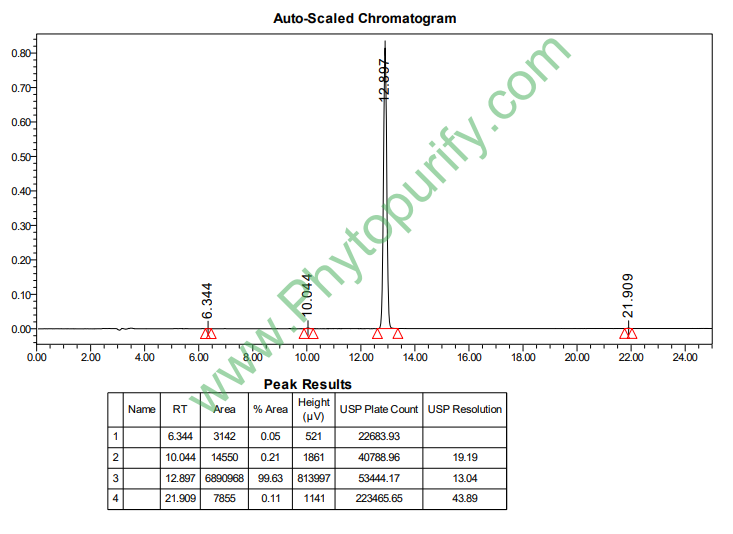
HPLC of Bavachin
Storage conditions:Short-term storage at 2~8℃, long-term storage at -20 ~ -80℃
Bavachin (CAS number: 19879-32-4) is a flavonoid natural product isolated from the seeds of traditional Chinese medicine Psoralea corylifolia. As a plant estrogen, psoralen A can activate estrogen receptors ER α and ER β, exhibiting strong estrogen like activity. In recent years, with the in-depth study of the pharmacological effects of natural products, psoralen A has gradually become an important research object in the field of adenoma and related disease prevention and treatment due to its multi-target regulatory ability and good safety. This article aims to systematically review the chemical structure and physicochemical properties, plant sources and extraction methods, pharmacological activity and mechanism of action, pharmacological evaluation and pharmacokinetic characteristics of psoralen A, as well as its clinical application prospects and development trends, providing theoretical basis and reference for subsequent research and clinical translation.
Psoralen A is a flavonoid compound with a molecular formula of C20H20O5 and a molecular weight of 324.37. Its structural characteristics include a typical flavonoid skeleton containing multiple hydroxyl and methoxy substituents, endowing it with strong biological activity. The LogP value of psoralen A is 3.66, indicating that it has moderate lipid solubility, which is beneficial for cell membrane penetration and in vivo distribution. The polarization surface area (TPSA) is 66.76 Å ² and the number of hydrogen bond acceptors is 4, which support its good bioavailability and pharmacokinetic performance.
Structurally, the flavonoid core structure of psoralen A enables it to form stable binding with the ligand binding domain of estrogen receptors, activating receptor function. Its molecular weight is moderate and there are no obvious structural toxic groups, which meets the ideal characteristics of most oral small molecule drugs. In addition, psoralen A has a high blood-brain barrier permeability, indicating its potential application value in central nervous system related diseases.
Psoralea corylifolia is mainly derived from the seeds of Psoralea corylifolia, a leguminous plant. Psoralea corylifolia is a commonly used traditional Chinese medicine herb for tonifying the kidneys, strengthening yang, promoting blood circulation, and removing blood stasis. Psoralea seeds contain various active ingredients, including flavonoids, glycosides, volatile oils, and coumarin compounds. Psoralen A, as an important flavonoid component, has high content and biological activity.
The common methods for extracting psoralen A include organic solvent extraction, ultrasound assisted extraction, and high-performance liquid chromatography (HPLC) purification. Generally, ethanol or methanol is used as the extraction solvent, and ultrasonic assisted extraction efficiency is improved. The extraction solution undergoes concentration, separation, and silica gel column chromatography, and is finally purified by HPLC to obtain high-purity psoralen. In recent years, green extraction techniques such as supercritical CO ₂ extraction and microwave-assisted extraction have also been used for the extraction of psoralen, significantly improving extraction efficiency and environmental friendliness.
The pharmacological activity research of psoralen A covers multiple aspects such as anti-tumor, anti-inflammatory, antioxidant, bone metabolism regulation, and endocrine regulation. As a plant estrogen, psoralen A can activate estrogen receptors ER α and ER β, with EC50 values of 320 nM and 680 nM, respectively, indicating its high affinity and activation ability for both receptors.
Psoralen A has shown inhibitory effects on tumor cell proliferation and induction of cell apoptosis in various tumor models. Especially in adenomas and related lesions, psoralen inhibits tumor growth and metastasis by regulating multiple signaling pathways. Research has shown that psoralen A can downregulate the activity of the STAT3 signaling pathway, inhibit the proliferation and invasion ability of tumor cells. In addition, its regulation of targets related to cell proliferation and DNA repair, such as APP and APEX1, further enhances its anti-tumor effect.
Psoralen A can significantly inhibit the production of inflammatory mediators and alleviate inflammatory reactions. It reduces the generation of inflammation related lipid mediators by regulating the expression of lipoxygenases such as ALOX15 and ALOX5. At the same time, psoralen activates the NFE2L2 (Nrf2) signaling pathway, enhances cellular antioxidant defense capabilities, and reduces tissue damage caused by oxidative stress.
As the main active ingredient of Fructus Psorale, Psoralen A plays an important role in regulating bone metabolism. It activates estrogen receptors, promotes bone formation, inhibits bone resorption, and has potential anti osteoporosis effects. In addition, the regulation of SIRT1 by psoralen A can help improve the function of bone cells and delay bone degeneration.
Psoralen A, as a plant estrogen, can simulate the biological effects of endogenous estrogen, regulate hormone levels and receptor activity. Its impact on nuclear receptors such as NR1H4 (FXR) suggests its potential role in lipid metabolism and energy balance.
The pharmacological effects of psoralen A involve multiple molecular targets and signaling pathways, reflecting its multi-target and multi pathway regulatory characteristics.
Psoralen A activates receptor-mediated gene transcription by binding to ER α and ER β, regulating cell proliferation, differentiation, and metabolism. Its ability to activate two receptors is different, which may lead to selective regulatory effects in different tissues and cell types.
STAT3, as a key transcription factor in various tumor and inflammation related signaling pathways, exerts anti-tumor and anti-inflammatory effects by inhibiting the phosphorylation and nuclear translocation of STAT3, blocking the expression of downstream pro proliferative and anti apoptotic genes.
APP plays multiple roles in cell proliferation and apoptosis, and the regulation of APP by psoralen may affect cell fate determination, especially in the formation and progression of adenomas, which is of great significance.
Psoralen A regulates the activity of ALOX15 and ALOX5, affects the synthesis of lipid mediators, regulates inflammatory responses, and cell signaling.
Psoralen activates the Nrf2 signaling pathway, promotes the expression of antioxidant enzymes, enhances cell resistance to oxidative stress, and protects tissues from oxidative damage.
As a key enzyme regulating cellular metabolism and lifespan, activation of SIRT1 helps improve cellular function and delay the aging process. Psoralen A positively regulates SIRT1 and may be involved in its bone metabolism and anti-inflammatory effects.
Psoralen A is also involved in regulating NR1H4 (FXR), affecting bile acid metabolism and energy homeostasis; The role of TYR (tyrosinase) suggests its potential applications in pigment metabolism and related diseases.
The pharmacological evaluation of psoralen A shows that it has good potential for drug development. Its molecular weight is 324.37, which meets the drug affinity criteria of Lipinski rule. The LogP is 3.66, indicating that it has moderate lipid solubility, which is conducive to cell membrane penetration and in vivo distribution. The TPSA is 66.76 and the number of hydrogen bond receptors is 4, both of which support its good oral absorption.
In terms of toxicological evaluation, psoralen A did not show hepatotoxicity, cardiotoxicity, or hERG channel inhibition. The Ames test result was negative, indicating a low risk of genotoxicity and high safety. In addition, its high blood-brain barrier permeability suggests that it can be used for the treatment of central nervous system related diseases.
Pharmacokinetic studies are still in the preliminary stage, and the metabolic pathways in vivo mainly involve the liver enzyme system, with metabolites yet to be further identified. The key parameters such as bioavailability, half-life, and clearance rate of psoralen A need to be clarified through systematic in vitro and in vivo studies, providing a basis for the development of clinical medication plans.
Psoralen A, as a natural flavonoid compound with multiple biological activities, has shown broad application prospects in the prevention and treatment of adenomas and related diseases. By activating estrogen receptors and regulating multiple signaling pathways, it can effectively inhibit tumor cell proliferation, alleviate inflammatory reactions, improve bone metabolism abnormalities, and has potential advantages in multi-target therapy.
In the future, psoralen A can be developed as a candidate drug for adjuvant therapy of breast adenomas, prostate adenomas, and other hormone related diseases. Meanwhile, its anti-inflammatory and antioxidant properties provide new ideas for the treatment of chronic inflammatory and degenerative diseases. Combining modern pharmaceutical formulation technologies, such as nanocarriers and targeted delivery systems, is expected to enhance its bioavailability and targeting, and improve therapeutic efficacy.
In addition, the potential of psoralen A in central nervous system diseases is also worth paying attention to, especially its good blood-brain barrier permeability, which provides the possibility for drug development in neurodegenerative diseases. In the future, it is necessary to strengthen its pharmacokinetics, toxicology, and preclinical evaluation to promote its clinical translation.
Psoralen A, as a natural flavonoid compound derived from Psoralea, exhibits significant pharmacological activity and good safety in the prevention and treatment of adenomas and related diseases due to its unique chemical structure and multi-target regulatory ability. It activates estrogen receptors and regulates key molecular targets such as STAT3, Nrf2, SIRT1, providing a new molecular basis for the treatment of various diseases. The evaluation of drug properties shows that psoralen A has good potential for drug development. In the future, through in-depth pharmacokinetic and clinical research, it is expected to achieve its clinical application in multiple fields. In summary, psoralen A is a natural product drug candidate molecule with broad application prospects and deserves further systematic research and development.
