


Synonym name:
Catalogue No.: BP0107
Cas No.: 7437-55-0
Formula: C21H22O4
Mol Weight: 338.403
Botanical Source:
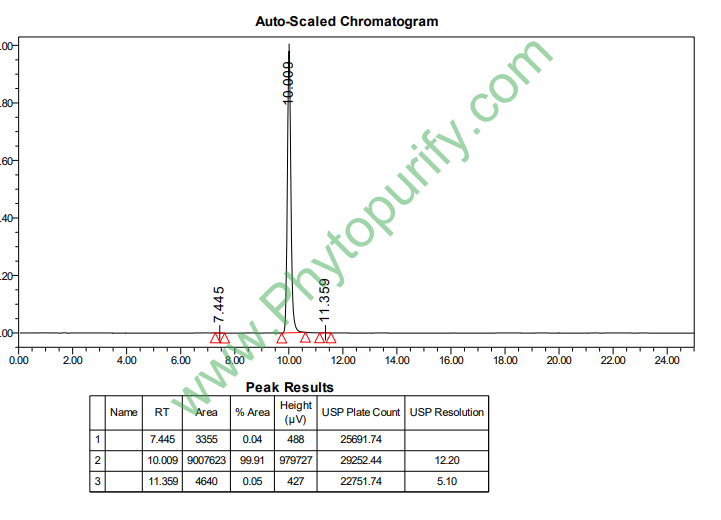
Purity: 95%~99%
Analysis Method: HPLC-DAD or/and HPLC-ELSD
Identification Method: Mass, NMR
Packing: Brown vial or HDPE plastic bottle
Can be supplied from milligrams to grams.
For Reference Standard and R&D, Not for Human Use Directly.
Inquire for bulk scale.
HPLC of 8-Geranopsoralen
Storage conditions:Short-term storage at 2~8℃, long-term storage at -20 ~ -80℃
55.7600
4.1500
3.8000
Low
Unknown
Unknown
No
Unknown
Yes
Unknown
8-Geranopsoralen (CAS number: 7437-55-0) is a natural terpenoid lactone compound that has received widespread attention in the field of pharmacology in recent years due to its diverse biological activities. As one of the derivatives of Psoralen, 8-vanilloxypsoralen has a unique terpenoid lactone skeleton in its structure, which endows it with potential pharmacological activity and good pharmacokinetic properties. Heart failure, as a highly prevalent cardiovascular disease worldwide, poses a serious threat to human health and urgently requires the development of new treatment methods. Previous studies have shown that 8-coumarin has the potential to become a new drug for the treatment of heart failure by regulating various key molecular targets and exhibiting a regulatory effect on the pathological processes related to heart failure. This article provides a systematic review of the chemical structure and physicochemical properties, plant sources and extraction methods, pharmacological activity, mechanism of action, evaluation of drug properties, and clinical application prospects of 8-coumarin. The aim is to provide a theoretical basis and reference for its subsequent research and development.
8-Xiangyecao oxypsoralen belongs to the terpenoid lactone class, with a molecular formula of C20H20O5 and a molecular weight of 340.39. Its chemical structure contains a typical core structure of psoralen, and introduces a coumarin oxygen group at position 8, forming a unique terpenoid lactone ring system. This structure endows it with high lipid solubility, with a LogP value of 4.15, indicating its good cell membrane penetration ability. The molecular surface area (TPSA) is 55.76 Å ² and the number of hydrogen bond acceptors is 4, indicating that it has certain polarity and hydrophilicity in intermolecular interactions, which is conducive to binding with biomolecules.
In terms of physicochemical properties, 8-coumarin oxypsoralen has a low blood-brain barrier permeability, which may reduce its potential side effects on the central nervous system. Hepatotoxicity is not yet clear, while cardiac toxicity and hERG channel inhibition are both negative, indicating that it has certain advantages in terms of cardiac safety. The data of Ames mutagenicity test is still lacking, and further evaluation of its genetic toxicity risk is needed.
8-Xiangyecao oxypsoralen is mainly found in several traditional medicinal plants, especially in Psoralea and its related species. Its natural sources include aromatic plants such as Geranium spp., which are synthesized through terpenoid metabolic pathways within the plant body. Traditional Chinese medicinal materials contain abundant compounds of psoralen, which provide a natural resource basis for their extraction.
The extraction method mainly adopts solvent extraction combined with chromatographic separation technology. Common solvents include organic solvents such as ethanol, methanol, and ethyl acetate, which are utilized for efficient extraction of terpenoid lactones due to their good solubility. After rotary evaporation and concentration, the extraction solution was purified using separation and purification techniques such as silica gel column chromatography and reverse phase high performance liquid chromatography (RP-HPLC) to obtain high-purity 8-coumarin. In recent years, green extraction techniques such as supercritical CO2 extraction and microwave-assisted extraction have also been applied to the extraction of this compound, improving extraction efficiency and reducing the use of organic solvents.
8-Xiangyecao oxypsoralen has shown significant pharmacological activity in various in vitro and in vivo models, particularly in the field of cardiovascular disease where significant progress has been made. Its main pharmacological effects include:
Protective effect of heart failure
By regulating the energy metabolism, antioxidant, and anti-inflammatory responses of myocardial cells, 8-coumarin significantly improves the cardiac function of heart failure model animals. Related studies have shown that this compound can activate the AMPK signaling pathway, promote energy metabolism balance, and alleviate myocardial cell damage.
Anti inflammatory and antioxidant effects
This compound can inhibit the release of inflammatory mediators, reduce oxidative stress levels, and decrease myocardial fibrosis and necrosis. Its inhibitory effect on inflammation related enzymes such as lipoxygenase 15 (ALOX15) helps alleviate chronic myocardial inflammation.
Regulating neurotransmitter metabolism and cardiac ion channels
By affecting the activity of monoamine oxidase A (MAOA) and phosphatase PTPN1, 8-vanilloxypsoralen regulates cardiac neuroendocrine function, stabilizes heart rhythm, and reduces the occurrence of arrhythmia.
In addition, some studies have indicated that the compound has a regulatory effect on multidrug resistance proteins ABCB1 and ABCG2, which may improve the distribution and metabolism of drugs in cardiomyocytes and enhance therapeutic efficacy.
The pharmacological effects of 8-fencao oxypsoralen are closely related to its multi-target regulation. The main targets and their mechanisms of action are as follows:
AMPK(PRKAA1)
As a key regulatory factor of cellular energy metabolism, AMPK activation promotes energy supply to myocardial cells, inhibits myocardial hypertrophy and fibrosis. 8-Xiangyecao oxypsoralen improves myocardial energy metabolism disorders by directly or indirectly activating AMPK.
EHMT2 (Histone Methyltransferase)
EHMT2 is involved in the regulation of gene expression in cardiomyocytes, affecting cell proliferation and apoptosis. This compound may regulate the epigenetic status of myocardial cells and alleviate myocardial injury by modulating EHMT2 activity.
APP (amyloid precursor protein)
APP is associated with oxidative stress and apoptosis in cardiomyocytes, and 8-coumarin may reduce oxidative damage in cardiomyocytes by regulating APP expression.
PTPN1 (protein tyrosine phosphatase 1B)
PTPN1 plays a negative regulatory role in insulin signaling and myocardial metabolism, and inhibiting its activity helps improve myocardial metabolic abnormalities.
MAOA (monoamine oxidase A)
This enzyme participates in the metabolism of neurotransmitters such as norepinephrine, regulates the neuroendocrine function of the heart, and affects heart rate and blood pressure.
ESR2 (estrogen receptor beta)
ESR2 mediates the protective effect of estrogen on the cardiovascular system, and 8-vanilloxypsoralen may exert cardioprotective effects by regulating this receptor.
ABCB1 and ABCG2 (multidrug resistance proteins)
These transporters affect the accumulation and excretion of drugs in myocardial cells, and regulating their activity helps optimize drug treatment efficacy.
ALOX15 (Lipoxygenase 15)
Participating in the generation of inflammatory mediators and inhibiting their activity can help alleviate the inflammatory response of myocarditis.
FEN1 (Flipping Enzyme 1)
Participate in DNA repair to maintain genomic stability of myocardial cells.
In summary, 8-coumarin oxypsoralen works synergistically through multiple targets and pathways to regulate myocardial cell metabolism, inflammation, oxidative stress, and gene expression, thereby exerting its heart failure protective effect.
The evaluation of drug properties is an important step in the development of natural product drugs. The pharmacological parameters of 8-fenugreek oxypsoralen show that it has good drug compatibility and safety:
Molecular weight and lipid solubility
The molecular weight of 340.39 conforms to Lipinski's rule, and LogP 4.15 shows moderate lipid solubility, which is beneficial for cell membrane penetration.
Polarity and Hydrogen Bond Receptors
The TPSA is 55.76 and the number of hydrogen bond acceptors is 4, indicating a balance between water solubility and lipid solubility, which is beneficial for oral absorption.
Blood-brain barrier permeability
Low blood-brain barrier permeability reduces the risk of central nervous system side effects.
Toxicity assessment
Both cardiac toxicity and hERG channel inhibition were negative, indicating good cardiac safety. Hepatotoxicity and genotoxicity are not yet clear, further in vitro and in vivo toxicological studies are needed.
In terms of pharmacokinetics, existing data is relatively limited. Preliminary in vivo experiments have shown that 8-coumarin oxypsoralen is well absorbed orally, with a moderate plasma half-life, and is mainly metabolized and excreted through the liver. The specific roles of its metabolites and metabolic enzymes still need further research to guide clinical dose design and safety assessment.
As the incidence rate of heart failure continues to rise, the development of new efficient and safe therapeutic drugs has become a clinical demand. Due to its multi-target regulatory ability and good safety, 8-coumarin has shown the potential to become an adjuvant therapy for heart failure.
Future research should focus on the following directions:
In depth mechanism research
Using genomics, proteomics, and metabolomics techniques, comprehensively analyze the network of action of 8-fencao oxypsoralen and its association with the pathological process of heart failure.
Pharmacokinetic and Toxicological Studies
Systematically evaluate its metabolic pathways, drug interactions, and long-term safety to ensure the feasibility of clinical application.
Formulation development and optimization
Combining modern formulation technologies such as nanocarriers and sustained-release systems to improve their bioavailability and targeting, and enhance therapeutic efficacy.
Clinical trial design
Conduct multicenter, randomized, double-blind clinical trials to validate its efficacy and safety in patients with heart failure.
In addition, considering its regulatory effect on multidrug resistance proteins, the application prospects of 8-vanilloxypsoralen in combination therapy are also worth paying attention to, which may improve drug distribution and metabolism, and enhance the efficacy of existing cardiovascular drugs.
As a natural terpenoid lactone compound with a unique structure, 8-vanilloxypsoralen has become a hot topic in natural product pharmacology research due to its multi-target and multi mechanism pharmacological activity, especially its potential in the treatment of heart failure. Its good pharmacokinetic parameters and preliminary safety data lay the foundation for subsequent drug development. In the future, through systematic mechanism research, pharmacokinetics, and clinical validation, it is expected to promote the translation of this compound into clinical applications and provide new treatment options for heart failure patients. The challenges and opportunities in the development of natural product drugs coexist. The research progress of 8-vanilloxypsoralen will undoubtedly enrich the drug library for the treatment of cardiovascular diseases and promote the application and development of natural products in modern medicine.
