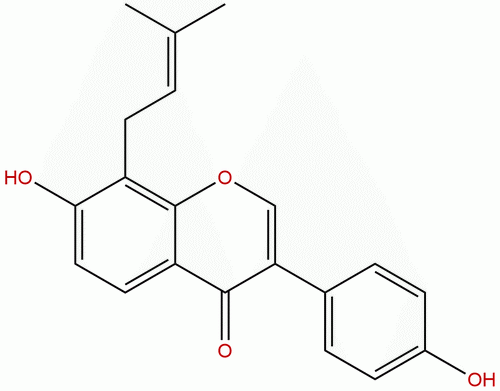
8-Isopentenyl daidzein: a natural isoflavone with antioxidant potential
1. Overview
8-Prenyldaidzein is a naturally occurring isoprenyl isoflavone compound. Its CAS number is 135384-00-8, molecular formula is C20H18O4, and molecular weight is 322.36 g/mol. This compound was originally derived from leguminous plants Bituminaria morisiana Separated from the middle and then processed in traditional medicinal plants Psoralea corylifolia Discovered in the middle. As a structural analogue of daidzein, its unique chemical structure lies in the introduction of a prenyl side chain at the C-8 position of the aromatic ring, which significantly alters its physicochemical properties and biological activity.
In natural product chemistry and pharmacology research, isoflavone compounds have attracted much attention due to their wide range of biological activities, including estrogen like effects, antioxidant, anti-inflammatory, and potential anti-cancer activities. The research background of 8-isoprenyl daidzein is rooted in the in-depth exploration of the structure activity relationship of isoflavones. Research has shown that the introduction of isopentenyl groups often enhances the lipid solubility, membrane permeability, and binding ability of parent compounds to their target proteins, potentially improving their bioavailability and pharmacological efficacy. Current research has preliminarily revealed that 8-isoprenyl daidzein exhibits significant antioxidant activity And targeting P-388 leukemia cells cytotoxicity The IC50 value of 5.82 µ g/mL suggests its potential research value in the fields of oxidative stress-related diseases and tumor prevention and treatment. This article will systematically expound the scientific connotation of this natural product from its chemical characteristics, plant sources, pharmacological mechanisms, medicinal evaluation, and research prospects.
2. Chemical structure and physicochemical properties
8-Isopentenyl daidzein belongs to the 7-hydroxyflavone class, with its core structure being daidzein, and an isopentenyl group (- CH2CH=C (CH3) 2) attached to the 8th carbon atom of its A ring. The SMILES string (CC (C)=CCc1c (O) ccc2c (=O) c (- c3ccc (O) cc3) co12) precisely describes this connection relationship: a benzopyranone (chromone) skeleton with a phenol ring and an isopentenyl side chain attached to it.
Analyzing its physicochemical properties from the parameters of drug properties:
- Molecular weight (MW):322.36 g/mol, Meets the standard that small molecule drugs typically have a molecular weight of less than 500 Da.
- Lipid water partition coefficient (LogP/LogD)LogP is 3.66 and LogD is 3.61. This value indicates that the compound has Intermediate to high lipophilicity This is mainly attributed to the introduction of non-polar isopentenyl groups, which significantly improve lipid solubility compared to the more hydrophilic parent daidzein (LogP of about 2.5). A higher LogP is beneficial for compounds to penetrate cell membranes, but it may also affect their water solubility and oral absorption.
- Topological Polarity Surface Area (TPSA)70.67 Å ². This value reflects the surface area of polar atoms (oxygen atoms) in the molecule, and the relatively low value suggests that their membrane permeability may be better.
- Water solubility Only 0.0254 mg/mL, belonging to Insoluble compound This is consistent with the high LogP value and is one of the key issues that need to be addressed in its formulation development.
- Other physical and chemical characteristics As a polyphenolic compound, the phenolic hydroxyl group in its structure endows it with the ability to act as a hydrogen donor, which is the chemical basis for its antioxidant properties. The introduction of isopentenyl groups also increases the steric hindrance and conformational diversity of the molecule, which may affect its interaction mode with biological targets.
3. Plant sources and traditional applications
The main plant source of 8-isoprenyl daidzein is Psoralea corylifolia L Also known as broken paper or Po Gu Zhi, it is a Fabaceae plant. The dried and ripe fruit of Fructus Psorale is a famous traditional Chinese medicinal herb, which has been used in the medical systems of Asian countries such as China and India for thousands of years.
In traditional Chinese medicine theory, psoralen has a pungent, bitter, and warm nature; Return to the kidney and spleen meridians. have Warming the kidneys and promoting yang, regulating qi and relieving asthma, warming the spleen and stopping diarrhea The efficacy. Commonly used to treat impotence and nocturnal emissions caused by insufficient kidney yang, cold pain in the waist and knees, wheezing due to kidney deficiency, and diarrhea caused by spleen and kidney yang deficiency. It can also be used externally to treat skin diseases such as vitiligo and alopecia areata. Modern plant chemistry research has confirmed that Fructus Psorale is rich in coumarins (such as psoralen and isopsoralen), flavonoids (such as dihydroflavones and chalcones), and Isopentenyl flavonoids/Isoflavones(such as 8-isopentenyl daidzein, psoralen) and other active ingredients. These isopentenyl compounds are considered as one of the important material foundations for the "kidney tonifying and yang strengthening" and "blood activating" effects of Fructus Psorale.
from Bituminaria morisiana The compound was isolated from a leguminous plant mainly distributed in the Mediterranean region, further expanding the diversity of its plant sources and suggesting that isopentenyl isoflavones may be widely present as an important secondary metabolite in leguminous plants, participating in plant defense responses.
4. Pharmacological activity and mechanism of action
The existing research data highlights the role of 8-isoprenyl daidzein in antioxidant The significant activity in the field is closely related to the activation of the endogenous antioxidant defense system in cells. This compound is predicted to act on the following five key targets: NFE2L2, SOD1, CAT, GPX1, and HMOX1. These targets together form the core network of cells in response to oxidative stress.
Core target analysis and mechanism of action
-
NFE2L2 (Nuclear Factor E2 Related Factor 2)This is in the antioxidant stress pathway Main regulatory factors Under oxidative stress conditions, 8-isoprenyl daidzein may dissociate Nrf2 from the Keap1-Nrf2 complex and transfer it to the nucleus by modifying cysteine residues on Keap1 protein. In the nucleus, Nrf2 binds to antioxidant response elements (ARE), initiating the transcription of a series of downstream phase II detoxifying enzymes and antioxidant proteins. This is where it exerts antioxidant effects Upstream core mechanism。
-
Downstream antioxidant enzyme targets:
- SOD1 (Superoxide Dismutase 1)Catalytic dismutation of superoxide anion radicals (O2 •−) into hydrogen peroxide (H2O2) and oxygen is the first line of defense against reactive oxygen species (ROS).
- CAT (catalase)Mainly located in peroxisomes, it catalyzes the decomposition of H2O2 into water and oxygen, preventing the accumulation of H2O2 and the production of more toxic hydroxyl radicals (• OH).
- GPX1 (Glutathione Peroxidase 1)The use of reduced glutathione (GSH) to reduce H2O2 or organic peroxides to water or corresponding alcohols is a key enzyme in the cytoplasm and mitochondria for clearing H2O2.
- HMOX1 (Heme Oxygenase 1)Catalytic degradation of hemoglobin into biliverdin, carbon monoxide, and iron ions. Gallbladder green pigment is subsequently reduced to a potent antioxidant bilirubin The induction of HMOX1 itself is also an important marker of Nrf2 pathway activation.
Mechanism integration 8-Isopentenyl daidzein is likely to act as Nrf2 activator By upregulating the transcriptional activity of Nrf2, it promotes the expression of a series of antioxidant enzymes and proteins such as SOD1, CAT, GPX1, HMOX1, etc. This multi-target and systematic activation method enables cells to synergistically respond to oxidative damage from different sources and types, which has more physiological regulatory significance than simply exogenous antioxidants such as vitamin C and E.
Related diseases: antioxidant
Oxidative stress is a state in which the oxidative and antioxidant systems in the body are imbalanced, leading to excessive accumulation of ROS and subsequent damage to proteins, lipids, and DNA. It is Aging And the common pathological basis of various chronic diseases, including:
- Neurodegenerative diseases Such as Alzheimer's disease and Parkinson's disease.
- cardiovascular disease: such as atherosclerosis and hypertension.
- Metabolic diseases Such as diabetes and its complications.
- Inflammatory diseases and cancer。
Therefore, the antioxidant effect exerted by 8-isoprenyl daidzein through activation of the Nrf2/ARE pathway provides potential application value for its prevention and treatment of oxidative stress-related diseases. In addition, its reported cytotoxicity against P-388 leukemia cells (IC50 5.82 µ g/mL) may also be partially attributed to its induction of oxidative stress imbalance in tumor cells or regulation of signaling pathways related to proliferation and apoptosis.
5. Evaluation of drug properties
Based on the provided pharmacological parameters, we combine Lipinski's Five Rules Preliminary evaluation of the potential of 8-isoprenyl daidzein as an oral medication using standards such as Rule of Five (Ro5):
-
Lipinski Five Rule Compliance:
- Molecular weight (MW):322.36 < 500,Comply with。
- Lipid water partition coefficient (LogP):3.66 < 5,Comply with。
- Number of hydrogen bond donors (HBDs)There are 2 phenolic hydroxyl groups in the structure, with a quantity of 2<5,Comply with。
- Number of hydrogen bond acceptors (HBA)There are 4 oxygen atoms (2 hydroxyl groups, 1 carbonyl group, 1 ether bond) in the molecule, with a quantity of 4<10,Comply with。
- Number of rotatable keys Approximately 5 are estimated, with a typical standard of<10,Comply with。
- Conclusion 8-Isopentenyl daidzein fully conforms to Lipinski's five rules, indicating its good performance Oral absorption potential。
-
Analysis of Key Medicinal Parameters:
- Permeability and absorption:
- Caco-2 permeability 22.19 (x 10 ⁻⁶ cm/s), a relatively high value, indicates its presence in small intestinal epithelial cells Good permeability Oral absorption may be better.
- Effective penetration rate (Peff)2.61, further supporting its good intestinal absorption characteristics.
- distribution:
- Plasma protein binding rate (PPB)As high as 91.66%, it indicates that it mostly binds to plasma proteins in the blood, which may affect its free drug concentration and tissue distribution, but this is also a common characteristic of many highly active natural products.
- Blood-brain barrier penetrability (BBB)Predicted as' low '. Although its LogP value is moderate, its high polar surface area (TPSA) and plasma protein binding rate may limit its ability to freely pass through the BBB, which is unfavorable for the treatment of central nervous system diseases but may also reduce the risk of central side effects.
- Metabolism and toxicity:
- AMES test The value is 0.6, usually a threshold>1 indicates a risk of mutagenicity, and a value<1 indicates Low risk of mutagenicity。
- chromosome aberration Predicted as' yes', this is something that requires high vigilance Potential genotoxic signals It must be rigorously validated through experiments in preclinical studies.
- HERG inhibition A prediction of 'no' indicates a low risk of causing prolonged QT interval in the heart, which is a positive factor.
- Other toxicities Prediction shows that it has Phototoxicity、Respiratory sensitization, as well as potential effects on serum alkaline phosphatase (ALK), gamma glutamyltransferase (GGT), and aspartate aminotransferase (AST), suggesting potential risks to the skin, respiratory system, and liver, requiring further toxicological evaluation.
- Maximum Recommended Treatment Dose (MRTD)A prediction of 'yes' indicates that there may be a therapeutic window at a reasonable dose.
Comprehensive Assessment 8-Isopentenyl Daidzein Oral absorption Excellent performance in all aspects, fully in line with the basic rules of drug properties. Its core advantages lie in clear antioxidant pharmacological mechanisms and good cell permeability. However, it Very poor water solubility、Potential genetic toxicity (chromosomal aberration)、Phototoxicity and Higher plasma protein binding rate This is the main challenge that it must face and solve on the road of drug development. It is more suitable as lead compound By optimizing the structure (such as preparing water-soluble prodrugs, modifying structural sites that may produce toxicity) to improve its drug defects.
6. Research Status and Application Prospects
Research status:
At present, research on 8-isoprenyl daidzein is still in progress Early preclinical stage The existing literature mainly focuses on:
1. Phytochemistry Extraction, isolation, purification, and structural identification from plants such as Fructus Psorale.
2. In vitro pharmacological activity screening Confirmed its antioxidant activity (such as DPPH radical scavenging) and anti-tumor activity (such as cytotoxicity against P-388 cells).
3. Preliminary mechanism exploration Based on bioinformatics or simple experiments, it suggests that its effect may be related to pathways such as Nrf2.
However, regarding its Detailed in vivo pharmacology(Anti disease effects in animal models)pharmacokinetics(absorption, distribution, metabolism, excretion processes)Toxicological evaluation of the system and The exact molecular target binding mode There is still a significant lack of research data on whether it directly interacts with Keap1.
Application Prospects:
1. As a lead compound for drug development Regarding its antioxidant and cytotoxic activity, through Pharmaceutical chemical modification Optimize its water solubility and safety (especially reduce potential genotoxicity and phototoxicity), and develop innovative drugs for treatment of oxidative stress related diseases (such as non-alcoholic fatty liver disease, diabetes nephropathy) or specific types of cancer.
2. Functional food and health supplement additives Psoraleae itself is a traditional medicinal and edible dual-use raw material. 8-Isopentenyl daidzein can be used as a signature ingredient in the development of health products with antioxidant and anti-aging functions. But this must be based on a thorough assessment of its human safe dosage and long-term safety for consumption.
3. cosmetic ingredient Its antioxidant activity can be used to develop cosmetics with anti skin photoaging, whitening and other effects. But special attention and verification are needed Phototoxicity risk Ensure product safety.
4. Scientific research tools As a specific activator of the Nrf2 pathway or representative molecule of isoprenylated isoflavones, it is used to study the biosynthesis, structure-activity relationship, and oxidative stress signal transduction mechanism of secondary metabolites in plants.
Future research directions:
- In depth study on the mechanism of action Using techniques such as molecular docking, surface plasmon resonance, and gene knockout/knockdown, clarify its direct interaction with target proteins such as Keap1.
- Comprehensive preclinical evaluation Establish relevant animal disease models and verify their in vivo efficacy; Complete pharmacokinetic and toxicological studies of the system, clarify its therapeutic window and safety margin.
- Structural optimization and derivative development Synthesize a series of structurally similar compounds and search for candidate molecules with better activity, lower toxicity, and better drug properties.
In summary, 8-isoprenyl daidzein is a natural product with a novel structure, unique mechanism, and clear biological activity. Despite facing challenges in drug development, it undoubtedly provides a valuable starting point for the development of new antioxidant and therapeutic drugs, and its subsequent research deserves continued attention in the field of natural product pharmacy.