


Product name: Angelicin
Synonym name: Isopsoralen; Bakuchicin
Catalogue No.: BP0171
Cas No.: 523-50-2
Formula: C11H6O3
Mol Weight: 186.166
Botanical Source: roots and leaves of angelica (Angelica archangelica). Found in roots and on surface of parsnips and diseased celery. Also in other Angelica spp, Heracleum spp. and others
Physical Description: Powder
Type of Compound: Coumarins
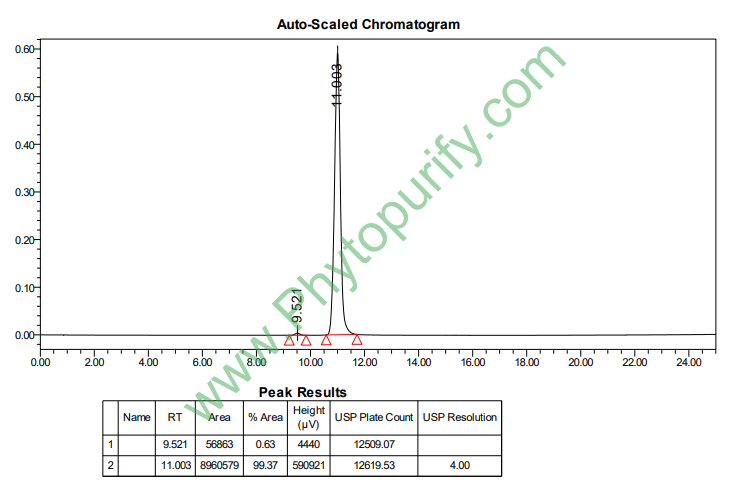
Purity: 95%~99%
Analysis Method: HPLC-DAD or/and HPLC-ELSD
Identification Method: Mass, NMR
Packing: Brown vial or HDPE plastic bottle
Storage: Store in a well closed container, protected from air and light. Put into refrigerate or freeze for long term storage.
Whenever possible, you should prepare and use solutions on the same day. However, if you need to make up stock solutions in advance, we recommend that you store the solution as aliquots in tightly sealed vials at -20℃. Generally, these will be useable for up to two weeks.
The product could be supplied from milligrams to grams, up to kilograms
Inquire for bulk scale.
Descriptions:
Angelicin is a furocoumarin found in Psoralea corylifolia L. fruit, can block the phosphorylation of IκBα, NFκBp65, p38 MAPK, and JNK in lipopolysaccharide-induced acute lung injury model, suggests that angelicin was potentially advantageous to prevent inflammatory diseases by inhibiting NF-κB and MAPK pathways, it might be a potential new agent for prevention of inflammatory reactions and diseases in the clinic.[1]
Angelicin, compared with cytosine arabinoside, mithramycin and cisplatin, is a powerful inducer of erythroid differentiation and -globin mRNA accumulation of human leukemia K562 cells, it is a potential therapeutic approach in hematological disorders, including -beta-thalassemia and sickle cell anemia.[2]
A novel angelicin derivative 6a was identified to inhibit influenza A (H1N1) virus induced Cytopathic effect in Madin-Darby canine kidney cell culture in low micromolar range, these compounds act as anti-influenza agents by inhibiting ribonucleoprotein (RNP) complex associated activity and have the potential to be developed further, which could form the basis for developing additional defense against influenza pandemics.[3]
Angelicin is structurally related to psoralens, a well-known chemical class of photosensitizers used for its antiproliferative activity in treatment of different skin disease, angelicin is an effective apoptosis-inducing natural compound of human SH-SY5Y neuroblastoma cells which suggests that this compound may have a role in future therapies for human neuroblastoma cancer.[4]
References:
[1] Liu F, Sun G Q, Gao H Y, et al. J Surg Res, 2013, 185(1):300-9.
[2] Lampronti I, Bianchi N M, Fibach E, et al. Eur J Haematol, 2003, 71(3):189-95.
[3] Yeh J, Coumar M, Horng J, et al. J Med Chem, 2010, 53(4):1519-33.
[4] Rahman M A, Kim N H, Yang H, et al. Mol Cell Biochem, 2012, 369(1-2):95-104.
[5] Yan R, Liu Z, Luo J. Chinese Medicine Modern Distance Education of China, 2008,6(11):1329-30.
HPLC of Angelicin
Storage conditions:Short-term storage at 2~8℃, long-term storage at -20 ~ -80℃
43.3500
2.0274
2.0272
.0141
5.2194
26.0741
High
82.9138
2.3725
Yes
No
Yes
No
Yes
Yes
1.5
Yes
Yes
Yes
Yes
Natural products have long been an important treasure trove for innovative drug discovery, among which coumarin compounds have attracted much attention due to their wide range of biological activities. Angelicin (CAS number: 523-50-2), as a unique linear furanocoumarin, is an isomer of psoralen. Its structural differences significantly reduce its photosensitivity, thus broadening its therapeutic application window. In recent years, with the deepening of molecular pharmacology research, isopsoralen has demonstrated multidimensional biological activities beyond traditional understanding, including significant anti-tumor, antiviral, and anti-inflammatory effects, making it an emerging hotspot in natural product pharmacology research. Especially in the treatment potential of hematological diseases (such as beta thalassemia) and inflammation related diseases, as well as their precise regulation ability on key signaling pathways (such as NF - κ B and MAPK), it has attracted widespread interest among researchers. This article aims to systematically review the chemical properties, plant sources, pharmacological activities, molecular mechanisms of action, pharmacological evaluation, and clinical application prospects of isopsoralen, in order to provide comprehensive academic references for the in-depth research and development of this compound.
Isopsoralen, chemical name 2H-Furo [2,3-h] -1-benzopyran-2-one, molecular formula C11H6O3, molecular weight 186.1660. Its core structure is formed by the linear condensation of a benzene ring and a furan ring, and then combined with an alpha pyranone ring (lactone ring) to form a typical linear furan coumarin skeleton. Unlike psoralen (whose furan ring is fused with the benzene ring in an angular manner), isopsoralen has a linear arrangement of furan ring and benzene ring, which is the key reason for its lower photochemical reactivity.
In terms of physicochemical properties, the lipid water partition coefficient (LogP) of isopsoralen is 2.0274, indicating its moderate lipophilicity and favorable transmembrane transport. Its topological polar surface area (TPSA) is 43.35 Å ², which is relatively small, further indicating its good membrane permeability. The water solubility data (approximately 0.0141 mg/mL) indicates that it is a poorly soluble compound, which may be a limiting factor for its oral bioavailability and needs to be improved through pharmaceutical methods. The calculation predicts that its blood-brain barrier (BBB) permeability is "high", indicating that it may have potential effects on central nervous system related targets, which is consistent with literature reports that it can induce apoptosis in neuroblastoma. Preliminary safety assessment shows that the risk of hERG inhibition is' no ', reducing the potential risk of causing QT interval prolongation in the heart; The Ames test value is 1.5, indicating a low risk of mutagenicity under the testing conditions, but further in vitro and in vivo genetic toxicity evaluation is still needed.
Isopsoralen is widely present in various plants such as Apiaceae and Fabaceae. Its main plant sources include:
1. Psoralea corylifolia L This is one of the most famous and primary sources of isopsoralen. The fruit of Fructus Psorale (Psoraleae) is a traditional Chinese medicine that is rich in various coumarins and flavonoids, including isopsoralen and psoralen.
2. Angelica spp As its name suggests, this compound is also present in the roots of certain plants in the genus Angelica archangelica.
3. Other sources Trace amounts are also found in celery (Apium graveolens), fig (Ficus carica) leaves, and some Rutaceae plants.
The extraction method usually follows the conventional process of natural product separation. Firstly, organic solvents such as methanol, ethanol, or ethyl acetate are used for reflux extraction or ultrasound assisted extraction of dried plant materials. After filtration and concentration, the crude extract obtained is separated and purified using methods such as silica gel column chromatography, preparative thin layer chromatography, or high-performance liquid chromatography (HPLC). Due to the fluorescent properties of isopsoralen, it can be monitored online using fluorescence detectors or ultraviolet detectors (typically with characteristic absorption at 250-300 nm) to improve separation efficiency and purity. Modern technologies such as high-speed countercurrent chromatography (HSCCC) are also used for efficient preparation of high-purity isopsoralen due to their high recovery rate and avoidance of irreversible adsorption caused by solid adsorbents.
Isopsoralen exhibits diverse pharmacological activities, mainly covering the following fields:
1. Antitumor activity
Isopsoralen exhibits growth inhibition and pro apoptotic effects on various tumor cell lines. Research shows that it can effectively inhibit the proliferation of human leukemia K562 cells, neuroblastoma cells, liver cancer cells, breast cancer cells, etc. Its anti-tumor effect is not limited to inducing cell apoptosis, but may also involve cell cycle arrest (such as G2/M phase arrest), inhibition of cell migration and invasion, etc. It is worth noting that compared with psoralen, isopsoralen can still exert significant cytotoxic effects under non light conditions, which provides convenience for its clinical application.
2. Antiviral activity
Isopsoralen has significant inhibitory activity against gamma herpesviruses, such as mouse gamma herpesvirus 68 (MHV-68) and Kaposi's sarcoma associated herpesvirus (KSHV). Its target is located in the early stages of viral infection, possibly by inhibiting the expression of the virus's immediate early gene RTA (replication and transcriptional activator), thereby blocking the virus's lytic replication cycle. This characteristic makes it a potential lead compound for developing anti herpesvirus drugs.
3. Anti inflammatory activity
In the macrophage inflammation model induced by lipopolysaccharide (LPS), isopsoralen can effectively inhibit the production of pro-inflammatory cytokines such as nitric oxide (NO), prostaglandin E2 (PGE2), tumor necrosis factor - α (TNF - α), interleukin-6 (IL-6), etc. Its anti-inflammatory efficacy is closely related to the regulation of key inflammatory signaling pathways.
4. Inducing erythroid differentiation activity
This is a highly distinctive pharmacological activity of isopsoralen. Research has found that it is a potent inducer of erythroid differentiation in human chronic myeloid leukemia K562 cells, significantly promoting hemoglobin synthesis and accumulation of globin mRNA. This feature provides a new drug development approach for treating blood diseases characterized by hemoglobin synthesis disorders, such as beta thalassemia and sickle cell anemia. Its function may be achieved by regulating transcription factors (such as GATA-1) or signaling pathways related to erythroid differentiation.
5. Potential associations with other diseases
Based on network pharmacology or computational prediction, the structure of isopsoralen may interact with multiple disease targets. For example, the provided target list (such as APP, MAOA, ESR1/2, HMGCR, etc.) suggests its potential impact on Alzheimer's disease (through APP), depression (through MAOA), hormone related diseases (through ESR), or lipid metabolism (through HMGCR). However, most of these associations are in the stage of computational prediction or preliminary research and require solid experimental verification.
The multiple pharmacological activities of isopsoralen stem from its regulation of multiple key signaling nodes and molecular targets within cells.
1. Inhibit the NF - κ B signaling pathway
NF - κ B is a core transcription factor that regulates inflammation, cell survival, and proliferation. Isopsoralen can effectively inhibit the degradation of I κ B α protein induced by LPS and other stimuli, prevent the phosphorylation of NF - κ B p65 subunit and subsequent nuclear translocation. After entering the nucleus, it may also interfere with the binding activity between NF - κ B and DNA. By inhibiting NF - κ B and downregulating its target genes such as pro-inflammatory cytokines (TNF - α, IL-6), anti apoptotic proteins (Bcl-2, Bcl xL, Mcl-1), and cyclooxygenase-2 (COX-2), isopsoralen synergistically exerts anti-inflammatory and pro apoptotic effects.
2. Regulating the MAPK signaling pathway
The MAPK family (including p38, JNK, and ERK) plays an important role in stress response, inflammation, and apoptosis. Isopsoralen has been shown to specifically inhibit LPS induced phosphorylation activation of p38 and JNK, but has little effect on the ERK pathway. Inhibition of the p38 and JNK pathways helps reduce the production of pro-inflammatory mediators and may promote apoptosis in certain cell types.
3. Inducing mitochondrial pathway apoptosis
In tumor cells such as neuroblastoma, isopsoralen downregulates the expression of anti apoptotic proteins such as Bcl-2, Bcl xL, and Mcl-1, disrupts mitochondrial membrane potential, and leads to the release of cytochrome c from mitochondria into the cytoplasm. Cytochrome c forms apoptotic bodies with Apaf-1 and caspase-9 precursors, activating caspase-9 and cascading downstream effector caspase-3, ultimately leading to cell apoptosis.
4. Inhibit virus replication
The mechanism of its anti - γ - herpesvirus effect is mainly related to the inhibition of the transcription of the virus's immediate early gene RTA. RTA is a key switch that initiates the viral lysis and replication cycle. Isopsoralen may inhibit RTA expression at the transcriptional level by interfering with the binding of host cytokines to viral promoters or affecting related signal transduction, thereby blocking the virus in a latent infection state.
5. Potential mechanisms for promoting erythroid differentiation
The specific molecular mechanism has not been fully elucidated, but it is speculated that it may involve: ① activating the activity or expression of the main transcription factors controlling erythroid differentiation, such as GATA-1 and KLF1; ② Regulating chromatin remodeling associated with globin gene expression; ③ Affects signaling pathways related to erythroid differentiation, such as JAK2/STAT5 or p38 MAPK.
As a promising lead compound for drugs, the evaluation of its pharmacological properties is crucial for its clinical application.
Pharmacokinetic (PK) characteristics Currently, there are relatively limited reports on pharmacokinetic studies of the isopsoralen system. Based on its physicochemical properties (moderate LogP, low TPSA, high BBB permeability prediction), it can be inferred that it may have good absorption and distribution characteristics after oral administration, especially the potential to penetrate the blood-brain barrier. However, its low water solubility may lead to incomplete oral absorption and high variability. Coumarin compounds typically undergo extensive metabolism in the body, mainly through phase I metabolism such as hydroxylation and dealkylation by the liver cytochrome P450 enzyme system (CYP), as well as phase II binding reactions with glucuronic acid or sulfuric acid. Further research is needed on its metabolites, excretion pathways, and the presence of enterohepatic circulation.
Challenges and Strategies in Pharmaceutical Science The main challenge is to improve its water solubility and oral bioavailability. Feasible formulation strategies include: ① forming solid dispersions; ② Preparation of nano drug delivery systems such as nanocrystals, liposomes, or polymer micelles; ③ Form inclusion complexes with cyclodextrin; ④ Develop prodrugs to improve solubility and targeting.
Preliminary Safety Assessment The existing data indicates that there is no significant risk of hERG inhibition, and the preliminary Ames test results are negative, suggesting a low risk of cardiac and genetic toxicity. However, comprehensive preclinical safety evaluation, including acute toxicity, long-term toxicity, reproductive toxicity, and phototoxicity (although its photosensitivity is weaker than that of psoralen, it still needs to be evaluated), is essential.
The clinical application prospects of isopsoralen are broad, but it also faces challenges.
Potential therapeutic areas:
1. Hematological system diseases As an inducer of erythroid differentiation, the treatment of β - thalassemia and sickle cell anemia is its most distinctive direction. Compared with existing therapies such as blood transfusion and hydroxyurea, it may correct hemoglobin synthesis defects at the molecular level and has the potential to cure the root cause. Compared with gene therapy, it has the advantages of lower cost and easier administration.
2. Inflammatory diseases Based on its strong NF - κ B and MAPK inhibitory activity, it can be used to treat chronic inflammatory diseases such as rheumatoid arthritis, inflammatory bowel disease, and neuroinflammation (such as neuroinflammation associated with Alzheimer's disease).
3. tumor therapy Can be used as an adjuvant drug in combination with traditional chemotherapy, radiotherapy, or targeted therapy to enhance anti-tumor efficacy, especially suitable for tumor types with excessive activation of the NF - κ B pathway. Its differentiation inducing properties can also be used for the treatment of certain leukemia.
4. antiviral therapy Provide new treatment options for diseases caused by gamma herpesviruses such as KSHV and EBV, such as Kaposi's sarcoma and post transplant lymphoproliferative disorders.
Challenges faced and future research directions:
1. Deep exploration of the mechanism of action Chemical biology methods (such as affinity fishing and proteomics) need to be used to search for its direct target proteins and elucidate its more precise molecular initiation mechanism.
2. Structural optimization and structure-activity relationship By modifying the structure of the parent nucleus of isopsoralen, the aim is to enhance its activity, selectivity, water solubility, and pharmacokinetic properties, while reducing potential toxicity.
3. Systematic pharmacokinetics and toxicology research Conduct comprehensive preclinical ADME (absorption, distribution, metabolism, excretion) and GLP (Good Laboratory Practice) toxicology studies to provide data support for clinical trial application.
4. Development of a new drug delivery system Develop efficient, stable, and targeted nano formulations or novel delivery systems to address the issue of poor solubility.
5. Combination therapy research Explore its synergistic effects with existing drugs such as decitabine, hydroxyurea, chemotherapy drugs, and anti-inflammatory drugs, and develop optimized treatment plans.
As a naturally occurring furan coumarin with a unique structure, isopsoralen has shown remarkable potential in anti-tumor, antiviral, anti-inflammatory, and erythroid differentiation inducing fields due to its multi-target and multi pathway pharmacological mechanisms. Coming from traditional medicinal plants, it is now revitalized through the interpretation of modern pharmacology and medicinal chemistry. Although there are still many challenges on the road to clinical drug development, such as optimizing drug properties, clarifying mechanisms, and evaluating system safety, its unique biological activity, especially in inducing hemoglobin synthesis, has opened up a promising new path for its use in the treatment of refractory hematological diseases. In the future, through interdisciplinary collaboration, in-depth and systematic research on isopsoralen is expected to develop it into an innovative drug derived from nature for clinical use, benefiting human health.
