


Product name: Platycodin D
Synonym name:
Catalogue No.: BP1111
Cas No.: 58479-68-8
Formula: C57H92O28
Mol Weight: 1225.34
Botanical Source: Platycodon grandiflorum
Physical Description: White powder
Type of Compound: Triterpenoids
Purity: 95%~99%
Analysis Method: HPLC-DAD or/and HPLC-ELSD
Identification Method: Mass, NMR
Packing: Brown vial or HDPE plastic bottle
Storage: Store in a well closed container, protected from air and light. Put into refrigerate or freeze for long term storage.
Whenever possible, you should prepare and use solutions on the same day. However, if you need to make up stock solutions in advance, we recommend that you store the solution as aliquots in tightly sealed vials at -20℃. Generally, these will be useable for up to two weeks.
The product could be supplied from milligrams to grams, up to kilograms
Inquire for bulk scale.
Descriptions:
Platycodon D (PD) and D3 (PD3) isolated from Platycodon grandiflorum has been previously reported to show anti-inflammatory activities in rats, PD may stimulate TNF-α synthesis or inhibit degradation of TNF-α mRNA, suggest a dichotomous regulation of these important proinflammatory mediators by PD and PD3.[1]
Platycodin D suppresses prostaglandin E2 production at 10 and 30 uM in rat peritoneal macrophages stimulated by the protein kinase C activator 12-O-tetradecanoylphorbol 13-acetate (TPA).[2]
Platycodin D has the ability to induce apoptosis in HaCaT cells through the upregulation of Fas receptor and FasL expression via to NF-κB activation in the transcriptional level, suggests that the NF-κB activation plays a crucial role in the induction of apoptosis in human HaCaT cells on treatment with platycodin D.[3]
Platycodin D (PD) significantly promotes the production of Th1 (IL-2 and IFN-gamma) and Th2 (IL-10) cytokines and up-regulates the mRNA expression of Th1 cytokines (IL-2 and IFN-gamma) in splenocytes from the mice immunized with HBsAg, also increases the killing activities of natural killer (NK) cells and CTLs from splenocytes in the HBsAg-immunized mice, which may have important implications for vaccination against hepatitis B virus,suggests that PD may be the candidates as adjuvants for use in prophylactic and therapeutic hepatitis B vaccine.[4]
Platycodin-D(PD) can induce autophagy in NCI-H460 and A549 cells through inhibiting PI3K/Akt/mTOR signaling pathway and activating JNK and p38 MAPK signaling pathways.[5]
Platycodin D has showed an antinociceptive effect .[6]
Platycodin D can inhibit migration, invasion, and growth of MDA-MB-231 human breast cancer cells via suppression of EGFR-mediated Akt and MAPK pathways.[7]
References:
[1] Wang C, Levis G B S, Lee E B, et al. Int Immunopharmacol, 2004, 4(8):1039-49.
[2] Kim Y P, Lee E B, Kim S Y, et al. Planta Medica, 2001, 67(4):362-4.
[3] Ahn K S, Hahn B S, Kwack K B, et al. Eur J Pharmacoly, 2006, 537(1-3):1-11.
[4] Xie Y, Sun H X, Li D. Vaccine, 2009, 27(5):757764.
[5] Zhao R, Chen M, Jiang Z, et al. J Cancer, 2015, 6(7):623-31.
[6] SeongSoo Choi, EunJung Han, TaeHee Lee, et al. Am J Chinese Med, 2004, 32(2):257-68.
[7] Chun J, Kim Y S. Chem-Biol Interact, 2013, 205(3):212-21.
[8] Chen G, Tai S, Huang L. China Pharm, 014(18):51-3.
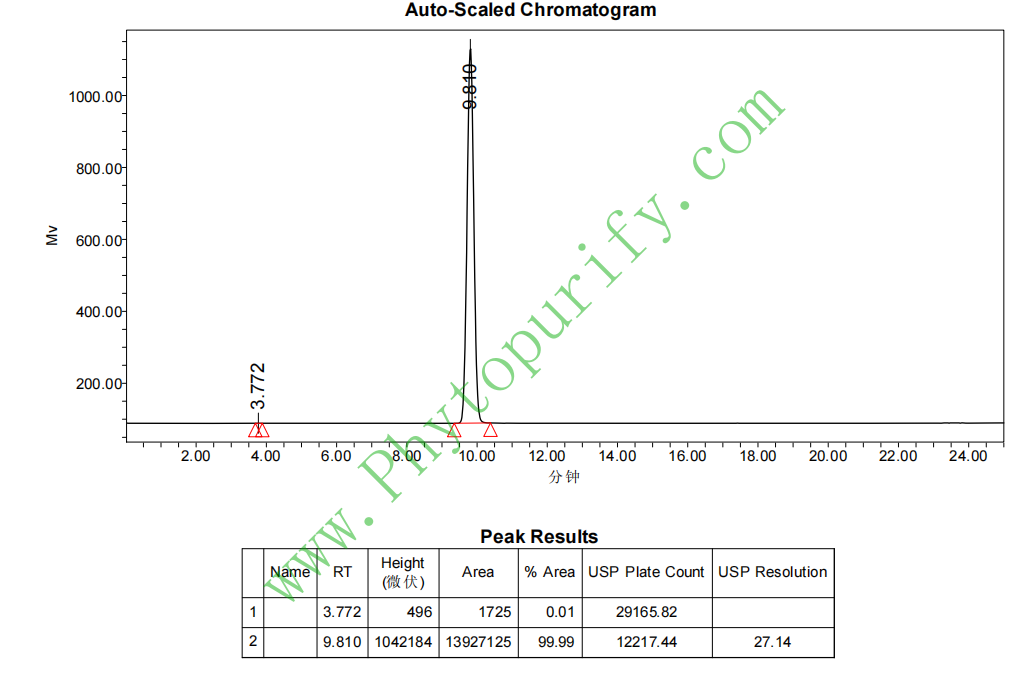
HPLC of Platycodin D
Storage conditions:Short-term storage at 2~8℃, long-term storage at -20 ~ -80℃
453.2800
.5233
.5234
.8045
.5211
.2367
Low
62.8872
7.4767
Yes
No
No
No
No
No
0.0
Yes
No
Yes
Yes
Platycodin D (PD) is a traditional Chinese medicine derived from Platycodin(Platycodon grandiflorum The main active triterpenoid saponin components isolated from the dried roots of (Jacq.) A. DC. have a CAS number of 58479-68-8. As a medicinal and edible plant, Platycodon grandiflorus has a long history of application in East Asia, often used to treat respiratory diseases such as cough, phlegm, sore throat, etc. Modern pharmacological research has revealed that many traditional benefits of Platycodon grandiflorus are closely related to its abundant saponin components, among which Platycodon grandiflorus saponin D has become a research focus due to its high content and wide biological activity.
Early research mainly focused on the cough suppressant, expectorant, anti-inflammatory and other activities related to traditional efficacy of Platycodon grandiflorum saponins D. With the deepening of research, its broader pharmacological effects are constantly being explored, especially in the field of metabolic diseases, showing great potential. Studies have shown that Platycodon grandiflorum saponin D is an effective activator of AMPK α, which can significantly inhibit fat production and improve insulin resistance, thus playing an anti obesity and anti diabetes role. In addition, its anti-tumor, hepatoprotective, neuroprotective, and immunomodulatory activities have also attracted much attention. Its anti adipogenic effect has been confirmed to be closely related to the inhibition of the classical WNT/β - catenin signaling pathway, providing key clues for understanding its mechanism of action.
This article aims to systematically review the chemical structure, plant origin, pharmacological activity, molecular mechanism of action, pharmacological characteristics, and clinical application prospects of Platycodon grandiflorum saponins D, in order to provide comprehensive scientific references for the in-depth research and development of this natural product.
Platycodon grandiflorus saponin D belongs to the oleanane type pentacyclic triterpenoid saponin, with a molecular formula of C57H92O28 and a molecular weight of 1225.3350. Its basic skeleton is oleanolic acid, with complex oligosaccharide chains connected at C-3 and C-28 positions, respectively. The sugar chain at C-3 position is usually composed of glucose, xylose, arabinose, etc., while C-28 position is often connected to a glucose unit, which is the structural basis for its strong surface activity and hemolytic activity. This highly glycosylated structure gives it significant hydrophilicity.
According to the provided pharmacological parameters, the logarithm of the lipid water partition coefficient (LogP) of Platycodon grandiflorum saponins D is 0.5233, indicating that it has a certain lipophilicity, but overall it still leans towards hydrophilicity. Its topological polar surface area (TPSA) is as high as 453.2800 Å ², which is consistent with the presence of a large number of hydroxyl and sugar ring structures in its molecule, and also indicates that its membrane permeability may be poor. The water solubility data is 0.8045 mg/mL, which belongs to the range of slightly soluble to soluble. This poses certain challenges for the development of its formulations, often requiring structural modification or the use of solubilizers to improve bioavailability. The high molecular weight (>500) and high TPSA also result in a lower ability to pass through the blood-brain barrier, which is consistent with the characteristic of limited central direct action but possibly smaller peripheral side effects. In the preliminary safety evaluation, its hERG inhibitory activity was "no", indicating a low risk of causing QT interval prolongation in the heart; The Ames test result was 0.0, indicating that no mutagenicity was observed in this testing system, providing preliminary support for its safety.
Platycodon grandiflorus saponins D mainly come from the dried roots of Platycodon grandiflorus, a plant in the family Platycodon grandiflorus. Platycodon grandiflorus is mainly distributed in China, South Korea, Japan, and the Far East of Russia. Its roots are rich in saponins, among which Platycodon grandiflorus saponin D is one of the highest content saponin monomers and is often used as a key indicator component for evaluating the quality of Platycodon grandiflorus medicinal materials.
The extraction of Platycodon grandiflorum saponins D usually follows the conventional process of natural product separation. Firstly, crush the dried Platycodon grandiflorus roots and extract them using a suitable solvent. The most commonly used method is alcohol extraction (such as methanol, ethanol, or ethanol water solutions of different concentrations), which utilizes the high solubility of saponins in alcohol. In recent years, modern technologies such as ultrasound assisted extraction and microwave-assisted extraction have also been widely applied to improve extraction efficiency and shorten time. After obtaining the crude extract, the total saponin fraction is obtained through steps such as lipid removal (petroleum ether or ethyl acetate extraction) and preliminary enrichment (n-butanol extraction of saponins in the aqueous layer).
Further separation and purification mainly rely on chromatographic techniques. Large pore adsorption resin (such as D101, AB-8) column chromatography is commonly used for preliminary separation to remove impurities such as sugars and pigments. Subsequently, fine separation was performed using methods such as silica gel column chromatography, reverse phase silica gel column chromatography (such as ODS), high performance liquid chromatography (HPLC), and high-speed countercurrent chromatography (HSCCC). Among them, semi preparative or preparative reverse phase HPLC is currently the most effective and commonly used method for obtaining high-purity monomers of Platycodon grandiflorum saponins D. It usually uses a C18 chromatographic column with methanol water or acetonitrile water as the mobile phase for gradient elution. The isolated compounds need to be structurally confirmed by spectroscopic techniques such as nuclear magnetic resonance (NMR) and mass spectrometry (MS).
Platycodon grandiflorum saponins D have diverse pharmacological activities, and their research has expanded from traditional applications to modern disease treatment fields.
Antitussive and expectorant effects This is the most classic effect of Platycodon grandiflorum. Research has shown that Platycodon grandiflorum saponins D exert cough suppressing effects through multiple targets. It can inhibit the capsaicin receptor (TRPV1) and transient receptor potential anchor protein 1 (TRPA1) channels, thereby alleviating the cough reflex mediated by these channels; It can also act on the μ - opioid receptor (OPRM1), producing a central cough suppressant effect; In addition, the regulation of key molecules in the cough signaling pathway, such as sodium channel SCN9A (Nav1.7), calcitonin gene-related peptide (CalcA), gastrin releasing peptide receptor (GRPR), neuromodulatory peptide U receptor 1 (NMUR1), and tachykinin TAC1 (such as substance P), together form its powerful anti cough activity network. Its expectorant effect is mainly related to stimulating the throat mucosa, reflexively promoting the secretion of thin fluid by respiratory glands, and reducing sputum viscosity.
The effect of anti obesity and improving metabolic syndrome This is one of the most anticipated activities of Platycodon grandiflorum saponins D in recent years. In cellular and animal models, PD can significantly inhibit the differentiation of preadipocytes and reduce lipid accumulation within adipocytes. Its function is closely related to the activation of the AMPK pathway. AMPK is a core regulatory factor in cellular energy metabolism, which, when activated, can inhibit key enzymes involved in fatty acid synthesis (such as ACC) and promote fatty acid oxidation, thereby reducing fat production. In addition, PD can improve insulin sensitivity in high-fat diet induced obese mice, reduce blood glucose and lipid levels, and also improve non-alcoholic fatty liver disease.
Anti inflammatory and immune regulatory effects PD has shown good anti-inflammatory effects on both acute and chronic inflammation models. It can inhibit the production of nitric oxide (NO), prostaglandin E2 (PGE2), and pro-inflammatory cytokines (such as TNF - α, IL-1 β, IL-6) in macrophages induced by lipopolysaccharide (LPS) and other factors. The mechanism involves inhibiting the activation of NF - κ B and MAPK signaling pathways. PD can also regulate the proliferation and function of T lymphocytes and B lymphocytes, exhibiting bidirectional immune regulatory characteristics.
Antitumor activity Research shows that PD can inhibit the proliferation and induce apoptosis of many cancer cell lines (such as lung cancer, liver cancer, breast cancer, colon cancer, leukemia, etc.). Its anti-tumor mechanisms are diverse, including inducing cell cycle arrest, activating mitochondrial apoptosis pathway, increasing intracellular reactive oxygen species (ROS) levels, inhibiting tumor cell migration and invasion, etc. It exerts its effects by regulating multiple signaling pathways such as WNT/β - catenin, PI3K/Akt, STAT3, etc.
Liver protection and lung protective effects PD has a protective effect on chemical (such as acetaminophen, carbon tetrachloride) and alcoholic liver injury, can reduce serum transaminase levels, alleviate liver tissue pathological damage, and its mechanism is related to anti-inflammatory, antioxidant, and anti apoptotic effects. PD has also shown potential in reducing inflammation and fibrosis in models of pulmonary fibrosis and acute lung injury.
The multiple pharmacological activities of Platycodon grandiflorum saponins D stem from their regulation of complex cellular signaling networks. The core mechanism of action and molecular targets can be summarized as follows:
Activation of AMPK signaling pathway PD is a direct or indirect activator of AMPK α. Research has shown that PD may activate AMPK by causing changes in intracellular calcium ion levels or increasing the AMP/ATP ratio. Activated AMPK phosphorylates downstream targets such as acetyl CoA carboxylase (ACC) and sterol regulatory element binding protein-1c (SREBP-1c), thereby inhibiting fatty acid synthesis while promoting peroxisome proliferator activated receptor gamma co activator factor-1 alpha (PGC-1 alpha) mediated mitochondrial biosynthesis and fatty acid oxidation, which is the core mechanism of its anti obesity, improved insulin resistance, and fatty liver.
Inhibition of WNT/β - catenin pathway The WNT/β - catenin pathway is a key negative regulatory pathway in the process of fat generation. PD has been shown to activate this pathway, promoting the stability and nuclear translocation of β - catenin. Nuclear β - catenin binds to TCF/LEF transcription factors, upregulates the expression of WNT target genes (such as Axin2), thereby inhibiting the expression of adipogenic transcription factors PPAR γ and C/EBP α, ultimately blocking the differentiation of preadipocytes into mature adipocytes. This is the specific molecular mechanism of its anti adipogenic effect.
Regulation of inflammation related pathways The anti-inflammatory effect of PD is mainly achieved by inhibiting the NF - κ B and MAPK pathways. It can inhibit the degradation of I κ B α, prevent the nuclear translocation of NF - κ B p65 subunit, and thereby downregulate the transcription of inflammatory mediators. Meanwhile, it can also inhibit the phosphorylation activation of MAPKs such as p38, JNK, and ERK.
Regulation of apoptosis pathway in cells In tumor cells, PD can induce apoptosis by upregulating pro apoptotic proteins (such as Bax, Bid) and downregulating anti apoptotic proteins (such as Bcl-2, Bcl xL), leading to a decrease in mitochondrial membrane potential, release of cytochrome C, and activation of caspase cascade reaction. The inhibition of survival signaling pathways such as PI3K/Akt and STAT3 is also involved in its pro apoptotic process.
Multi directional regulation of cough reflex related targets As mentioned earlier, PD antagonizes TRPV1 and TRPA1 ion channels, activates OPRM1 opioid receptors, and regulates multiple pathways related to cough sensation and transmission, such as SCN9A, GRPR, NMUR1, TAC1/ALCA, forming a multi-target cough suppression network. This explains its potent and potentially multi link inhibitory cough suppression effect.
Although the pharmacological activity of Platycodon grandiflorum saponin D is significant, its pharmacological properties, especially pharmacokinetic properties, are the main challenges facing its conversion into drugs.
absorb Due to its high molecular weight and polarity (high TPSA), the oral bioavailability of PD is generally low. Animal studies have shown that its oral absorption is slow and incomplete, and its absolute bioavailability may be low. This is mainly attributed to its poor intestinal permeability and possible first pass effects.
distribution PD is widely distributed in the body, but it is difficult to penetrate the blood-brain barrier (BBB permeability is low), which is consistent with its physicochemical properties. Research has shown that after oral or injection, PD can be distributed in tissues such as lungs, liver, kidneys, and adipose tissue, among which its distribution in the lungs is consistent with its anti cough and anti pulmonary fibrosis effects.
Metabolism As a saponin compound, PD is prone to hydrolytic metabolism in the gastrointestinal tract and liver. Its glycosyl portion may be gradually hydrolyzed by glycosidases in the gut microbiota or tissues, generating secondary glycosides (such as deglycosylated Platycodigenin). The activity of these metabolites may differ from that of the prototype drug, forming its complex in vivo effector substance basis.
excretion PD and its metabolites are mainly excreted through the kidneys and bile. There are studies suggesting that it may have hepatic intestinal circulation.
Formulation strategy To improve its bioavailability, researchers have attempted various strategies, including: ① structural modification: preparing prodrugs or derivatives to improve lipid solubility and membrane permeability; ② New drug delivery systems: Developing liposomes, nanoparticles, microemulsions, self microemulsifying drug delivery systems, etc. to enhance their solubility, promote lymphatic absorption, or avoid first pass effects; ③ Combination therapy: Used in combination with absorption enhancers or other drugs.
safety Current toxicology studies have shown that PD is relatively safe within a certain dose range, but high doses may cause gastrointestinal irritation (shared by saponins) and reversible changes in liver and kidney function. Its advantage in preclinical development is its lack of hERG inhibition and Ames mutagenicity negative results.
The clinical application prospects of Platycodon grandiflorum saponin D are broad, but it needs to overcome existing bottlenecks and promote its transition from the laboratory to the market.
Treat metabolic diseases Based on its clear AMPK activation and anti adipogenic effect, PD is a potential candidate molecule for developing new anti obesity, anti type 2 diabetes and non-alcoholic fatty liver drugs. Systematic preclinical studies and clinical trials can be conducted for these indications.
Treatment of respiratory system diseases Its multi-target potent cough suppressant effect provides the possibility for the development of new cough suppressants that are different from traditional central or peripheral cough suppressants, especially suitable for refractory chronic cough. Its protective role in pulmonary fibrosis and pneumonia also deserves further exploration.
Antitumor adjuvant therapy The combination of PD and existing chemotherapy drugs may have sensitization and attenuation effects. Developing it as an adjuvant therapy or chemopreventive agent for tumors is a promising direction.
Development Strategy:
Platycodon grandiflorum saponin D, as a natural triterpenoid saponin derived from traditional Chinese medicine, has become a hot topic in natural product pharmacology research due to its wide pharmacological activity and unique multi-target mechanism of action. From traditional cough suppressants and expectorants to modern anti obesity, anti-tumor, and anti-inflammatory treatments, their application value is constantly being re recognized and expanded. Especially by activating the AMPK and WNT/β - catenin pathways to regulate energy metabolism and fat production, it provides new ideas and candidate drugs for the prevention and treatment of metabolic diseases.
However, its poor drug resistance, especially low oral bioavailability, is the main obstacle to its clinical translation. Future research should focus on improving its pharmacokinetic properties using modern pharmaceutical and medicinal chemistry methods, while conducting in-depth studies on the mechanisms of action for specific indications, conducting systematic preclinical safety evaluations, and exploring reasonable clinical development pathways. With the gradual overcoming of these scientific and technological challenges, Platycodon grandiflorum saponin D is expected to successfully transform from an excellent natural active molecule into an innovative drug that benefits patients worldwide, fully demonstrating the enormous potential of modernization and internationalization of traditional Chinese medicine.
