Introduction/Overview
Natural products have always been an important source of innovative drug discovery, among which ginseng, as a traditional precious Chinese medicine, continues to receive widespread attention in the study of its pharmacological active ingredients. Ginsenosides are the main active ingredients of plants in the Panax genus. According to their different glycosidic frameworks, they are mainly divided into Damaran type, Oleander type, and Oketilon type. 20 (R) -25 Methoxyprotopanaxadiol (20 (R) -25 OMe PPD) is a structurally novel derivative of the Damatane type ginsenoside, with a CAS number of 1050479-86-1. Compared with the common protopanaxadiol (PPD), it has an R configuration at the C-20 position and introduces methoxy substitution at the C-25 position. This unique structural modification significantly changes its biological activity and pharmaceutical properties.
In recent years, a large number of studies have revealed that 20 (R) -25-OMe PPD exhibits excellent anti-tumor potential, involving inducing cell apoptosis, inhibiting proliferation, invasion and metastasis, and exhibiting strong inhibitory activity against various tumor cell lines. Its mechanism of action is complex, involving the regulation of multiple key signaling pathways and molecular targets, such as Bcl-2 family proteins STAT3、HIF-1α、 Matrix metalloproteinases (MMPs) and targets related to the estrogen signaling pathway. Although its poor water solubility and low bioavailability pose challenges for drug development, its clear pharmacological activity and relatively low genetic toxicity risk make it a highly valuable lead compound for development. This article aims to systematically review the chemical structure, plant origin, pharmacological activity, mechanism of action, pharmacological evaluation, and clinical application prospects of 20 (R) -25 methoxyprotopanaxadiol, in order to provide comprehensive scientific references for the in-depth research and development of this compound.
Chemical structure and physicochemical properties
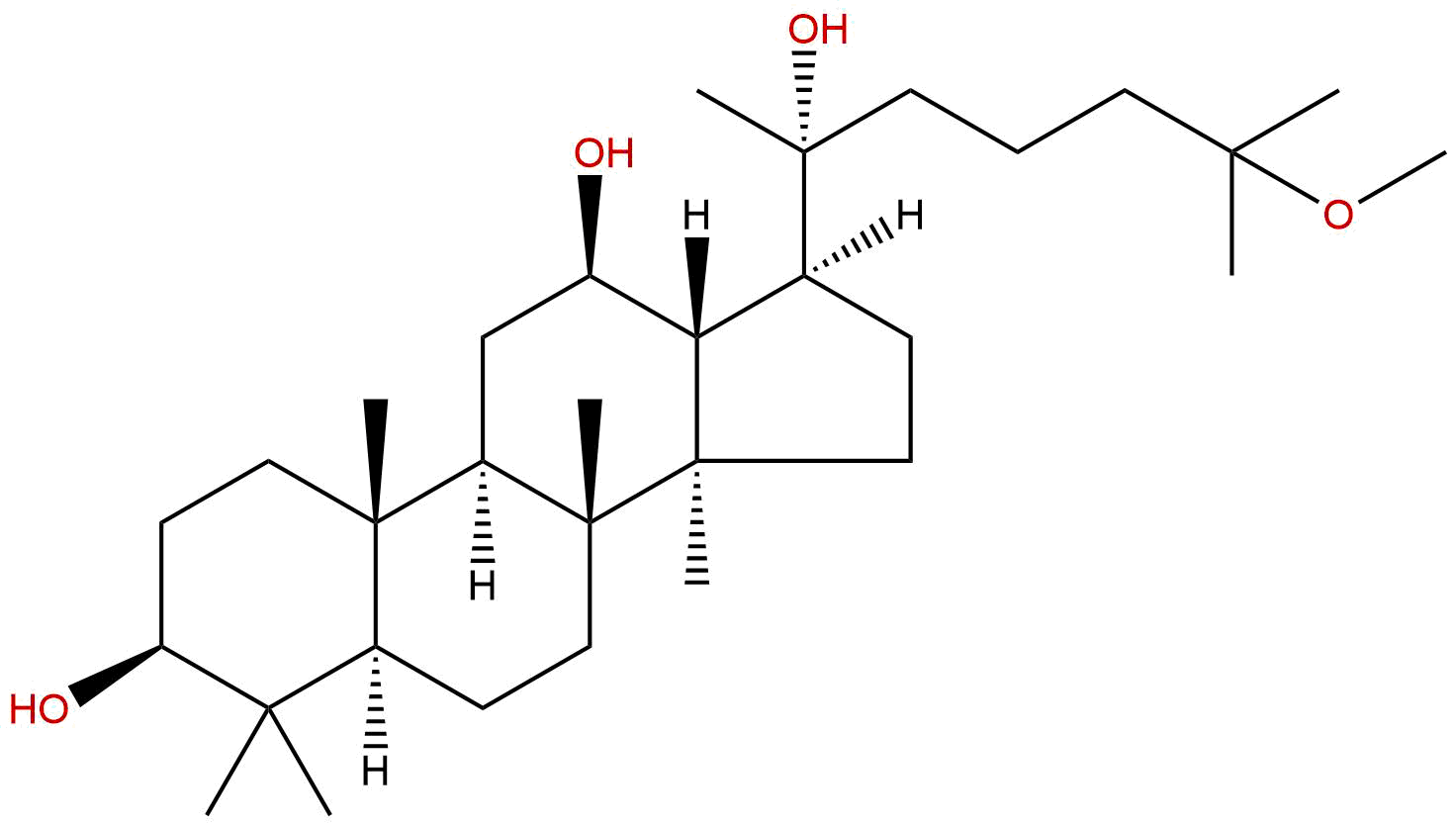
The molecular formula of 20 (R) -25 methoxy protopanaxadiol is C31H56O4, with a molecular weight of 492.7850. Its core structure is a tetracyclic triterpenoid damaane skeleton, with the following specific features:
1. Stereochemical configuration The C-20 position is in the R configuration (20 (R)), which is a key feature that distinguishes it from the common 20 (S) - configuration of protopanaxadiol. The three-dimensional configuration of C-25 is usually S-shaped.
2. functional group There is a free hydroxyl group (- OH) at positions C-3 and C-12, which is an important functional group for its pharmacological activity. The C-25 junction has a methoxy group (- OCH3), which is the origin of its name and one of the important reasons why its activity is significantly stronger than PPD.
3. parent nucleus It has a typical Damaran type structure, consisting of four rings A/B/C/D.
Based on its chemical structure, its theoretical physicochemical properties parameters are as follows:
* Lipid water partition coefficient (LogP)The calculated value is approximately 6.0672, indicating that the compound has a high degree of lipophilicity.
* Topological Polarity Surface Area (TPSA)Approximately 69.92 Å ², mainly derived from two hydroxyl groups and one ether bond.
* Water solubility Extremely low, with a predicted value of approximately 0.0005 mg/mL. The high LogP and low TPSA determine that it is almost insoluble in water, which poses a challenge for its formulation development.
* Blood-brain barrier permeability Predicted as low. Although it has high lipid solubility, its molecular weight is relatively large (close to 500) and there are polar groups present, which may limit its ability to freely pass through the blood-brain barrier.
* HERG inhibition risk A prediction of 'no' indicates a low risk of potential arrhythmias (QT interval prolongation), which is a favorable pharmacological feature.
* Ames test prediction The predicted value is 0.0, indicating that it may not have direct genetic toxicity, but further experimental verification is needed.
In summary, 20 (R) -25-OMe PPD is a highly lipophilic and low water soluble dammarane type triterpenoid compound, and its unique 20 (R) configuration and 25 methoxy substitution are the structural basis for its high activity.
Plant sources and extraction methods
20 (R) -25 methoxy protopanaxadiol is not the main native saponin in plants of the Panax genus. It has very little content in natural plants and is mainly obtained through the following two ways:
-
Semi synthetic pathway (main source)This is currently the most commonly used method to obtain sufficient amounts of 20 (R) -25-OMe PPD for pharmacological research. Usually, abundant ginsenosides (such as Rb1, Rc, Rb2, Rd, etc.) or their aglycone protopanaxadiol (PPD) are used as starting materials. Extracted from ginseng(Panax ginseng C. A. Mey.)、 American ginseng(Panax quinquefolius L. Or Sanqi(Panax notoginseng Saponins of Burk. F. H. Chen are hydrolyzed with acid, alkali, or enzyme to obtain a mixture of 20 (S) - PPD or 20 (R) - PPD. Subsequently, selective methylation modification was carried out at the C-25 position through chemical methods, and chiral separation or asymmetric synthesis was performed to obtain high-purity 20 (R) -25 methoxy protopanaxadiol. This method has strong controllability and can meet the needs of basic research.
-
Natural extraction and biotransformation There are research reports that trace amounts of C-25 oxidized or methylated derivatives may be produced during the biotransformation of ginsenosides in processed products of ginseng (such as red ginseng) or through microorganisms (such as certain fungi or bacteria), which may include 20 (R) -25-Ome-PPD or its analogues. However, the efficiency of directly isolating and purifying this compound from plants is extremely low, making it difficult to obtain sufficient samples.
Summary of Extraction and Purification Process(Taking semi synthesis as an example):
* Raw material extraction Ginseng roots were extracted with alcohol and enriched with macroporous resin to obtain total saponins.
* Glycoside preparation Total saponins are hydrolyzed by heating under acidic conditions to obtain a mixed aglycone containing 20 (S) - and 20 (R) - PPD.
* chemical modification Mixed PPD undergoes C-25 methylation reaction under specific conditions (such as using iodomethane and base) to obtain a 25 methoxy-PPD mixture.
* Separation and purification Using preparative high-performance liquid chromatography (HPLC), especially chiral chromatography columns, separate 20 (R) -25-OMe PPD from 20 (S) - isomer and other by-products.
* Structural Identification By means of nuclear magnetic resonance (NMR, including 1H, 13C, 2D-NMR), mass spectrometry (MS), infrared spectroscopy (IR), and specific rotation determination, the chemical structure and stereoconfiguration of the compound were confirmed.
Pharmacological activity research
The most notable pharmacological activity of 20 (R) -25 methoxy protopanaxadiol is its broad-spectrum and potent anti-tumor effect. Numerous in vitro and in vivo studies have confirmed its inhibitory activity against various human cancer cells.
1. Antitumor activity
* In vitro cytotoxicity 20 (R) -25-OMe PPD exhibits significant proliferation inhibition and cytotoxicity against various tumor cell lines, with IC50 values typically at micromolar (μ M) or even sub micromolar levels, and its activity is generally stronger than its parent compound PPD. Sensitive cell lines include lung cancer (such as A549, NCI-H460), liver cancer (HepG2, SMMC-7721), breast cancer (MCF-7, MDA-MB-231), colon cancer (HCT-116, SW480), prostate cancer (PC-3, LNCaP), gastric cancer (SGC-7901) and glioma (U87, U251).
* In vivo anti-tumor efficacy: In nude mice transplanted tumor model (such as human lung cancer A549, liver cancer HepG2, breast cancer MDA-MB-231 transplanted tumor), intraperitoneal injection or intragastric administration of 20 (R) -25-OMe-PPD can inhibit tumor growth in a dose-dependent manner, and the animal tolerance is relatively good, without significant weight loss or organ toxicity.
* Function characteristics:
* Inducing apoptosis It can significantly induce apoptosis of tumor cells, manifested as cell shrinkage, chromatin condensation, phosphatidylserine eversion, and activation of caspase-3/9.
* Inhibition of proliferation Blocking the cell cycle mainly involves blocking cells in the G0/G1 or G2/M phase, inhibiting DNA synthesis.
* Anti invasion and metastasis It can effectively inhibit the migration and invasion ability of tumor cells, which is closely related to its downregulation of the expression of matrix metalloproteinases (such as MMP-2, MMP-9).
* Angiogenesis inhibition Has shown the potential to inhibit angiogenesis in both in vivo and in vitro models.
2. Other potential activities
In addition to anti-tumor effects, based on its structural similarity with certain neuroprotective or anti-inflammatory saponins, it is speculated that it may have potential activities such as neuroprotection and anti-inflammatory effects. However, there are few related research reports and further exploration is needed.
Mechanism of action and molecular targets
The anti-tumor effect of 20 (R) -25 methoxy protopanaxadiol involves synergistic regulation of multiple targets and pathways, and its mechanism of action is complex and refined.
1. Regulating apoptosis related proteins (targeting MCL1 and BCL2)
* effect 20 (R) -25-OMe PPD can downregulate the expression of anti apoptotic proteins Bcl-2 and Mcl-1, while upregulating the expression of pro apoptotic protein Bax, leading to a decrease in mitochondrial membrane potential, release of cytochrome C, and activation of caspase cascade reaction, inducing endogenous apoptosis pathway. Its regulation of MCL1 is particularly significant.
2. Inhibit the STAT3 signaling pathway
* effect Signal transduction and transcription activator 3 (STAT3) is an important oncogenic transcription factor. This compound can inhibit the phosphorylation (activation) of STAT3, prevent its nuclear translocation, thereby downregulating the expression of downstream target genes (such as Bcl-2, Mcl-1, Cyclin D1, MMP-2, etc.), achieving multiple effects of inhibiting proliferation, inducing apoptosis, and anti metastasis.
3. Inhibit tumor adaptation mediated by HIF-1 α
* effect Under hypoxic conditions, tumor cells adapt to their environment by activating hypoxia inducible factor-1 alpha (HIF-1 alpha). 20 (R) -25-OMe PPD can inhibit the protein accumulation and transcriptional activity of HIF-1 α, thereby interfering with tumor glucose metabolism reprogramming (Warburg effect) and angiogenesis, and enhancing tumor sensitivity to chemotherapy.
4. Inhibit matrix metalloproteinases (targeting MMP2)
* effect By inhibiting the mRNA and protein expression of MMP-2 (and MMP-9), the ability of tumor cells to degrade extracellular matrix is directly weakened, which is one of the core mechanisms of their anti invasion and anti metastasis.
5. Interference with DNA topoisomerase activity (targeting TOP1, TOP2A)
* effect Research has shown that it can inhibit the activity of topoisomerase I (TOP1) and topoisomerase II alpha (TOP2A), interfere with DNA replication, transcription, and repair processes, lead to DNA damage, and thus exert cytotoxic effects.
6. Regulating the MAPK/ERK signaling pathway (targeting MAPK1)
* effect It has an inhibitory effect on the phosphorylation of extracellular signal regulated kinase 1/2 (MAPK1/3). The MAPK/ERK pathway typically promotes cell proliferation and survival, and inhibiting this pathway contributes to its anti proliferative and pro apoptotic effects.
7. Intervention in estrogen signaling pathway (targeting ESR1, CYP19A1)
* effect For estrogen receptor alpha (ESR1) positive breast cancer (such as MCF-7 cells), 20 (R) -25-OMe PPD shows the characteristics of selective estrogen receptor modulator (SERM), which may antagonize the transcription activity of estrogen receptor. At the same time, it can also inhibit the activity of aromatase (CYP19A1), which is the key enzyme for the conversion of androgen to estrogen. Inhibiting its activity can reduce the estrogen level in the body, which is of significance for the treatment of hormone dependent breast cancer.
Mechanism network integration These targets and pathways do not exist in isolation. For example, inhibition of STAT3 can lead to downregulation of Bcl-2/Mgl-1; Inhibition of HIF-1 α can affect the expression of MMPs; Inhibition of MAPK signaling is associated with cell cycle arrest. 20 (R) -25-OMe PPD exerts synergistic anti-tumor effects by simultaneously acting on multiple nodes in this network, which may also help overcome the problem of resistance to single target drugs.
Evaluation of drug properties and pharmacokinetics
Although the pharmacological activity of 20 (R) -25 methoxy protopanaxadiol is clear, its medicinal properties still face challenges, and related research is gradually deepening.
1. Analysis of pharmacological parameters
* Advantage Moderate molecular weight (<500), no predicted hERG inhibition and genotoxicity (Ames negative), providing favorable signals for its preliminary safety assessment.
* Main challenges:
* Poor solubility The extremely high LogP (>5) and extremely low water solubility are the biggest obstacles to its development into oral or injectable forms, seriously affecting its absorption and bioavailability.
* Permeability and Distribution High lipid solubility is beneficial for transmembrane absorption, but low solubility limits its dissolution in gastrointestinal fluids. The prediction of blood-brain barrier permeability is low, which may not be conducive to the treatment of brain tumors, but it also reduces the risk of central nervous system side effects.
* Metabolism and excretion As a triterpenoid compound, it is likely to undergo extensive phase I (such as CYP450 enzyme mediated hydroxylation) and phase II (glucuronidation, sulfation) metabolism in the liver. Its metabolites, major metabolic enzymes, and excretion pathways still need to be clearly studied.
2. Progress in pharmacokinetic research
At present, there are limited reports on the pharmacokinetic studies of the 20 (R) -25-OMe PPD system, but it can be inferred from the research on its analog PPD.
* absorb After oral administration, its absolute bioavailability may be low due to low solubility and potential effects on intestinal metabolism and efflux pumps (such as P-gp).
* distribution Once absorbed, due to its high lipid solubility, it may be widely distributed in tissues such as fat and liver, and the plasma protein binding rate is expected to be high.
* Metabolism and excretion The liver is the main metabolic organ. The prototype drug and its metabolites may be mainly excreted through bile and feces, with a small portion excreted through the kidneys.
3. Formulation strategy and structural optimization
To enhance its medicinal properties, the main strategies include:
* New drug delivery system Developing nano formulations is a highly promising direction. For example, preparing it into liposomes, nanomicelles, solid lipid nanoparticles, polymer nanoparticles, etc. can significantly improve its water solubility and stability, enhance passive targeting of tumor sites (EPR effect), and may improve its pharmacokinetic behavior.
* Prodrug design Connect hydrophilic groups (such as phosphate esters, amino acid esters, polyethylene glycol chains) to their free hydroxyl groups (C-3 or C-12 positions) to make prodrugs, in order to improve water solubility and bioavailability, and then release the original drug through enzymatic interpretation in vivo.
* Eutectic/co amorphous Prepare drug co crystals or amorphous solid dispersions with suitable co morphs to improve dissolution rate.
Clinical application prospects and prospects
20 (R) -25 methoxy protopanaxadiol, as an efficient anti-tumor lead compound, has broad prospects for clinical application and development, but there are also many breakthroughs needed.
1. Development prospects
* New anti-tumor candidate drugs Its multi-target mechanism of action helps to overcome tumor heterogeneity and drug resistance, and is expected to be developed as a single drug or combination drug for the treatment of solid tumors such as lung cancer, liver cancer, breast cancer, colorectal cancer, etc.
* Combination therapy sensitizer Given its ability to inhibit pathways related to chemotherapy resistance, such as HIF-1 α and STAT3, when used in combination with conventional chemotherapy drugs (such as cisplatin, paclitaxel, 5-fluorouracil, etc.), it may produce synergistic effects, reduce chemotherapy dosage, alleviate toxic side effects, and reverse drug resistance.
* Hormone dependent tumor treatment Its intervention on estrogen receptor and aromatase provides a new idea for the development of drugs for the treatment of estrogen receptor positive breast cancer and ovarian cancer.
2. Challenges faced
* Drug bottleneck Low solubility and low bioavailability are the primary obstacles to advancing its preclinical and clinical research, which must be addressed through advanced formulation technology.
* Insufficient research in systemic pharmacology At present, research mainly focuses on in vitro cell and a few in vivo transplant tumor models, lacking comprehensive evaluation of their systemic toxicity (long-term toxicity, reproductive toxicity, etc.), detailed pharmacokinetics (ADME), drug interactions, and activity in other disease models.
* Depth of mechanism of action Although multiple targets are known, further molecular and structural biology research is needed to clarify their direct binding sites to each target, binding strength, and the primary secondary relationships and cross dialogues between various pathways.
* mass production The large-scale, low-cost semi synthetic or fully synthetic processes of high-purity 20 (R) -25-OMe PPD need to be optimized.
3. Future research directions
* In depth mechanism exploration Using proteomics, metabolomics, CRISPR screening and other technologies to comprehensively reveal its functional network; Verify its direct interaction with key target proteins through molecular docking and site directed mutagenesis.
* Advanced formulation development and evaluation Focus on promoting the research and development of its nano formulations, and systematically evaluate the efficacy, pharmacokinetics, and safety of nano formulations in animal models.
* Preclinical comprehensive evaluation According to the guidelines for preclinical research of innovative drugs, complete standardized pharmacological (more models), pharmacokinetic, and toxicological studies, and provide a complete data package for their application for clinical trials.
* structural optimization Using it as a lead compound, a systematic structure-activity relationship study was conducted to synthesize a series of derivatives through rational design, with the aim of improving their water solubility and pharmacokinetic properties while maintaining their activity.
Conclusion
20 (R) -25 methoxy protopanaxadiol is a highly active derivative obtained by structural modification of dammarane type ginsenosides. Its unique 20 (R) -25 methoxy structure endows it with significantly stronger anti-tumor activity than the parent nucleus. Research has shown that it forms a multidimensional and synergistic anti-tumor mechanism network by simultaneously acting on multiple key targets such as MCL1, BCL2, STAT3, HIF-1 α, MMP2, TOP1/2, MAPK, and estrogen signaling pathways, demonstrating good therapeutic potential in various tumor models. Although its inherent low water solubility and other drug forming defects are the main bottlenecks in current development, modern pharmaceutical technologies (especially nanotechnology) and medicinal chemistry strategies (prodrug design) provide powerful tools to overcome these obstacles. In the future, by deepening its system pharmacology research, developing efficient delivery systems, and conducting standardized preclinical development, 20 (R) -25 methoxy protopanaxadiol is expected to gradually move from an excellent natural product lead compound to clinical use, providing a new multi-target treatment option for tumor therapy and a successful example for innovative drug development based on natural products.