


Product name: Naringenin
Synonym name: 4',5,7-Trihydroxyflavanone
Catalogue No.: BP0981
Cas No.: 480-41-1
Formula: C15H12O5
Mol Weight: 272.256
Botanical Source: Aurantii fructus immaturus
Physical Description:
Type of Compound: Flavonoids
Purity: 95%~99%
Analysis Method: HPLC-DAD or/and HPLC-ELSD
Identification Method: Mass, NMR
Packing: Brown vial or HDPE plastic bottle
Storage: Store in a well closed container, protected from air and light. Put into refrigerate or freeze for long term storage.
Whenever possible, you should prepare and use solutions on the same day. However, if you need to make up stock solutions in advance, we recommend that you store the solution as aliquots in tightly sealed vials at -20℃. Generally, these will be useable for up to two weeks.
The product could be supplied from milligrams to grams
Inquire for bulk scale.
Chengdu Biopurify Phytochemicals Ltd. is a leading company in the research, development, manufacture and marketing of High Quality Phytochemicals and Extracts(especially Active Ingredients from Traditional Chinese Medicine,TCM), Natural Active Pharmaceutical Ingredients worldwide.
The main services:
A. Supply active ingredients and reference standards of TCM, from mgs to kgs scale
B. Custom extraction and purification, target Herb Active Ingredients
C. Custom synthesis and semi-synthesis for Natural Active Ingredients
D. CR(contract research), CM(contract manufacture) and PD(process development) services from lab scale, pilot scale to commercial scale(GMP is also available)
E. TCM compounds library for drug screen,more than 3000 compounds available, many of them are rare and unique.
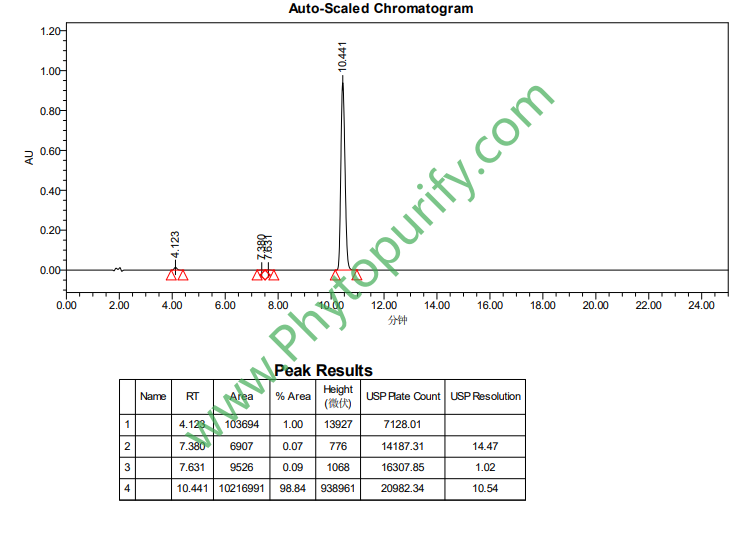
HPLC of Naringenin
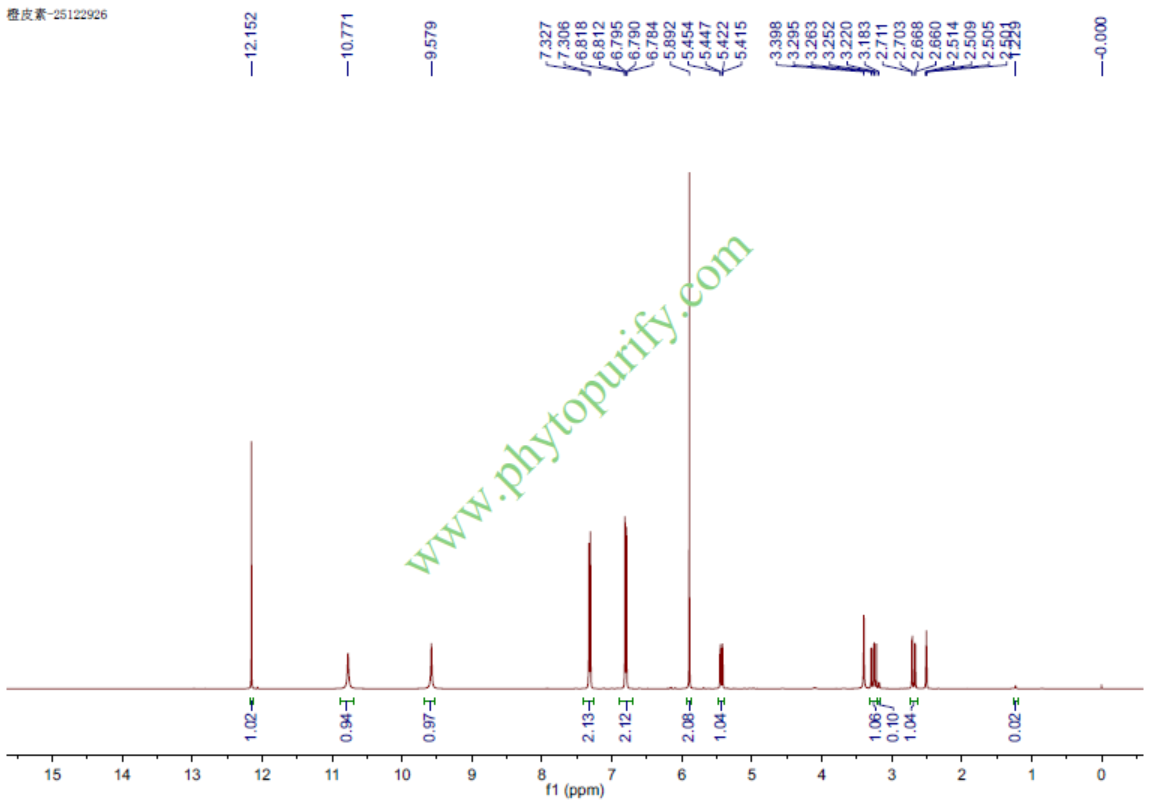
HNMR of Naringenin
Storage conditions:Short-term storage at 2~8℃, long-term storage at -20 ~ -80℃
Naringenin (CAS number: 480-41), as a natural flavanone mainly found in citrus fruits, has attracted much attention in recent years due to its diverse biological activities. Naringin not only exhibits significant anti-inflammatory and antioxidant effects, but has also been proven to have the potential to resist viruses, especially dengue virus (DENV). In addition, the application research of naringin in the prevention and treatment of cardiovascular diseases is becoming increasingly in-depth, involving multiple key molecular targets, reflecting its broad prospects as a natural drug candidate molecule. This article aims to systematically review the chemical structure and physicochemical properties, plant sources and extraction methods, pharmacological activity and mechanism of action, pharmacological evaluation, pharmacokinetic characteristics, and clinical application potential of naringin. The purpose is to provide theoretical basis and research reference for scientific research and drug development in related fields.
Naringin belongs to the class of flavanone compounds, with a molecular formula of C15H12O5 and a molecular weight of 272.2560. Its chemical structure is composed of a typical flavanone skeleton, consisting of two benzene rings (A and B rings) and one oxygen heterocyclic ring (C ring). The specific structure is 5,7,4 '- trihydroxyflavanone. The LogP value of naringin is 2.2375, indicating its moderate lipid solubility, which is beneficial for membrane penetration. The polar surface area (TPSA) is 86.9900, reflecting its moderate molecular polarity and a certain degree of water solubility (0.3040 mg/mL), which has a positive impact on its bioavailability. The low blood-brain barrier permeability of naringin suggests its limited distribution in the central nervous system. The negative result of hERG channel inhibition experiment indicates a low risk of cardiac toxicity. The Ames test score is 0.6, indicating a low risk of genotoxicity and meeting safety requirements.
Naringin is widely present in the fruits, peels, and leaves of citrus plants, with grapefruit (Citrus paradisi), orange (Citrus sinensis), lemon (Citrus limon), and orange (Citrus reticulata) being the main sources. The content of naringin is significantly affected by variety, maturity, and cultivation environment. The traditional extraction method mainly adopts solvent extraction technology, and commonly used solvents include ethanol, methanol, and ethyl acetate. Modern extraction techniques such as ultrasound assisted extraction (UAE), microwave-assisted extraction (MAE), and supercritical fluid extraction (SFE) have improved extraction efficiency and purity, while reducing solvent usage and environmental pollution.
The extraction process usually includes raw material pretreatment (cleaning, drying, crushing), solvent extraction, impurity filtration, concentration, and purification. Purification steps often use column chromatography, reverse phase high-performance liquid chromatography (RP-HPLC), or membrane separation techniques to obtain high-purity naringin. The optimization of extraction process not only affects the yield, but also relates to the biological activity preservation of naringin and the accuracy of subsequent pharmacological research.
Naringin exhibits significant anti-inflammatory activity and can inhibit the expression and release of various pro-inflammatory factors, such as tumor necrosis factor - α (TNF - α), interleukin-6 (IL-6), and nitric oxide synthase (iNOS). Both in vitro cell models and in vivo inflammation models have confirmed that naringin reduces the production of inflammatory mediators by regulating the nuclear factor kappa B (NF - κ B) signaling pathway, thereby alleviating tissue damage and inflammatory response.
Naringin has strong free radical scavenging ability, which can effectively remove superoxide anions, hydroxyl radicals, and reactive oxygen species (ROS) such as hydrogen peroxide. Its antioxidant mechanism mainly includes directly clearing free radicals and upregulating the expression of endogenous antioxidant enzymes (such as superoxide dismutase (SOD) and glutathione peroxidase (GPx)), protecting cells from oxidative stress damage, delaying cell aging and tissue degeneration.
Naringin has shown potential inhibitory effects in anti dengue virus (DENV) research. In vitro experiments have shown that naringin can inhibit the replication of DENV, reduce viral load, and alleviate virus mediated cellular lesions. Its antiviral mechanism may involve blocking virus entry into cells, inhibiting virus protein synthesis, and interfering with virus gene expression, providing important clues for the development of new antiviral drugs.
Naringin has multiple protective effects in the prevention and treatment of cardiovascular diseases, including anti atherosclerosis, lowering blood lipids, improving vascular endothelial function and anti myocardial ischemia reperfusion injury. Its mechanism of action involves regulating lipid metabolism, inhibiting inflammatory reactions and oxidative stress, promoting vasodilation, reducing myocardial cell apoptosis, and comprehensively improving cardiovascular system function.
The multi-target mechanism of action of naringin is the basis of its multiple pharmacological effects. Research on cardiovascular disease-related targets has revealed the molecular network of action of naringin:
The synergistic regulation of these targets constitutes a multidimensional pharmacological network of naringin, laying a solid foundation for its potential as a therapeutic candidate molecule for cardiovascular diseases and related metabolic disorders.
The pharmacological evaluation of naringin shows that it has good drug compatibility. The molecular weight is moderate, and the LogP value indicates good membrane permeability. The TPSA is moderate, which is beneficial for oral absorption. Although its water solubility is not high, its bioavailability can be improved through formulation technology. Naringin does not inhibit hERG channels, reducing the risk of cardiac toxicity. Ames test results show that its genotoxicity is low and its safety is good.
Pharmacokinetic studies have shown that naringin is rapidly absorbed after oral administration, but its bioavailability is limited by first pass metabolism and low water solubility. Naringin is mainly metabolized by the liver, generating various glucuronic acid complexes and sulfate complexes, and excreted mainly through bile and urine. Its blood-brain barrier permeability is low, which limits the potential application of the central nervous system. The half-life of naringin is moderate and suitable for daily administration.
In response to its pharmacokinetic limitations, researchers have attempted to enhance the stability, bioavailability, and targeting of naringin through novel formulation technologies such as nanocarriers, liposomes, and solid dispersions, providing technical support for clinical applications.
Naringin, with its multi-target and multi mechanism pharmacological properties, has shown broad application prospects in the field of cardiovascular disease prevention and treatment. Its anti-inflammatory, antioxidant and metabolic regulating effects provide potential therapeutic strategies for atherosclerosis, hypertension, diabetes, myocardial ischemia and other cardiovascular pathological conditions. In addition, the antiviral activity of naringin, especially its inhibition of dengue virus, has opened up new directions for the development of antiviral drugs.
Although the research on the clinical application of naringin is still in its preliminary stage, some preclinical and early clinical trials have verified its safety and effectiveness. In the future, with the advancement of formulation technology and pharmacokinetic optimization, naringin is expected to become an important component of natural medicine or adjuvant therapy drugs.
In addition, the potential role of naringin in neurodegenerative diseases, metabolic syndrome, and tumors also deserves further in-depth research. The application of multi omics techniques and systems pharmacology will help reveal its complex network of action and precise targets, promoting the clinical translation of naringin.
As a typical citrus flavanone, naringin has become a hot topic in natural product pharmacology research due to its excellent pharmacological activity and safety. Its multiple mechanisms of action in anti-inflammatory, antioxidant, antiviral, and cardiovascular protection provide rich scientific basis for the development of new natural medicines. In the future, with the advancement of modern medicinal chemistry, pharmacokinetics, and formulation technology, naringin is expected to play a greater role in clinical treatment and benefit a large number of patients. Continued in-depth basic and clinical research will lay a solid foundation for the drug development and application of naringin, promoting it to become an important member of the natural medicine field.
