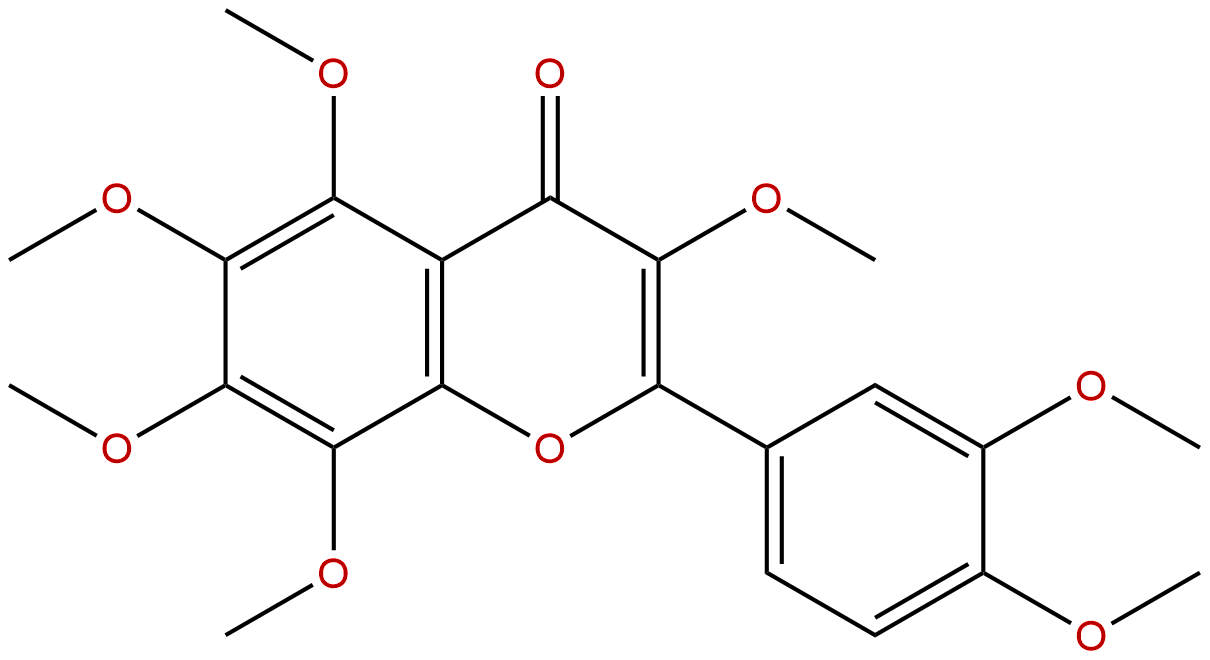


Product name: 3,5,6,7,8,3',4'-Heptamethoxyflavone
Synonym name: 3,3',4',5,6,7,8-Heptamethoxyflavone
Catalogue No.: BP1804
Cas No.: 1178-24-1
Formula: C22H24O9
Mol Weight: 432.425
Botanical Source: Citrus aurantium L.
Physical Description:
Type of Compound: Flavonoids
Purity: 95%~99%
Analysis Method: HPLC-DAD or/and HPLC-ELSD
Identification Method: Mass, NMR
Packing: Brown vial or HDPE plastic bottle
The product could be supplied from milligrams to grams. Inquire for bulk scale.
We provide solution to improve the water-solubility of compounds, thereby facilitating the variety of activity tests and clinic uses.
For Reference Standard and R&D, Not for Human Use Directly.
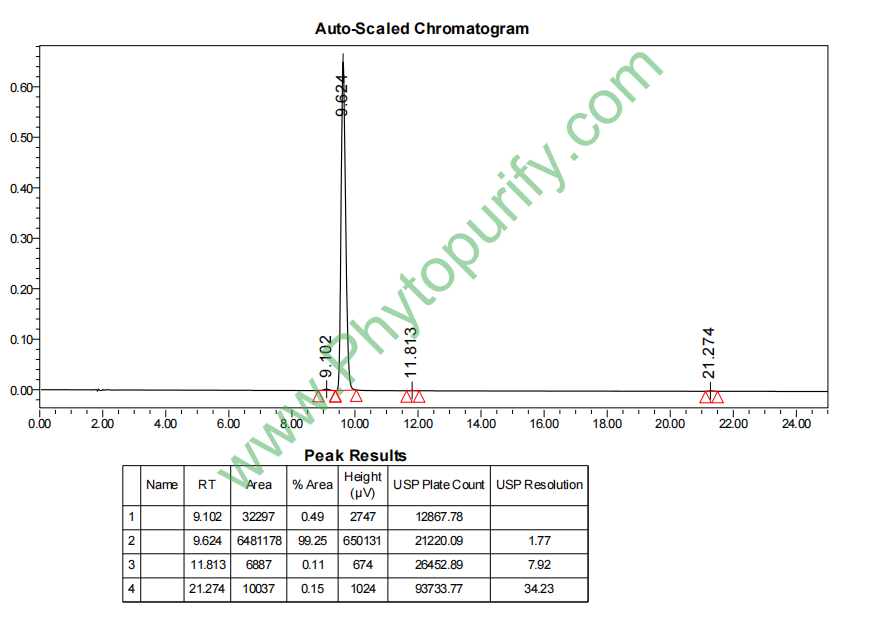
HPLC of 3,5,6,7,8,3',4'-Heptamethoxyflavone
Storage conditions:Short-term storage at 2~8℃, long-term storage at -20 ~ -80℃
94.8200
2.5226
2.5227
.0081
3.0954
28.1188
High
83.1604
2.5491
Yes
No
Yes
No
Yes
No
0.6
Yes
No
No
Yes
Flavonoids are a class of secondary metabolites widely present in the plant kingdom, known for their diverse chemical structures and extensive biological activities. They have shown great potential in fields such as anti-inflammatory, antioxidant, anti-tumor, and neuroprotective effects. Among numerous multi methoxy flavonoids, 3,5,6,7,8,3 ', 4' - heptamethoxyflavone (3,5,6,7,8,3 ', 4' - Heptemethoxyflavone, commonly known as 3-methoxynobiletin, CAS number: 1178-24-1) has received high attention from natural product pharmacology researchers in recent years due to its unique chemical modifications and significant pharmacological activities. Compared with the parent compound naringin, its additional methoxy substitution at C-3 position may significantly alter its physicochemical properties, bioavailability, and interaction mode with biological targets. Existing research, especially in the field of anti-tumor, has preliminarily revealed that this compound has multi-target and multi pathway characteristics in combating malignant tumors such as liver cancer, involving multiple key links such as cell apoptosis induction, cell cycle arrest, and signal pathway inhibition. This article aims to systematically review the chemical properties, plant sources, pharmacological activities, molecular mechanisms of action, pharmacological evaluation, and clinical application prospects of 3,5,6,7,8,3 ', 4' - heptamethoxyflavonoids, in order to provide comprehensive scientific references for the deep development and transformation research of this natural product.
3,5,6,7,8,3 ', 4' - heptamethoxyflavone is a highly methoxylated flavonoid compound. Its basic skeleton consists of 15 carbon atoms (C6-C3-C6), including a benzo - γ - pyranone core. Its structural feature is that the A ring (C-5, C-6, C-7, C-8 positions) and B ring (C-3 ', C-4' positions) of the flavonoid mother nucleus, as well as the C-3 position of the C ring, are all replaced by methoxy groups (- OCH3), totaling seven methoxy groups, hence its name. This dense methoxylation modification significantly enhances its hydrophobicity and affects its physicochemical properties.
According to the provided pharmacological parameters, its molecular weight is 432.4250 Da. The calculated lipid water partition coefficient (LogP) is 2.5226, indicating that the compound has moderate lipophilicity, which is beneficial for its penetration of cell membranes but may also affect its water solubility. Its topological polar surface area (TPSA) is 94.82 Å ², which is relatively low due to its high degree of methoxylation and lack of strong polar groups such as free phenolic hydroxyl groups. The measured water solubility data is 0.0081 mg/mL, which is a difficult to dissolve compound, posing a challenge for its formulation development. It is worth noting that its predicted blood-brain barrier permeability is "high", indicating its potential central nervous system activity, providing a theoretical basis for studying its application in brain diseases such as neurodegenerative diseases or brain tumors. In the preliminary safety screening, its hERG inhibitory activity is' no ', indicating a low risk of causing QT interval prolongation in the heart; The Ames test result is 0.6 (usually considered positive if>1.5), indicating a low risk of mutagenicity, but further in vitro and in vivo genetic toxicity experiments are needed to confirm.
3,5,6,7,8,3 ', 4' - heptamethoxyflavones are mainly found in the fruit peels of citrus plants in the Rutaceae family, especially in certain specific varieties of citrus fruits, and are an important member of the multi methoxyflavones in citrus peels. It often coexists with other methoxyflavones such as tangerine peel extract and tangerine peel extract. Its content is greatly influenced by citrus variety, origin, maturity, and extraction site.
The compound is often extracted from plant materials using organic solvent extraction method. Due to its strong lipophilicity, commonly used solvents include methanol, ethanol, ethyl acetate, chloroform, etc. The typical process for laboratory and small-scale preparation includes crushing dried citrus peel, heating reflux with organic solvents (such as methanol), or ultrasound assisted extraction. The crude extract was obtained by vacuum concentration of the extraction solution. Subsequently, chromatographic techniques are required for separation and purification. The silica gel column chromatography method is commonly used for preliminary separation using gradient elution systems such as petroleum ether ethyl acetate or chloroform methanol. Further purification may require the use of preparative thin-layer chromatography, reverse phase silica gel column chromatography (such as C18 column, eluted with methanol water system), or high-performance liquid chromatography. In recent years, green technologies such as supercritical CO2 extraction have also been explored for the extraction of citrus flavonoids, due to their advantages of no solvent residue and good selectivity, but with high equipment costs. The optimization of extraction and separation processes is crucial for obtaining high-purity 3,5,6,7,8,3 ', 4' - heptamethoxyflavonoids for in-depth pharmacological research.
A large number of in vitro and partially in vivo studies have confirmed that 3,5,6,7,8,3 ', 4' - heptamethoxyflavonoids have a wide range of pharmacological activities, among which anti-tumor activity is the most prominent, especially in liver cancer research where data is abundant.
1. Antitumor activity:
This compound exhibits growth inhibition and cytotoxicity against various human cancer cell lines, with particularly significant activity against liver cancer cells such as HepG2, Huh7, and Hep3B. Research has shown that it can inhibit the proliferation of liver cancer cells in a dose-dependent and time-dependent manner. Its function is not limited to cytotoxicity, but also involves multidimensional regulation of tumor malignant phenotype: it can effectively induce apoptosis of liver cancer cells, leading to a decrease in mitochondrial membrane potential and activation of Caspase cascade reaction; Can block the cell cycle progression, often blocking cells in G0/G1 or G2/M phase, preventing them from entering mitosis; It can also inhibit the migration, invasion, and vasculogenic mimicry of tumor cells, which are closely related to cancer metastasis.
2. Anti inflammatory and immune regulatory activity:
As a multi methoxy flavonoid, it usually has good anti-inflammatory potential. Research has shown that this compound can inhibit the excessive production of nitric oxide (NO) and prostaglandin E2 (PGE2) in macrophages induced by stimuli such as lipopolysaccharides, and downregulate the expression of inducible nitric oxide synthase and cyclooxygenase-2. It can also inhibit the release of various pro-inflammatory cytokines such as TNF - α, IL-1 β, IL-6. These effects suggest that it has intervention potential for chronic inflammation related diseases, including inflammation driven cancers.
3. Antioxidant and neuroprotective activities:
Although its direct free radical scavenging ability may be weaker than that of polyhydroxyflavonoids due to the substitution of phenolic hydroxyl groups with methoxy groups, studies have shown that it can exert indirect antioxidant effects by activating the cell's own antioxidant defense system, such as the Nrf2/ARE pathway. Due to its high blood-brain barrier permeability, its application in neuroprotection has attracted much attention. Preliminary research suggests that it may have a protective effect against beta amyloid induced neurotoxicity, glutamate excitotoxicity, and oxidative stress-related neuronal damage, providing a new candidate for the prevention and treatment of neurodegenerative diseases such as Alzheimer's disease and Parkinson's disease.
4. Other activities:
In addition, there have been studies reporting that this compound has potential activities in antiviral, antibacterial, and improving metabolic syndrome (such as regulating lipid metabolism and improving insulin resistance), but related research is still in its infancy and further exploration is needed.
The anti-tumor effect, especially the anti liver cancer effect, of 3,5,6,7,8,3 ', 4' - heptamethoxyflavone is not achieved through a single target, but through a complex multi-target network synergistic effect. According to the provided target information, its mechanism of action can be summarized as follows:
1. Inducing apoptosis and regulating apoptosis related proteins:
This compound can upregulate pro apoptotic proteins (such as Bax) and downregulate anti apoptotic proteins BCL2 This expression disrupts mitochondrial membrane stability, triggering cytochrome C release and Caspase dependent apoptosis pathways. Meanwhile, it can inhibit transcription factors STAT3 Phosphorylation and activation. STAT3 is an important oncogene that continuously activates to promote cell proliferation, survival, and inhibit apoptosis. Inhibition of STAT3 signaling can directly lead to downregulation of downstream anti apoptotic genes (such as Mcl-1, Survivor) expression.
2. Inhibit key survival promoting and inflammatory signaling pathways:
* NF - κ B pathway This compound can inhibit IKBKB The activity of NF - κ B inhibits the degradation of I κ B α, thereby suppressing the NF - κ B complex (whose key subunit is RELA/p65)Nuclear translocation and transcriptional activity. Inhibition of the NF - κ B pathway can effectively reduce the expression of pro-inflammatory cytokines and pro survival genes.
* PI3K/Akt pathway As a key catalytic subunit of this pathway,PIK3CA The activity or downstream signals of this compound may be interfered with, leading to a decrease in Akt phosphorylation levels, which in turn affects cell growth, metabolism, and survival.
* MAPK/ERK pathway: Yes MAPK1 Inhibition affects the downstream transmission of growth factor signals and interferes with the regulation of cell proliferation and differentiation.
3. Interference with DNA metabolism and telomere maintenance:
This compound has been reported to serve as TOP1 and TOP2A The inhibitor. Topoisomerase plays a crucial role in DNA replication, transcription, and repair. Inhibiting its activity can lead to the accumulation of DNA damage, triggering activation of cell cycle checkpoints and apoptosis. In addition, for telomerase reverse transcriptase TERT Inhibition may weaken the potential for unlimited proliferation of cancer cells.
4. Inhibit tumor microenvironment adaptation:
By downregulating hypoxia inducible factor HIF1A The protein level or activity of this compound can disrupt the adaptability of tumor cells in hypoxic environments, inhibit the expression of genes related to angiogenesis, glycolysis, and invasion and metastasis mediated by it.
In summary, 3,5,6,7,8,3 ', 4' - heptamethoxyflavonoids form a "multi pronged" anti-cancer mechanism by simultaneously acting on multiple key targets and pathways mentioned above. This helps to overcome the problem of drug resistance that single target drugs are prone to, but also brings complexity to the complete elucidation and specific evaluation of their mechanism of action.
Although 3,5,6,7,8,3 ', 4' - heptamethoxyflavonoids exhibit strong biological activity in vitro, their drug affinity and in vivo pharmacokinetic behavior are key factors determining their successful conversion into drugs.
Drug analysis:
According to the "Five Principles of Similar Drugs", its molecular weight (432.4) is slightly higher than the ideal value (<500), but still within an acceptable range. The LogP value (~2.52) is in the ideal range (1-3), which is beneficial for oral absorption and membrane permeation. The main challenge lies in its extremely low water solubility (0.0081 mg/mL), which may lead to low oral bioavailability. Its low TPSA value, combined with moderate LogP, explains its predicted high blood-brain barrier permeability. The preliminary negative results of hERG and Ames have given the green light for its safety assessment, but comprehensive preclinical toxicology studies (such as acute toxicity, long-term toxicity, reproductive toxicity, etc.) have not been systematically reported, which is a gap that must be filled in future development.
Pharmacokinetic studies:
At present, there is relatively limited pharmacokinetic research on this compound system, but speculation can be made based on its structural characteristics and studies on similar multi methoxyflavones (such as naringin). Due to its strong lipid solubility and poor water solubility, it may be slowly and incompletely absorbed in the gastrointestinal tract after oral administration. After absorption, it may highly bind to plasma proteins (such as albumin) in the blood. Methoxy groups may undergo demethylation metabolism in the body, generating corresponding hydroxylation products, which may have different activities. The main metabolic site may be in the liver, involving the cytochrome P450 enzyme system (such as CYP1A2, CYP3A4), which then binds to glucuronic acid or sulfuric acid and is excreted through bile and urine. Its high lipid solubility and molecular weight also suggest the possibility of enterohepatic circulation. Clear absolute bioavailability, tissue distribution characteristics, identification of major metabolites, and excretion pathways are key PK parameters that need to be further studied in animal models through standardized radioactive labeling or high-sensitivity LC-MS/MS methods. The formulation strategy (such as nanocrystals, liposomes, solid dispersions, phospholipid complexes, etc.) will be the key to improving their solubility and bioavailability.
3,5,6,7,8,3 ', 4' - heptamethoxyflavone, as a multi-target natural active molecule, has broad clinical application prospects, but also faces many challenges.
Potential application directions:
1. Antitumor adjuvant therapy and new drug development In the treatment of liver cancer, its multi-target nature makes it a potential sensitizer or combination therapy partner for traditional chemotherapy drugs or targeted drugs (such as sorafenib) to enhance efficacy, reduce dosage, and delay drug resistance. It can also serve as a lead compound for structural optimization and the development of novel anticancer drugs with higher activity and better pharmacokinetic properties.
2. Prevention and treatment of neurodegenerative diseases Its high blood-brain barrier permeability and neuroprotective activity make it uniquely valuable in the prevention and early intervention of diseases such as Alzheimer's and Parkinson's, and can be developed as a functional food ingredient or drug.
3. Management of chronic inflammatory diseases For diseases driven by chronic inflammation, such as atherosclerosis, nonalcoholic steatohepatitis, inflammatory bowel disease, its anti-inflammatory and antioxidant effects may provide new treatment ideas.
4. As a dietary supplement or functional food Given that it originates from citrus peel and has relatively high safety, developing citrus extracts rich in this type of multi methoxy flavonoid as a health food for cancer prevention, immune enhancement, cardiovascular and nervous system protection is a feasible market-oriented direction.
Challenges and Future Prospects:
1. Deep analysis of the mechanism of action Chemical biology methods such as affinity fishing, molecular docking and kinetic simulation, CRISPR screening, etc. need to be used to more accurately identify its direct target and elucidate the synergistic or antagonistic relationship network between its multiple targets.
2. Systematic pharmacodynamic and pharmacokinetic studies It is urgent to validate its in vivo anti-tumor effect in various tumor bearing animal models, especially human tumor xenograft models, and complete systematic and standardized ADME studies to clarify its in vivo fate.
3. Formulation technology research and development To address the bottleneck of poor water solubility, innovative delivery systems such as nano formulations must be developed to improve their bioavailability, tumor targeting, and therapeutic index.
4. Comprehensive Security Assessment Conduct comprehensive preclinical toxicology studies to provide a safety basis for its entry into human clinical trials.
5. Source and synthesis Relying on plant extraction may be limited by resources and instability. Developing efficient and green chemical total synthesis or semi synthesis routes is of great significance for ensuring raw material supply and quality control.
3,5,6,7,8,3 ', 4' - heptamethoxyflavone, as a characteristic multi methoxyflavone derived from citrus, has become a highlight molecule in the field of natural product anti-tumor and neuroprotective research due to its unique chemical structure and multi-target pharmacological activity. Its ability to inhibit tumor growth by regulating multiple key pathways such as BCL2, STAT3, NF - κ B, PI3K/Akt, topoisomerase, and HIF-1 α in liver cancer models highlights the advantages of natural product multi-component and multi-target intervention in complex diseases. Despite facing challenges such as poor water solubility in drug formulation, modern pharmaceutical and medicinal chemistry technologies provide possible solutions for this. Future research should focus on revealing its molecular action profile, optimizing its pharmacokinetic properties, and promoting its translation into clinical applications. The study of this compound not only contributes to the development of new therapeutic drugs, but also provides important scientific basis for a deeper understanding of the health benefits of citrus fruits.
