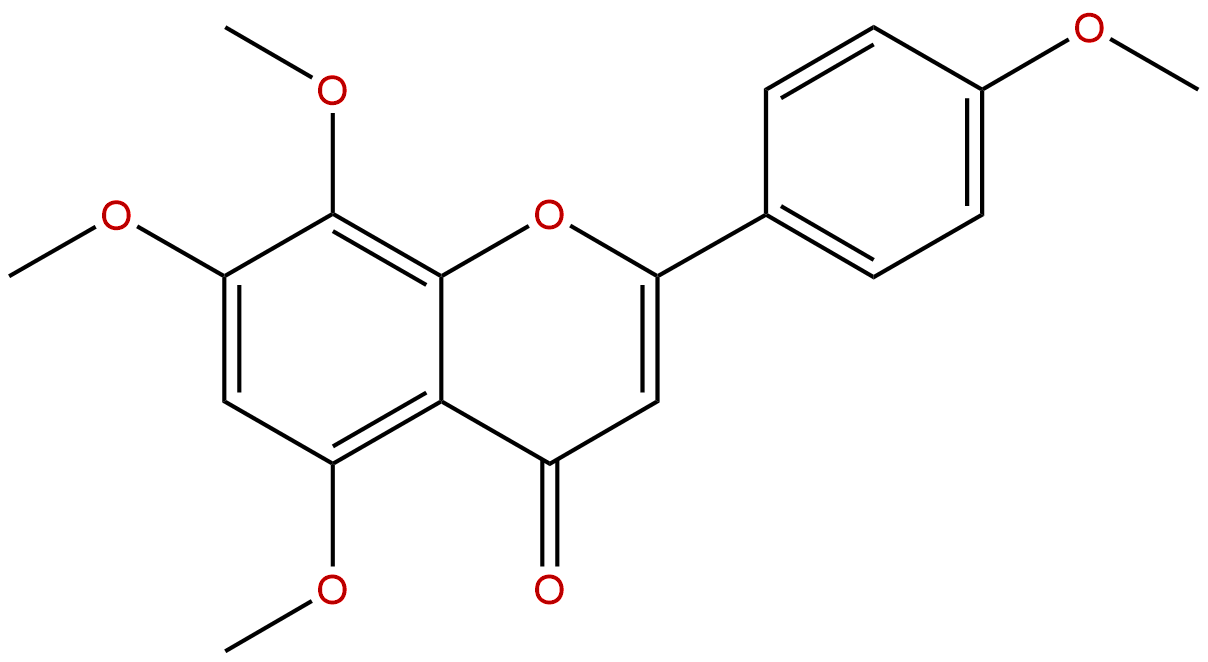


Product name: 6-Demethoxytangeretin
Synonym name: 4',5,7,8-Tetramethoxyflavone; 6-Demethoxytangeritin; Tetra-O-methylisoscutellarein
Catalogue No.: BP1787
Cas No.: 6601-66-7
Formula: C19H18O6
Mol Weight: 342.347
Botanical Source: Citrus sinensis
Physical Description:
Type of Compound: Flavonoids
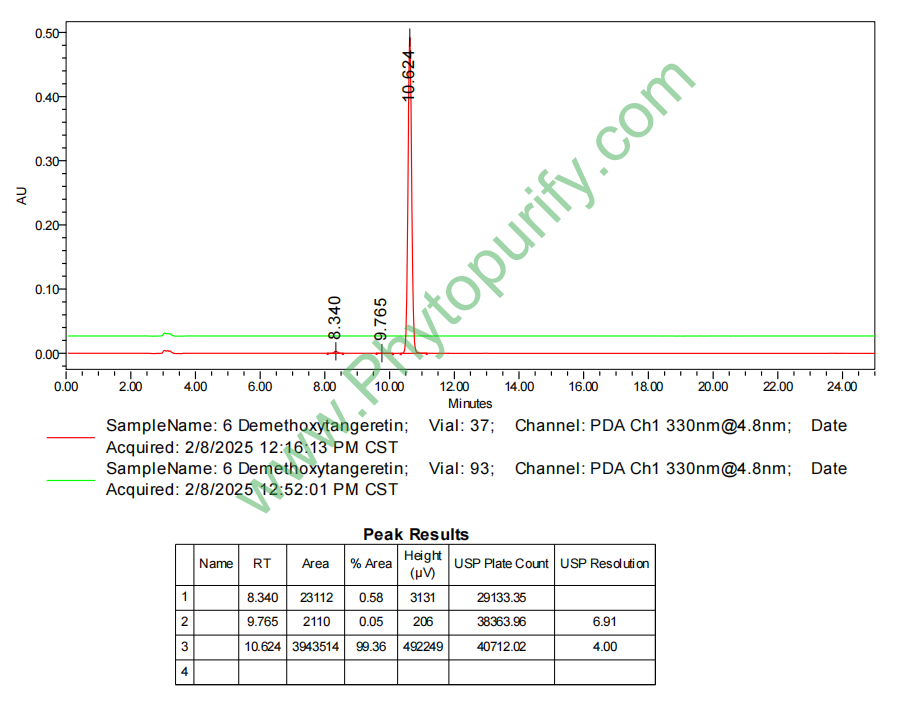
Purity: 95%~99%
Analysis Method: HPLC-DAD or/and HPLC-ELSD
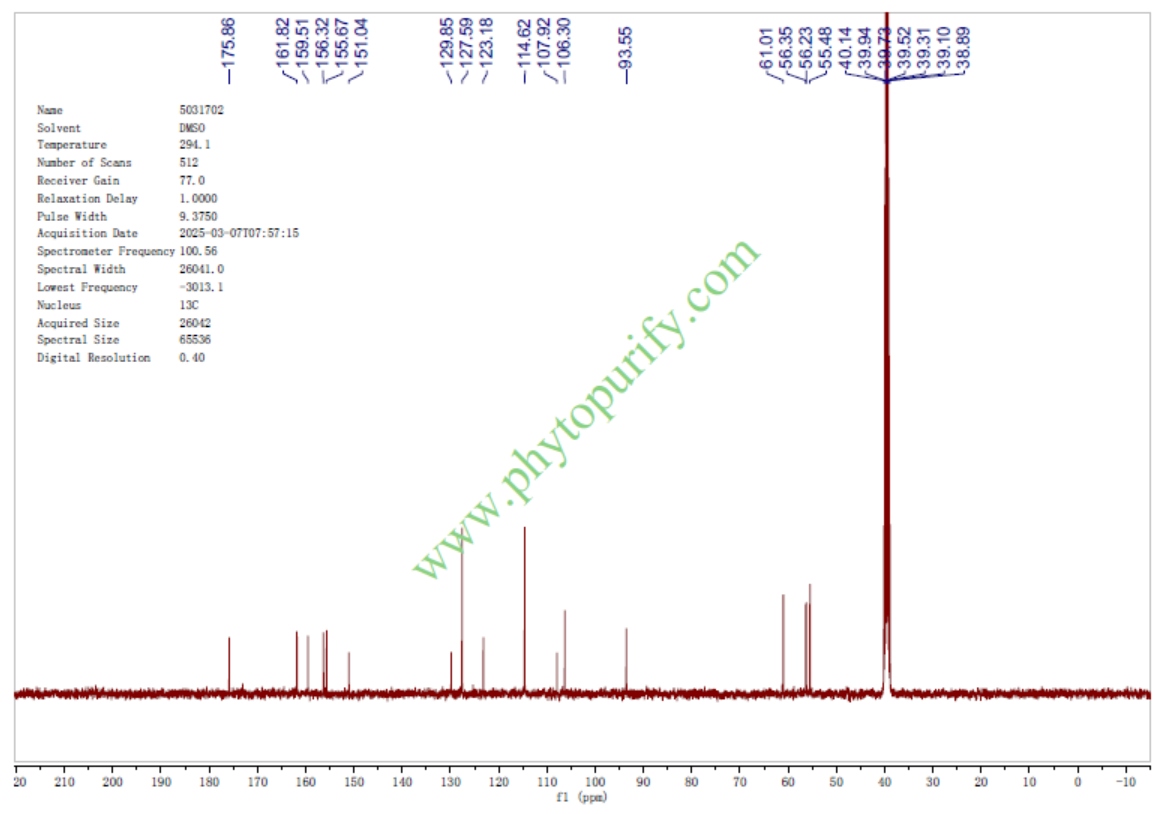
Identification Method: Mass, NMR
Packing: Brown vial or HDPE plastic bottle
The product could be supplied from milligrams to grams. Inquire for bulk scale.
We provide solution to improve the water-solubility of compounds, thereby facilitating the variety of activity tests and clinic uses.
For Reference Standard and R&D, Not for Human Use Directly.
Description:
6-Demethoxytangeretin has anti-inflammatory activity, it also can suppress production and gene expression of interleukin-6 in human mast cell-1 via anaplastic lymphoma kinase and mitogen-activated protein kinase pathways. 6-Demethoxytangeretin can suppress the interleukin 1 (IL-1) induced production of proMMP-9/progelatinase B in rabbit synovial cells in a dose dependent manner (<64 microM).
References:
Biol Pharm Bull. 2013;36(10):1646-9.
6-demethoxynobiletin, a nobiletin-analog citrus flavonoid, enhances extracellular signal-regulated kinase phosphorylation in PC12D cells.
We previously demonstrated that nobiletin, a polymethoxylated flavone isolated from citrus peels, has the potential to improve cognitive dysfunction in patients with Alzheimer's disease (AD). Recent studies suggest that the generation of intraneuronal amyloid-beta (Aβ) oligomers is an early event in the pathogenesis of AD. Aβ oligomers cause deficits in the regulation of the extracellular signal-regulated kinase (ERK) signaling which is critical for consolidation of the memory. Our previous studies revealed that nobiletin activated ERK signaling and subsequent cyclic AMP response element-dependent transcription.
METHODS AND RESULTS:
In this study, the effects of five nobiletin analogs, 6-demethoxynobiletin, tangeretin, 5-demethylnobiletin, sinensetin, and 6-Demethoxytangeretin, isolated from citrus peels were assessed on ERK phosphorylation in PC12D cells, and the structure-activity relationships were examined. PC12D cells were treated with nobiletin or its analogs, and the cell extracts were analyzed by Western blotting using an antibody specific to phosphorylated ERK. 6-Demethoxynobiletin markedly enhanced ERK phosphorylation in a concentration-dependent manner.
CONCLUSIONS:
These results may be useful in developing drugs and functional foods using citrus peels for the treatment of dementia including AD.
J Rheumatol. 2000 Jan;27(1):20-5.
A citrus flavonoid, nobiletin, suppresses production and gene expression of matrix metalloproteinase 9/gelatinase B in rabbit synovial fibroblasts.
Flavonoids including nobiletin are known to exert many biological actions in vitro. We investigated the chondroprotective effect of citrus flavonoids, especially nobiletin, using cultured rabbit synovial fibroblasts and articular chondrocytes.
METHODS AND RESULTS:
We examined the effects of citrus flavonoids on the production and gene expression of matrix metalloproteinases (MMP) and prostaglandin E2 (PGE2)production in rabbit synovial fibroblasts. Six flavonoids isolated from Citrus depressa Rutaceae including tangeretin, 6-Demethoxytangeretin, nobiletin, 5-demethylnobiletin, 6-demethoxynobiletin, and sinensetin suppressed the interleukin 1 (IL-1) induced production of proMMP-9/progelatinase B in rabbit synovial cells in a dose dependent manner (<64 microM); nobiletin most effectively suppressed proMMP-9 production along with the decrease in its mRNA. Nobiletin also reduced IL-1 induced production of PGE2 in the synovial cells, but did not modify the synthesis of total protein. These suppressive effects of nobiletin were also observed in rabbit articular chondrocytes. Nobiletin inhibited proliferation of rabbit synovial fibroblasts in the growth phase.
CONCLUSIONS:
These results suggest nobiletin is a novel antiinflammatory candidate that has the potential to inhibit PGE2 production, matrix degradation of the articular cartilage, and pannus formation in osteoarthritis and rheumatoid arthritis. CONCLUSION: These results suggest nobiletin is a novel antiinflammatory candidate that has the potential to inhibit PGE2 production, matrix degradation of the articular cartilage, and pannus formation in osteoarthritis and rheumatoid arthritis.
HPLC of 6-Demethoxytangeretin
NMRof 6-Demethoxytangeretin
Storage conditions:Short-term storage at 2~8℃, long-term storage at -20 ~ -80℃
67.1300
2.8418
2.8420
.0052
3.2683
41.2730
High
85.7462
2.1695
Yes
No
Yes
No
Yes
No
0.6
No
No
No
Yes
Flavonoids, as one of the most widely distributed plant secondary metabolites in nature, have always been an important source of drug development and functional food development due to their diverse chemical structures and extensive biological activities. Citrus fruits are not only important global economic crops, but also a treasure trove of methoxyflavonoids. 6-Demethoxytangeretin (6-DMT), CAS number 6601-66-7, is a structurally unique and highly active member. As a derivative of Tangeretin, 6-DMT exhibits different physicochemical properties and biological activity spectra due to the lack of a methoxy group in its molecule.
In recent years, with the deepening of research on chronic inflammatory diseases, metabolic syndrome, and neurodegenerative diseases, the multi-target regulatory advantages of natural products have become increasingly prominent. The research on 6-DMT has expanded from early anti-inflammatory and anti allergic activities to explore its potential anti-cancer activities, neuroprotection, and alcoholic liver disease. Its mechanism of action involves precise regulation of key signaling pathways (such as NF - κ B, MAPK, Nrf2, etc.) and specific molecular targets (such as TLR4, AKR1B1, etc.), demonstrating great potential as lead compounds or dietary supplements. This article aims to systematically review the chemical properties, plant sources, pharmacological activities, mechanisms of action, medicinal properties, and clinical application prospects of 6-DMT, in order to provide comprehensive scientific references for the in-depth research and development of this compound.
6-Methoxyhesperidin belongs to the class of multi methoxyflavones, and its chemical name is 5-hydroxy-4 ', 6,7,8-tetramethoxyflavone. Compared with the parent compound hesperidin (5,6,7,8,4 '- pentamethoxyflavone), 6-DMT lacks a methoxy group (- OCH ∝) at the C-6 position and is replaced by a hydroxyl group (- OH). This structural difference is the material basis for its unique biological activity.
Its molecular formula is C ₁₉ H ₁₈ O ₇, and its molecular weight is 342.3470. Based on the analysis of the pharmacological parameters, the lipid water partition coefficient (LogP) of the compound is 2.8418, indicating that it has moderate lipophilicity and is conducive to transmembrane transport and absorption. The topologically polar surface area (TPSA) is 67.13 Å ², which is relatively low due to the presence of multiple methoxy substituents and fewer polar groups in the molecule. However, its water solubility is poor, only 0.0052 mg/mL, which to some extent limits its bioavailability and is a key issue that needs to be overcome in formulation development. It is worth noting that the prediction shows that it has high blood-brain barrier permeability, which provides the possibility for it to exert central nervous system related pharmacological effects (such as promoting CRE mediated transcription in hippocampal neurons). In the preliminary safety screening, its hERG inhibitory activity was negative, indicating a low risk of cardiac toxicity; The Ames test result is 0.6 (usually considered positive if>1.5), indicating a low risk of mutagenicity, but further in vitro and in vivo experiments are needed to confirm.
6-DMT mainly exists in the peel, leaves, and flowers of citrus plants in the Rutaceae family, and is one of the contributors to the characteristic flavor and biological activity of citrus fruits. Common sources include sweet oranges, wide skinned oranges, lemons, grapefruits, etc., especially in the white sponge layer (white skin layer) and oil cell layer of citrus peels where the content is relatively high. Its content is influenced by factors such as citrus variety, origin, maturity, and storage conditions.
The extraction of 6-DMT from plant materials typically follows the general extraction strategy for flavonoids. Traditional methods include organic solvent reflux extraction or cold soaking, with commonly used solvents including methanol, ethanol, acetone, and their mixed solutions with water. Due to the fact that 6-DMT belongs to the class of multi methoxy flavonoids with relatively low polarity, high proportion organic solvents (such as 80-95% ethanol) have better extraction efficiency. Modern extraction techniques such as ultrasound assisted extraction, microwave-assisted extraction, and supercritical CO ₂ extraction have been widely used, which can significantly shorten extraction time, improve yield, and reduce solvent consumption.
The crude extract after extraction needs further separation and purification to obtain high-purity 6-DMT. The conventional separation steps include: liquid-liquid distribution using different polar solvents such as petroleum ether and ethyl acetate to preliminarily enrich the target components; Subsequently, silica gel column chromatography, polyamide column chromatography or dextran gel column chromatography were used for separation; The final high-purity preparation relies on high-performance liquid chromatography, especially preparative HPLC. Structural identification involves the comprehensive use of techniques such as ultraviolet spectroscopy, infrared spectroscopy, mass spectrometry, and nuclear magnetic resonance spectroscopy.
Numerous in vitro and in vivo pharmacological studies have shown that 6-DMT has multiple biological activities, with its core revolving around anti-inflammatory, antioxidant, and cell protective effects.
The pharmacological effects of 6-DMT are not achieved through a single target, but exhibit typical natural product multi-target and multi pathway synergistic effects. The network of action for diseases such as alcoholic liver disease is relatively clear:
Although 6-DMT has shown good pharmacological activity, its pharmacological development still faces challenges, and pharmacokinetic studies are relatively limited.
Absorption, distribution, metabolism, excretion (ADME):
Challenges and optimization strategies for drug development:
Based on its multi-target and multi effect pharmacological properties, 6-DMT has broad development prospects in multiple disease fields:
Future research should focus on: 1) conducting systematic preclinical pharmacological and safety evaluations; 2) Thoroughly elucidate its precise metabolic pathways and main active metabolites in vivo; 3) Using modern technologies such as crystallography and computer simulations to accurately analyze the interaction patterns between it and key targets such as AKR1B1 and TLR4 complexes; 4) Explore advanced drug delivery systems to overcome their solubility bottlenecks.
6-Methoxyhesperidin, as a multi methoxy flavonoid derived from citrus, has become a highlight molecule in the pharmacological research of natural products due to its unique chemical structure and rich biological activity. From anti-inflammatory and anti allergic effects to protective effects against multiple systemic diseases such as alcoholic liver disease, its pharmacological value is constantly being explored. Its mechanism of action clearly outlines a multi-target regulatory network, involving core signaling pathways such as TLR4/NF - κ B, Nrf2/ARE, MAPK, as well as regulation of key targets such as AKR1B1 and SREBF1. Despite facing challenges such as poor water solubility in drug development, these obstacles are expected to be overcome through the optimization of modern medicinal chemistry and formulation methods. With the continuous deepening of research, 6-DMT is expected to move from the laboratory to clinical applications, providing a new natural source of choice for the prevention and treatment of chronic inflammatory, metabolic, and neurodegenerative diseases. At the same time, it will also enhance the added value of citrus by-products and achieve efficient utilization of resources.
