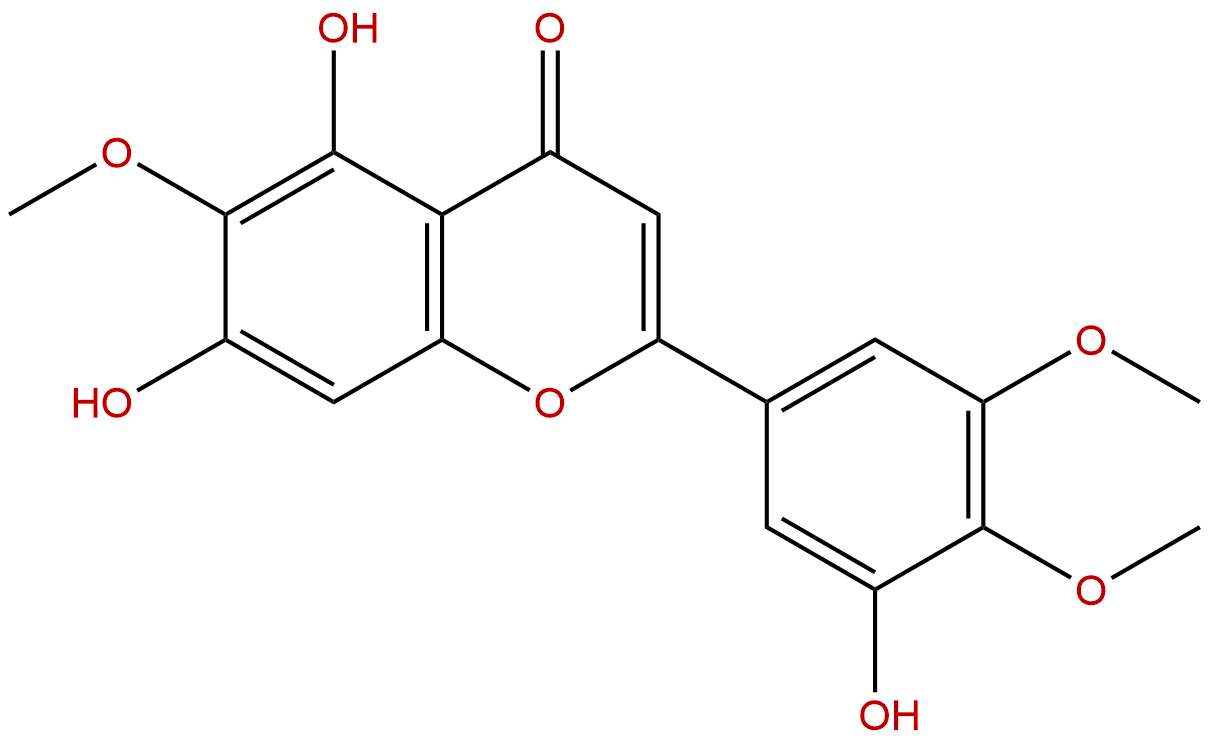


Product name: 5,7,3'-Trihydroxy-6,4',5'-trimethoxyflavone
Synonym name:
Catalogue No.: BP1766
Cas No.: 78417-26-2
Formula: C18H16O8
Mol Weight: 360.318
Botanical Source: Eupatorium capillifolium; Artemisia argyi
Physical Description:
Type of Compound: Flavonoids
Purity: 95%~99%
Analysis Method: HPLC-DAD or/and HPLC-ELSD
Identification Method: Mass, NMR
Packing: Brown vial or HDPE plastic bottle
The product could be supplied from milligrams to grams. Inquire for bulk scale.
We provide solution to improve the water-solubility of compounds, thereby facilitating the variety of activity tests and clinic uses.
For Reference Standard and R&D, Not for Human Use Directly.
Description:
5,7,3'-Trihydroxy-6,4',5'-trimethoxyflavone is a natural product from Artemisia argyi.
References:
Nat Prod Commun. 2014 Feb;9(2):163-4.
Further characterization of foliar flavonoids in Crossostephium chinense and their geographic variation.
METHODS AND RESULTS:
Foliar flavonoids of Crossostephium chinense in Japan and Taiwan were isolated and further characterized. Eighteen flavonoid aglycones, luteolin, apigenin, hispidulin, chrysoeriol, 5,7,4'-trihydroxy-6,3',5'-trimethoxyflavone, jaceosidin, cilsimaritin, quercetin 3-methyl ether, axillarin, chrysosplenol-D, cirsiliol, apometzgerin, 5,7,3'-Trihydroxy-6,4',5'-trimethoxyflavone, luteolin 3',4'-dimethyl ether, cirsilineol, eupatilin, nepetin and 5,7,3',4'-tetrahydroxy-6,5'-dimethoxyflavone, were identified by UV, 1H and 13C NMR spectroscopic, LC-MS and HPLC comparisons w ith authentic samples. The compounds existed on the leaf surface. Four flavonoid glycosides, quercetin 3,7-di-O-glucoside, quercetin 3-O-rutinoside, luteolin 7-O-glucoside and apigenin 7-O-rutinoside, were also isolated as the intracellular flavonoids.
CONCLUSIONS:
It was shown by HPLC survey that variation of the species' flavonoids occurs among the collection sites.
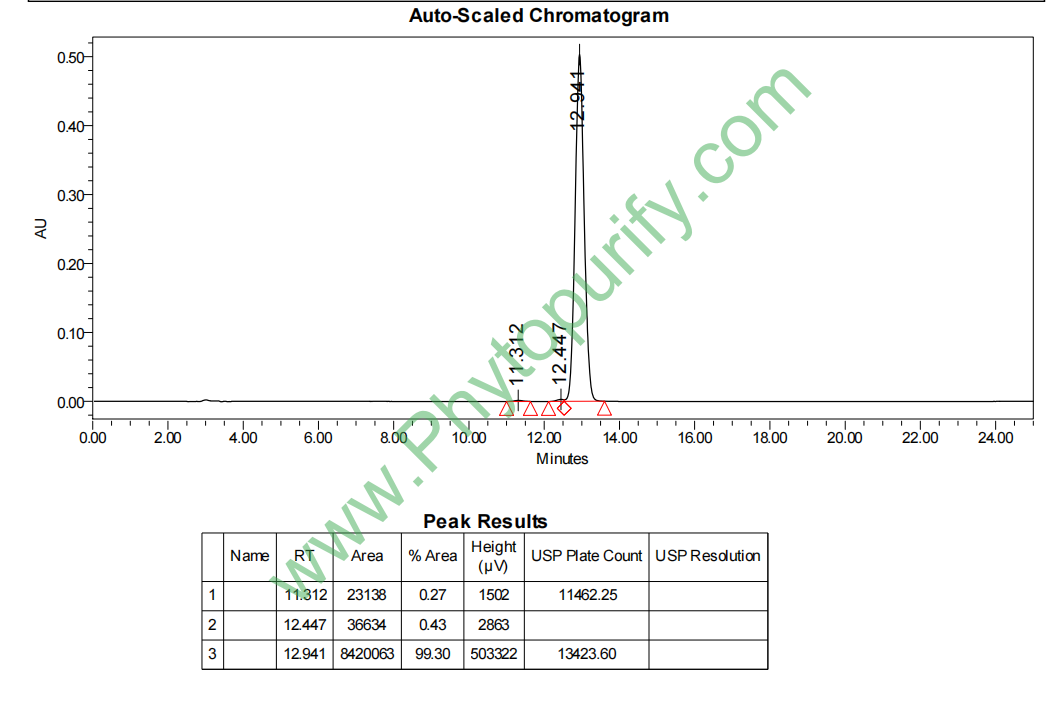
HPLC of 5,7,3'-Trihydroxy-6,4',5'-trimethoxyflavone
Storage conditions:Short-term storage at 2~8℃, long-term storage at -20 ~ -80℃
118.5900
2.2266
1.9015
.0159
3.7541
22.0470
Low
89.9315
2.6316
Yes
No
Yes
No
Yes
No
0.6
Yes
No
Yes
No
Flavonoids are a class of polyphenolic secondary metabolites widely present in nature, known for their diverse chemical structures and extensive biological activities, and have attracted much attention in the fields of drug discovery and functional food development. Among them, multi methoxy flavonoids usually exhibit better bioavailability and pharmacological activity than their hydroxy analogues due to their unique substitution mode. 5,7,3 '- trihydroxy-6,4', 5 '- trimethoxyflavone (CAS: 78417-26-2) is a type of flavonoid molecule with a unique structure. The compound is substituted with methoxy groups at positions C-6, C-4 ', and C-5', while retaining hydroxyl groups at positions C-5, C-7, and C-3 ', forming a mixed hydroxyl methoxy substitution pattern. This structural feature may endow it with unique electron distribution, molecular polarity, and biological target recognition ability. In recent years, with the development of network pharmacology and molecular docking technology, the potential of this compound in anti-inflammatory and antioxidant fields, especially in the treatment of inflammatory diseases such as pneumonia, has gradually entered the research field. This article aims to systematically review the chemical properties, plant sources, pharmacological activities, mechanisms of action, and medicinal properties of this compound, in order to provide comprehensive scientific references for the in-depth research and potential applications of this natural product.
5,7,3 '- trihydroxy-6,4', 5 '- trimethoxyflavone, molecular formula C18H16O8, molecular weight 360.3180. Its core structure is the classic 2-phenylchromenone skeleton. The specific substitution mode is: the C-5 and C-7 positions of the A ring are hydroxyl groups, and the C-6 position is methoxy; The C-3 'position of the B ring is a hydroxyl group, while the C-4' and C-5 'positions are methoxy groups. The A ring pattern of "5,7-dihydroxy-6-methoxy" is commonly found in various active flavonoids (such as baicalin), while the B ring pattern of "3 '- hydroxy-4', 5 '- dimethoxy" is relatively unique and may be related to specific receptor binding.
From the analysis of physical and chemical properties, the calculated lipid water partition coefficient (LogP) is 2.2266, indicating that the compound has moderate lipophilicity and is conducive to transmembrane transport. The topological polar surface area (TPSA) is 118.59 Å ², reflecting the presence of multiple hydrogen bond donors (3 hydroxyl groups) and acceptors (carbonyl and ether oxygen atoms) in its molecule, which can affect its solubility and interaction with biomolecules. Its water solubility prediction value is relatively low (about 0.0159 mg/mL), making it a poorly soluble compound, which is a key factor to consider in formulation development. Based on its moderate molecular weight, LogP value within the ideal range (usually considered to be 1-3), but high TPSA and poor water solubility, it is preliminarily judged that it meets the three criteria of the five rules for class drugs (molecular weight<500, LogP<5, number of hydrogen bond donors<5, number of hydrogen bond acceptors=10, slightly higher than the upper limit of 10), and belongs to a lead compound with certain development potential but also faces challenges in bioavailability.
5,7,3 '- trihydroxy-6,4', 5 '- trimethoxyflavone has a relatively limited distribution in nature and is mainly found in some traditional medicinal plants, especially in the Asteraceae, Lamiaceae, and Rutaceae families. According to literature reports, this compound can be obtained from wild chrysanthemum The inflorescence of Chrysanthus indicum L mugwort leaf Artemisia argyi and some others Citrus genus Separated from the skin or leaves of plants. These plants are often used in traditional medicine to treat fever, inflammation and infectious diseases, suggesting that this ingredient may be one of the material bases of its efficacy.
Its extraction and separation usually follow the conventional process of natural product chemistry. Firstly, organic solvents such as methanol, ethanol, or acetone are used to extract dry plant materials through leaching or ultrasound assisted extraction. After vacuum concentration, the crude extract was subjected to liquid-liquid distribution and enrichment using solvents such as petroleum ether and ethyl acetate. The compound was mainly concentrated in the ethyl acetate fraction. Further purification depends on column chromatography technology. Silica gel, polyamide or dextran gel (Sephadex LH-20) is often used as the stationary phase, and chloroform methanol, petroleum ether ethyl acetate and other gradient solvent systems are used for elution. High performance liquid chromatography (HPLC) or preparative thin layer chromatography (PTLC) is the final step in obtaining high-purity monomers. Structural identification involves the comprehensive use of techniques such as ultraviolet spectroscopy (UV), mass spectrometry (MS), nuclear magnetic resonance hydrogen spectroscopy, and carbon spectroscopy (1H-NMR, 13C-NMR), and confirmation through comparison with literature data or standard samples.
The pharmacological activity research of this compound is currently mainly focused on in vitro and animal model levels, exhibiting various biological effects, especially in anti-inflammatory and antioxidant activities.
Based on network pharmacology prediction and preliminary experimental verification, the anti-inflammatory effects of 5,7,3 '- trihydroxy-6,4', 5 '- trimethoxyflavonoids, especially in pneumonia related pathological processes, may involve synergistic regulation of multiple targets and pathways. Its core mechanism revolves around inhibiting the excessive activation of inflammatory signaling pathways and regulating cell fate.
In summary, this compound may serve as a multi-target regulator, forming an anti-inflammatory network by acting on key nodes such as TLR4, NF - κ B, and CASP1, thereby exerting therapeutic effects in diseases such as pneumonia.
Based on the provided pharmacological parameters and existing research experience on flavonoids, a preliminary evaluation of the pharmacological properties of 5,7,3 '- trihydroxy-6,4', 5 '- trimethoxyflavonoids is conducted
At present, pharmacokinetic studies on this compound system (such as absolute bioavailability, half-life, tissue distribution, etc.) are still blank, which is a key data gap that must be filled to advance its preclinical research.
5,7,3 '- trihydroxy-6,4', 5 '- trimethoxyflavone in treatment Pneumonia It has shown clear application prospects in the areas of acute lung injury (ALI) and acute respiratory distress syndrome (ARDS) related to it. Its multi-target anti-inflammatory mechanism, especially targeting the regulation of TLR4/NF - κ B and inflammasome pathways, is expected to suppress excessive inflammatory storms from the source, which is currently an urgent problem in clinical treatment. It may be used as an adjuvant drug in combination with antibiotics to more effectively manage inflammatory damage and improve patient prognosis while controlling infection.
In addition, its antioxidant and potential anti fibrotic effects (through SMAD3 targets) also suggest its exploratory value in chronic respiratory diseases such as chronic obstructive pulmonary disease (COPD) and pulmonary fibrosis. Beyond the respiratory system, based on its core anti-inflammatory and antioxidant mechanism, this compound is also worth expanding research in metabolic diseases (such as diabetes and its complications, involving PTPN1, SIRT1 targets), autoimmune diseases, neurodegenerative diseases and other fields.
Future research directions should focus on:
1. In depth mechanism verification Using techniques such as gene knockout, reporter genes, and co precipitation, the direct interaction with the predicted targets and downstream signal changes were empirically demonstrated in cell and animal models.
2. Systematic pharmacokinetic study Conduct comprehensive ADME (absorption, distribution, metabolism, excretion) research to clarify its in vivo fate and provide a basis for dosage form design.
3. lead optimization Based on its structure, reasonable chemical modifications can be made, such as preparing prodrugs or derivatives, to improve its water solubility and metabolic stability while retaining or enhancing its activity.
4. Preclinical safety and efficacy evaluation Complete standardized GLP toxicology studies and validate their therapeutic effects in disease models that are closer to clinical practice.
5,7,3 '- trihydroxy-6,4', 5 '- trimethoxyflavone, as a structurally unique natural flavonoid compound, has become a valuable candidate molecule for the treatment of inflammatory diseases such as pneumonia due to its significant anti-inflammatory and antioxidant activities, as well as its potential to act on multiple key inflammatory targets such as TLR4, CASP1, NF - κ B. Although it faces challenges such as poor water solubility and low bioavailability in drug development, its clear multi-target mechanism of action and good preliminary safety implications (hERG negative) have laid a solid foundation for its subsequent development. By optimizing it through modern medicinal chemistry and formulation methods, and conducting systematic pharmacological and toxicological research, it is expected to transform this natural product into innovative drugs or lead compounds with clinical application value, providing new strategies for the treatment of infectious and inflammatory diseases.
