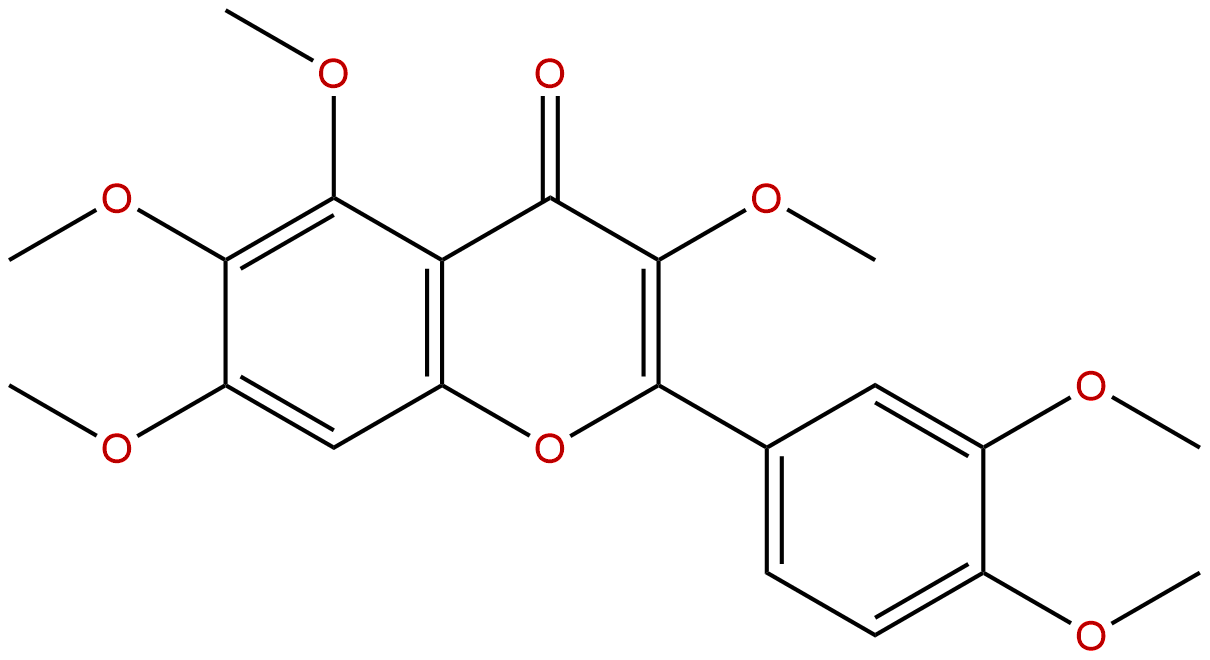
3,5,6,7,3 ', 4' - Hexamethoxyflavone: a natural anti prostate cancer candidate molecule derived from Fructus Aurantii immaturus
1. Overview
3,5,6,7,3 ', 4' - Hexamethoxyflavone (CAS number: 1251-84-9) is a highly methoxylated flavonoid compound. Flavonoids are an important class of secondary metabolites widely present in the plant kingdom, known for their diverse biological activities, including antioxidant, anti-inflammatory, antiviral, and anti-tumor effects. The molecular formula of this compound is C21H22O8, with a molecular weight of 402.39 g/mol. Its structural feature is that methoxy groups (- OCH3) are substituted at positions 3, 5, 6, 7 of the flavonoid nucleus and 3 ', 4' of the B ring. This dense methoxylation modification is relatively rare in natural flavonoids, often indicating unique physicochemical properties and biological activity.
This compound is mainly derived from Rutaceae plants Immature Bitter Orange It was isolated from the immature fruit of Citrus aurantium L. Zhishi has a long history of clinical application in traditional Chinese medicine, commonly used to treat conditions such as chest distension, incomplete digestion, and stagnation of phlegm and fluids. Modern pharmacological research gradually reveals that various flavonoids in Fructus Aurantii are important material basis for its pharmacological effects. In recent years, with the deepening of natural product chemistry and molecular pharmacology research, 3,5,6,7,3 ', 4' - hexamethoxyflavonoids have attracted attention for their potential activity in the treatment of prostate cancer. The database information shows that the compound interacts with multiple key targets closely related to the occurrence and development of prostate cancer, such as AR, PTEN, MYC, etc., suggesting that it may intervene in the progression of prostate cancer through a multi-target mechanism. This article will provide a systematic and professional scientific interpretation of this potential natural product from the aspects of its chemical structure, plant origin, pharmacological mechanism, medicinal evaluation, and research prospects.
2. Chemical structure and physicochemical properties
The chemical structure of 3,5,6,7,3 ', 4' - hexamethoxyflavones is based on the classical flavonoid nucleus (2-phenylchromenone), and its systematic name is 2- (3,4-dimethoxyphenyl) -3,5,6,7-tetramethoxy-1-benzopyran-4-one. Its SMILES is represented asCOc1ccc(-c2oc3cc(OC)c(OC)c(OC)c3c(=O)c2OC)cc1OCIt intuitively depicts the topological structure of six methoxy groups connected to its benzene ring.
Analyzing its physicochemical properties from the parameters of drug properties:
- Molecular weight (MW):402.3990 g/mol, Slightly higher than the recommended upper limit of 500 Da in Lipinski's Rule of Five, but still within the acceptable range for many oral medications.
- Lipid water partition coefficient (LogP/LogD)All are 2.7237. This value indicates that the compound has moderate lipophilicity, neither too hydrophilic (LogP<0) leading to poor membrane permeability, nor too lipophilic (LogP>5) leading to low solubility or strong non-specific binding. This is beneficial for it to cross the cell membrane and bind to the target.
- Topological Polarity Surface Area (TPSA)85.59 Å ². This value reflects the surface area of polar atoms (mainly oxygen atoms) in the molecule. Generally, TPSA<140 Å ² is beneficial for good oral bioavailability. The TPSA value of this compound is moderate, which is related to its multiple methoxy groups (polar rotatable groups), but still in a favorable range.
- Water solubility The value is relatively low (0.0067, usually measured in mg/mL or mol/L), which is related to its high LogP value and the molecular rigidity and larger molecular weight caused by multiple methoxy groups, suggesting that solubilization strategies may need to be considered in formulation development.
- Permeability The permeability of Caco-2 cells is 37.6350 (usually on the order of apparent permeability coefficient Papp × 10 ^ -6 cm/s), which belongs to moderate or good permeability.Blood-brain barrier (BBB) penetrability The prediction is' high ', which is consistent with its moderate LogP and TPSA, suggesting that the compound may act on central nervous system related targets, but BBB penetration is not necessary for its main anti prostate cancer scenario.
- Plasma protein binding rate (PPB)83.58%, belonging to a relatively high level. High protein binding can affect the free concentration, distribution volume, and clearance rate of drugs, which need to be considered in efficacy and pharmacokinetic design.
In summary, the physical and chemical properties of this compound exhibit a certain degree of "drug like" overall, but poor water solubility and high protein binding are key areas that need to be optimized during its pharmaceutical process.
3. Plant sources and traditional applications
The main plant sources of 3,5,6,7,3 ', 4' - hexamethoxyflavonoids are Immature Bitter Orange The dried young fruit of Citrus aurantium L., a plant in the Rutaceae family. Lime and its variants are cultivated in many parts of the world, and their immature fruit (Citrus aurantium) and nearly mature fruit (Citrus aurantium shell) are commonly used Chinese medicinal materials. Among them, Citrus aurantium has a stronger ability to break down qi, reduce accumulation, and disperse phlegm.
In traditional Chinese medicine theory, the nature of Fructus Aurantii is bitter, pungent, sour, slightly cold, and belongs to the spleen and stomach meridians. Commonly used for treatment: (1) gastrointestinal stagnation, abdominal distension, and severe diarrhea; (2) Chest obstruction, chest nodules; (3) Qi stagnation, chest and rib pain; (4) Postpartum abdominal pain, etc. Classic prescriptions such as Dachengqi Tang and Zhishi Xiebai Guizhi Tang in the Treatise on Cold Damage, as well as Zhizhu Wan in the Treatise on Internal and External Injuries, all use Zhishi as one of the main components. Traditional applications are mainly based on its "promoting qi and breaking qi" effect, while modern research links its antispasmodic, regulating gastrointestinal movement, anti-inflammatory, antioxidant and other effects with its components such as sinomenine (alkaloids) and flavonoids (such as hesperidin, neohesperidin, naringin and the multi methoxy flavonoids discussed in this article).
Multimethoxyflavones (PMFs) are a type of characteristic flavonoid component found in the bark of citrus plants. They typically have stronger lipid solubility and cell permeability, and their biological activity is often superior to that of hydroxyflavonoid glycosides or glycosides. 3,5,6,7,3 ', 4' - Hexamethoxyflavones, as one of them, were isolated and identified from Fructus Aurantii, reflecting the value of traditional Chinese medicine as a treasure trove of active molecules. From the traditional record of "breaking through the accumulation of symptoms" (possibly related to anti-tumor) to modern research on its anti-tumor activity, it reflects the inheritance and innovation from traditional experience to modern scientific interpretation.
4. Pharmacological activity and mechanism of action
The database information clearly indicates that the potential targets of 3,5,6,7,3 ', 4' - hexamethoxyflavonoids include AR, PTEN, MYC, NKX3-1, and CDKN1B And the related diseases point to prostate cancer These five targets play a central role in the occurrence, development, castration resistance, and transformation of prostate cancer. Based on existing knowledge, analyze the possible mechanism of action of this compound:
- Androgen receptor (AR)AR is the core driving factor for the growth and survival of prostate cancer cells, and is the main target of endocrine therapy for prostate cancer. This compound may act as an AR regulator (possibly an antagonist or degrader), interfering with the binding of androgens to AR, or affecting the nuclear translocation, transcriptional activity, and expression of target genes (such as PSA) of AR, thereby inhibiting tumor cell proliferation dependent on the AR signaling pathway.
- Phosphatase and tensin homolog (PTEN)PTEN is an important tumor suppressor gene that encodes a protein that inhibits cell growth, proliferation, and survival by antagonizing the PI3K/Akt/mTOR signaling pathway. In prostate cancer, PTEN deficiency or dysfunction is very common, leading to abnormal activation of the Akt signaling pathway. This compound may induce cell cycle arrest and apoptosis by upregulating PTEN expression or stabilizing its protein, restoring its inhibitory effect on the PI3K/Akt pathway.
- MYC oncogene C-MYC is a transcription factor that regulates a large number of genes involved in cell cycle, metabolism, proliferation, and apoptosis. The abnormally high expression of MYC is closely related to the progression and poor prognosis of prostate cancer. This compound may inhibit the malignant phenotype of tumor cells by intervening in the transcription, translation, or protein stability of MYC, downregulating its expression.
- NK3 homologous box 1 (NKX3-1)NKX3-1 is a prostate specific tumor suppressor gene that plays a critical role in maintaining prostate epithelial cell differentiation and inhibiting proliferation. Its expression deficiency is a common event in the early stage of prostate cancer. This compound may act as an activator of NKX3-1 expression, helping to restore its tumor suppressive function.
- Cyclin dependent kinase inhibitor 1B (CDKN1B, p27)P27 is a cyclin dependent kinase inhibitor that mainly blocks cells from entering the S phase from the G1 phase, and is an important negative regulator of the cell cycle. In prostate cancer, decreased levels of p27 protein are associated with tumor progression and poor prognosis. This compound may increase intracellular p27 levels and lead to cell cycle arrest by inhibiting its degradation (such as through Skp2 ubiquitin ligase) or upregulating its expression.
Mechanism of Action Integration Hypothesis 3, 5, 6, 7, 3 ', 4' - Hexamethoxyflavones may pass through Multi target synergistic effect Fight against prostate cancer. It may be on one hand Inhibit carcinogenic driving signals(such as antagonizing AR and downregulating MYC), on the other hand Activate endogenous tumor suppression pathway(such as upregulating PTEN, NKX3-1, and p27). This multi pronged approach is expected to more effectively inhibit tumor growth and may overcome the problem of drug resistance that may arise from targeting a single target therapy. Its dense methoxy structure may enhance its binding ability with hydrophobic pockets of these target proteins. Of course, these speculations need to be validated and elucidated one by one through subsequent biochemical experiments (such as enzyme activity/binding experiments), cell experiments (reporting genes, gene knockdown/overexpression), and animal model studies.
5. Evaluation of drug properties
Based on the provided pharmacokinetic parameters, we conducted a preliminary evaluation of the potential of this compound as an oral candidate for anti prostate cancer drugs by combining the Lipinski's Rule of Five and other commonly used standards
-
Lipinski Five Rule Compliance:
- Molecular weight (MW): 402.4<500, Comply with。
- Lipid water partition coefficient (LogP): 2.72<5, Comply with。
- Hydrogen bond donor (HBD): Structurally, the 4-carbonyl and all hydroxyl groups of flavonoids are replaced by methoxy groups, so the number of HBDs is 0, Comply with(<5)。
- Hydrogen bond acceptor (HBA): There are 8 oxygen atoms in the molecule (6 methoxy oxygen, 1 pyran epoxide, 1 carbonyl oxygen), so the number of HBAs is 8, Comply with(<10)。
- Number of rotatable keys: about 6-7 (mainly from methoxy groups), generally considered to be less than 10, Comply with。
- Conclusion This compound fully complies with Lipinski's five rules, indicating its good oral absorption potential.
-
Analysis of other key parameters:
- Solubility and permeability Belonging to the possible classification system of biopharmaceuticals (BCS)Class II (low solubility and high permeability) or Class IV (low solubility and low permeability) chemical compound. Its low water solubility (0.0067) is the main weakness, but moderate Caco-2 permeability (37.6350) and predicted high BBB permeability indicate that its membrane permeability is still acceptable. During development, it is necessary to use strategies such as nano formulations, solid dispersions, and cyclodextrin inclusion to improve its solubility.
- Metabolism and toxicity:
- The Ames test value is 0.6 (usually<1.0 is considered negative), indicating that No direct mutagenicity This is a positive signal.
- Chromosome aberration test shows' yes', indicating that it may cause chromosome damage at higher concentrations or under specific conditions, and further development is needed Focus on genetic toxicity assessment。
- HERG inhibition is' no ', reducing the risk of causing QT interval prolongation in the heart.
- Liver toxicity markers: Serum alkaline phosphatase (Ser_LK) and alanine aminotransferase (Ser_LT) are "yes", indicating their May have the potential for liver damage Further in vitro and in vivo hepatotoxicity studies are needed.
- Respiratory sensitization (Resp_Sens) is "yes" and also requires attention.
- Preliminary pharmacokinetic prediction A higher plasma protein binding rate (83.58%) may affect drug efficacy and clearance. The MRTD (Maximum Recommended Starting Dose) is "Yes", indicating that there may be an acceptable starting dose range based on preliminary calculations.
Comprehensive Assessment 3,5,6,7,3 ', 4' - Hexamethoxyflavones At the molecular level, it exhibits good drug like and multi-target resistance potential against prostate cancer Its main advantages lie in its novel structure, compliance with the basic rules of oral medication, and the potential for multi-target synergistic effects in its mechanism of action. However, it Poor water solubility, potential hepatotoxicity, and chromosomal aberration risk It is a challenge that must be seriously faced and resolved before being pushed into clinical practice. It should currently be regarded as an excellent one lead compound It is necessary to improve its solubility and safety while maintaining activity through systematic drug chemical modifications, such as optimizing the number and position of methoxy groups and introducing groups that enhance solubility.
6. Research Status and Application Prospects
At present, there is relatively limited public research literature on 3,5,6,7,3 ', 4' - hexamethoxyflavonoids, and their activity data mainly comes from target prediction in databases and some preliminary biological screening. This precisely indicates that the compound is a "potential stock" worth exploring in depth. The current research status may be at Early detection and target validation stage。
Future research directions and prospects:
- Deep verification of the mechanism of action The primary task is to use prostate cancer cell lines (such as LNCaP, PC-3, DU145, etc.) and organoid models to confirm their anti proliferative, pro apoptotic, and anti migratory effects through MTT/CCK-8, clone formation, flow cytometry (cell cycle, apoptosis), scratch/Transwell assays, etc. Furthermore, Western Blot, qPCR, immunofluorescence, chromatin immunoprecipitation (ChIP), dual luciferase reporter genes and other techniques were used to verify their specific effects on the expression of targets such as AR, PTEN, MYC, NKX3-1, and p27, as well as downstream pathways such as PSA, Akt, and Cyclin D1.
- Pharmaceutical Chemistry Optimization Using it as the parent nucleus for structural modification. For example, attempting to replace some methoxy groups with hydroxyl, amino, or introduce water-soluble groups (such as polyethylene glycol chains) to improve water solubility and reduce potential toxicity; Through computer-aided drug design, simulate its binding mode with various targets, and guide the rational design of highly selective derivatives.
- Systematic evaluation of drug properties Conduct a comprehensive ADMET (absorption, distribution, metabolism, excretion, toxicity) evaluation of the optimized lead compound, including more detailed in vitro metabolic stability (liver microsomes), CYP450 enzyme inhibition/induction, in vivo pharmacokinetics (mice, rats), and standardized genotoxicity and subacute toxicity studies.
- Exploration of Combination Therapy Given its multi-target nature, exploring its combined efficacy with existing standard treatment drugs for prostate cancer (such as enzalutamide, abiraterone, docetaxel, etc.) may reveal synergistic effects and provide new solutions for overcoming drug resistance.
- Source expansion and biosynthesis Besides extracting from Fructus Aurantii, it is possible to explore whether other citrus plants contain this ingredient. In addition, studying its biosynthetic pathway is expected to achieve efficient and sustainable production in microorganisms through synthetic biology methods, solving the problem of limited natural sources.
Application Prospects If subsequent research can successfully verify its potent anti prostate cancer activity and overcome its drug defects through structural optimization, 3,5,6,7,3 ', 4' - hexamethoxyflavone and its optimized derivatives are expected to be developed into New multi-target anti prostate cancer candidate drugs Especially for the clinical challenge of castration resistant prostate cancer (CRPC). It may also serve as Chemical probe Used to study the cross dialogue network between targets such as AR and PTEN. From a broader perspective, research on it has also enriched the biological activity spectrum of citrus derived multi methoxy flavonoids, providing another scientific evidence for the modernization and internationalization of traditional Chinese medicine Fructus Aurantii.
In summary, 3,5,6,7,3 ', 4' - hexamethoxyflavone is a natural molecule derived from traditional Chinese medicine with distinct chemical characteristics and promising biological target predictions. Although the road ahead is full of challenges, the chemical and biological value it contains deserves more efforts from natural product pharmaceutical researchers to uncover its mysterious veil and explore its potential for translational medicine.