


Product name: Auraptene
Synonym name:
Catalogue No.: BP1807
Cas No.: 495-02-3
Formula: C19H22O3
Mol Weight: 298.382
Botanical Source: Citrus aurantium L.
Physical Description: Powder
Type of Compound: Coumarins
Purity: 95%~99%
Analysis Method: HPLC-DAD or/and HPLC-ELSD
Identification Method: Mass, NMR
Packing: Brown vial or HDPE plastic bottle
The product could be supplied from milligrams to grams. Inquire for bulk scale.
We provide solution to improve the water-solubility of compounds, thereby facilitating the variety of activity tests and clinic uses.
For Reference Standard and R&D, Not for Human Use Directly.
HPLC of Auraptene
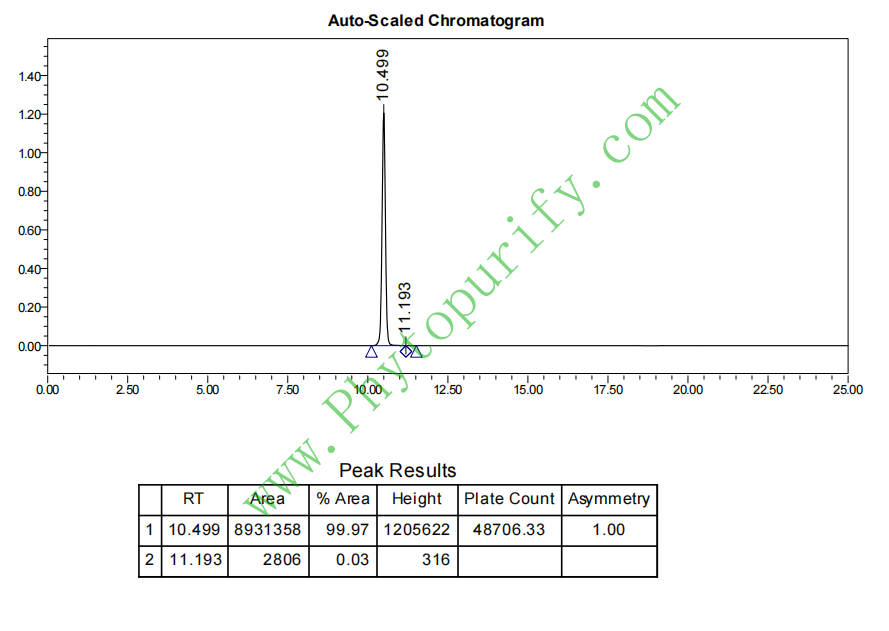
Storage conditions:Short-term storage at 2~8℃, long-term storage at -20 ~ -80℃
39.4400
5.2592
5.2592
.0016
3.7048
25.7481
High
92.1841
2.4976
Yes
Yes
No
No
No
Yes
0.3
No
Yes
Yes
Yes
Natural products, as an important treasure trove for drug discovery and development, play an irreplaceable role in the long history of human fight against diseases. Among them, coumarin compounds have always been a hot topic in medicinal chemistry and pharmacology research due to their extensive and significant biological activities. Auraptene, a unique coumarin derived from fragrant leaves, has gradually revealed its multi-target and multi pathway pharmacological activities since its first isolation and identification from Rutaceae plants, demonstrating great potential for applications in inflammation, tumors, metabolic diseases, and neurological disorders. Especially in recent years, its mechanism of action in regulating digestive function has been deeply explored, making it a potential candidate molecule for treating chronic diseases such as digestive disorders. This article aims to systematically review the chemical properties, plant sources, pharmacological activities, molecular mechanisms of action, pharmacological characteristics, and clinical application prospects of hesperetin, in order to provide comprehensive academic references for the deep development and transformation research of this natural product.
Auraptene, also known as 7-geranyloxycoumarin, has a CAS number of 495-02-3. Its molecular formula is C19H2203 and its molecular weight is 298.38. Structurally, hesperetin is composed of a classic coumarin core (benzo α - pyranone), with its 7th carbon atom connected to a linear geranyl side chain via an ether bond. This structural feature is the key distinguishing factor from other simple coumarins, and it is also an important structural basis for its unique lipid solubility and biological activity.
Its physicochemical properties are closely related to its medicinal properties. Orange peel oil has high lipid solubility, with a calculated LogP value of approximately 5.26, which determines its good membrane permeability. Its topological polar surface area (TPSA) is relatively low, at 39.44 Å ². These parameters collectively result in its extremely low water solubility (approximately 0.0016 mg/mL), making it a typical BCS class II (low solubility, high permeability) compound. High lipid solubility and low water solubility pose challenges for its oral absorption, but also promote its ability to penetrate biofilms. It is worth noting that its blood-brain barrier permeability is predicted to be "high", which provides a structural basis for its neuroprotective effect. In the preliminary safety screening, hesperetin did not show significant hERG potassium channel inhibitory activity (indicating a low potential risk of arrhythmia), and the Ames test result was 0.3, indicating a low risk of mutagenicity, providing favorable preliminary safety data for its further development.
Orange peel oil is widely present in Rutaceae plants, especially in the peel, leaves, and root bark of Citrus plants, where its content is relatively high. This is also the source of its common name "orange peel oil". For example, it has been reported in grapefruit (Citrus paradisi), lime (Citrus aurantium), and bergamot (Citrus bergamia). In addition, it has also been found in other genera of plants in the Umbelliferae and Rutaceae families, as well as some medicinal plants such as Ferula.
The extraction method mainly depends on its lipid solubility characteristics. Traditional methods include organic solvent extraction, with commonly used solvents including n-hexane, ethyl acetate, chloroform, etc. For example, dried citrus peel powder can be subjected to Soxhlet extraction or cold soaking with n-hexane or petroleum ether, concentrated and preliminarily separated by silica gel column chromatography, and then purified by preparative high-performance liquid chromatography (HPLC) to obtain high-purity hesperetin. Modern extraction techniques such as supercritical CO2 fluid extraction have also been applied to the extraction of hesperetin due to their green, efficient, and solvent-free advantages, and can better preserve its biological activity. The optimization of extraction processes usually focuses on factors such as solvent type, solid-liquid ratio, extraction temperature, and pressure to improve yield and purity.
A large number of in vitro and in vivo studies have confirmed that hesperetin has broad and powerful pharmacological activities, and its effects almost cover several major chronic disease fields.
The core of the multi pharmacological effects of hesperetin lies in its multi-target properties. It can not only directly eliminate free radicals, but also exert anti-inflammatory, antioxidant, and anti-tumor effects by regulating multiple key signaling pathways such as NF - κ B, Nrf2, MAPK, PI3K/Akt, Wnt/β - catenin, etc. In terms of regulating digestive function, its mechanism of action is particularly systematic and specific, involving the regulation of a series of ion channels, receptors, and transporters:
In summary, hesperetin is like a "jack of all trades". By synergistically regulating multiple targets related to digestive fluid secretion, nutrient absorption, gastrointestinal motility, and water balance, it comprehensively improves digestive dysfunction from multiple aspects. This provides a solid mechanism basis for its development as a multi-target drug for the treatment of complex digestive system diseases such as functional dyspepsia, irritable bowel syndrome, chronic constipation, etc.
Although hesperetin has excellent pharmacological activity, its pharmacological properties, especially pharmacokinetic properties, are the bottleneck that must be overcome in its conversion to drugs.
Existing animal pharmacokinetic studies have shown that hesperetin is rapidly absorbed after oral administration, but its absolute bioavailability varies greatly depending on the formulation form (some reports range from 10% to 40%), which is mainly limited by its extremely low water solubility. It is widely distributed in the body and easily accumulates in adipose tissue and other areas due to its high lipid solubility. In terms of metabolism, hesperetin undergoes extensive phase I metabolism mainly through the liver cytochrome P450 enzyme system (especially CYP3A4 and CYP1A2). Its main metabolic pathways include oxidation of the coumarin side chain and hydroxylation of the coumarin nucleus, followed by phase II binding reactions (glucuronidation and sulfation). Its metabolites may still have biological activity. Hesperidin and its metabolites are mainly excreted through bile and urine.
The challenges faced mainly include: 1) Poor oral absorption Low water solubility limits its dissolution in gastrointestinal fluids and is the primary factor affecting oral bioavailability. 2) The first pass effect is significant Metabolism is rapid in the liver and intestinal wall. 3) Potential drug drug interactions As a substrate and potential regulator of CYP enzymes, it may interact with co administered drugs.
In response to these challenges, current strategies mainly focus on pharmaceutical improvement, such as:Nanoformulation technology(such as nanocrystals, liposomes, nanoemulsions, solid lipid nanoparticles) can significantly increase their specific surface area and solubility, improve dissolution rate and bioavailability;Cyclodextrin inclusion technology Can improve its water solubility and stability;Self microemulsion drug delivery system SMEDDS can spontaneously form microemulsions in the gastrointestinal tract, promoting their dissolution and lymphatic absorption, bypassing some liver first pass effects. These advanced delivery systems are key to promoting the clinical application of hesperetin.
The path from laboratory research to clinical application of hesperetin is clear, with broad prospects but also full of challenges.
Potential clinical application directions:
1. Digestive system diseases As a multi-target digestive function regulator, it is a highly promising candidate drug for the treatment of functional gastrointestinal diseases (such as irritable bowel syndrome, functional dyspepsia), chronic constipation, and cystic fibrosis digestive complications.
2. Chronic inflammatory diseases Can be used as an adjuvant or alternative therapy for inflammatory bowel disease (Crohn's disease, ulcerative colitis) and chronic arthritis.
3. Chemotherapy prevention and adjuvant therapy for tumors Given its preventive and therapeutic effects in various cancer models, it can be used as a chemopreventive agent in high-risk populations or as an adjuvant in combination with radiotherapy and chemotherapy to enhance efficacy and reduce toxicity.
4. Neurodegenerative diseases As a neuroprotective agent, it has application value in early intervention and course management of Alzheimer's disease and Parkinson's disease.
5. Metabolic syndrome It may play a role in the comprehensive management of nonalcoholic fatty liver disease, obesity and type 2 diabetes.
Future research prospects:
1. In depth mechanism research Chemical biological methods such as photoaffinity labeled probes and proteomics need to be used to more accurately identify its direct target and create a more complete pharmacological network map.
2. structural optimization On the premise of retaining the core pharmacophore, the structure is modified through medicinal chemical methods to improve water solubility, metabolic stability, optimize target selectivity, and reduce potential off target effects.
3. Advanced delivery system development Continuing to deepen the research on new drug delivery systems such as nanomedicine and conducting systematic pharmacokinetic/pharmacodynamic evaluations is the core project for achieving their clinical translation.
4. Preclinical and clinical research A rigorous and compliant preclinical safety evaluation (GLP toxicology study) needs to be designed, and based on this, human clinical trials should be promoted to confirm its effectiveness and safety.
5. Multi omics integration research Combining metabolomics and gut microbiome, this study aims to investigate the systemic biological effects of hesperetin in animals and humans, particularly in regulating the gut axis and immune metabolic network.
Orange peel oil extract, as a natural coumarin derived from citrus plants, has become a star molecule in the pharmacological research of natural products due to its extensive pharmacological activities such as anti-inflammatory, antioxidant, anti-tumor, neuroprotective, and multi-target regulation of digestive function. It demonstrates unique systemic regulatory advantages in the treatment of digestive disorders by regulating key targets such as CFTR, SLC5A1, CHRM3, etc. Although there are challenges in drug formulation, especially in terms of solubility and pharmacokinetics, modern pharmaceutical technology provides feasible solutions to these problems. In the future, through interdisciplinary collaboration and continuous efforts in deep mechanism exploration, rational structural optimization, and advanced delivery system development, hesperetin is highly likely to be successfully transformed from a promising lead compound into an innovative drug for treating various chronic diseases, achieving a value leap from "laboratory to clinical" and contributing to the cause of human health.
