


Product name: Scutellarein
Synonym name: 6-Hydroxyapigenin
Catalogue No.: BP1277
Cas No.: 529-53-3
Formula: C15H10O6
Mol Weight: 286.239
Botanical Source: Scutellariae radix
Physical Description:
Type of Compound: Flavonoids
Purity: 95%~99%
Analysis Method: HPLC-DAD or/and HPLC-ELSD
Identification Method: Mass, NMR
Packing: Brown vial or HDPE plastic bottle
Storage: Store in a well closed container, protected from air and light. Put into refrigerate or freeze for long term storage.
Whenever possible, you should prepare and use solutions on the same day. However, if you need to make up stock solutions in advance, we recommend that you store the solution as aliquots in tightly sealed vials at -20℃. Generally, these will be useable for up to two weeks.
The product could be supplied from milligrams to grams
Inquire for bulk scale.
Description:
Scutellarein has antioxidant, antitumor, anti-adipogenic, antiviral and anti-inflammatory activities, it can improve neuronal injury, has better protective effect in rat cerebral ischemia. Scutellarein may serve as a SARS-CoV chemical inhibitor, it also exerts strong inhibition towards the tested UDP-glucuronosyltransferase isoforms.
References:
Chin J Physiol. 2014 Aug 31;57(4):182-7.
Inhibitory effects of scutellarein on proliferation of human lung cancer A549 cells through ERK and NFκB mediated by the EGFR pathway.
High expression levels of cyclooxygenase-2 (COX-2) contribute a strong proliferative ability to human lung cancer cells, and this function is link to the epidermal growth factor receptor (EGFR) pathway, which was mediated by extracellular-signal-regulated kinase (ERK) and nuclear factor kappa B (NFκB).
METHODS AND RESULTS:
In this study, Scutellarein, a flavonoid compound, was screened for proliferation inhibition at different concentrations (0, 5, 25 and 50 μM) at 24 h or 48 h in human lung cancer cell line A549. Results showed that A549 cell proliferation was inhibited by 50 μM Scutellarein treatment in 24 h and 48 h of treatment. The expression levels of phosphorylated EGFR, phosphorylated ERK, phosphorylated NFκB and COX-2 were reduced in a dose-dependent manner after 24 h Scutellarein treatments at different concentrations. Further, ERK inhibitor U0126 and NFκB inhibitor MG132 also inhibited A549 cell proliferation similar to 50 κM Scutellarein treatment from 24 h to 48 h.
CONCLUSIONS:
The experimental results showed that Scutellarein could inhibit proliferation of the human lung cancer cell line A549 through ERK and NFκB mediated by the EGFR pathway.
Pharmacol Biochem Behav. 2014 Mar;118:51-9.
Neuroprotective effects of scutellarin and scutellarein on repeatedly cerebral ischemia-reperfusion in rats.
Scutellarin had protective effects against neuronal injury, however, there are few studies on the protective effect of Scutellarein, which is the main metabolite of scutellarin in vivo.
METHODS AND RESULTS:
This study investigated whether the neural injury by ischemia/reperfusion would be influenced by different doses of scutellarin and Scutellarein. Male Wistar rats were orally administered with scutellarin and Scutellarein at the doses of 0.09, 0.17, 0.35, 0.70, 1.40 mmol/kg, respectively; then after six consecutive days, they were subjected to global ischemia by occlusion of the bilateral common carotid arteries (BCCAO). After reperfusion for about 21 h, neurological and histological examinations were performed. The present results showed that Scutellarein attenuated neuronal cell damage, reduced cerebral water content, regulated the expression of glutamic acid (Glu), aspartic acid (Asp), glycine (Gly), γ-aminobutyric acid (GABA) and taurine (Tau), and improved the Ca(2+)-ATPase and Na(+),K(+)-ATPase activity. Meanwhile, significant difference was found among various doses of scutellarin and Scutellarein.
CONCLUSIONS:
Our studies indicated that scutellarin and Scutellarein could improve neuronal injury, and Scutellarein had better protective effect than scutellarin in rat cerebral ischemia.
Int J Mol Med. 2015 Jan;35(1):31-8.
Scutellarein inhibits cancer cell metastasis in vitro and attenuates the development of fibrosarcoma in vivo.
Fibrosarcoma is an aggressive and highly metastatic cancer of the connective tissue, for which effective therapeutic methods are limited. Recently, there has been a renewed interest in small molecular compounds from natural products in the treatment of cancer.
METHODS AND RESULTS:
In the present study, we investigated the compound, Scutellarein, extracted from the perennial herb Scutellaria lateriflora, and it was found to possess anticancer potential. Cell proliferation assay and cell cycle analysis revealed that the proliferation rate of HT1080 human fibrosarcoma cells was significantly suppressed by treatment with Scutellarein through the induction of apoptosis. Moreover, an in vivo experiment using Balb/c nude mice revealed that the volume and weight of the tumors were markedly reduced following treatment with Scutellarein. We also analyzed the effects of Scutellarein on the markers of metastasis, using the HT1080 cells. The results indicated that Scutellarein potently inhibited cell migration, invasion and the expression and activity of matrix metalloproteinase (MMP)-2, -9 and -14. Furthermore, MMP activation and cell survival were suppressed due to the Scutellarein-mediated downregulation of nuclear factor κ-light-chain-enhancer of activated B cells (NF-κB) activation.
CONCLUSIONS:
In conclusion, our data suggest that Scutellarein has the ability to attenuate the development of fibrosarcoma and inhibit cancer cell metastasis.
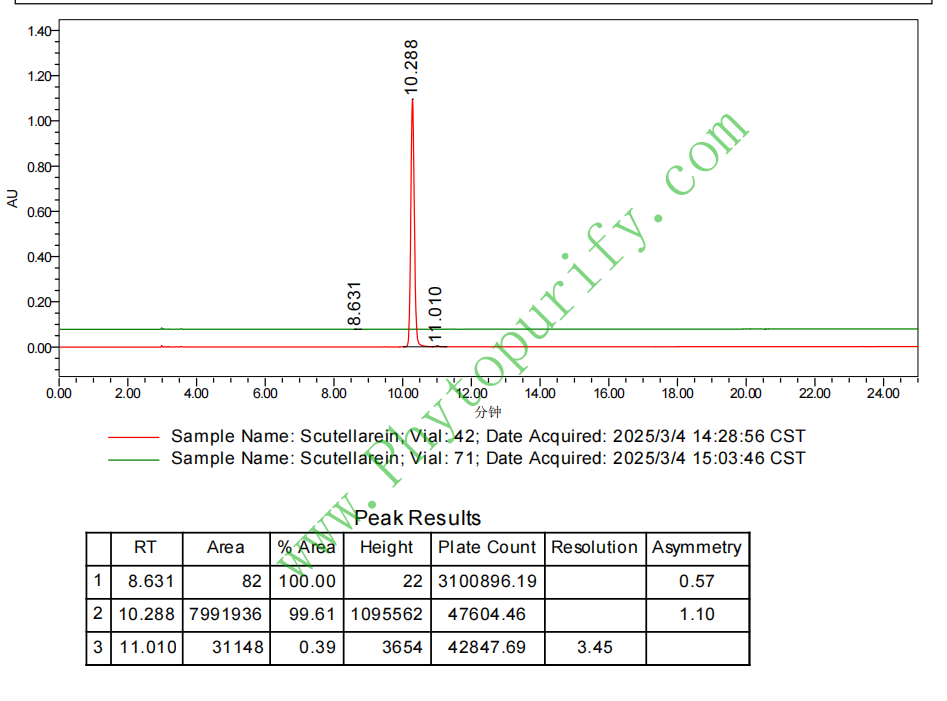
HPLC of Scutellarein
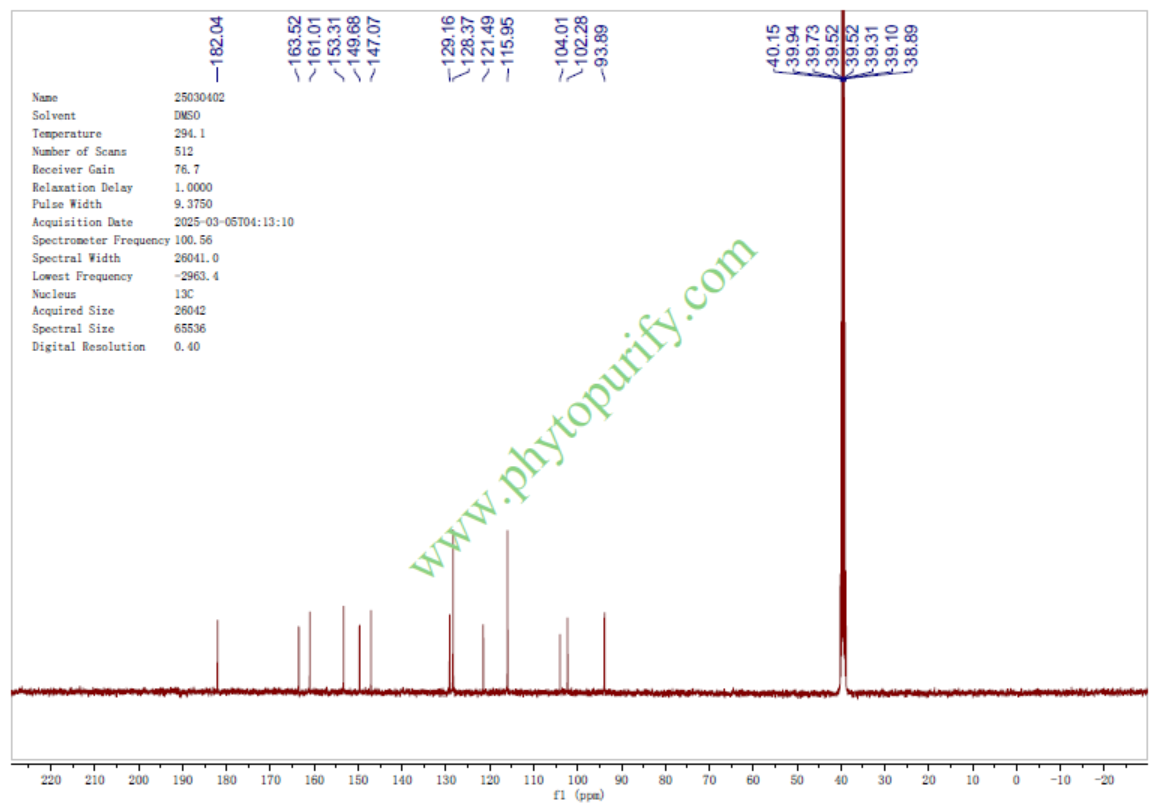
NMR of Scutellarein
Storage conditions:Short-term storage at 2~8℃, long-term storage at -20 ~ -80℃
Scutellarein (CAS number: 529-53-3) is a natural flavonoid compound that has received widespread attention in the field of natural product pharmacology in recent years due to its significant biological activity and potential medicinal value. As a metabolite of baicalein, wild baicalein is substituted with hydroxyl groups at positions C-4 ', 5, 6, and 7, endowing it with unique chemical properties and biological activity. Its structure is closely related to apigenin and is also a conjugated acid of Scutellarin. Numerous studies have shown that Scutellaria baicalensis extract has significant pharmacological activities such as anti-inflammatory, antioxidant, anti-tumor, and neuroprotective effects, especially in regulating oxidative stress-related diseases.
This review aims to systematically summarize the chemical structure and physicochemical properties, plant sources, and extraction methods of Scutellaria baicalensis extract, explore its pharmacological activity and mechanism of action, evaluate its pharmacological and pharmacokinetic characteristics, and prospect its clinical application prospects. It is expected to provide theoretical basis and practical guidance for subsequent research and drug development.
Scutellaria baicalensis is a flavonoid compound with the chemical formula C15H10O6 and a molecular weight of 286.2390. Its basic skeleton is a flavonoid structure, specifically 2-phenyl-4H-1-benzopyran-4-one, with hydroxyl groups located at positions C-4 ', 5, 6, and 7, forming a multi hydroxyl substituted flavonoid structure. This structure endows Scutellaria baicalensis with strong free radical scavenging ability and metal ion chelating ability, which is the basis of its antioxidant activity.
In terms of physicochemical properties, the LogP value of Scutellaria baicalensis extract is approximately 2.0096, indicating its moderate lipid solubility, which is beneficial for membrane penetration. The polarization surface area (TPSA) is 111.13 Å ², indicating its high polarity, which affects its bioavailability and ability to penetrate the blood-brain barrier. Low water solubility (0.0332 mg/mL) suggests limited solubility in the aqueous phase, which may affect its oral absorption. The low permeability of the blood-brain barrier suggests limited distribution in the central nervous system. The negative result of hERG channel inhibition experiment indicates a low risk of cardiac toxicity. The Ames test result is 0.6, indicating a low risk of genotoxicity and good safety.
Scutellaria baicalensis is mainly found in the genus Scutellaria in the family Lamiaceae, with Scutellaria baicalensis being the main source. The root of Scutellaria baicalensis contains abundant flavonoids, among which Scutellaria baicalensis extract is one of the important active ingredients, widely distributed in plant roots, stems, leaves and other parts.
Traditional extraction methods mainly use solvent extraction techniques, such as ethanol, methanol, or water alcohol mixed solvent extraction. The extraction process usually includes crushing plant materials, soaking, reflux extraction, or ultrasound assisted extraction, followed by obtaining crude extracts through filtration, concentration, and other steps. To improve purity, column chromatography (such as silica gel column, C18 reverse phase column) or high-performance liquid chromatography (HPLC) are often used for separation and purification.
In recent years, green and efficient technologies such as supercritical CO2 extraction and microwave-assisted extraction have gradually been applied to the extraction of baicalein, significantly improving extraction efficiency and purity, reducing solvent usage and environmental pollution. In addition, enzyme assisted extraction technology has also been explored to improve the extraction rate of baicalein.
Wild baicalein exhibits significant anti-inflammatory activity. Multiple in vitro and in vivo studies have shown that baicalein can inhibit the expression and release of inflammatory mediators such as tumor necrosis factor - α (TNF - α), interleukin-6 (IL-6), nitric oxide (NO), and cyclooxygenase-2 (COX-2). Its anti-inflammatory mechanism mainly involves regulating the nuclear factor kappa B (NF - κ B) signaling pathway, inhibiting the transcription of inflammatory genes, and reducing inflammatory responses.
Scutellaria baicalensis extract, as a polyhydroxyflavonoid, has strong free radical scavenging ability. It can directly eliminate reactive oxygen species (ROS) and reactive nitrogen species (RNS), reducing oxidative damage. In addition, Scutellaria baicalensis extract can activate the intracellular antioxidant defense system, regulate the expression of key antioxidant enzymes such as superoxide dismutase (SOD1, SOD2), catalase (CAT), glutathione peroxidase (GPX1), and heme oxygenase-1 (HMOX1), and enhance the cell's resistance to oxidative stress.
Due to its antioxidant and anti-inflammatory properties, baicalein has shown potential in the field of neuroprotection. Research has shown that Scutellaria baicalensis extract can alleviate damage to nerve cells caused by oxidative stress and inflammation, improve cognitive function, and delay the progression of neurodegenerative diseases such as Alzheimer's disease and Parkinson's disease.
Scutellaria baicalensis extract exhibits inhibitory effects on proliferation, induces apoptosis, and blocks cell cycle in various tumor cell lines. Its anti-tumor mechanism involves regulating multiple signaling pathways, including PI3K/Akt, MAPK, Wnt/β - catenin, etc., which affect the growth, migration, and invasion ability of tumor cells.
In addition, wild baicalein also exhibits various biological activities such as antibacterial, antiviral, cardiovascular protection, and liver protection, demonstrating its potential as a multi-target drug.
The pharmacological effects of Scutellaria baicalensis extract are mainly achieved by regulating oxidative stress and inflammation related signaling pathways. Its key molecular targets include:
NFE2L2/NRF2 Scutellaria baicalensis extract can activate NRF2 transcription factor, promote its nuclear translocation, induce the expression of downstream antioxidant enzyme genes (such as SOD1, SOD2, CAT, GPX1, HMOX1), enhance cellular antioxidant defense, and alleviate oxidative damage.
SOD1、SOD2、CAT、GPX1、HMOX1 These antioxidant enzymes are key enzymes for cell clearance of ROS, and baicalein promotes the maintenance of redox balance by upregulating their expression.
NF - κ B signaling pathway Wild baicalein inhibits the activation of NF - κ B, reduces the expression of inflammatory factors, and alleviates inflammatory reactions.
MAPK, PI3K/Akt and other signaling pathways Scutellaria baicalensis participates in regulating cell proliferation, apoptosis, and metabolism, and exerts anti-tumor and neuroprotective effects by regulating these pathways.
In addition, Scutellaria baicalensis extract, as a conjugated acid of Scutellaria baicalensis extract, may regulate its biological activity and pharmacokinetic properties through metabolic transformation.
The pharmacological evaluation of Scutellaria baicalensis extract shows that it has certain advantages and limitations. Its molecular weight of 286.24 conforms to Lipinski's rule, and its LogP value is moderate, indicating that it has good cell membrane permeability. The high TPSA may limit its oral bioavailability. Low water solubility suggests that its absorption and distribution in the body may be limited.
The low permeability of the blood-brain barrier limits its direct application in central nervous system diseases, but also reduces the risk of central side effects. The hERG inhibition test was negative, indicating low cardiac toxicity and good safety. The Ames test results show that its genotoxicity risk is low.
Pharmacokinetic studies have shown that the oral absorption of Scutellaria baicalensis extract is slow, its bioavailability is limited, and its metabolism in the body is mainly carried out through the liver enzyme system, producing multiple metabolites. Its metabolites may have different biological activities and pharmacokinetic characteristics. To improve its pharmacokinetic properties, strategies such as nano formulations, liposome encapsulation, and structural modification have been widely explored.
Wild baicalein has shown broad clinical application prospects due to its multi-target and multi mechanism pharmacological activities. Its potential in anti-inflammatory, antioxidant, neuroprotective, and anti-tumor fields provides new ideas for the treatment of related diseases.
In the treatment of neurodegenerative diseases, cardiovascular diseases, chronic inflammatory diseases, and tumors, baicalein is expected to play an adjuvant therapeutic role as a single drug or combination therapy. However, the clinical research on Scutellaria baicalensis extract is still in its infancy and lacks systematic clinical trial data. Its low water solubility and limited bioavailability are the main bottlenecks restricting its clinical application.
Future research should focus on optimizing its pharmacokinetic characteristics, developing efficient delivery systems, deeply analyzing its mechanism of action and safety evaluation, and promoting its clinical translation. In addition, the design and synthesis of derivatives based on the structure of Scutellaria baicalensis provide a broad space for the development of new drugs.
As an important natural flavonoid compound, Scutellaria baicalensis extract has become a hot topic in natural product pharmacology research due to its significant anti-inflammatory, antioxidant, and various pharmacological activities. The systematic study of chemistry, pharmacology, and drug properties has laid a solid foundation for its clinical application. Despite challenges such as water solubility and bioavailability, with the development of modern drug delivery technology and structural modification strategies, baicalein is expected to become a new natural drug candidate molecule for the treatment of various diseases. In the future, it is necessary to strengthen preclinical and clinical research, comprehensively evaluate its efficacy and safety, promote its clinical application process, and benefit human health.
