


Product name: Wogonoside
Synonym name: Oroxindin; Glychionide B
Catalogue No.: BP1454
Cas No.: 51059-44-0
Formula: C22H20O11
Mol Weight: 460.391
Botanical Source: Scutellariae radix
Physical Description:
Type of Compound: Flavonoids
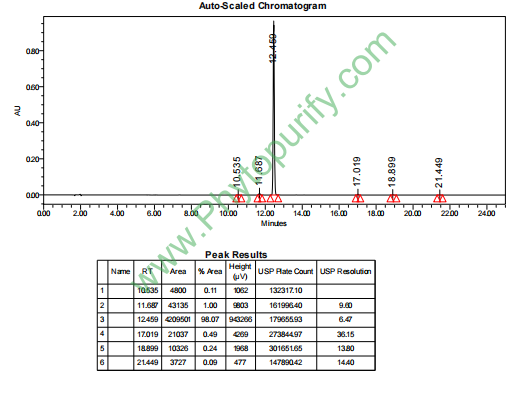
Purity: 95%~99%
Analysis Method: HPLC-DAD or/and HPLC-ELSD
Identification Method: Mass, NMR
Packing: Brown vial or HDPE plastic bottle
Storage: Store in a well closed container, protected from air and light. Put into refrigerate or freeze for long term storage.
Whenever possible, you should prepare and use solutions on the same day. However, if you need to make up stock solutions in advance, we recommend that you store the solution as aliquots in tightly sealed vials at -20℃. Generally, these will be useable for up to two weeks.
The product could be supplied from milligrams to grams
Inquire for bulk scale.
Description:
Wogonoside has anticoagulant, anti-inflammatory, anti-angiogenic and anticancer effects, it may exert its anti-inflammatory effect via dual inhibition of NF-κB and NLRP3 inflammasome. Wogonoside induced autophagy through the MAPK-mTOR pathway, it inhibited LTB 4 production at the concentration of 100 uM.
References:
Toxicology. 2009 May 2;259(1-2):10-7.
Wogonoside inhibits lipopolysaccharide-induced angiogenesis in vitro and in vivo via toll-like receptor 4 signal transduction.
Wogonoside, one flavonoid derived from the root of Scutellaria baicalensis Georgi, has been reported for its anti-inflammation activity; however, whether it can inhibit inflammation-induced angiogenesis is still unclear.
METHODS AND RESULTS:
In the present study, we evaluated the effect of Wogonoside on lipopolysaccharide (LPS)-induced angiogenesis in vitro and in vivo. Wogonoside suppressed the LPS-stimulated migration and tube formation of human umbilical vein endothelial cells (HUVECs), as well as microvessel sprouting from rat aortic rings in vitro. Moreover, Wogonoside also inhibited LPS-stimulated vessel growth of Chicken chorioallantoic membrane (CAM) in vivo. The mechanism revealed that Wogonoside inhibited LPS-induced toll-like receptor 4 (TLR4) up-regulation and its downstream mitogen-activated protein kinases (MAPKs) activation, by decreasing the phosphorylation of c-Jun N-terminal kinase (JNK), extracellular signal-regulated kinase (ERK) and p38 mitogen-activated protein kinase.
CONCLUSIONS:
The results suggest that Wogonoside inhibits LPS-induced angiogenesis both in vitro and in vivo, and that it might have a therapeutic potential for the diseases associated with the development of both inflammation and angiogenesis progress.
Food Chem Toxicol. 2013 Jan;51:53-60.
Wogonoside induces autophagy in MDA-MB-231 cells by regulating MAPK-mTOR pathway.
Previous studies have demonstrated that Wogonoside, a bioactive flavonoid extracted from the root of Scutellaria baicalensis Gerogi, has anti-inflammatory and anti-angiogenic activities.
METHODS AND RESULTS:
In this study, we evaluated Wogonoside-induced autophagy on human breast MDA-MB-231 cells. We report that Wogonoside triggered the formation of microtubule-associated protein-light chain 3 (MAP-LC3) positive autophagosomes and the accumulation of acidic vesicular and autolysosomes in MDA-MB-231 cells. In addition, cells treated by Wogonoside developed autophagosome-like characteristics, including single and double membrane vacuoles containing intact and degraded cellular debris. The results showed that Wogonoside promotes the expression of LC3-II and Beclin-1. Furthermore, Wogonoside inhibited cell growth of MDA-MB-231 cells in a concentration- and time-dependent manner, which was associated with Wogonoside-induced autophagy. Wogonosidealso suppressed the activation of mammalian target of rapamycin (mTOR) and p70-S6 kinase (p70S6K) by regulating the expression of the extracellular signal-regulated kinase (ERK1/2) and p38 involved mitogen-activated protein kinase (MAPK) signaling pathway.
CONCLUSIONS:
Taken together, these results suggest that Wogonoside partially inhibits MDA-MB-231 cell growth by inducing autophagy through the MAPK-mTOR pathway and may be a promising anti-tumor agent.
Biochem Pharmacol. 2015 Mar 15;94(2):142-54.
Wogonoside protects against dextran sulfate sodium-induced experimental colitis in mice by inhibiting NF-κB and NLRP3 inflammasome activation.
Previous studies have demonstrated that Wogonoside, the glucuronide metabolite of wogonin, has anti-inflammatory, anti-angiogenic and anticancer effects. However, the anti-inflammatory mechanism of Wogonoside has not been fully elucidated. Recently, NLRP3 inflammasome has been reported to be correlated with inflammatory bowel disease for its ability to induce IL-1β release. Nevertheless, there are few drug candidates targeting NLRP3 inflammasome for this disease.
METHODS AND RESULTS:
In this study, we investigated the anti-inflammatory effect of Wogonoside in dextran sulfate sodium (DSS)-induced murine colitis and further revealed the underlying mechanisms by targeting NF-κB and NLRP3 inflammasome. Wogonoside treatment dose-dependently attenuated DSS-induced body weight loss and colon length shortening. Moreover, Wogonoside prevented DSS-induced colonic pathological damage, remarkably inhibited inflammatory cells infiltration and significantly decreased myeloperoxidase (MPO) and inducible nitric oxide synthase (iNOS) activities. The production of pro-inflammatory mediators in serum and colon was also significantly reduced by Wogonoside. The underlying mechanisms for the protective effect of Wogonoside in DSS-induced colitis may be attributed to its inhibition on NF-κB and NLRP3 inflammasome activation in colons. Furthermore, Wogonoside markedly decreased production of IL-1β, TNF-α and IL-6 and suppressed mRNA expression of pro-IL-1β and NLRP3 in phorbol myristate acetate (PMA)-differentiated monocytic THP-1 cells via inhibiting the activation of NF-κB and NLRP3 inflammasome.
CONCLUSIONS:
In conclusion, our study demonstrated that Wogonoside may exert its anti-inflammatory effect via dual inhibition of NF-κB and NLRP3 inflammasome, suggesting that Wogonoside might be a potential effective drug for inflammatory bowel diseases.
HPLC of Wogonoside
Storage conditions:Short-term storage at 2~8℃, long-term storage at -20 ~ -80℃
176.1200
.7943
-1.5396
1.3933
.5437
.2532
Low
86.7726
3.8969
Yes
No
No
No
Yes
No
0.6
Yes
No
Yes
No
Natural products have always been an important source of innovative drug discovery, among which flavonoids have attracted much attention due to their broad biological activity and low toxicity. Wogonoside (CAS number: 51059-44-0) is a traditional Chinese medicine derived from Scutellaria baicalensis(Scutellaria baicalensis The flavonoid glycoside compounds isolated from Georgi are the 7-O - β - D-glucuronide form of its main active ingredient wogonin. In recent years, with the deepening of modern pharmacological research, baicalin has demonstrated unique biological activities beyond its aglycone, especially in the fields of anti-inflammatory and anti-tumor effects, showing great potential. Studies have shown that wogonin not only induces autophagy of breast cancer cells by regulating the MAPK mTOR pathway, but also shows the characteristics of multi target and multi pathway regulation in various malignant tumor models such as lung cancer. This article aims to systematically review the chemical structure, plant origin, pharmacological activity, molecular mechanism of action, pharmacological evaluation, and clinical application prospects of baicalin, in order to provide comprehensive scientific references for the in-depth research and development of this compound.
The chemical name of baicalin is baicalein 7-O - β - D-glucuronide, with a molecular formula of C22H20O11 and a molecular weight of 460.3910. Its structural parent nucleus is flavonoids, specifically 5,7-dihydroxy-8-methoxyflavone (i.e. baicalein) with a β - D-glucuronic acid group attached to the hydroxyl group at position 7. This glycosylation modification significantly altered its physicochemical properties.
From the perspective of pharmacological parameters, the lipid water partition coefficient (LogP) of baicalin is 0.7943, indicating its relatively balanced lipophilicity and hydrophilicity, which is superior to its glycoside baicalein (LogP is usually>2), which is beneficial for its dissolution and distribution in aqueous environments. Its topological polar surface area (TPSA) is as high as 176.1200 Å ², mainly attributed to the numerous hydrogen bond acceptors and donors (such as hydroxyl and uronic acid carboxyl groups) in the molecule, which is often associated with poor membrane permeability. Its water solubility is 1.3933 mg/mL, which is significantly improved compared to most flavonoid glycosides, thanks to the introduction of glucuronic acid groups. However, the higher TPSA and polarity also lead to a predicted "low" blood-brain barrier (BBB) permeability, limiting its direct effect on central nervous system diseases. In the preliminary safety assessment, the hERG inhibition risk of baicalin is "no", indicating a low risk of cardiac toxicity; The Ames test value is 0.6, indicating a low risk of mutagenicity and providing preliminary safety evidence for its further development.
Hanhuangqin glycoside mainly comes from the plant Scutellaria baicalensis in the family Lamiaceae(Scutellaria baicalensis The dried root of Georgi is also the main medicinal part of traditional Chinese medicine Scutellaria baicalensis. In Huangqin, baicalin often coexists with its aglycone baicalein and other flavonoid components such as baicalin and baicalein.
The extraction and separation method follows the conventional process of natural product chemistry. Firstly, alcohol (such as methanol, ethanol) or a mixture of alcohol and water solvents are usually used for reflux extraction or ultrasound assisted extraction of Scutellaria baicalensis root powder to fully dissolve flavonoids. Subsequently, the crude extract was enriched and purified using macroporous adsorption resins such as D101 and AB-8. Different concentrations of ethanol water solutions were used for gradient elution, and baicalin was usually obtained in the low to medium concentration alcohol elution fraction. Further purification relies on chromatographic techniques, including silica gel column chromatography, polyamide column chromatography, and high-performance liquid chromatography (HPLC) preparative chromatography. Modern analysis and identification mainly rely on high-performance liquid chromatography-mass spectrometry (HPLC-MS) and nuclear magnetic resonance (NMR) techniques to ensure accurate structural identification and content determination of compounds. Optimizing the extraction process (such as solvent ratio, temperature, time) and adopting green extraction techniques (such as supercritical fluid extraction) are research hotspots for improving the yield and purity of baicalin.
Hanhuangqin glycoside has a wide range of pharmacological activities, and its research has expanded from traditional anti-inflammatory fields to multiple aspects such as anti-tumor, neuroprotective, and cardiovascular protection.
anti-inflammatory activity This is one of the earliest recognized activities of baicalin. Research has shown that baicalin can significantly inhibit the excessive production of nitric oxide (NO), prostaglandin E2 (PGE2), and pro-inflammatory cytokines (such as TNF - α, IL-1 β, IL-6) in macrophages induced by lipopolysaccharide (LPS) and other factors. Its anti-inflammatory effect is stronger than its aglycone baicalein, suggesting that glycosylation may enhance its bioavailability or target affinity in the inflammatory microenvironment.
Antitumor activity Hanhuangqin glycoside has inhibitory effects on proliferation, induces apoptosis, and autophagy in various cancer cell lines. It has been proved to be an effective autophagy inducer in breast cancer research. In the field of lung cancer, its anti-tumor activity is particularly prominent, which can inhibit the growth, migration, and invasion of various lung cancer cells such as non-small cell lung cancer (NSCLC), and induce cell cycle arrest and programmed cell death.
Other activities: Preliminary studies also showed that wogonin has the potential of antioxidation, protecting neurons from damage, improving atherosclerosis and anti fibrosis (such as liver fibrosis and pulmonary fibrosis). These activities are closely related to their regulation of oxidative stress, inhibition of abnormal cell proliferation, and inflammatory response.
The pharmacological effects of baicalin, especially in the treatment of lung cancer, involve precise regulation of multiple key signaling pathways and molecular targets. Based on the provided target information, its mechanism of action network can be summarized as follows:
Regulating the balance between apoptosis and autophagy:
Inhibiting inflammation and survival signals:
Interference with tumor microenvironment and metastasis:
Intervention in Cell Cycle and DNA Metabolism:
Regulating the cytoskeleton and signal transduction:
In summary, baicalin acts on core targets such as BCL2, STAT3, TLR4, MMP2, TOP2A, and interweaves into a multi-target, multi pathway anti lung cancer network, reflecting the characteristics of natural product system regulation.
Although baicalin has significant in vitro activity, its pharmacological properties, especially its pharmacokinetic properties in vivo, are obstacles that must be overcome for its clinical application.
Absorption and bioavailability As a highly polar glycoside compound, the oral absorption of baicalin may be limited. Its absorption may involve transporters of intestinal epithelial cells, such as glucose transporters. Preliminary studies have shown that its oral bioavailability may not be high, and it is easily hydrolyzed by gut microbiota or β - glucuronidase on the intestinal mucosa in vivo, converting into the active glycoside baicalein, which is absorbed and then re glucuronidated in the liver. This cycle of "prodrug glycoside recombination" is an important characteristic of its metabolism.
distribution Due to its high polarity and TPSA, baicalin is difficult to freely penetrate the blood-brain barrier and has limited distribution in the central nervous system. It may be mainly distributed in tissues and organs with abundant blood supply, such as the liver, kidneys, and lungs. The binding rate between it and plasma proteins is a key parameter affecting its free drug concentration and distribution volume, which needs further experimental determination.
Metabolism and excretion The liver is the main site for the metabolism of baicalin. In addition to the possible deglucuronic acid reaction, II combination reactions such as methylation and sulfation may also occur. Its prototype and metabolites are mainly excreted through the kidneys via urine, and bile excretion is also an important pathway. The structure of glucuronide makes it easier for the body to clear.
Formulation strategy To improve the bioavailability and targeting of baicalin, research on novel drug delivery systems is crucial. For example, preparing it into nanoparticles (such as liposomes, polymer nanoparticles), solid dispersions, or cyclodextrin inclusion complexes can improve its solubility and stability, delay metabolism, and potentially passively target tumor tissues through enhanced permeability and retention (EPR) effects. The development direction of active targeting strategy is to modify it with prodrug (such as esterification) or couple it with targeting ligands (such as folate, peptides).
The diversified pharmacological activities of baicalin, especially its multi-target anti lung cancer effect, have shown broad prospects for its clinical application, but also face challenges.
As an adjuvant therapy drug for anti-tumor treatment The combination of baicalin with conventional chemotherapy drugs (such as cisplatin, paclitaxel) or targeted drugs may produce synergistic effects, enhance efficacy, and reduce the dosage and side effects of chemotherapy drugs. Its anti-inflammatory and immune regulatory properties also contribute to improving the tumor microenvironment and enhancing the response of immunotherapy. Developing injectable liposomes or nano formulations of baicalin for adjuvant therapy of lung cancer is a promising direction.
Treat inflammation related diseases Based on its strong anti-inflammatory effect, baicalin can be used to develop new drugs for the treatment of chronic inflammatory diseases such as rheumatoid arthritis, inflammatory bowel disease, chronic obstructive pulmonary disease (COPD), and asthma. Its relatively good security is its advantage.
Challenges and Future Research Directions:
As an important flavonoid glycoside component in Scutellaria baicalensis, baicalin has become a hot topic in natural product pharmacology research due to its unique chemical structure and extensive pharmacological activity. Its multi-target mechanism of action in anti lung cancer, especially its regulation of key targets such as BCL2, STAT3, TLR4, MMP2, etc., demonstrates its therapeutic potential as a multi pathway regulator. Despite facing challenges such as low bioavailability and poor blood-brain barrier permeability in drug development, modern pharmaceutical and medicinal chemistry technologies provide the possibility to overcome these obstacles. In the future, through in-depth basic research, rational structural optimization, and advanced delivery system development, baicalin is expected to evolve from a promising lead compound into an innovative drug for the treatment of tumors and inflammatory diseases, contributing the wisdom of traditional medicine and the achievements of modern technology to the cause of human health.
