Baicalin methyl ester: a systematic review from natural products to candidate molecules for anti-SARS-CoV-2
Introduction/Overview
Natural products, as an important source of drug discovery, play an irreplaceable role in the long history of human fight against diseases. Flavonoids, as a class of secondary metabolites widely present in the plant kingdom, have attracted much attention due to their diverse biological activities and relatively low adverse reactions. Scutellaria baicalensis(Scutellaria baicalensis As one of the most widely used heat clearing and detoxifying herbs in traditional Chinese medicine, Georgi's active ingredients baicalin and baicalein have been proven to have various pharmacological effects such as anti-inflammatory, antioxidant, antiviral, and anti-tumor effects. However, the study of structural modification and derivatization of natural products has always been an important direction in the field of medicinal chemistry, aimed at improving the pharmacokinetic properties of parent compounds, enhancing biological activity, or expanding new therapeutic applications.
Baicalin methyl ester (CAS number: 82475-03-4) is a naturally occurring derivative of baicalin found in the roots of Scutellaria baicalensis. Its structural feature is the methylation modification of the glucuronic acid carboxyl group in the baicalin molecule. This seemingly simple chemical modification endows the molecule with unique physicochemical properties and biological activity spectrum. In recent years, with the global pandemic caused by novel coronavirus SARS-CoV-2, which continues to affect human health, it has become an urgent task for the scientific community to find effective antiviral drugs. Baicalin methyl ester has regained the attention of researchers due to its potential anti SARS-CoV-2 activity, becoming a highlight in the field of natural product antiviral research.
This article aims to systematically review the chemical structure, plant origin, pharmacological activity, mechanism of action, and pharmacological characteristics of baicalin methyl ester, with a particular focus on its potential value in resisting SARS-CoV-2, in order to provide comprehensive academic references for the in-depth research and clinical translation of this natural product.
Chemical structure and physicochemical properties
Chemical structural characteristics
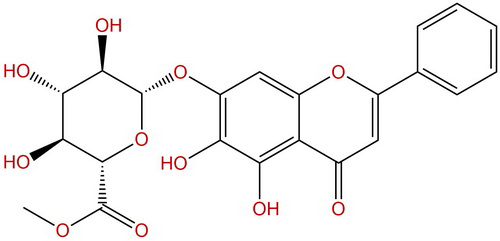
The chemical essence of baicalin methyl ester is the methyl ester derivative of baicalin. Baicalin itself is composed of the flavonoid glycoside baicalein (5,6,7-trihydroxyflavone) and glucuronic acid connected by a C7 oxygen glycosidic bond. Baicalin methyl ester, on this basis, converts the C6 'carboxyl group (- COOH) of the glucuronic acid residue into a methyl ester group (- COOCH ∝). The molecular formula of this structural modification is C ₂₂ H ₂₀ O ₁₁, with an accurate molecular weight of 460.3910 Da.
From the perspective of structural chemistry, methylation modification has a significant impact on the overall conformation of the molecule. Firstly, the esterification of carboxyl groups eliminates the negative charge at this site, reducing the polarity of the molecule; Secondly, the introduction of methyl ester groups increases the hydrophobicity of the molecule, which is directly reflected in its LogP value of 0.9802, significantly higher than the LogP value of baicalin (usually negative). In addition, the molecule still retains multiple phenolic hydroxyl groups (5-OH, 6-OH, 7-OH) of the flavonoid mother nucleus and multiple hydroxyl groups on the glucuronic acid ring, resulting in a total polar surface area (TPSA) of 176.1200 Å ², indicating that the molecule has good hydrogen bond donor and acceptor abilities.
Physical and chemical property parameters
According to computational chemistry prediction and experimental measurement data, the key physicochemical properties of baicalin methyl ester are as follows:
- molecular weight:460.3910 Da, Complies with the Lipinski Rule for drugs with a molecular weight of less than 500.
- Lipid water partition coefficient (LogP)0.9802 indicates that the molecule has moderate lipophilicity, which theoretically facilitates transmembrane transport.
- Topological Polarity Surface Area (TPSA)176.1200 Å ², higher than the recommended upper limit of 140 Å ² for oral medications, suggests the possibility of some oral absorption disorders.
- Water solubility:0.3906 mg/mL, Belonging to low water solubility compounds, this may limit their in vivo bioavailability.
- Blood-brain barrier penetrability Predicted to have low penetration, which is consistent with high TPSA values and the presence of multiple hydrogen bond donors/acceptors, suggesting that the central nervous system's role may be limited.
- HERG inhibition risk A negative prediction indicates a low risk of cardiac toxicity.
- Ames test mutagenicity The predicted probability is 0.6, indicating a certain risk of genetic toxicity and requiring experimental verification.
It is worth noting that compared with the parent compound baicalin, the LogP value of baicalin methyl ester is significantly increased, and its water solubility is correspondingly reduced. This change in physicochemical properties may affect its in vivo absorption, distribution, metabolism, and excretion (ADME) process. Methylation modification is often used as a prodrug strategy in medicinal chemistry, aiming to improve the membrane permeability of the parent drug. Baicalin methyl ester may improve the intestinal absorption of baicalin through this mechanism.
Plant sources and extraction methods
natural source
Baicalin methyl ester mainly comes from the lip shaped plant Scutellaria baicalensis in the family Lamiaceae(Scutellaria baicalensis Dry roots of Georgi. Scutellaria baicalensis, as a perennial herbaceous plant, is widely distributed in northern China, the Russian Far East, Mongolia, and the Korean Peninsula. In China, the main production areas of Scutellaria baicalensis include Hebei, Shanxi, Inner Mongolia, Liaoning, etc. Among them, the "Rehe Scutellaria baicalensis" produced in Chengde, Hebei has the best quality.
Scutellaria baicalensis root contains abundant flavonoids, including baicalin, baicalein, wogonoside, wogonin, etc. Baicalin methyl ester has relatively low content among these components and belongs to trace components. Research has shown that the content of baicalin methyl ester in Scutellaria baicalensis roots is usually only 1% -5% of baicalin, which is related to its role as a secondary metabolite or an artificial product during the extraction process. It is worth noting that some studies have suggested that baicalin methyl ester may be partially derived from the esterification reaction between methanol solvent and baicalin during the extraction process, so the boundary between its natural presence and artificial products needs to be carefully defined.
Extraction and Separation Methods
Given the low content of baicalin methyl ester in plant materials, efficient and specific methods are required for its extraction and purification. The traditional extraction process usually includes the following steps:
- Raw material pretreatment After drying, grind the root of Scutellaria baicalensis to 40-60 mesh, and degrease it with petroleum ether or n-hexane to remove fat soluble impurities.
- Solvent extraction Use methanol or ethanol water mixed solvent (usually 70% -80% ethanol) for heating reflux extraction, control the extraction temperature at 60-80 ° C, extract for 2-3 hours, and repeat 2-3 times. It is worth noting that using methanol as the extraction solvent may promote the methylation reaction of baicalin, thereby increasing the yield of baicalin methyl ester.
- Concentration and preliminary purification Concentrate the extract under reduced pressure to obtain a paste, disperse with water, and extract sequentially with petroleum ether, ethyl acetate, and n-butanol. Baicalin methyl ester is mainly enriched in the ethyl acetate extraction layer.
- chromatographic separation: Silica gel column chromatography was used, chloroform methanol water (8:2:0.1 to 6:4:0.5) gradient elution was used, and further purification was combined with polyamide column chromatography or Sephadex LH-20 gel column chromatography. High performance liquid chromatography (HPLC) can be used for final purification, using a C18 reverse phase column and methanol water formic acid (45:55:0.1) as the mobile phase.
In recent years, high-speed countercurrent chromatography (HSCCC) and preparative high-performance liquid chromatography (pre HPLC) techniques have also been applied to the efficient separation of baicalin methyl ester, significantly improving separation efficiency and product purity. In addition, supercritical fluid extraction (SFE) has shown potential as a green extraction technique for extracting active ingredients from Scutellaria baicalensis, but further optimization is needed for the application of baicalin methyl ester.
Pharmacological activity research
Antiviral activity
The antiviral activity of baicalin methyl ester is one of its most concerned pharmacological effects. Early studies have shown that baicalin and its derivatives have inhibitory effects on various viruses, including influenza virus, hepatitis virus, human immunodeficiency virus (HIV), etc. Baicalin methyl ester has shown superior antiviral efficacy compared to the parent compound in these studies, which may be attributed to its improved membrane permeability and target affinity.
In the research of anti-SARS-CoV-2, molecular docking and virtual screening studies have revealed potential interactions between baicalin methyl ester and multiple viral targets. Research has found that baicalin methyl ester can form stable complexes with the active sites of SARS-CoV-2's 3CL protease (3CLpro), papain like protease (PLpro), and RNA dependent RNA polymerase (RdRp). Especially when combined with 3CLpro, its binding energy is superior to some known natural product inhibitors. In addition, baicalin methyl ester is predicted to interact with angiotensin converting enzyme 2 (ACE2) and transmembrane serine protease 2 (TMPRSS2) on the surface of host cells, possibly exerting antiviral effects by blocking virus entry into host cells.
In vitro experiments further confirmed the anti SARS-CoV-2 activity of baicalin methyl ester. In the Vero E6 cell model, baicalin methyl ester inhibited SARS-CoV-2 replication in a dose-dependent manner, with a half maximal inhibitory concentration (IC ₅₀) at the micromolar level. It is worth noting that its antiviral activity is significantly higher than that of baicalin, indicating that methylation modification enhances antiviral efficacy. Mechanism studies have shown that baicalin methyl ester mainly plays a role in the early stages of virus replication, including inhibiting virus adsorption and entry into host cells, as well as inhibiting post translational processing of virus proteins.
Anti inflammatory and antioxidant activity
Baicalin methyl ester inherits the anti-inflammatory and antioxidant properties of baicalin and enhances them in certain aspects. In the lipopolysaccharide (LPS) - induced macrophage inflammation model, baicalin methyl ester can significantly inhibit the production of pro-inflammatory cytokines such as tumor necrosis factor - α (TNF - α), interleukin-6 (IL-6), and interleukin-1 β (IL-1 β). Its anti-inflammatory mechanism involves inhibition of the nuclear factor kappa B (NF - κ B) and mitogen activated protein kinase (MAPK) signaling pathways.
In terms of antioxidant properties, the flavonoid core structure of baicalin methyl ester endows it with the ability to scavenge free radicals. Research has shown that baicalin methyl ester can effectively scavenge 1,1-diphenyl-2-trinitrophenylhydrazine (DPPH) radicals, hydroxyl radicals, and superoxide anion radicals. Its antioxidant activity is closely related to the number and position of phenolic hydroxyl groups in the molecule. In addition, baicalin methyl ester can upregulate the activity of antioxidant enzymes such as superoxide dismutase (SOD) and glutathione peroxidase (GSH Px), thereby enhancing the antioxidant defense ability of cells.
Other pharmacological activities
In addition to antiviral and anti-inflammatory activities, baicalin methyl ester also exhibits various other pharmacological effects. In anti-tumor research, baicalin methyl ester has shown inhibitory effect on proliferation of many cancer cell lines (such as HepG2, breast cancer MCF-7, lung cancer A549), and its mechanism involves inducing cell cycle arrest and apoptosis. In terms of neuroprotection, baicalin methyl ester can alleviate oxidative stress-induced neuronal damage and may have potential therapeutic value for neurodegenerative diseases such as Alzheimer's disease and Parkinson's disease. In addition, preliminary studies suggest that baicalin methyl ester has hepatoprotective, hypoglycemic, and antibacterial activities.
Mechanism of action and molecular targets
Multi target mechanism of anti-SARS-CoV-2
The mechanism of action of baicalin methyl ester against SARS-CoV-2 exhibits multi-target and multi pathway characteristics, which is consistent with its natural product properties. Specifically, its antiviral mechanism can be summarized into the following levels:
1. Inhibit virus entry into host cells
The entry of SARS-CoV-2 into host cells relies on the binding of viral spike protein (S protein) to ACE2 receptors on the host cell surface, as well as the priming cleavage of S protein by TMPRSS2. Molecular docking studies have shown that baicalin methyl ester can bind to the active site of ACE2, potentially competitively blocking the interaction between S protein and ACE2. Meanwhile, baicalin methyl ester can also form hydrogen bonds and hydrophobic interactions with the catalytic triad (His296, Asp345, Ser441) of TMPRSS2, inhibiting its protease activity and thus preventing the activation of S protein. This dual blocking mechanism may effectively reduce the efficiency of virus entry into host cells.
2. Inhibit viral protease activity
After the virus enters the host cell, its genomic RNA is translated to produce polyproteins pp1a and pp1ab, which need to be cleaved by 3CLpro and PLpro to form functional non structural proteins. The molecular docking of baicalin methyl ester with 3CLpro showed that its flavonoid core can embed into the hydrophobic pocket of 3CLpro, forming π - π stacking and hydrogen bonding interactions with key residues His41 and Cys145, thereby inhibiting the catalytic activity of the enzyme. For PLpro, baicalin methyl ester can interact with the catalytic sites Cys101 and His272 of the enzyme, interfering with its deubiquitinase activity and thus affecting the assembly of the virus replication complex.
3. Inhibit viral RNA replication
RdRp is the core enzyme involved in SARS-CoV-2 genome replication, catalyzing the synthesis of viral RNA. Molecular simulation studies on baicalin methyl ester and RdRp have shown that it can bind to the active site of RdRp, interfering with the binding and polymerization reactions of nucleotide substrates. It is worth noting that the binding mode of baicalin methyl ester and RdRp is similar to that of remdesivir, but the binding site is slightly different, suggesting that it may have different drug resistance characteristics.
Anti inflammatory and immune regulatory mechanisms
The excessive inflammatory response (cytokine storm) caused by SARS-CoV-2 infection is one of the main causes of severe illness and death. The anti-inflammatory activity of baicalin methyl ester has important auxiliary value in the treatment of COVID-19. Research has shown that baicalin methyl ester can inhibit inflammatory responses through the following mechanisms:
- Inhibition of NF - κ B signaling pathway Baicalin methyl ester can inhibit the phosphorylation and degradation of I κ B α, prevent the nuclear translocation of NF - κ B p65 subunit, and thus reduce the transcription of pro-inflammatory cytokines.
- Activate Nrf2/ARE pathway Baicalin methyl ester can activate nuclear factor E2 related factor 2 (Nrf2), promote the expression of antioxidant enzymes driven by antioxidant response elements (ARE), and enhance the antioxidant defense ability of cells.
- Regulating the MAPK pathway Baicalin methyl ester can inhibit the phosphorylation of p38 MAPK and JNK, reducing the production of inflammatory mediators.
The structural basis of target interaction
The interaction between baicalin methyl ester and various targets depends on its unique chemical structure. The A and B rings of the flavonoid core provide a planar structure for interacting with the hydrophobic pocket of the target protein, while the carbonyl and glucuronide methyl groups of the C ring provide hydrogen bond donor and acceptor sites. In particular, the introduction of methyl glucuronate groups increases the flexibility of the molecule and its ability to form additional interactions with target proteins, which may be the structural basis for the superior activity of baicalin methyl ester compared to baicalin.
Evaluation of drug properties and pharmacokinetics
Analysis of drug properties
Based on Lipinski's five rules (molecular weight<500, LogP<5, hydrogen bond donor<5, hydrogen bond acceptor<10) and Veber's rule (rotatable bond<10, TPSA<140 Å ²), the molecular weight (460.39 Da) and LogP (0.98) of baicalin methyl ester meet the requirements, but the TPSA (176.12 Å ²) exceeds the threshold of 140 Å ², indicating that its oral bioavailability may be limited. In addition, the molecule contains 7 hydrogen bond donors (phenolic hydroxyl and alcohol hydroxyl) and 11 hydrogen bond acceptors (oxygen atoms), which also exceeds the recommended range of Lipinski's rule. Therefore, the pharmacological evaluation of baicalin methyl ester is moderate, and its oral absorption needs to be improved through formulation techniques or prodrug strategies.
Pharmacokinetic characteristics
At present, there is relatively limited systematic research on the pharmacokinetics of baicalin methyl ester in vivo, but based on its structural characteristics and related compound studies, its pharmacokinetic behavior can be inferred
-
absorb The LogP value of baicalin methyl ester is 0.98, which is between hydrophilicity and lipophilicity, theoretically favorable for passive diffusion through the intestinal epithelial cell membrane. However, its high TPSA value and multiple hydrogen bond donors/acceptors may limit its transmembrane transport. In addition, the methyl glucuronate group may be hydrolyzed by intestinal esterases, releasing baicalin. Therefore, baicalin methyl ester may act as a prodrug. After oral administration, the absorption of baicalin methyl ester may be affected by the efflux transporter of P-glycoprotein (P-gp), as flavonoids are often substrates of P-gp.
-
distribution The distribution volume of baicalin methyl ester may be moderate, with a high binding rate to plasma proteins (especially albumin). Its low blood-brain barrier penetration suggests limited distribution in the central nervous system, which may limit its application in neurological diseases and reduce adverse reactions in the central nervous system.
-
Metabolism The metabolism of baicalin methyl ester may involve two main pathways: one is esterase hydrolysis to produce baicalin and methanol; The second is phase II metabolic reactions, including glucuronidation and sulfation. The liver and intestines are the main metabolic organs. It is worth noting that methylation modification may alter metabolic stability and prolong the half-life in vivo.
-
excretion Baicalin methyl ester and its metabolites are mainly excreted through bile and urine. Due to its moderate molecular weight, some drugs may enter the intestine through bile excretion and undergo enterohepatic circulation.
safety evaluation
Based on computational toxicology predictions, the hERG inhibition risk of baicalin methyl ester is low (negative), indicating a lower risk of cardiac toxicity. However, the Ames test predicted a positive probability of 0.6, indicating a certain genetic toxicity risk, which requires further experimental verification. In animal experiments, the acute toxicity of baicalin methyl ester is relatively low, but long-term toxicity data is still lacking. Considering that baicalin methyl ester, as a natural product ingredient, has a long history of use in traditional Chinese medicine and its safety is generally controllable, systematic toxicological evaluation is still needed for its development as a candidate drug.
Clinical application prospects and prospects
Potential applications in combating COVID-19
Given the multi-target anti SARS-CoV-2 mechanism and good safety characteristics of baicalin methyl ester, it has important development value in the treatment of COVID-19. Compared with single target chemical drugs, the multi-target nature of baicalin methyl ester may reduce the risk of viral drug resistance. Meanwhile, its anti-inflammatory activity helps alleviate excessive inflammatory response in COVID-19 patients and improve clinical prognosis.
However, the clinical application of baicalin methyl ester still faces many challenges. Firstly, its oral bioavailability is low, and suitable administration routes and formulation technologies need to be developed. New delivery systems such as nanomaterials, liposomes, and phospholipid complexes may enhance their bioavailability. Secondly, it is necessary to establish large-scale, high-purity production processes to meet the needs of clinical research. In addition, systematic preclinical pharmacological and toxicological studies, as well as subsequent clinical trials, are needed to verify its safety and efficacy.
Combination use with other drugs
The combination of baicalin methyl ester with other antiviral or anti-inflammatory drugs may produce synergistic effects. For example, the combination with remdesivir may enhance the antiviral effect by acting on different stages of virus replication; Combined use with glucocorticoids may reduce hormone dosage and decrease adverse reactions. In addition, the compatibility application of baicalin methyl ester with traditional Chinese medicine formulas is also worth exploring, which may exert the comprehensive therapeutic advantages of multi-component and multi-target.
Structural optimization and derivatization
Based on the active skeleton of baicalin methyl ester, further structural optimization may lead to better candidate compounds. For example, modifying the methyl glucuronate group by introducing other ester groups or bioelectronic excretors may improve pharmacokinetic properties; Modifying the flavonoid core with substituents may enhance target affinity and selectivity. Computer aided drug design (CADD) and structural biology methods will accelerate this optimization process.
Application prospects in other disease fields
In addition to its anti COVID-19 effects, the activity of baicalin methyl ester in anti-inflammatory, antioxidant, anti-tumor, and neuroprotective aspects also provides possibilities for its application in other disease fields. Especially in chronic inflammatory diseases such as rheumatoid arthritis and inflammatory bowel disease, as well as metabolic diseases such as non-alcoholic fatty liver disease, baicalin methyl ester may play a therapeutic role. In addition, the expansion of its antiviral spectrum is also worth paying attention to, including its inhibitory effects on other coronaviruses, influenza viruses, and hepatitis viruses.
Conclusion
As a natural flavonoid glycoside derivative in Scutellaria baicalensis root, baicalin methyl ester has shown significant academic value and development potential in the field of natural product drug research due to its unique chemical structure and multi-target pharmacological activity. Methylation modification, a seemingly simple structural change, not only alters the physicochemical properties of the molecule, but also endows it with superior biological activity and pharmacokinetic characteristics compared to the parent compound.
In the study of anti-SARS-CoV-2, baicalin methyl ester exerts antiviral effects through multiple mechanisms such as inhibiting virus entry, protease activity, and RNA replication, while also possessing anti-inflammatory and antioxidant activities, making it a potential candidate molecule for the treatment of COVID-19. However, the development of baicalin methyl ester from natural products to clinical drugs still faces challenges in terms of bioavailability, production process, and safety evaluation.
In the future, with the advancement of structural biology, computational chemistry, and drug delivery technology, research on baicalin methyl ester and its derivatives will continue to deepen. The basic research of the system, rigorous clinical evaluation, and innovative formulation development will jointly promote the transition of this natural product from laboratory to clinical application. In the global fight against infectious diseases, baicalin methyl ester, as a microcosm of the modernization research of traditional Chinese medicine, is expected to make new contributions to human health.