


Product name: Baicalin
Synonym name: Baicalein 7-beta-D-glucuronide; Baicaloside
Catalogue No.: BP0233
Cas No.: 21967-41-9
Formula: C21H18O11
Mol Weight: 446.364
Botanical Source: Scutellaria spp., Oroxylum indicum and other plant spp.
Physical Description: Yellow powder
Type of Compound: Flavonoids
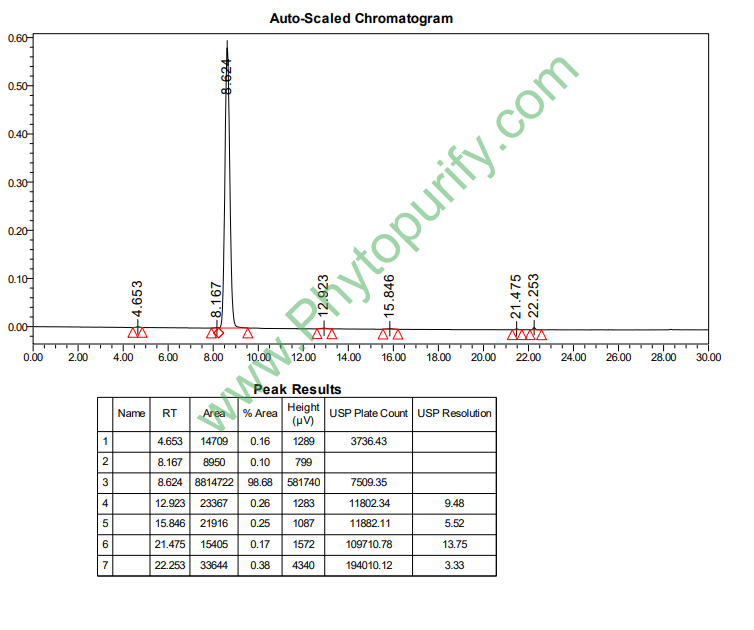
Purity: 95%~99%
Analysis Method: HPLC-DAD or/and HPLC-ELSD
Identification Method: Mass, NMR
Packing: Brown vial or HDPE plastic bottle
Storage: Store in a well closed container, protected from air and light. Put into refrigerate or freeze for long term storage.
Whenever possible, you should prepare and use solutions on the same day. However, if you need to make up stock solutions in advance, we recommend that you store the solution as aliquots in tightly sealed vials at -20℃. Generally, these will be useable for up to two weeks.
The product could be supplied from milligrams to grams, up to kilograms
Inquire for bulk scale.
Descriptions:
Baicalin is a flavonoid and a major component of a herbal medicine, Sho-saiko-to, which is commonly used for treatment of chronic hepatitis in Japan and China. baicalin acts as anti-oxidants, also causes cytotoxic effect,and induces caspase-3 activation and apoptosis via mitochondrial pathway.[1]
Baicalin has anti-inflammatory activity, exhibits the greatest inhibition activity against carrageenan-induced rat paw edema.[2]
Baicalin has neuroprotection, might be associated with its anti-oxidative and anti-apoptotic properties in global cerebral ischemia in the gerbils.[3]
References:
[1] Ueda S, Nakamura H, Masutani H, et al. Mol Immunol, 2002, 38(10):781-91.
[2] Chun-ChingLin, Den-EnShieh. Am J Chinese Med?, 1996, 24(1):31-6.
[3] Cao Y, Mao X, Sun C, et al. Brain Res Bull , 2011, 85(6):396-402.
[4] Yu-Xiang G U, Zhou Z L, Yang Y M, et al. Physical Testing & Chemical Analysis, 2012(4).
HPLC of Baicalin
Storage conditions:Short-term storage at 2~8℃, long-term storage at -20 ~ -80℃
187.1200
.6155
-1.6584
.6173
.5955
.1146
Low
86.9325
3.8928
Yes
No
No
No
Yes
No
0.6
Yes
No
Yes
No
Baicalin, registered with the Chemical Abstracts Service (CAS) number 21967-41, is derived from the traditional Chinese medicine Scutellaria baicalensis(Scutellaria baicalensis A major active flavonoid glycoside isolated from Georgi roots. As the 7-O-glucuronide of baicalein, baicalin is not only the material basis for the heat clearing and detoxifying, fire clearing and dampness drying effects of baicalein, but also a hot molecule in modern pharmacological research. In recent years, with the deepening of interdisciplinary research, the pharmacological activity spectrum of baicalin has been greatly expanded, and its mechanism of action has extended from traditional anti-inflammatory and antioxidant effects to cutting-edge fields such as regulating energy metabolism, programmed cell death, and epigenetic modification. Of particular note is its potential for multi-target and multi pathway intervention in various major disease models such as heart failure, neurodegenerative diseases, tumors, and viral infections, making it an attractive candidate molecule in the field of natural product new drug development. This article aims to systematically review the chemical properties, pharmacological activities, molecular mechanisms of action, pharmacological evaluation, and clinical application prospects of baicalin, in order to provide comprehensive academic references for the in-depth research and development of this compound.
The chemical name of baicalin is 5,6-dihydroxy-4-oxo-2-phenyl-4H-1-benzopyran-7-yl β - D-glucuronide, with a molecular formula of C21H18O11 and a molecular weight of 446.3640. The core of its structure is the flavonoid mother nucleus (2-phenylchromenone), which has a phenolic hydroxyl group at the 5th and 6th positions of the A ring, which is the key functional group for its antioxidant activity; Its 7th hydroxyl group is connected to glucuronic acid through glycosidic bonds, forming a glycosidic structure. This glucuronic acid group significantly affects the physicochemical properties of baicalin.
In terms of physicochemical properties, the logarithm of the lipid water partition coefficient (LogP) of baicalin is 0.6155, indicating that it has a certain lipophilicity, but the glucuronic acid moiety endows it with strong hydrophilicity. Its topological polar surface area (TPSA) is as high as 187.1200 Å ². This amphiphilic characteristic makes its solubility in water relatively limited, about 0.6173 mg/mL, but its solubility increases under alkaline conditions. The parameters related to drug properties show that baicalin has a lower ability to penetrate the blood-brain barrier (BBB), which to some extent limits its direct effects on central nervous system diseases, but also suggests that its peripheral safety may be higher. In addition, it has no inhibitory effect on the potassium channel of the human ether-a-go-go related gene (hERG), indicating a low risk of cardiac toxicity; The Ames test result is 0.6, indicating a low risk of mutagenicity. These basic pharmacological parameters provide preliminary safety basis for the subsequent development of baicalin.
Baicalin is mainly derived from the plant Scutellaria baicalensis in the family Lamiaceae(Scutellaria baicalensis Dry roots of Georgi, in addition to plants of the same genus such as Scutellaria barbata(S. barbata)There is also distribution in it. Scutellaria baicalensis, as a traditional Chinese medicine, has a history of more than two thousand years of application. Its quality evaluation is often based on the content of flavonoids such as baicalin and baicalein as key indicators.
The extraction method of baicalin has been continuously optimized with technological advancements. The traditional methods mainly use water extraction or alcohol extraction (such as methanol, ethanol), and improve efficiency by heating reflux or ultrasound assisted extraction. Due to the fact that baicalin often exists in the form of salt in plants, weak alkaline aqueous solutions (such as dilute ammonia water) are commonly used for extraction to dissolve it first, followed by acidification and precipitation. This method can obtain crude products with higher purity. Modern separation and purification techniques often use macroporous adsorption resin method, which utilizes the specific adsorption and desorption of flavonoids by resin for enrichment, and then combines silica gel column chromatography, preparative high-performance liquid chromatography (HPLC) and other methods for purification. In recent years, green extraction techniques such as supercritical fluid extraction and microwave-assisted extraction have also been applied to the extraction of baicalin. These methods have the advantages of high efficiency, low solvent consumption, and environmental friendliness. The optimization of extraction process aims to balance extraction rate, purity, and economic cost to meet the needs of different applications such as research, pharmaceuticals, and health products.
Numerous in vitro and in vivo studies have confirmed that baicalin has broad and significant pharmacological activities, covering multiple systems and disease domains.
The multiple pharmacological activities of baicalin stem from its interactions with multiple molecular targets, forming a complex network regulatory system.
Despite the excellent pharmacological activity of baicalin, there are certain challenges in its pharmacological development, especially in terms of pharmacokinetic properties, which are obstacles that it must overcome to develop from an active compound into a successful drug.
Pharmacokinetic characteristics:
* absorb After oral administration, baicalin has poor and irregular absorption in the gastrointestinal tract, mainly due to its high polarity and as a substrate for the efflux transporter P-gp. Compared with baicalein, its glycoside form is better absorbed.
* distribution Baicalin is widely distributed in the body, but its plasma protein binding rate is high and its blood-brain barrier permeability is low, which limits its distribution in the central nervous system.
* Metabolism The main metabolic pathway of baicalin is the hydrolysis reaction mediated by gut microbiota, which converts it into the glycoside baicalein, which can be reabsorbed by glucuronidation or sulfation in the liver after absorption. Metabolism in the liver also involves UDP glucuronosyltransferase (UGT) and sulfotransferase (SULT).
* excretion Baicalin and its metabolites are mainly excreted in urine through the kidneys, and there is also a bile excretion pathway, as well as hepatic intestinal circulation.
Challenges and Strategies in Drug Development:
1. Solubility and permeability Moderate solubility and low membrane permeability are the main reasons for its low oral bioavailability (usually<2%).
2. First pass effect and metabolism The extensive metabolism of gut microbiota and the first pass effect in the liver further reduce its systemic exposure.
3. Formulation improvement To overcome the aforementioned shortcomings, researchers have developed various novel drug delivery systems, including phospholipid complexes, cyclodextrin inclusion complexes, solid dispersions, nanoparticles (such as liposomes and polymer nanoparticles), microemulsions, and self microemulsifying drug delivery systems. These technologies can effectively improve the solubility, stability, and membrane permeability of baicalin, and may bypass the first pass effect through lymphatic transport and other pathways, significantly enhancing its oral bioavailability.
4. Structural modification Chemical modification of the sugar or phenolic hydroxyl groups of baicalin to synthesize prodrugs or derivatives is another way to improve its pharmacokinetic properties.
The clinical application prospects of baicalin are broad, but solid research is still needed to promote its transformation.
Current application and development stage:
At present, baicalin has been used as a raw material or main ingredient in some traditional Chinese medicine compound preparations and health products. Injections containing baicalin as the main active ingredient (such as for antiviral and anti-inflammatory purposes) have been clinically studied and applied in China. In Europe and America, dietary supplements containing standardized Scutellaria baicalensis extract (rich in baicalin) are used to support immune health and anti-inflammatory effects.
Future development direction:
1. Drug development based on precise mechanisms Develop innovative drugs for specific indications (such as heart failure, specific types of cancer) targeting their clear molecular targets (such as CPT1 activators, G9a inhibitors). The field of heart failure is a highly promising breakthrough, and its energy metabolism remodeling mechanism complements current treatment strategies.
2. Combination therapy strategy By utilizing the sensitizing and detoxifying effects of baicalin, it can be combined with existing chemotherapy drugs, targeted drugs, or immune checkpoint inhibitors to improve efficacy, reduce side effects, or reverse drug resistance.
3. Industrialization of new drug delivery systems Promote the development of new drug delivery systems, such as nano formulations and complexes, from the laboratory to large-scale production and clinical validation, and solve the core bottleneck of drug development.
4. Expand the exploration of clinical indications In addition to traditional cardiovascular, infectious, and inflammatory diseases, its application in metabolic diseases (such as non-alcoholic fatty liver disease), fibrotic diseases, neurodegenerative diseases, and iron death related diseases (such as ischemia-reperfusion injury and neurodegeneration) deserves further exploration.
5. In depth security evaluation Although traditional applications have a long history, the systemic toxicity and reproductive toxicity of high-purity monomers or new formulations used in large doses for a long time still need to be strictly evaluated according to modern new drug research standards.
As a star molecule derived from classic Chinese medicine, baicalin continues to attract global attention in pharmacology and drug development due to its diverse pharmacological activities and constantly revealed deep molecular mechanisms. The multi-target action characteristics of CPT1 energy metabolism regulation to G9a epigenetic inhibition reflect the unique advantages of natural product system intervention in complex diseases. Despite its inherent pharmaceutical challenges, such as low oral bioavailability and poor blood-brain barrier permeability, which pose difficulties for development, modern pharmaceutical and medicinal chemistry technologies provide powerful solutions for this. In the future, through continuous deepening of basic research, precise analysis of the mechanism of action, and innovative breakthroughs in formulation technology, baicalin is expected to be successfully transformed from a broad-spectrum active lead compound into a targeted therapeutic drug for major diseases such as heart failure, or become an important component in combination therapy plans, thus revitalizing the modern medical system and achieving a magnificent transformation from traditional wisdom to innovative drugs.
