


Product name: Baicalein
Synonym name: 5,6,7-Trihydroxyflavone; Noroxylin
Catalogue No.: BP0232
Cas No.: 491-67-8
Formula: C15H10O5
Mol Weight: 270.24
Botanical Source: Scutellaria spp. and other plants
Physical Description: Yellow powder
Type of Compound: Flavonoids
Purity: 95%~99%
Analysis Method: HPLC-DAD or/and HPLC-ELSD
Identification Method: Mass, NMR
Packing: Brown vial or HDPE plastic bottle
Storage: Store in a well closed container, protected from air and light. Put into refrigerate or freeze for long term storage.
Whenever possible, you should prepare and use solutions on the same day. However, if you need to make up stock solutions in advance, we recommend that you store the solution as aliquots in tightly sealed vials at -20℃. Generally, these will be useable for up to two weeks.
The product could be supplied from milligrams to grams, up to kilograms
Inquire for bulk scale.
Descriptions:
Baicalin, saikosaponins, and baicalein have antitumor effects on human hepatoma cell lines and bladder cancer cell lines.[1,2]
Baicalin, wogonin,and baicalein inhibition of inducible nitric oxide synthase and cyclooxygenase-2 gene expressions induced by nitric oxide synthase inhibitors and lipopolysaccharide .[3]
Baicalin and its aglycone baicalein have widely investigated in hematological malignancies because both of them exhibit remarkable pharmacological properties.[4]
Baicalin, baicalein, and wogonin have antioxidant and free radical scavenging effects.[5]
Baicalin exhibits the greatest inhibition activity against carrageenan-induced rat paw edema.[6]
Baicalein can induce cancer cell death and proliferation retardation by the inhibition of CDC2 kinase and survivin associated with opposite role of p38 mitogen-activated protein kinase and AKT.[7]
References:
[1] Motoo Y, Sawabu N. Cancer Lett, 1994, 86(1):91-5.
[2] Ikemoto S, Sugimura K, Yoshida N, et al. Urology, 2000, 55(6):951-5.
[3] Chen Y C, Shen S C, Chen L G, et al. Biochem Pharmacol, 2001, 61(11):1417-27.
[4] Chen H, Gao Y, Wu J, et al. Cancer Lett, 2014, 354(1):5-11.
[5] Shieh D E, Liu L T, Lin C C. Anticancer Res, 2000, 20(5A):2861-5.
[6] ChunChing Lin, DenEn Shieh. Am J Chinese Med, 1996, 24(1):31-6.
[7] Chao J, Su W H. Mol Cancer Ther, 2007, 6(11):3039-48.
[8] Dong W J, Liu Y L. Chinese J Pharma Anal, 2009, 29(3):2120-2.
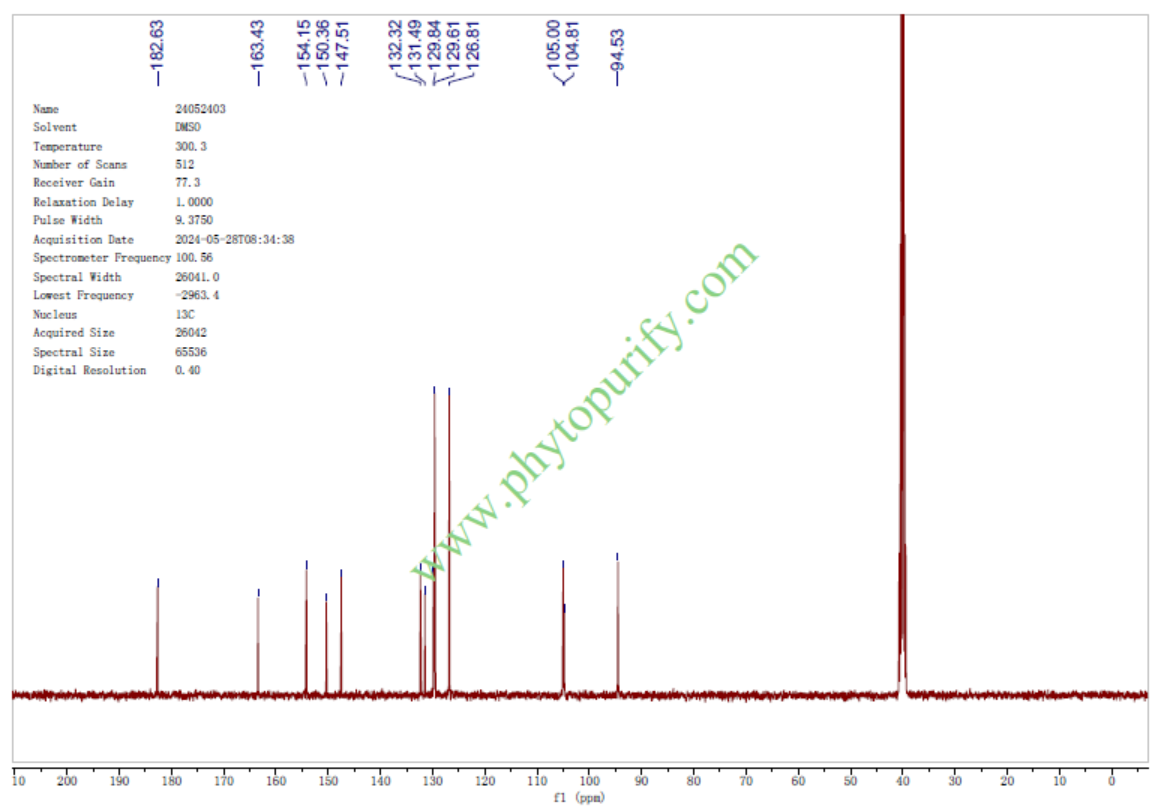
NMR of Baicalein
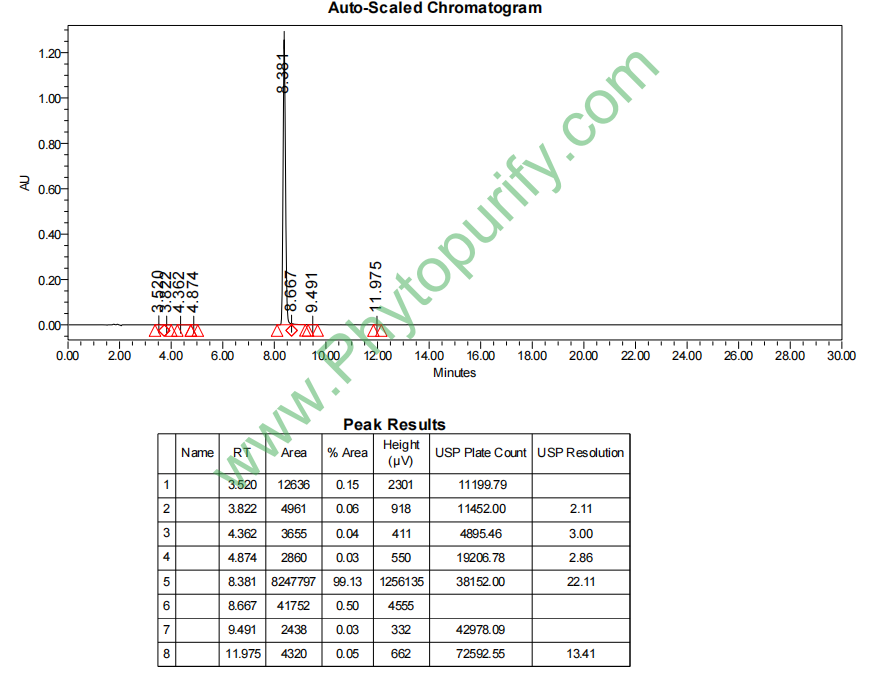
HPLC of Baicalein
Storage conditions:Short-term storage at 2~8℃, long-term storage at -20 ~ -80℃
90.9000
2.5355
1.6336
.0105
4.3158
9.1256
Low
92.5040
2.2485
Yes
Yes
No
No
Yes
No
0.6
Yes
No
Yes
No
Baicalein, also known as 5,6,7-trihydroxyflavone, is a traditional Chinese medicine derived from Scutellaria baicalensis(Scutellaria baicalensis The main active flavonoids isolated from Georgi roots. Its CAS number is 491-67-8, and it has long been used in the traditional Chinese medicine system for clearing heat, drying dampness, purging fire, and detoxifying. With the deepening of modern pharmacological research, baicalein has surpassed its traditional application scope and demonstrated extremely extensive and complex biological activities. Research has shown that baicalein is not only an effective xanthine oxidase inhibitor (IC50=3.12 μ M), but has also been proven to have multiple pharmacological effects, including anti-tumor, antioxidant, anti-inflammatory, antibacterial, antiviral (including anti coronavirus), neuroprotective, angiogenesis inhibition, and metabolic regulation. Its target network is complex, involving multiple signaling pathways closely related to major diseases such as AMPK, SGLT2, MAOA, ESR2, etc. Especially, its potential therapeutic value in the fields of diabetes and its complications, neurodegenerative diseases, cardiovascular diseases and cancer makes it a hot molecule in natural product pharmacology research. This article aims to systematically review the chemical properties, pharmacological activity, mechanism of action, pharmacological evaluation, and clinical application prospects of baicalein, in order to provide comprehensive scientific references for the in-depth research and development of this compound.
The molecular formula of baicalein is C15H10O5, with a molecular weight of 270.24 g/mol. Its basic skeleton is flavonoids (2-phenylchromenone), characterized by three consecutive phenolic hydroxyl groups arranged at positions 5, 6, and 7 of the A ring. This structure of pyrogallol (gallic acid) is the chemical basis for its strong antioxidant and free radical scavenging abilities. The double bond between positions 2 and 3 of the C ring is conjugated with the carbonyl group at position 4, forming a key pharmacophore that exerts various biological activities.
In terms of physicochemical properties, the lipid water partition coefficient (LogP) of baicalein is 2.54, indicating that it has a certain lipophilicity, but not highly lipophilic. Its topological polar surface area (TPSA) is 90.9 Å ², reflecting the polarity brought by multiple hydroxyl groups in the molecule. The water solubility is poor, about 0.0105 mg/mL, which to some extent limits its bioavailability. The preliminary in vitro safety assessment showed that the Ames test result was 0.6 (negative) and had no significant inhibitory effect on hERG potassium channels, indicating a low risk of genetic toxicity and cardiac toxicity. It is worth noting that the blood-brain barrier permeability of baicalein is predicted to be "low", which may affect its direct therapeutic effect on central nervous system diseases, but also suggests that its peripheral side effects may be relatively small. These basic pharmacological parameters provide important basis for subsequent formulation design and structural modification.
Baicalin is mainly derived from the lip shaped plant Scutellaria baicalensis(Scutellaria baicalensis The dry roots of Georgi are one of its characteristic components. In addition, in plants of the same genus such as Scutellaria barbata(S. barbata)And there are also small amounts present in some other plants. In the roots of Scutellaria baicalensis, baicalein often coexists with its glycoside form, baicalin, which can be hydrolyzed and converted into baicalein in vitro and in vivo.
There are various methods for extracting baicalein, aiming to efficiently and environmentally obtain high-purity products. Traditional methods include solvent extraction, commonly using ethanol, methanol, or ethanol water systems with different ratios for reflux or ultrasound assisted extraction, followed by separation and purification through acid-base treatment, column chromatography (such as silica gel, polyamide, macroporous adsorption resin), and other methods. Modern technologies such as supercritical CO2 extraction, microwave-assisted extraction, and high-pressure liquid chromatography have been widely used, which can better protect thermally unstable components, improve extraction efficiency, and reduce the use of organic solvents. Industrial production usually uses baicalin as a precursor to prepare baicalein in large quantities through enzymatic or acid hydrolysis. The optimization of extraction process always revolves around three major goals: improving yield, maintaining activity, and reducing costs.
Baicalin has multi-target and multi pathway pharmacological activities, and its research has covered multiple major disease fields.
1. Antitumor activity: Baicalein has significant proliferation inhibition, apoptosis induction and cycle arrest effects on a variety of cancer cell lines (such as lung cancer, liver cancer, breast cancer, colorectal cancer, prostate cancer, etc.). In addition, it can inhibit the invasion, migration, and angiogenesis of tumor cells, demonstrating anti metastatic potential.
2. Antioxidant and anti-inflammatory activities: With its phenolic hydroxyl structure, baicalein is a potent antioxidant that can directly eliminate free radicals such as ROS and RNS, and upregulate the expression of endogenous antioxidant enzymes such as SOD and GSH Px. Its anti-inflammatory effect is achieved by inhibiting inflammatory signaling pathways such as NF - κ B and MAPK, downregulating the expression of COX-2, iNOS, and various pro-inflammatory cytokines (such as TNF - α, IL-6, IL-1 β).
3. Neuroprotective and anti-aging activities: Baicalin has shown protective effects in neurodegenerative disease models such as Alzheimer's disease and Parkinson's disease. It can reduce the toxicity of beta amyloid (A β) protein, inhibit tau protein hyperphosphorylation, alleviate neuroinflammation, and has iron death inhibitory activity, protecting neurons from various types of damage. Its antioxidant and mitochondrial protective functions also provide support for its "anti-aging agent" properties.
4. Antimicrobial and antiviral activity: Baicalin has inhibitory effects on various bacteria and fungi. What is particularly noteworthy is its antiviral activity, especially as an effective inhibitor of the major protease (3CLpro) of SARS coronavirus, showing potential therapeutic value for coronaviruses including SARS-CoV-2.
5. Metabolic disease-related activities: In the study of diabetes and its complications, baicalein has shown the effects of reducing blood sugar, improving insulin resistance, protecting pancreatic islet β cells, and preventing and treating diabetes nephropathy and retinopathy.
6. Cardiovascular protective activity: Baicalein has protective effects on atherosclerosis and myocardial ischemia reperfusion injury through antioxidant, anti-inflammatory, inhibiting the proliferation of vascular smooth muscle cells, improving endothelial function and other ways.
The multiple pharmacological effects of baicalein stem from its interactions with complex biological molecular networks. The mechanism of action of diabetes related target information provided by you can be explained in depth as follows:
In addition, baicalein serves as Xanthine oxidase inhibitor It can reduce uric acid production, indicating its potential anti gout effect. its antioxidant The effect is related to the direct clearance of free radicals and activation of the Nrf2/ARE pathway.anti-inflammatory The effect mainly depends on the inhibition of NF - κ B and NLRP3 inflammasome activation.antitumor The mechanism involves inducing apoptosis (mitochondrial pathway, death receptor pathway), autophagy, cycle arrest (G1/S phase), and inhibiting survival promoting signaling pathways such as PI3K/Akt and Wnt/β - catenin.
Although baicalein has a wide range of pharmacological activities, its medicinal properties face challenges, mainly due to its poor solubility and low bioavailability.
Pharmacokinetic characteristics: After oral administration, baicalein is rapidly but incompletely absorbed in the gastrointestinal tract and is prone to extensive first pass metabolism. Its main metabolic pathways include glucuronidation and sulfation, producing metabolites such as baicalin-7-O-glucuronide (i.e. baicalin). These metabolites also have biological activity, and in some aspects, their activity is even stronger or more persistent, forming the characteristic of baicalein as a "prodrug" or "multi-component synergy". Baicalin and its metabolites are widely distributed in the body, but the amount of the prototype drug entering brain tissue is limited. Mainly excreted through the kidneys and bile.
Challenges and strategies for drug development:
1. Solubility and permeability: Low water solubility and moderate permeability make it a class II or IV drug in the Biopharmaceutical Classification System (BCS), with significant variability in oral absorption.
2. Bioaccumulation: The strong first pass effect leads to low absolute bioavailability (usually<10% in animal studies).
3. Stability The phenolic hydroxyl structure makes it unstable in alkaline or oxidative environments.
Improvement strategy:
* Formulation innovation: The use of solid dispersions, cyclodextrin inclusion complexes, liposomes, nanoparticles, microemulsions, self microemulsions, and other delivery systems significantly improves their solubility, stability, and intestinal absorption.
* Predrug modification: Esterification and other modifications are carried out on phenolic hydroxyl groups to improve lipid solubility and membrane permeability, and to explain the release of active ingredients in vivo.
* Joint administration: Combined with P-glycoprotein inhibitors or metabolic enzyme inhibitors to reduce efflux and metabolism.
* Structural optimization: On the basis of retaining the pharmacophore, semi synthetic modifications are carried out to search for derivatives with better activity and pharmacokinetic properties.
The transformation path of baicalein from traditional Chinese medicine to modern clinical practice is becoming increasingly clear, and its application prospects are broad, but key bottlenecks need to be overcome.
Potential clinical application directions:
1. Metabolic disorders: As a multi target anti diabetes candidate drug, it is particularly suitable for type 2 diabetes patients with insulin resistance, high uric acid or mild inflammation. Its dual effects of SGLT2 inhibition and AMPK activation are quite distinctive.
2. Neurodegenerative diseases: The development of neuroprotective agents for Alzheimer's disease and Parkinson's disease requires a focus on addressing their brain delivery issues.
3. Antiviral therapy: As a lead compound for broad-spectrum antiviral drugs, it has strategic research value, especially in responding to newly emerging viral infectious diseases.
4. Tumor adjuvant therapy: Combined with conventional chemotherapy and radiotherapy, it plays a role in enhancing sensitivity, reducing toxicity, and preventing metastasis, improving overall efficacy.
5. Cardiovascular and cerebrovascular diseases: To develop drugs for prevention and treatment of atherosclerosis and ischemic cardiovascular and cerebrovascular diseases.
6. Functional foods and cosmetics: Utilize its strong antioxidant and anti-inflammatory properties to develop health foods, functional beverages, and anti-aging skincare products.
Future research prospects:
1. In depth mechanism exploration: Using omics techniques (proteomics, metabolomics) and chemical biology methods, systematically elucidate the precise network and key nodes of multi-target synergistic effects.
2. Overcoming the bottleneck of traditional Chinese medicine: The preclinical and clinical research of the new drug delivery system is the key to successful transformation. Exploring non oral routes of administration (such as inhalation, transdermal) may open up new fields.
3. High quality clinical research: Rigorous randomized controlled clinical trials were designed to verify the exact efficacy and safety of specific diseases (such as non-alcoholic fatty liver disease, diabetes nephropathy, mild cognitive impairment), and obtain high-level evidence-based medical evidence.
4. Structural modification and innovative drug development: Using baicalein as the lead compound, systematic structure-activity relationship research and structural optimization will be conducted to develop a new chemical entity with independent intellectual property rights, stronger activity, higher selectivity, and better pharmacokinetic properties.
5. Multi component collaborative research: Study the synergistic effects of baicalein with other components in Scutellaria baicalensis (such as baicalin and baicalein) or with other drugs, and develop modern compound preparations based on traditional Chinese medicine theory.
Huangqin extract, as a classic flavonoid compound derived from traditional Chinese medicine, has attracted sustained attention from researchers worldwide due to its rich pharmacological activity and complex mechanism of action. From inhibiting xanthine oxidase to regulating multiple diabetes related targets such as AMPK and SGLT2, from strong anti oxidant and anti-inflammatory capacity to significant anti-tumor, anti-virus and neuroprotective effects, baicalein fully demonstrates the unique advantages of natural products in "multiple targets and multiple pathways" to intervene in complex diseases. Although its poor solubility and bioavailability are currently the main obstacles to clinical translation, these challenges are gradually being overcome through the interdisciplinary integration of modern pharmacy, medicinal chemistry, and pharmacology. In the future, with the continuous deepening of basic research and the continuous promotion of transformation and application, baicalein is very likely to transform from a bright scientific star into a clinical drug or key functional ingredient that benefits human health, play an important role in the prevention and treatment of metabolic diseases, neuropsychiatric diseases, infectious diseases, tumors and other major diseases, and continue to write a new chapter in the modernization of traditional Chinese medicine.
