Introduction/Overview
7-O-Methylbaicalein, registered with CAS number 29550-13-8, is a traditional Chinese medicine derived from Scutellaria baicalensis(Scutellaria baicalensis Natural flavonoid compounds in the roots of Georgi. As a 7-hydroxymethylated derivative of baicalein, it is not only one of the iconic components in Scutellaria baicalensis medicinal materials, but also an important metabolite of baicalein in vivo. Flavonoids have always been a hot topic in natural product pharmacology research due to their wide range of biological activities, such as anti-inflammatory, antioxidant, antiviral, and anti-tumor effects. In recent years, with the deepening of research on Scutellaria baicalensis and its active ingredients, baicalin-7-methyl ether has gradually emerged from the halo of baicalin due to its unique chemical modification and potential pharmacological effects, becoming an independent research object.
In particular, baicalin-7-methyl ether shows the potential of multi-target and multi-channel regulation in inflammatory related diseases, especially in respiratory infectious diseases such as pneumonia. Modern pharmacological research has preliminarily revealed that it regulates pathological processes such as inflammatory storms, cell death, and oxidative stress by intervening in key targets such as Toll like receptor 4 (TLR4), tumor necrosis factor - α (TNF - α), nuclear factor kappa B (NF - κ B, with its key subunit being RELA/p65), and cysteine containing aspartate proteolysis enzyme 1 (CASP1). This article aims to systematically review the chemical properties, plant sources, pharmacological activities, molecular mechanisms of action, pharmacological characteristics, and clinical application prospects of baicalin-7-methyl ether, in order to provide comprehensive scientific references for the in-depth research and development of this compound.
Chemical structure and physicochemical properties
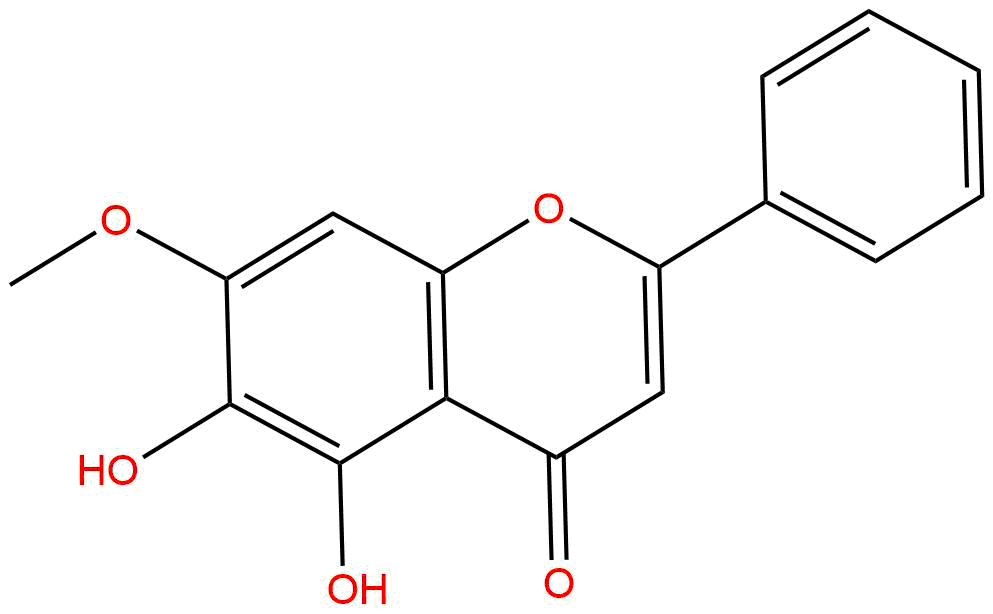
Baicalin-7-methyl ether belongs to the flavonol subclass of flavonoids. Its parent nucleus is 2-phenylchromenone, with the specific chemical name 5,6-dihydroxy-7-methoxy-2-phenyl-4H-1-benzopyran-4-one. Compared with Huangqinsu (5,6,7-trihydroxyflavone), its significant structural feature is that the hydroxyl group (- OH) at position C-7 is replaced by a methoxy group (- OCH3). Although this methylation modification is small, it significantly changes the polarity, lipophilicity, and biological activity of the molecule.
Its basic physicochemical properties are as follows: the molecular weight is 284.2670 g/mol, and the calculated lipid water partition coefficient (LogP) is 2.6068, indicating that the compound has a moderate degree of lipophilicity. The topological polar surface area (TPSA) is 79.90 Å ², reflecting the characteristics of hydrogen bond acceptors in the molecule. The water solubility is relatively low, about 0.0070 mg/mL, which is consistent with its LogP value, indicating that its absorption and distribution in organisms may be limited by solubility. The preliminary drug risk assessment shows that its ability to cross the blood-brain barrier is low, and it has no significant inhibitory effect on hERG potassium channels (indicating a low potential risk of arrhythmia). The Ames test result is 0.6 (usually considered negative if it is less than 2), indicating that it has no significant genetic toxicity. These physicochemical and preliminary safety parameters provide basic data for the subsequent optimization of drug chemistry and formulation development.
Plant sources and extraction methods
Baicalin-7-methyl ether is mainly found in the lip shaped plant Scutellaria baicalensis(Scutellaria baicalensis In the dry roots of Georgi. Scutellaria baicalensis, as a classic traditional Chinese medicine for clearing heat, drying dampness, purging fire, and detoxifying, has a complex chemical composition. In addition to baicalin-7-methyl ether, it is also rich in flavonoids such as baicalin, baicalein, and baicalin. This compound can exist as a primary secondary metabolite in plants, and can also be generated by baicalein catalyzed by methyltransferase in plants.
The extraction of baicalin-7-methyl ether from Scutellaria baicalensis medicinal materials is often carried out using organic solvent extraction method. The classic process includes heating and refluxing the powder of Scutellaria baicalensis root with high concentration ethanol (such as 70% -95%) or ultrasound assisted extraction, combining the extraction solutions, and concentrating them under reduced pressure to obtain a paste. Subsequently, preliminary separation was carried out by utilizing its solubility differences in different polar solvents, such as defatting with petroleum ether and then extracting and enriching flavonoids with ethyl acetate or n-butanol. Further purification relies on column chromatography technology, often using silica gel, polyamide, or macroporous adsorption resin as the stationary phase, and using gradient elution systems such as chloroform methanol and petroleum ether ethyl acetate for separation. High performance liquid chromatography (HPLC) and preparative thin layer chromatography (PTLC) are key steps in obtaining high-purity monomeric compounds. In recent years, modern separation technologies such as supercritical fluid extraction and high-speed countercurrent chromatography have also been applied to improve extraction efficiency and product purity. In addition, semi synthesis of abundant baicalein through chemical or biocatalytic methods is also a feasible approach to obtain baicalin-7-methyl ether.
Pharmacological activity research
A large number of in vitro and in vivo pharmacological studies have shown that baicalin-7-methyl ether has various biological activities, among which anti-inflammatory and antioxidant effects are the most prominent, and extend to fields such as anti fibrosis and neuroprotection.
-
Anti inflammatory and immune regulatory activity This is the activity of baicalin-7-methyl ether that has received the most attention. In the lipopolysaccharide (LPS) - induced macrophage (such as RAW264.7) inflammation model, it can significantly inhibit the excessive production of inflammatory mediators such as nitric oxide (NO), prostaglandin E2 (PGE2), interleukin-6 (IL-6), IL-1 β, and TNF - α. In animal models, it exhibits good protective effects against inflammatory diseases such as acute lung injury, pneumonia, and arthritis. For example, in the LPS induced mouse pneumonia model, baicalin-7-methyl ether pretreatment can alleviate lung tissue edema, inflammatory cell infiltration, and histopathological damage.
-
antioxidant activity As a flavonoid, baicalin-7-methyl ether has the ability to scavenge free radicals. The catechol structure (5,6-dihydroxy) in its molecular structure is the main antioxidant active site, which can effectively eliminate reactive oxygen species (ROS) such as superoxide anions and hydroxyl radicals, and may enhance cellular antioxidant stress resistance by upregulating the endogenous antioxidant system (such as the nuclear factor E2 related factor 2/Nrf2 pathway).
-
Anti fibrotic activity Research suggests that baicalin-7-methyl ether has an improving effect on pulmonary, hepatic, and renal fibrosis. In the fibroblast activation model induced by transforming growth factor - β 1 (TGF - β 1), it can inhibit cell proliferation and collagen deposition, and its mechanism may be related to regulating the Smad signaling pathway.
-
Neuroprotective activity Preliminary studies have shown that baicalin-7-methyl ether may have protective potential against neurodegenerative diseases such as ischemic brain injury and Alzheimer's disease. Its effects involve anti-inflammatory, antioxidant, and acetylcholinesterase inhibition.
-
Other activities There are also studies reporting its potential for antiviral (such as influenza virus), anti-tumor (inhibiting the proliferation of certain cancer cells), and antibacterial effects, but related research is still in its early stages.
Mechanism of action and molecular targets
The pharmacological effects of baicalin-7-methyl ether, especially in inflammatory diseases such as pneumonia, are achieved by interacting with multiple molecular targets and regulating complex signaling networks. Based on existing research, its core mechanism of action can be summarized as follows:
-
Inhibition of TLR4/NF - κ B inflammatory core pathway LPS is a component of the cell wall of Gram negative bacteria that triggers downstream inflammatory cascades by activating TLR4. Baicalin-7-methyl ether has been shown to directly or indirectly inhibit the activation of TLR4 and its adaptor protein MyD88, thereby blocking the activation of I κ B kinase (IKK) complex, inhibiting the degradation of I κ B α and nuclear translocation of NF - κ B (RELA/p65 subunit). The decrease in NF - κ B nuclear entry leads to a decrease in the transcription levels of inflammatory cytokine genes such as TNF - α, IL-6, IL-1 β, and inducible nitric oxide synthase (NOS2). This is the central link of its anti-inflammatory effect.
-
Regulating NLRP3 inflammasome and cell pyroptosis The assembly and activation of NLRP3 inflammasomes are key events leading to the mature release of IL-1 β and IL-18, as well as pyroptosis, and play an important role in severe pneumonia. Research has shown that baicalin-7-methyl ether can inhibit the activation of NLRP3 inflammasome and reduce the self splicing activation of CASP1. Activated CASP1 not only cleaves IL-1 β precursor, but also cleaves Gasdermin D protein, leading to cell pyroptosis. Through this pathway, compounds can alleviate inflammatory reactions and tissue damage.
-
Intervene in other key signal nodes:
- SIRT1 activation Silencing information regulatory factor 1 (SIRT1) is an NAD+- dependent deacetylase with anti-inflammatory and antioxidant effects. Baicalin-7-methyl ether may activate SIRT1, deacetylate, and inhibit the transcriptional activity of NF - κ B p65, while possibly activating factors such as PGC-1 α to enhance antioxidant defense.
- PTPN1 inhibition Protein tyrosine phosphatase 1B (PTPN1) is a negative regulator of the insulin and leptin signaling pathways and is also associated with inflammation. Inhibition of PTPN1 may indirectly improve metabolic inflammation, but its specific role in pneumonia and the direct impact of baicalin-7-methyl ether need further clarification.
- IDH1 and metabolic reprogramming Isocitrate dehydrogenase 1 (IDH1) is involved in cellular metabolism. In certain pathological states, mutations or functional abnormalities are associated with inflammation and fibrosis. Whether baicalin-7-methyl ether regulates metabolic reprogramming of immune cells by affecting IDH1 function is a new direction worth exploring.
- TGF - β/Smad3 pathway In the process of fibrosis, baicalin-7-methyl ether may exert anti pulmonary and anti hepatic fibrosis effects by inhibiting the phosphorylation of Smad3 and blocking the expression of pro fibrotic genes mediated by TGF - β 1.
In summary, baicalin-7-methyl ether forms a synergistic regulatory network through multi-target action, from membrane receptors (TLR2/4), intracellular signal transduction (NF - κ B, SIRT1, Smad3), to inflammatory executors (NLRP3/CASP1) and effector molecules (TNF, NOS2), providing a molecular basis for its treatment of complex multifactorial diseases such as pneumonia.
Evaluation of drug properties and pharmacokinetics
Although baicalin-7-methyl ether exhibits good pharmacological activity, its pharmacological properties still require systematic evaluation.
-
Absorption, Distribution, Metabolism, and Excretion (ADME):
- absorb The moderate LogP value and low water solubility suggest that its oral bioavailability may face challenges. It may be absorbed in the small intestine through passive diffusion, but the first pass effect (especially in liver metabolism) may be significant.
- distribution Lower TPSA and moderate lipid solubility are beneficial for its penetration through cell membranes, but the prediction of low blood-brain barrier permeability limits its direct effect on central nervous system diseases. It may be widely distributed in organs with abundant blood flow such as the liver, lungs, and kidneys in the body.
- Metabolism As a flavonoid, it mainly undergoes II binding reactions in the body, such as glucuronidation and sulfation, to generate more polar metabolites that are excreted through bile and urine. The methoxy group at position C-7 may make it more stable than baicalein and resist certain forms of metabolic degradation. The cytochrome P450 enzyme system in liver microsomes may also be involved in its metabolism.
- excretion The prototype drug and its conjugates are mainly excreted through the kidneys and bile.
-
Formulation and administration strategy To improve its bioavailability, it may be necessary to develop new drug delivery systems. For example, using techniques such as nanocrystals, liposomes, solid dispersions, or cyclodextrin inclusion complexes to increase their solubility and dissolution rate. Phospholipid complexes or prodrug strategies may also improve their intestinal absorption and targeting.
-
Preliminary Safety Assessment The existing limited data (hERG inhibition negative, Ames test negative) provide preliminary safety signals. However, comprehensive preclinical safety evaluation, including acute toxicity, long-term toxicity, reproductive toxicity, and more in-depth toxicokinetics research, is the necessary path for its translation into clinical application.
Clinical application prospects and prospects
The clinical application prospects of baicalin-7-methyl ether are mainly based on the long history of medicinal use of Scutellaria baicalensis and its clear modern pharmacological mechanism.
-
Potential indications:
- Community acquired pneumonia and acute lung injury/acute respiratory distress syndrome (ALI/ARDS)As an adjuvant or therapeutic drug, it reduces lung tissue damage and improves oxygenation by inhibiting excessive inflammatory response and cell pyroptosis. Its multi-target characteristics may be beneficial for pneumonia caused by various pathogens such as bacteria and viruses.
- Chronic inflammatory and fibrotic lung disease During the acute exacerbation phase of idiopathic pulmonary fibrosis (IPF) and chronic obstructive pulmonary disease (COPD), their dual anti-inflammatory and anti fibrotic effects may delay disease progression.
- Other inflammation related diseases Such as rheumatoid arthritis, inflammatory bowel disease, chronic low-grade inflammation related to metabolic syndrome, etc.
-
Development Strategy and Challenges:
- structural optimization Based on its pharmacological activity and pharmacological shortcomings, it can be structurally modified. For example, modifying other sites to improve solubility, metabolic stability, or targeting while retaining essential functional groups (such as 5,6-dihydroxyl).
- Development of compound preparations Following the theory of "Jun Chen Zuo Shi" in traditional Chinese medicine, combining it with antibiotics, other anti-inflammatory drugs, or synergistic extracts of traditional Chinese medicine may enhance efficacy, reduce side effects, and reduce drug resistance.
- Precision drug delivery system Develop lung targeted inhalation formulations (such as dry powder inhalers, nebulizers) that can directly deliver drugs to lesions, increase local drug concentration, and reduce systemic exposure and side effects.
- challenge The main challenges include the confirmation of its absolute bioavailability, identification and activity research of metabolites in vivo, safety data gaps for long-term drug use, and validation of its effectiveness from cellular animal models to human clinical trials.
Conclusion
Baicalin-7-methyl ether, as an important flavonoid component in Scutellaria baicalensis, has shown great potential in the treatment of inflammatory diseases such as pneumonia due to its clear anti-inflammatory, antioxidant, and anti fibrotic pharmacological activities, as well as its molecular mechanism of acting on multiple targets such as TLR4/NF - κ B, NLRP3/CASP1, SIRT1, etc. Despite challenges such as low water solubility and the need to optimize pharmacokinetic properties in drug development, these obstacles are expected to be overcome through the intervention of modern medicinal chemistry, pharmacology, and nanotechnology. Future research should focus on further elucidating its metabolic fate in vivo, conducting systematic preclinical safety evaluations, and actively exploring new drug delivery systems. With the continuous deepening of research, baicalin-7-methyl ether is expected to develop from a traditional natural product molecule into a candidate drug or lead compound with modern medical value, providing new strategies and choices for the prevention and treatment of respiratory and other inflammatory diseases.