


Synonym name:
Catalogue No.: BP0619
Cas No.: 98665-22-6
Formula: C30H44O8
Mol Weight: 532.674
Botanical Source: Ganoderma lucidum (reishi)
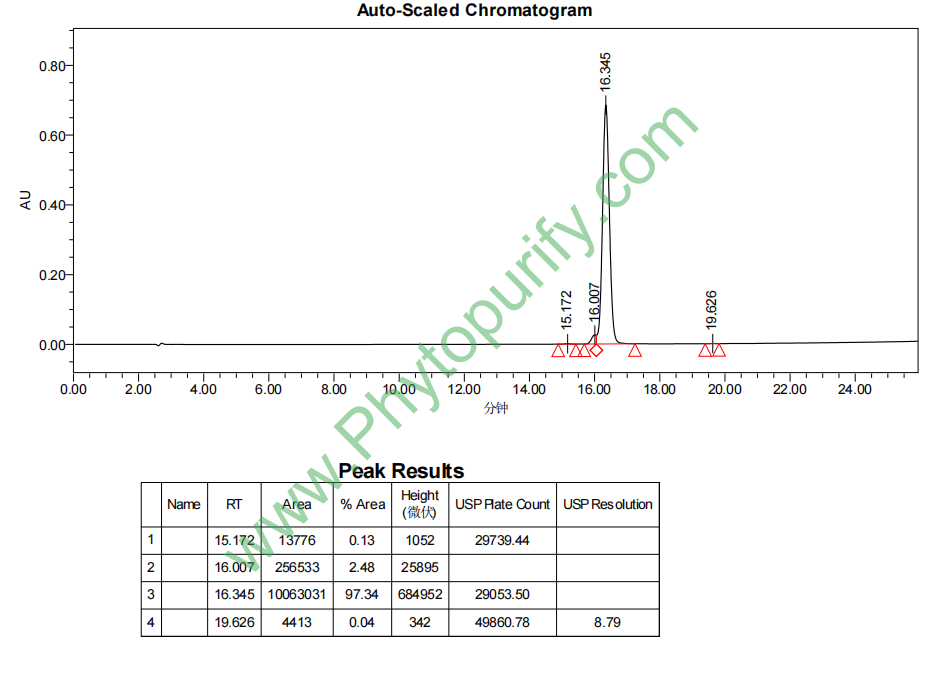
Purity: 95%~99%
Analysis Method: HPLC-DAD or/and HPLC-ELSD
Identification Method: Mass, NMR
Packing: Brown vial or HDPE plastic bottle
Can be supplied from milligrams to grams.
For Reference Standard and R&D, Not for Human Use Directly.
Inquire for bulk scale.
HPLC of Ganoderic Acid G
Storage conditions:Short-term storage at 2~8℃, long-term storage at -20 ~ -80℃
Ganoderma lucidum(Ganoderma lucidum)As a traditional Chinese medicinal herb, it has always been known as the "fairy grass" due to its significant medicinal value and rich active ingredients. Among them, ganoderic acid triterpenoids are the most representative secondary metabolites in Ganoderma lucidum, with various biological activities. Ganoderma Acid G (CAS number: 98665-22-6), as a triterpenoid compound isolated from the surface of Ganoderma lucidum tubes, has received widespread attention in recent years due to its excellent immune regulatory function and potential medicinal value. This article provides a systematic review of the chemical structure and physicochemical properties, plant sources and extraction methods, pharmacological activity, mechanism of action, pharmacological evaluation, and clinical application prospects of ganoderic acid G. The aim is to provide theoretical basis and reference for its further drug development and application research.
Lingzhi acid G belongs to the triterpenoid class, with a molecular formula of C30H44O8 and a molecular weight of 532.6740. Its structure is based on a pentacyclic triterpenoid skeleton, with multiple hydroxyl and carboxyl functional groups, endowing it with strong polarity and biological activity. The LogP value of Ganoderma lucidum acid G is 2.5263, indicating its moderate lipid solubility, which is beneficial for cell membrane permeability. Its topological polar surface area (TPSA) is 149.2 Å ², indicating a high molecular polarity that may affect its oral absorption and bioavailability. Low water solubility (0.0709 mg/mL) suggests limited solubility in aqueous phase and requires appropriate formulation techniques to enhance bioavailability. The low permeability of the blood-brain barrier indicates that it mainly acts on peripheral targets, reducing the risk of central nervous system side effects. Lingzhi acid G has no hERG channel inhibitory activity and high safety. The Ames mutagenicity test result is 0, indicating no significant mutagenicity and meeting the drug safety requirements.
Ganoderma lucidum acid G mainly comes from the surface of the fungal tube layer of Ganoderma lucidum, a genus of fungi widely distributed in temperate and subtropical regions of Asia. Traditionally, Ganoderma lucidum is obtained through solid-state fermentation cultivation, and both the mycelium and fruiting body contain abundant triterpenoid compounds. The extraction of ganoderic acid G is usually carried out using organic solvent extraction method, with ethanol or methanol commonly used as extractants to improve the extraction efficiency of ganoderic acid. The extraction process includes drying, crushing, solvent extraction, concentration, and separation and purification. During the purification process, techniques such as silica gel column chromatography and reverse phase high-performance liquid chromatography (RP-HPLC) are commonly used to obtain high-purity ganoderic acid G. In recent years, supercritical CO2 extraction technology has also been applied to the extraction of ganoderic acid G, which has the advantages of environmental protection and high efficiency. The optimization of extraction process is crucial for ensuring the yield and activity of ganoderic acid G.
The pharmacological activities of Ganoderma lucidum acid G mainly focus on immune regulation, anti-inflammatory, anti-tumor, and antioxidant aspects. Numerous in vitro and in vivo studies have shown that ganoderic acid G can significantly regulate immune cell function and promote the balance of the immune system.
Immune regulatory effect
Lingzhi acid G enhances the body's immune response by regulating various immune related signaling pathways. It can promote T cell proliferation and activation, enhance the cytotoxicity of NK cells, and regulate the phagocytic function of macrophages. In addition, ganoderic acid G can regulate the secretion of cytokines, such as upregulating pro-inflammatory factors such as IL-2 and IFN - γ, while promoting the expression of anti-inflammatory factors such as IL-10, achieving immune homeostasis.
anti-inflammatory effect
Lingzhi acid G inhibits the nuclear factor kappa B (NF - κ B) signaling pathway, reduces the release of pro-inflammatory cytokines such as TNF - α and IL-6, and alleviates inflammatory responses. Its anti-inflammatory effect has been validated in various inflammatory models, demonstrating potential value in treating chronic inflammatory diseases.
Antitumor activity
Lingzhi acid G exhibits significant anti-tumor activity, which can induce tumor cell apoptosis, inhibit tumor cell proliferation and migration. Its anti-tumor mechanism involves the regulation of multiple signaling pathways, including the inhibition of STAT3 and the regulation of cell cycle proteins. In addition, ganoderic acid G can enhance the activity of immune cells in the tumor microenvironment and improve the body's anti-tumor immunity.
Antioxidant effect
Lingzhi acid G has the ability to eliminate free radicals, alleviate oxidative stress damage, protect cells from oxidative damage, and promote tissue repair.
The immunomodulatory effect of ganoderic acid G is mainly achieved by regulating multiple key molecular targets:
In summary, ganoderic acid G regulates immune system function through multi-target and multi pathway synergistic effects, and has broad pharmacological potential.
The pharmacological parameters of Ganoderma lucidum acid G show that it has good potential for drug development. The molecular weight of 532.6740 is moderate, and the LogP is 2.5263, indicating that it has good lipid solubility and is conducive to cell membrane penetration. A high TPSA (149.2 Å ²) may limit its oral absorption, but its bioavailability can be improved through pharmaceutical formulation techniques. Low water solubility suggests the need to optimize the administration route or formulation form.
The low permeability of the blood-brain barrier reduces the risk of central nervous system side effects and is suitable for peripheral immune regulation applications. HERG channel has no inhibitory activity, reducing the risk of cardiac toxicity. The Ames test is negative, indicating that it has no mutagenicity and high safety.
In terms of pharmacokinetics, current research is relatively limited. Animal experiments have shown that ganoderic acid G can be detected in plasma after oral administration, indicating its absorption capacity. Its metabolism is mainly through the liver enzyme system, and the metabolites need further research. In the future, systematic ADME (absorption, distribution, metabolism, excretion) research needs to be conducted to clarify its in vivo kinetic characteristics and provide a basis for clinical applications.
Lingzhi acid G has shown broad application prospects in various immune related diseases due to its significant immunomodulatory and anti-inflammatory activities. Its potential indications include autoimmune diseases (such as rheumatoid arthritis, multiple sclerosis), chronic inflammatory diseases (such as inflammatory bowel disease), adjuvant tumor immunotherapy, and regulation of immune dysfunction.
In addition, ganoderic acid G has good safety and low toxicity, making it an ideal candidate for natural medicine development. In the future, modern pharmaceutical formulation technology can be combined to develop oral formulations, nanocarrier systems, etc., to improve their bioavailability and targeting.
Preclinical research should further clarify its pharmacological mechanism and safety evaluation, and conduct systematic toxicological studies. During the clinical trial phase, it is necessary to design a reasonable dosage and medication plan to verify its therapeutic effect and safety. Combining modern molecular biology techniques, explore the synergistic effects of ganoderic acid G with other drugs and expand its clinical application scope.
As an important triterpenoid active ingredient in Ganoderma lucidum, ganoderic acid G exhibits a wide range of pharmacological activities and good medicinal potential due to its unique chemical structure and multi-target immunomodulatory effects. Its research progress in immune regulation, anti-inflammatory, and anti-tumor fields provides valuable resources for natural product pharmacology and new drug development. In the future, through in-depth pharmacological mechanism research, optimized extraction and purification processes, and systematic pharmacokinetic and clinical evaluations, ganoderic acid G is expected to become a new natural medicine for the treatment of immune related diseases, contributing new strength to human health.
