| Catalog No | Package | Original Price | Price | Inventory | Quantity | Operating |
|---|---|---|---|---|---|---|
| BP4199-5mg | 5mg | $420.00 | Sign in |
|


Storage conditions:Short-term storage at 2~8℃, long-term storage at -20 ~ -80℃
146.0400
2.5153
.1739
.0516
1.6211
3.5506
Low
85.1598
5.2746
No
No
No
No
No
No
0.0
Yes
No
No
Yes
Ganoderma lucidum(Ganoderma lucidum)As an important medicinal fungus in traditional Chinese medicine, it has always been known as the "fairy grass" due to its wide pharmacological activity and good safety. The triterpenoids in Ganoderma lucidum are its main active ingredients, which have significant biological activities such as immune regulation, anti-tumor, anti-inflammatory, and antioxidant. 12 Hydroxyganoderic acid D (CAS number: 942950-96-1) is an important triterpenoid secondary metabolite in Ganoderma lucidum, which has received widespread attention in the field of natural product pharmacology in recent years. This article systematically reviews the chemical structure and physicochemical properties, plant sources and extraction methods, pharmacological activity, mechanism of action, pharmacological evaluation, and clinical application prospects of 12 hydroxy ganoderic acid D. The aim is to provide theoretical basis and reference for the in-depth research and development of this compound.
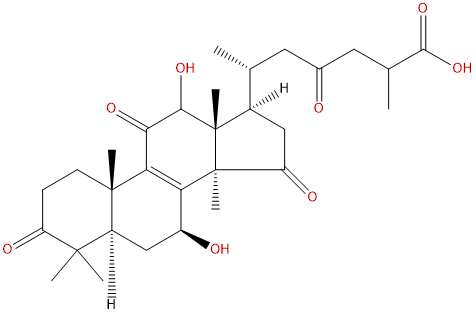
12 hydroxy ganoderic acid D belongs to triterpenoid compounds of ganoderic acid, with a molecular formula of C30H46O7 and a molecular weight of 530.6580. Its structural feature is a typical triterpenoid skeleton, with multiple hydroxyl and carboxyl functional groups, especially hydroxyl modification at the C-12 position, which endows it with unique chemical properties. In terms of physical and chemical properties, the LogP value of 12 hydroxy ganoderic acid D is 2.5153, indicating its moderate lipid solubility, which is beneficial for cell membrane permeation; The polar surface area (TPSA) is 146.0400, indicating that its molecular polarity is high and may affect its bioavailability and penetration ability. Low water solubility (0.0516 mg/mL) suggests limited solubility in the aqueous phase. The low permeability of the blood-brain barrier suggests that its main target may be limited to peripheral tissues. The hERG channel inhibition test was negative, indicating a low risk of cardiac toxicity. The Ames mutagenicity test result is 0.0, indicating that the compound has no significant genetic toxicity.
12 hydroxy ganoderic acid D is mainly derived from Ganoderma lucidum(Ganoderma lucidum)Extract from the fruiting body and mycelium. Lingzhi, as a fungus of the genus Lingzhi in the family Polyporus, is widely distributed in many regions of Asia, especially in China, Japan, and South Korea where wild and cultivated resources are the most abundant. The content of triterpenoids in Ganoderma lucidum is greatly affected by growth environment, variety, harvesting time, and processing methods.
The extraction method usually uses organic solvent extraction combined with chromatographic separation technology. Common extraction solvents include methanol, ethanol, and ethyl acetate. The specific process is generally as follows: first, the Ganoderma lucidum is dried and crushed, and the crude triterpenoid mixture is extracted using ultrasound assisted or reflux extraction method; Subsequently, high-purity 12 hydroxy ganoderic acid D was obtained through techniques such as silica gel column chromatography and reverse phase high-performance liquid chromatography (RP-HPLC) for separation and purification. In recent years, the application of supercritical CO2 extraction and membrane separation technology has improved extraction efficiency and purity, while reducing the use of organic solvents, in line with the concept of green chemistry.
12 hydroxy ganoderic acid D exhibits significant pharmacological activity in various in vitro and in vivo models, particularly playing an important role in the field of immune regulation.
As a representative compound of triterpenoids in Ganoderma lucidum, 12 hydroxyganoderic acid D can regulate the body's immune response and promote the balance of immune cell function. Research has shown that this compound can enhance the phagocytic ability of macrophages, promote the maturation of dendritic cells, activate T cell proliferation and cytokine secretion. Its mechanism of action involves regulating various immune related signaling pathways and key molecules, such as TLR4, STAT3, NFKB1, etc., to regulate inflammatory response and immune tolerance.
12 hydroxylingzhi acid D reduces the expression of pro-inflammatory cytokines such as TNF - α and IL-6 by inhibiting the nuclear factor kappa B (NF - κ B) signaling pathway, thereby alleviating the inflammatory response. It shows potential therapeutic effects on chronic inflammatory disease models such as arthritis and inflammatory bowel disease.
Some studies have reported that 12 hydroxylingzhi acid D can inhibit the proliferation and migration of various tumor cells, induce cell apoptosis, and may affect the immune escape mechanism in the tumor microenvironment by regulating transcription factors such as STAT3 and FOXP3, exerting anti-tumor immune effects.
In addition, 12 hydroxylingzhi acid D also exhibits certain antioxidant activity, which can clear free radicals, alleviate oxidative stress damage, and protect tissue and cell functions.
The pharmacological effects of 12 hydroxy ganoderic acid D are mainly achieved through multi-target and multi pathway synergistic regulation. Its key targets and mechanisms of action include:
TLR4 (Toll like receptor 4)As a key receptor of innate immunity, TLR4 recognizes pathogen associated molecular patterns (PAMPs) and activates downstream signaling pathways. 12 hydroxylingzhi acid D regulates TLR4 mediated signaling, affects the activation status of immune cells, and regulates inflammatory responses.
STAT3 (Signal Transduction and Transcription Activation Factor 3)STAT3 plays a central role in immune regulation, cell proliferation, and tumorigenesis. 12 hydroxylingzhi acid D can inhibit abnormal activation of STAT3, restore immune cell function, and inhibit tumor cell growth.
NFKB1 (nuclear factor kappa B subunit)The NF - κ B signaling pathway is a key regulatory node for inflammation and immune responses. 12 hydroxylingzhi acid D alleviates inflammation by inhibiting the activation of NFKB1, reducing the expression of pro-inflammatory cytokines.
IL2, IL10, IFNG (cytokines)Regulating various cytokines secreted by T cells to promote the balance of immune response. 12 hydroxylingzhi acid D can regulate the expression of these cytokines and enhance the adaptive response of the immune system.
TGFB1 (transforming growth factor beta 1) and FOXP3 (regulatory T cell transcription factor)Participate in immune tolerance and autoimmune regulation. 12 hydroxylingzhi acid D regulates these factors, helping to maintain immune homeostasis and prevent immune disorders.
CTLA4 (cytotoxic T lymphocyte associated antigen 4) and STAT4 Regulating T cell activity and differentiation, 12 hydroxylingzhi acid D regulates the functional status of immune cells by affecting these targets.
In summary, 12 hydroxylingzhi acid D achieves its comprehensive pharmacological effects of immune regulation, anti-inflammatory and anti-tumor through the synergistic action of multiple targets and pathways.
The pharmacological parameters of 12 hydroxylingzhi acid D indicate that it has certain potential for drug development. Although the molecular weight of 530.6580 is slightly higher than the recommended 500 Da by Lipinski's rule, it is still within an acceptable range. The LogP value of 2.5153 indicates moderate lipid solubility, which is beneficial for membrane penetration. The TPSA value of 146.0400 is relatively high, indicating strong polarity that may affect oral bioavailability.
Low water solubility (0.0516 mg/mL) is a major challenge in its development, which may limit its absorption and distribution in vivo. The low blood-brain barrier permeability means that its role in the central nervous system is limited, but it also reduces the risk of central nervous system toxicity. The negative inhibition of hERG channel and the absence of mutagenicity in Ames test indicate its high safety.
At present, there is limited pharmacokinetic research on 12 hydroxylingzhi acid D. Preliminary data suggest that its oral absorption is poor, and its metabolic stability is good in vivo, mainly processed by the liver metabolic enzyme system. Further systematic ADME (absorption, distribution, metabolism, excretion) and toxicological assessments are needed in the future to optimize dosage forms and administration regimens.
Based on the significant activities of 12 hydroxylingzhi acid D in immune regulation, anti-inflammatory and anti-tumor aspects, its clinical application prospects are broad. Firstly, in immune related diseases such as autoimmune diseases, allergic diseases, and immunodeficiency states, 12 hydroxylingzhi acid D is expected to serve as an immunomodulatory agent to restore immune balance and alleviate symptoms. Secondly, its anti-inflammatory effect makes it a potential therapeutic drug for chronic inflammatory diseases such as rheumatoid arthritis and inflammatory bowel disease. In addition, its anti-tumor activity provides new possibilities in the field of tumor adjuvant therapy, especially in regulating the tumor immune microenvironment.
However, current clinical research is still in its infancy and lacks systematic clinical trial data. Future research should focus on its pharmacokinetic characteristics, formulation optimization, and safety evaluation, while combining modern molecular biology techniques to explore its mechanism of action and target regulation in depth. Multidisciplinary collaboration to promote the clinical application of 12 hydroxy ganoderic acid D from the laboratory will greatly promote the innovative development of natural product drugs.
12 hydroxy ganoderic acid D, as an important triterpenoid active ingredient in Ganoderma lucidum, exhibits a wide range of pharmacological activities and good safety due to its unique chemical structure and multi-target immunomodulatory effects. Its potential in immune regulation, anti-inflammatory, and anti-tumor fields provides valuable resources for the development of natural product drugs. Although there are still certain challenges in drug development and clinical application, with the continuous deepening of extraction and purification technology, pharmacokinetic research, and clinical evaluation, 12 hydroxylingzhi acid D is expected to become an important representative of the new generation of immunomodulators and natural medicines. Future research should strengthen the elucidation of its mechanism of action and clinical translation, promoting its widespread application in modern medicine.
