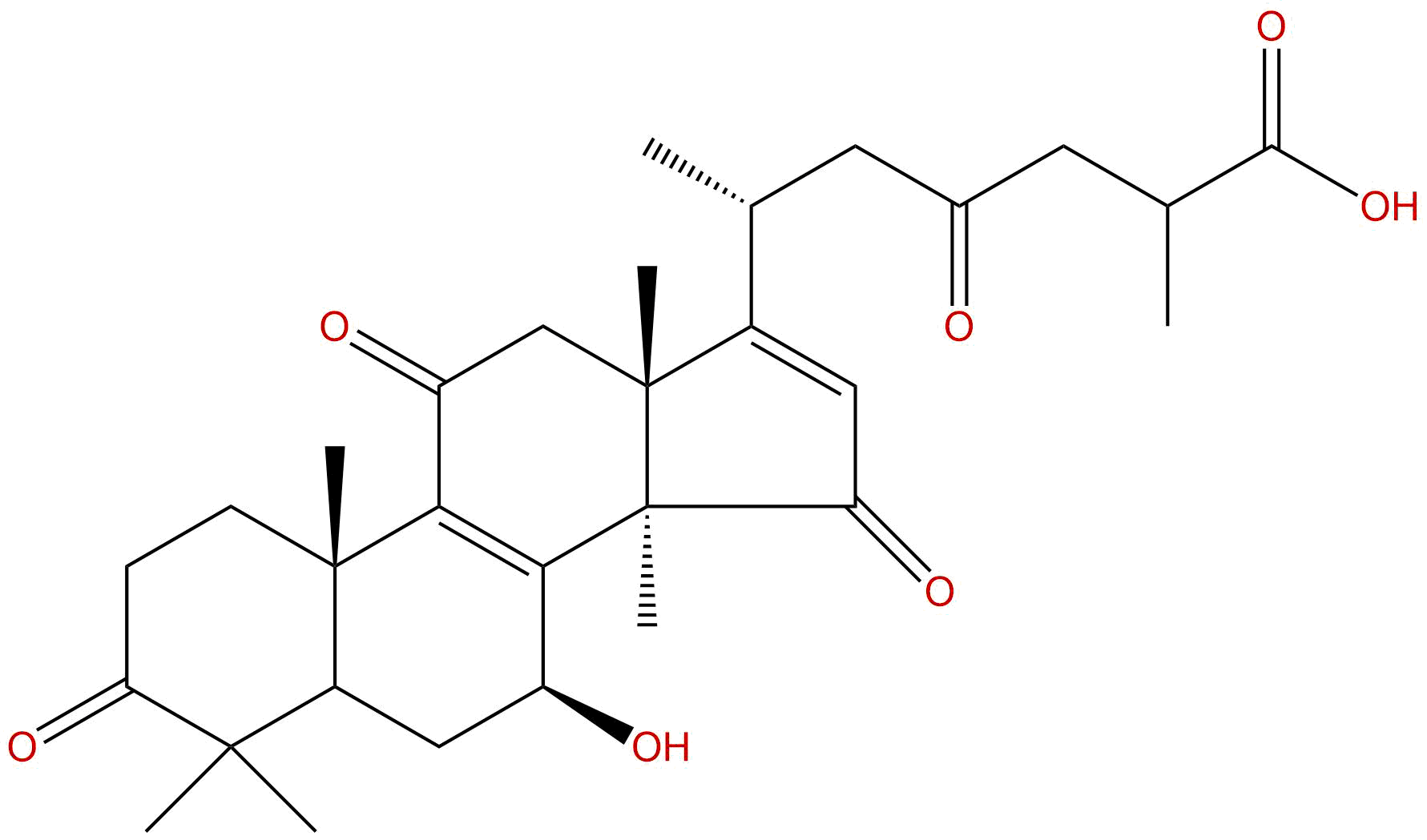


Product name: 16,17-Didehydroganoderic acid D
Synonym name: (7β)-7-Hydroxy-3,11,15,23-tetraoxolanosta-8,16-dien-26-oic acid;3,11,15,23-Tetraoxo-25ξ-lanosta-8,16-dien-26-oic acid;1494686-09-7
Catalogue No.: BP2168
Cas No.: 1427189-02-3
Formula: C30H40O7
Mol Weight: 512.643
Botanical Source:
Type of Compound:
Purity: 95%~99%
Analysis Method: HPLC-DAD or/and HPLC-ELSD
Identification Method: Mass, NMR
Packing: Brown vial or HDPE plastic bottle
Storage: Store in a well closed container, protected from air and light. Put into refrigerate or freeze for long term storage.
Whenever possible, you should prepare and use solutions on the same day. However, if you need to make up stock solutions in advance, we recommend that you store the solution as aliquots in tightly sealed vials at -20℃. Generally, these will be useable for up to two weeks.
The product could be supplied from milligrams to grams
Inquire for bulk scale.
For Reference Standard and R&D, Not for Human Use Directly.
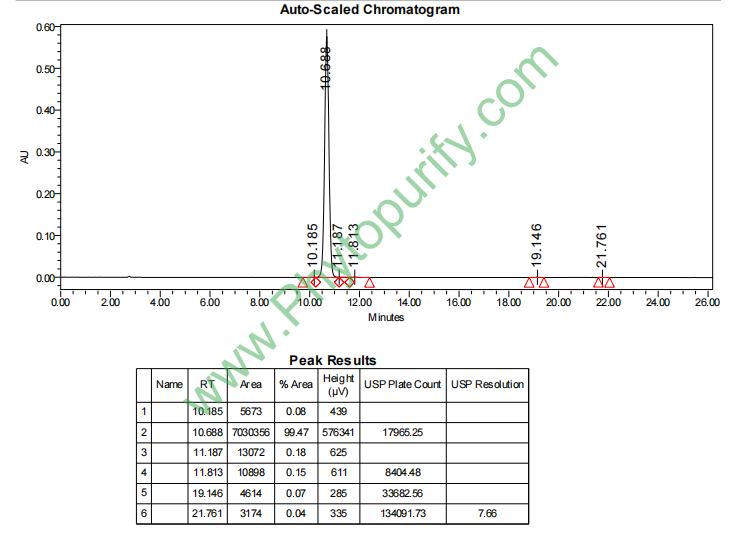
HPLC of 16,17-Didehydroganoderic acid D
Storage conditions:Short-term storage at 2~8℃, long-term storage at -20 ~ -80℃
125.8100
2.9100
.4575
.0160
2.0893
5.9013
Low
84.5133
5.1879
No
No
Yes
No
No
No
0.0
Yes
Yes
No
Yes
Natural products, as an important source of drug discovery, play an irreplaceable role in the history of human disease treatment. Among them, triterpenoids have always been a hot topic in medicinal chemistry and pharmacology research due to their structural diversity and wide range of biological activities. Ganoderma lucidum(Ganoderma lucidum)As a treasure of traditional Chinese medicine, its pharmacological active substances are mainly concentrated in triterpenoids and polysaccharides. Ganoderma triterpenoids, especially ganoderic acid compounds, have been proven to have various pharmacological effects such as anti-tumor, anti-inflammatory, and hepatoprotective effects. 16,17-Didehydroganoderic acid D (CAS: 1427189-02-3) is a triterpenoid compound with a unique chemical structure that has been isolated and identified from Ganoderma lucidum in recent years. Its chemical name is 3,11,15,23-tetraoxo-27xi-lanosta-8,16-dien-26-oic Acid. Preliminary studies have shown that the compound exhibits significant potential in anti liver cancer, involving multiple key signaling pathways and molecular targets such as BCL2, STAT3, MAPK1, etc., which has attracted widespread attention from researchers. This article aims to provide a systematic review of the chemical structure, plant origin, pharmacological activity, mechanism of action, and pharmacological properties of 16,17-dihydroganoderic acid D, and to explore its clinical application prospects, in order to provide comprehensive scientific references for the in-depth research and development of this compound.
16,17-Dihydroganoderic acid D belongs to the lanostane type tetracyclic triterpenoid compounds. Its basic skeleton is a 27 carbon lanostane, which has been highly oxidized and modified at multiple positions. Specifically, its structural features include the presence of four keto carbonyl groups (oxo -) at positions 3, 11, 15, and 23 on the A ring, C ring, and side chain, respectively, forming a multi carbonyl structure; There are two double bonds (-8,16-dien -) at positions 8 and 16, with the dehydrogenation structure at positions 16 and 17 being the key distinguishing feature from other ganoderic acid D homologues; The C-26 position is oxidized to a carboxyl group (-26 oic Acid), which has a significant impact on its biological activity and solubility. Its molecular formula is C30H40O7 and its molecular weight is 512.6430.
Based on its chemical structure, the compound exhibits specific physicochemical properties. Its lipid water partition coefficient (LogP) is 2.91, indicating that it has moderate lipophilicity and is conducive to transmembrane transport, but excessively high LogP may also affect water solubility. Its topological polar surface area (TPSA) is 125.81 Å ², reflecting the polarity brought by multiple carbonyl and carboxyl groups in the molecule. These structural characteristics collectively determine its low water solubility, approximately 0.0160 mg/mL. Preliminary pharmacological risk assessment shows that the compound has no significant inhibitory effect on hERG potassium channels, indicating a low potential risk of arrhythmia; The Ames test result is 0.0, indicating preliminarily that it has no direct genetic toxicity. These basic physicochemical parameters and early safety data provide important basis for its subsequent pharmacological research and structural optimization.
16,17-Dihydroganoderic acid D mainly comes from fungi of the Ganoderma genus in the family Polyporus, especially Ganoderma lucidum(Ganoderma lucidum)And Zizhi(Ganoderma sinense). It is distributed in the fruiting body, mycelium, and spore powder of Ganoderma lucidum, but its content is usually low, and it is significantly affected by factors such as strain type, growth conditions (such as temperature, humidity, light, medium composition), growth stage, and harvesting time.
At present, the extraction and separation of 16,17-dihydroganoderic acid D from Ganoderma lucidum materials mainly adopt the following process:
1. Extract Organic solvent extraction method is often used. Due to the target compound being a moderately polar triterpenoid acid, methanol, ethanol, or ethanol water mixed solvents with different ratios are commonly used for reflux extraction or ultrasound assisted extraction. Supercritical CO2 extraction technology has also been used for the extraction of triterpenoids from Ganoderma lucidum due to its advantages of green, high efficiency, and adjustable selectivity, and can better preserve thermosensitive components.
2. Enrichment and Coarse Separation The extract obtained by vacuum concentration is usually extracted with organic solvents such as ethyl acetate or chloroform to enrich triterpenoid components and remove most polysaccharides and water-soluble impurities. Further separation can be performed using silica gel column chromatography with petroleum ether ethyl acetate or chloroform methanol gradient elution.
3. Refining and Purification After obtaining a fraction rich in ganoderic acid components, higher resolution chromatographic techniques are required for the separation and purification of monomer compounds. Commonly used methods include reverse phase high performance liquid chromatography (RP-HPLC, commonly C18 column, using methanol water or acetonitrile water as mobile phase), preparative thin layer chromatography (PTLC), or medium pressure liquid chromatography (MPLC). The separation and identification of 16,17-dihydroganoderic acid D requires a combination of UV detection (which has UV absorption around 250 nm and originates from the conjugated ketene structure) and spectroscopic methods such as mass spectrometry and nuclear magnetic resonance for final confirmation.
Due to the limited content of natural sources, fully chemical or microbial synthesis methods are being explored, but due to their complex structure and multiple chiral centers, they still face significant challenges. The analysis of biosynthetic pathways and the application of synthetic biology techniques may provide new strategies for the future large-scale acquisition of this compound.
A large number of in vitro and in vivo pharmacological studies have shown that 16,17-dihydroganoderic acid D has various biological activities, among which the most prominent is its anti-tumor effect, especially in the field of liver cancer research.
1. Antitumor activity
* In vitro anti liver cancer activity This compound exhibits significant proliferation inhibitory activity against various human liver cancer cell lines (such as HepG2, Huh7, SMMC-7721), with IC50 values typically at the micromolar level. The effect exhibits concentration and time dependence. In addition to inhibiting proliferation, it can also effectively induce apoptosis in liver cancer cells, leading to cell cycle arrest (often in G0/G1 or G2/M phases).
* In vivo anti liver cancer activity In nude mouse liver cancer transplantation models or chemically induced liver cancer models, intraperitoneal injection or gavage of 16,17-dihydroganoderic acid D can significantly inhibit tumor growth, reduce tumor volume and weight, and no significant weight loss or organ toxicity was observed within a certain dose range, indicating its good in vivo anti-tumor effect and therapeutic window.
2. Other potential pharmacological activities
Based on its core triterpenoid structure of ganoderic acid, it is speculated that it may also have activity shared by other ganoderic triterpenoids. However, further research is needed on this specific compound
* anti-inflammatory activity It may exert its effect by inhibiting the production of inflammatory mediators (such as prostaglandins, nitric oxide) and the activity of inflammation related enzymes (such as COX-2).
* Hepatoprotective activity May have a protective effect against chemical liver damage caused by carbon tetrachloride, acetaminophen, and other substances.
* antioxidant activity The ketene and multiple carbonyl groups in its structure may have the ability to scavenge free radicals.
The anti liver cancer effect of 16,17-dihydroganoderic acid D is not achieved through a single pathway, but rather through the synergistic action of multiple targets and pathways. Based on its associated disease target information, its mechanism of action network can be summarized as follows:
1. Inducing cell apoptosis
* Regulating the BCL2 family This compound can downregulate the expression of anti apoptotic protein BCL2, while possibly upregulating the expression of pro apoptotic proteins such as BAX, disrupting mitochondrial membrane potential, leading to the release of cytochrome C, thereby activating the Caspase cascade reaction and inducing endogenous apoptotic pathways.
* Affects the TP53 pathway In TP53 wild-type liver cancer cells, it may enhance apoptosis signaling by stabilizing or activating p53 protein, upregulating the expression of downstream pro apoptotic target genes (such as PUMA, NOXA).
2. Inhibit cell proliferation and survival signals
* Blocking the STAT3 signaling pathway STAT3 is an important oncogenic transcription factor. 16,17-Dihydroganoderic acid D can inhibit the phosphorylation (activation) of STAT3, prevent its nuclear translocation, and thereby downregulate the expression of pro proliferative and anti apoptotic genes such as Cyclin D1, Bcl-2, and Survivin that it regulates.
* Interference with PI3K/AKT/mTOR pathway By directly or indirectly acting on PIK3CA (the catalytic subunit of PI3K), the activity of PI3K is inhibited, thereby reducing the phosphorylation levels of downstream AKT and mTOR, inhibiting protein synthesis and cell growth, and promoting autophagy.
* Inhibition of MAPK/ERK pathway Inhibition of MAPK1 (i.e. ERK2) activity can block growth factor signaling and affect cell cycle progression.
3. Inhibition of telomerase activity and genomic stability
* Inhibition of TERT transcription Telomerase reverse transcriptase (TERT) is the rate limiting component of telomerase activity and is highly expressed in most liver cancer cells. This compound may downregulate TERT expression by inhibiting transcription factors such as c-Myc, thereby shortening telomeres and triggering replicative aging or apoptosis.
4. Inhibit invasion and metastasis
* Downregulation of MMP9 expression Matrix metalloproteinase 9 (MMP9) is a key enzyme that degrades extracellular matrix and promotes tumor invasion and metastasis. This compound can significantly inhibit the mRNA and protein expression of MMP9, thereby reducing the migration and invasion ability of liver cancer cells.
* Inhibition of EGFR signaling Overactivation of epidermal growth factor receptor (EGFR) signaling is associated with liver cancer progression. This compound may interfere with the activation of EGFR or its downstream signaling, inhibiting the invasive phenotype of cells.
5. Interactions with other targets
* Inhibition of Topoisomerase I (TOP1)It may stabilize DNA enzyme complexes by interfering with the binding of TOP1 to DNA, leading to DNA replication fork arrest and double strand breaks, and exerting cytotoxic effects.
* Inhibition of cyclooxygenase-2 (PTGS2/COX-2)COX-2 is highly expressed in inflammation related liver cancer. Inhibiting its activity contributes to anti-inflammatory and inhibition of tumor microenvironment formation.
In summary, 16,17-dihydroganoderic acid D exerts its anti liver cancer effects through an interwoven signaling network, from multiple dimensions such as inducing apoptosis, inhibiting proliferation, blocking the cell cycle, and anti metastasis, reflecting the advantages of natural products with multi-target effects.
Although 16,17-dihydroganoderic acid D exhibits good in vitro biological activity, its drug like and pharmacokinetic (PK) properties are the key factors determining whether it can be developed into a drug.
1. Analysis of pharmacological parameters
* Solubility and permeability The poor water solubility (0.016 mg/mL) is the main limiting factor, which may affect the oral absorption bioavailability. A moderate LogP (2.91) indicates that its membrane permeability is acceptable and belongs to Class II (low solubility and high permeability) or Class IV (low solubility and low permeability) compounds in the Biopharmaceutical Classification System (BCS). Formulation techniques such as nanocrystals, solid dispersions, liposomes, and cyclodextrin inclusion are needed to improve their solubility and dissolution rate.
* Molecular size and flexibility The molecular weight of 512.6 is slightly higher than the recommended value of Lipinski's "Five Rules" (500), but still within an acceptable range. Its rigid four ring skeleton and multiple carbonyl groups make its molecules less flexible.
* Early safety The absence of hERG inhibition and negative Ames test are positive signals, but comprehensive preclinical safety evaluation (such as subacute toxicity, reproductive toxicity, etc.) still needs to be conducted.
2. Pharmacokinetic characteristics (based on speculation of similar compounds)
Currently, there are few reports on the specific pharmacokinetic studies of this compound. Referring to other studies on triterpenoids of ganoderic acid, their PK behavior can be preliminarily speculated:
* absorb After oral administration, absorption in the gastrointestinal tract may be slow and incomplete, affected by low solubility and first pass effects.
* distribution Due to its moderate LogP and possibly high protein binding rate (carboxyl groups easily bind to albumin), it is widely distributed in the body, but has low blood-brain barrier permeability and limited distribution in the central nervous system.
* Metabolism As a triterpenoid acid, the liver is its main metabolic site. May undergo phase I metabolism (such as CYP450 enzyme mediated oxidation and reduction) and phase II metabolism (such as glucuronidation and sulfation). Multiple ketone groups and double bonds in its structure may be metabolic sites.
* excretion Metabolites may be mainly excreted through bile and feces, with some excreted through the kidneys.
Future research needs to establish a sensitive LC-MS/MS bioanalysis method to systematically investigate its absolute bioavailability, tissue distribution, metabolite identification, and excretion pathways in animals such as rats and dogs, providing a basis for dosage form design and clinical dosing regimens.
16,17-Dihydroganoderic acid D, as a natural triterpenoid with multi-target anti liver cancer activity, has broad clinical application prospects but also faces challenges.
1. Development prospects
* Candidate drugs for liver cancer treatment New small molecule drugs can be developed for the treatment of liver cancer as a single drug or in combination with existing chemotherapy drugs such as sorafenib and cisplatin. Its multi-target characteristics may help overcome the resistance problem of single target drugs.
* Liver protective adjuvant medication Based on the traditional hepatoprotective effects of Ganoderma triterpenoids, their application in chronic liver diseases such as chemotherapy-induced liver injury or non-alcoholic fatty liver disease (NAFLD) can be explored.
* Lead compounds for structural optimization Using it as the parent nucleus, structural modifications such as esterification and salt formation to improve solubility, simplification of the skeleton to reduce synthesis difficulty, and introduction of specific functional groups to enhance targeting are expected to obtain derivatives with higher activity and better drug properties.
2. Challenges faced
* Source and Supply Natural extraction has low yield, high cost, and complex chemical synthesis routes. Developing sustainable acquisition methods, such as synthetic biology, is a prerequisite for industrialization.
* Drug bottleneck Low water solubility and potential low oral bioavailability are core obstacles that rely on advanced formulation technology breakthroughs.
* Mechanism depth At present, the understanding of the mechanism of action is still at the network level, and more in-depth research is needed to clarify its direct target (such as searching for binding proteins through chemical biology methods) and precise signal regulation details.
* Lack of system evaluation Lack of complete preclinical pharmacodynamic (PD/PK association), toxicological, and safety evaluation data.
3. Future research directions
* In depth mechanism research Using proteomics, transcriptomics, molecular docking and validation techniques to elucidate its primary target.
* Pharmacokinetic and Formulation Research The system conducts in vitro and in vivo ADME research and actively explores new formulations such as nano delivery systems.
* Combination therapy research Explore the synergistic effects of combining with existing standard therapies and study their potential to reverse drug resistance.
* Preclinical development Complete a systematic pharmacological and toxicological evaluation that complies with the guidelines for preclinical research of new drugs, laying the foundation for their application for clinical trials.
16,17-Dihydroganoderic acid D is a structurally unique and biologically active triterpenoid compound in Ganoderma lucidum, which exhibits multi-target effects in inducing apoptosis, inhibiting proliferation and metastasis by regulating multiple signaling pathways such as BCL2, STAT3, PI3K/AKT, MAPK, etc., especially in the field of liver cancer. Despite facing challenges such as poor water solubility in drug development, its clear pharmacological activity and good early safety indicate its enormous potential as a lead compound for anti liver cancer drugs. Future research should focus on addressing its source issues, delving into molecular mechanisms, systematically evaluating pharmacokinetic properties, and improving its bioavailability through modern pharmaceutical technologies. With the continuous deepening of research, 16,17-dihydroganoderic acid D is expected to move from the laboratory to clinical practice, providing new treatment options for liver cancer patients and valuable examples for the development of multi-target drugs based on natural products.
