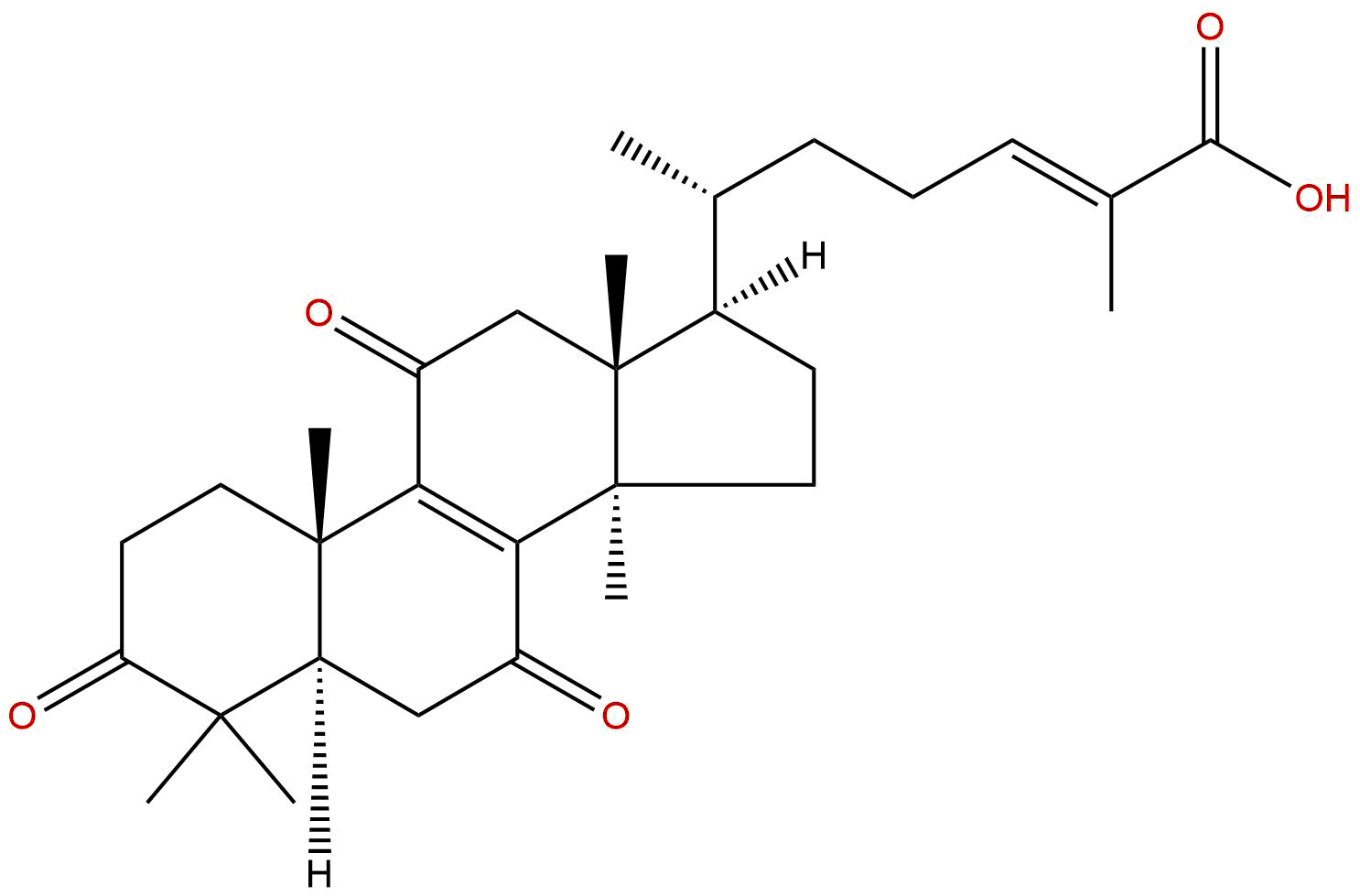


Product name: 11-Oxo-ganoderic acid DM
Synonym name: 3,7,11-Trioxo-5α-lanosta-8,24(E)-dien-26-oic acid;(24E)-3,7,11-Trioxolanosta-8,24-dien-26-oic acid
Catalogue No.: BP2282
Cas No.: 1408244-15-4
Formula: C30H42O5
Mol Weight: 482.661
Botanical Source: Ganoderma
Type of Compound: Triterpenoids
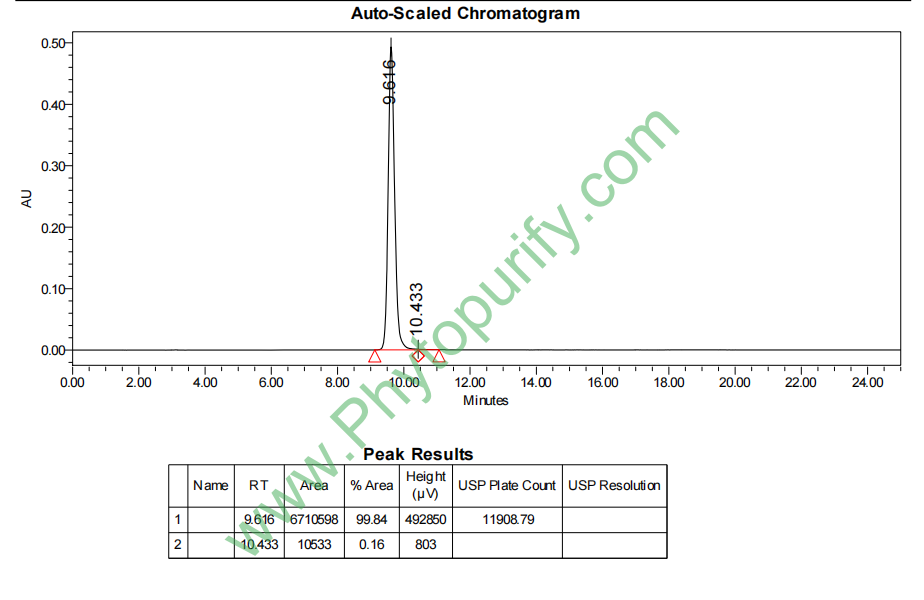
Purity: 95%~99%
Analysis Method: HPLC-DAD or/and HPLC-ELSD
Identification Method: Mass, NMR
Packing: Brown vial or HDPE plastic bottle
Storage: Store in a well closed container, protected from air and light. Put into refrigerate or freeze for long term storage.
Whenever possible, you should prepare and use solutions on the same day. However, if you need to make up stock solutions in advance, we recommend that you store the solution as aliquots in tightly sealed vials at -20℃. Generally, these will be useable for up to two weeks.
The product could be supplied from milligrams to grams
Inquire for bulk scale.
For Reference Standard and R&D, Not for Human Use Directly.
HPLC of 11-Oxo-ganoderic acid DM
Storage conditions:Short-term storage at 2~8℃, long-term storage at -20 ~ -80℃
88.5100
4.6227
1.8321
.0033
5.2243
11.9323
Low
88.6653
4.7468
No
Yes
Yes
No
No
No
0.0
No
No
No
No
11 Oxo ganoderic acid DM is a triterpenoid natural product isolated from Ganoderma lucidum, which has received widespread attention in recent years due to its significant pharmacological activity. Ganoderma lucidum, as a traditional Chinese medicinal herb, has various bioactive components, especially ganoderic acid triterpenoids, which exhibit multiple effects such as anti-tumor, anti-inflammatory, and immune regulation. 11 carbonyl ganoderic acid DM, as a derivative of ganoderic acid, has a unique structure and diverse functions, especially showing potential clinical value in the treatment research of malignant tumors such as liver cancer.
Liver cancer is a malignant tumor with high incidence rate and mortality worldwide. Traditional treatment methods have limited efficacy and large side effects. It is urgent to develop new efficient and low toxic therapeutic drugs. 11 carbonyl ganoderic acid DM exhibits excellent anti-tumor activity and multi-target mechanisms by regulating multiple key signaling pathways and molecular targets, such as BCL2, STAT3, TOP1, TERT, PIK3CA, MMP9, EGFR, TP53, NFKB1, and CASP3, making it a hot topic in the development of liver cancer drugs.
This article provides a systematic review of the chemical structure and physicochemical properties, plant sources and extraction methods, pharmacological activity and mechanism of action, pharmacological evaluation and pharmacokinetic characteristics of 11 carbonyl ganoderic acid DM, and explores its prospects and challenges in clinical applications. The aim is to provide scientific basis and reference for the in-depth research and development of this natural product.
11 carbonyl ganoderic acid DM belongs to triterpenoid compounds of ganoderic acid, with a molecular formula of C30H42O6 and a molecular weight of 482.6610. Its structural feature is a typical triterpenoid skeleton with multiple hydroxyl and carbonyl functional groups, especially the carbonyl substituent located at C11 position, which endows it with unique chemical properties and biological activity. The LogP value of this compound is 4.6227, indicating that it has good lipid solubility and is beneficial for penetrating cell membranes, but its water solubility is low (0.0033), which limits its solubility and bioavailability in aqueous environments.
The molecular polar surface area (TPSA) is 88.51 Å ², indicating that the molecule has moderate polarity, which may affect its binding ability and pharmacokinetic behavior with biomolecules. The low blood-brain barrier permeability of 11 carbonyl ganoderic acid DM suggests its limited distribution in the central nervous system, reducing the risk of central toxicity. The hERG channel inhibition experiment result was negative, indicating that the compound has a low risk of cardiac toxicity. The Ames mutagenicity test result is 0.0, indicating a low risk of genetic toxicity and meeting safety requirements.
In summary, the physicochemical properties of 11 carbonyl ganoderic acid DM indicate that it is a natural triterpenoid compound with strong lipid solubility and moderate polarity, which has good potential for drug development. However, it needs to overcome the limitations of poor water solubility and low bioavailability.
11 carbonyl ganoderic acid DM mainly comes from Ganoderma lucidum, a medicinal fungus widely distributed in Asia with a long history and known as the "fairy grass". Ganoderma lucidum contains abundant triterpenoids, with ganoderic acid as one of its main active ingredients, and 11 carbonyl ganoderic acid DM is a representative derivative among them.
The collection of Ganoderma lucidum usually uses mature fruiting bodies or mycelium, which are dried. The extraction process often uses organic solvents, including ethanol, methanol, ethyl acetate, and other commonly used solvents. The specific extraction steps are as follows:
Crude extraction After crushing the dried Ganoderma lucidum, reflux extraction is carried out using 70% ethanol or methanol for 2-4 hours, and repeated 2-3 times to ensure extraction efficiency.
Concentration and Separation The extract is concentrated under reduced pressure to a viscous state, and then separated from triterpenoid components using organic solvents such as ethyl acetate through liquid-liquid partitioning.
purification The crude extract was separated and purified using techniques such as silica gel column chromatography and reverse phase high performance liquid chromatography (RP-HPLC) to obtain high-purity 11 carbonyl ganoderic acid DM.
Structural Identification Confirm the structure of the compound through modern analytical methods such as mass spectrometry (MS) and nuclear magnetic resonance (NMR).
In recent years, new technologies such as supercritical CO2 extraction and microwave-assisted extraction have also been applied to the extraction of triterpenoids from Ganoderma lucidum, improving extraction efficiency and purity, providing technical support for the industrial production of 11 carbonyl ganoderic acid DM.
11 carbonyl ganoderic acid DM has shown significant pharmacological activity in various disease models, especially in the anti-tumor effect of liver cancer, which has been extensively studied. Its main pharmacological activities include:
Multiple in vitro cell experiments and in vivo animal model studies have shown that 11 carbonyl ganoderic acid DM can significantly inhibit the proliferation of liver cancer cells, promote apoptosis, and inhibit tumor metastasis. Its anti-tumor effect involves the regulation of multiple signaling pathways, exhibiting a synergistic effect of multiple targets and mechanisms.
11 carbonyl ganoderic acid DM can regulate the NFKB1 signaling pathway, reduce the expression of inflammatory factors, alleviate the inflammatory response in the tumor microenvironment, enhance the immune surveillance function of the body, and help inhibit the occurrence and development of tumors.
Some studies have also found that this compound has certain effects on liver protection, antioxidant, and other aspects. It may improve liver cell function and alleviate liver injury by regulating molecules such as TP53 and TERT.
The pharmacological effects of 11 carbonyl ganoderic acid DM are based on its regulation of multiple key molecular targets, forming a complex signaling network. The specific mechanism is as follows:
BCL2, as an anti apoptotic protein, is abnormally upregulated in liver cancer cells, promoting tumor cell survival. 11 carbonyl ganoderic acid DM can downregulate BCL2 expression, disrupt the anti apoptotic barrier in cells, and promote cell apoptosis.
STAT3 plays a crucial role in tumor cell proliferation, immune escape, and metastasis. This compound inhibits the phosphorylation and nuclear translocation of STAT3, blocks its transcriptional activity, and suppresses the malignant phenotype of tumor cells.
TOP1 participates in DNA replication and transcription, and 11 carbonyl ganoderic acid DM inhibits TOP1 activity, leading to DNA damage accumulation and inducing tumor cell death.
TERT plays an important role in the infinite proliferation of tumor cells. This compound can inhibit TERT expression and limit the proliferation potential of tumor cells.
PIK3CA encodes the catalytic subunit of PI3K, and 11 carbonyl ganoderic acid DM inhibits this pathway, blocking cell proliferation and survival signals.
MMP9 participates in matrix degradation and metastasis of tumor cells, and compounds inhibit its expression, reducing tumor invasion ability.
The EGFR signaling pathway promotes tumor cell proliferation and survival, and 11 carbonyl ganoderic acid DM blocks downstream signaling by inhibiting EGFR activity.
As a key factor in cell cycle regulation and apoptosis, 11 carbonyl ganoderic acid DM can activate TP53, promote cell cycle arrest and apoptosis.
NFKB1 regulates inflammation and immune response, and the compound reduces tumor associated inflammation and improves the tumor microenvironment by inhibiting its activity.
CASP3, as a key apoptosis executing enzyme, is activated by 11 carbonyl ganoderic acid DM, which accelerates the process of tumor cell apoptosis.
In summary, 11 carbonyl ganoderic acid DM achieves effective inhibition of liver cancer cells through multi-target and multi pathway synergistic effects, demonstrating the advantages of natural product multi-target drugs.
The molecular weight of 11 carbonyl ganoderic acid DM is 482.66, slightly higher than the Lipinski rule's recommended standard of below 500, but still within an acceptable range. Its LogP value is 4.62, indicating high lipid solubility, which is beneficial for cell membrane penetration, but may affect water solubility and oral absorption. TPSA is 88.51 Å ², suitable for cell membrane permeation and has a certain polarity, which helps to bind to targets.
Very low water solubility (0.0033 mg/mL) suggests limited solubility in vivo, which may affect bioavailability and efficacy. Low blood-brain barrier permeability reduces the risk of central nervous system side effects. HERG channel inhibition is negative, indicating a low risk of cardiac toxicity. Ames test negative, low risk of genetic toxicity, and good safety.
Overall, 11 carbonyl ganoderic acid DM has good potential as a drug, but it needs to be optimized through drug formulation to improve its water solubility and bioavailability.
At present, there is relatively little systematic pharmacokinetic research on 11 carbonyl ganoderic acid DM. However, based on its physicochemical properties and studies on ganoderic acid related compounds, it can be inferred that its oral absorption is slow, and its distribution in the body is mainly limited to peripheral tissues. The liver may have a high enrichment, and the metabolic pathway is mainly through the liver enzyme system for redox and binding metabolism.
The compound's low blood-brain barrier permeability reduces the risk of central nervous system toxicity, but also limits its application in central system diseases. Further research is needed on the activity and excretion pathways of its metabolites.
In the future, systematic in vivo pharmacokinetic and toxicological evaluations are needed to guide clinical dose design and safety assessment.
11 carbonyl ganoderic acid DM, as a multi-target natural triterpenoid compound, has shown broad application prospects in the field of liver cancer treatment. It provides a new strategy for the comprehensive treatment of liver cancer by regulating multiple mechanisms of tumor cell proliferation, apoptosis, metastasis, and tumor microenvironment.
Currently, the clinical treatment of liver cancer mainly relies on surgical resection, radiotherapy, chemotherapy, and targeted drugs, but the efficacy is limited and accompanied by significant side effects. 11 carbonyl ganoderic acid DM has the advantages of low toxicity and multi-target effects, and is expected to be used as an adjuvant therapy drug to improve patient prognosis. In addition, its anti-inflammatory and immunomodulatory effects also provide potential support for immunotherapy of liver cancer.
Future research directions should include:
In addition, the potential of 11 carbonyl ganoderic acid DM in other diseases such as inflammation, autoimmunity, and liver protection is also worth further exploration.
11 carbonyl ganoderic acid DM, as an important triterpenoid natural product in Ganoderma lucidum, has shown significant potential in the treatment of liver cancer due to its unique chemical structure and multi-target pharmacological activity. It exerts anti-tumor, anti-inflammatory, and immune regulatory effects by regulating key molecules such as BCL2, STAT3, TOP1, TERT, PIK3CA, MMP9, EGFR, TP53, NFKB1, and CASP3, demonstrating the multiple advantages of natural product drugs.
Although its poor water solubility and low bioavailability currently limit its clinical application, with the advancement of extraction and purification technology and pharmaceutical formulation, 11 carbonyl ganoderic acid DM is expected to become a new candidate drug for the treatment of liver cancer and related diseases. The pharmacokinetics, toxicology, and clinical research of future systems will provide a solid foundation for their translational applications.
In summary, 11 carbonyl ganoderic acid DM not only enriches the pharmacological research of triterpenoids in Ganoderma lucidum, but also provides valuable scientific resources for the development of natural anti-tumor drugs, with broad development prospects and application value.
