Introduction/Overview
Pancreatic cancer, especially pancreatic ductal adenocarcinoma, is one of the most malignant tumors of the digestive tract. Its five-year survival rate has been hovering at a low level for a long time, known as the "king of cancer". Its treatment faces multiple challenges, including difficulty in early diagnosis, high resistance to traditional radiotherapy and chemotherapy, and susceptibility to metastasis. Therefore, it is an urgent need for tumor pharmacology research to find new, efficient and low toxic anti pancreatic cancer drugs. In recent years, discovering active lead compounds with unique structures and multi-target mechanisms from natural products has become an important strategy for the development of anti-tumor drugs. Ganoderma lucidum(Ganoderma lucidum)As a treasure of traditional Chinese medicine, its anti-tumor activity has attracted much attention, and triterpenoid compounds of Ganoderma lucidum are considered as one of its core pharmacological substances. 12 Hydroxyganoderic acid B (12-HGAB) is a novel lanostane triterpenoid acid isolated and identified from Ganoderma lucidum in recent years. Preliminary studies have shown that it exhibits significant inhibitory activity on pancreatic cancer cells and involves in regulating multiple key pathological processes such as apoptosis, inflammation, and multidrug resistance, suggesting that it has great potential to become a candidate drug for anti pancreatic cancer. This article aims to systematically review the chemical structure, sources, pharmacological activities, mechanisms of action, and pharmacological properties of 12-HGAB, in order to provide comprehensive scientific references for the in-depth research and development of this compound.
Chemical structure and physicochemical properties
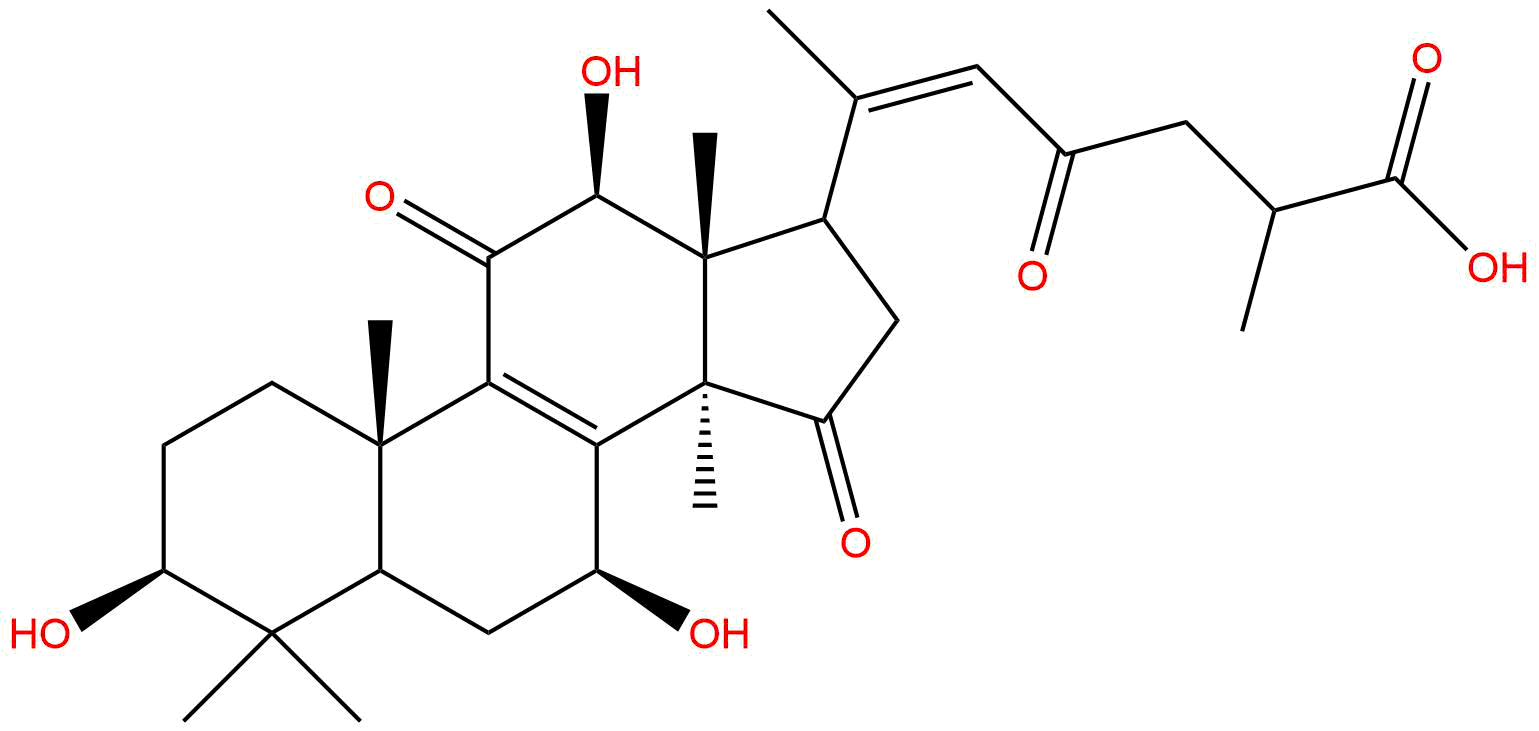
The chemical name of 12-hydroxy-glycolic acid B is (24E) -3,4-dihydroxy-15,26-dioxo-5 α - lanostane-8,24-diene-26-acid, and its CAS number is 1309931-84-7. This compound belongs to the highly oxidized lanostane type tetracyclic triterpenoid, with a molecular formula of C30H42O8 and a molecular weight of 530.6580.
Its structural core is a typical lanostane skeleton (A/B/C/D four ring system), and it has the following significant features: 1) There are two consecutive hydroxyl groups at positions 3 and 4 on the A ring, forming a ortho dihydroxy structure, which is usually related to antioxidant and free radical scavenging activities; 2) The C ring is an aromatic ring (unsaturated at positions 8 and 9), which is a common characteristic of ganoderic acid compounds; 3) The side chain (located at C-17 position) is highly modified, containing an alpha, beta unsaturated ketone structure (15,26-dione) and a terminal carboxyl group (26 position), and forms a double bond with position 24 (24E configuration). The hydroxyl group at position 12 is the characteristic functional group for its naming. This complex multifunctional structure determines its unique physicochemical properties and biological activity.
According to the provided pharmacological parameters, the lipid water partition coefficient (LogP) of 12-HGAB is 2.3233, indicating that it has moderate lipophilicity and is beneficial for penetrating cell membranes. Its topological polar surface area (TPSA) is as high as 149.2000 Å ², mainly attributed to the presence of multiple polar groups such as hydroxyl, carboxyl, and carbonyl groups in the molecule. A higher TPSA usually affects its membrane permeability. Its water solubility value is 0.0937 (usually measured in mg/mL or log mol/L, not specified here, but the value is relatively small), indicating that it belongs to insoluble compounds, which are common in natural triterpenoid acids and are also one of the key issues that need to be addressed in the development of its formulations. Based on the comprehensive analysis of LogP and TPSA, this compound meets three criteria in the five rules of class drugs (MW<500, LogP<5, hydrogen bond donor<5, hydrogen bond acceptor<10), but its molecular weight slightly exceeds 500 and the hydrogen bond acceptor (8 oxygen atoms) is close to the upper limit, indicating that its oral bioavailability may face challenges.
Plant sources and extraction methods
12 hydroxy ganoderic acid B is mainly derived from fungi of the genus Ganoderma in the family Polyporus, with Ganoderma being the main source(Ganoderma lucidum)And Zizhi(Ganoderma sinense)The content is relatively abundant in the fruiting body, mycelium, or spore powder. There are significant differences in the content of 12-HGAB among different varieties, origins, growth stages, and parts of Ganoderma lucidum. Usually, modern chromatographic analysis techniques such as HPLC-MS can be used for qualitative and quantitative analysis of this component in Ganoderma lucidum materials to screen for high-quality resources.
Its extraction and separation follow the conventional process of natural product chemistry, but optimization is needed for the properties of its triterpenoid acids:
1. Extract Organic solvent extraction method is usually used. Due to the carboxyl group and acidity of 12-HGAB, methanol, ethanol, or aqueous ethanol (such as 70-95%) are commonly used for reflux extraction or ultrasound assisted extraction. Sometimes, in order to increase the dissolution of polar components, weak alkaline aqueous solutions (such as dilute ammonia water) are used for preliminary extraction, followed by acidification and extraction with organic solvents. This method can enrich acidic triterpenoids.
2. Separation and purification After vacuum concentration, the crude extract is preliminarily separated by liquid-liquid extraction (commonly using ethyl acetate or n-butanol extraction) and column chromatography. Column chromatography often uses silica gel as the stationary phase and gradient elution systems such as petroleum ether ethyl acetate and chloroform methanol to separate different polar components. The components containing 12-HGAB need to be further purified through efficient preparation techniques, such as reverse phase preparative high-performance liquid chromatography (RP pre HPLC), commonly using C18 chromatography columns and methanol water or acetonitrile water (often with small amounts of formic acid or acetic acid added to inhibit carboxyl protonation and improve peak shape) as the mobile phase. By using spectroscopic data such as nuclear magnetic resonance (NMR, including 1H-NMR, 13C-NMR, 2D-NMR), mass spectrometry (MS), and specific rotation, the planar structure and relative configuration were ultimately determined.
Pharmacological activity research
A large number of in vitro and a small number of in vivo studies have confirmed that 12-HGAB has various pharmacological activities against pancreatic cancer.
- Antiproliferative activity against pancreatic cancer Many cell experiments have shown that 12-HGAB can inhibit the proliferation of many human pancreatic cancer cell lines (such as PANC-1, MIA PaCa-2, BxPC-3) in a dose-dependent and time-dependent manner, and its IC50 value is usually at the micromolar level. Its activity is stronger than many other triterpenoid analogues of Ganoderma lucidum. In addition to directly inhibiting proliferation, it can also effectively induce cancer cell cycle arrest. Studies have shown that it can block cells in the G0/G1 phase or S phase, preventing them from entering mitosis.
- Inducing cell apoptosis The induction of tumor cell apoptosis is one of the core mechanisms of 12 HGAB against pancreatic cancer. After treatment with 12-HGAB, pancreatic cancer cells can show typical morphological changes of apoptosis, such as cell shrinkage, chromatin agglutination, nuclear fragmentation, etc. Flow cytometry detection can observe a significant increase in the sub-G1 peak (withering peak). Further research has shown that it can upregulate pro apoptotic proteins (such as Bax), downregulate anti apoptotic proteins (such as Bcl-2), induce a decrease in mitochondrial membrane potential, release cytochrome C, activate the Caspase cascade reaction, and ultimately lead to cell apoptosis.
- Inhibit cell migration and invasion Metastasis is the main cause of death in patients with pancreatic cancer. Scratch test and Transwell test confirmed that 12-HGAB can significantly inhibit the migration and invasion of pancreatic cancer cells. This effect is closely related to its downregulation of matrix metalloproteinases (MMPs, such as MMP-2 and MMP-9) expression, upregulation of tissue metalloproteinase inhibitors (TIMPs), and impact on epithelial mesenchymal transition (EMT) related proteins (such as upregulation of E-cadherin, downregulation of N-cadherin, and vimentin).
- Reverse multidrug resistance The resistance of pancreatic cancer to chemotherapy drugs (such as gemcitabine) is the key to clinical treatment failure. Studies have shown that 12-HGAB can effectively reverse the drug resistance of pancreatic cancer cells. When combined with gemcitabine, it can significantly reduce the survival rate of drug-resistant cells, and its mechanism may be related to the inhibition of drug efflux pumps (such as P-glycoprotein, encoded by ABCB1 gene) function or expression.
- Anti inflammatory and immune regulation Chronic inflammation is the "soil" for the occurrence and development of pancreatic cancer. 12-HGAB exhibits good anti-inflammatory activity and can inhibit the excessive production of inflammatory factors such as TNF - α and IL-6 induced by lipopolysaccharides. This effect may help to improve the tumor microenvironment of pancreatic cancer and indirectly inhibit tumor growth.
- In vivo anti-tumor activity: In the nude mouse model of transplanted pancreatic cancer, intraperitoneal injection or intragastric administration of 12-HGAB can significantly inhibit the growth of tumor in a dose-dependent manner. Analysis of tumor tissue slices showed that the apoptosis index of tumor cells in the treatment group increased, the expression of proliferation markers (such as Ki-67) decreased, and no significant weight loss or major organ toxicity was observed, indicating its in vivo effectiveness and safety.
Mechanism of action and molecular targets
The anti pancreatic cancer effect of 12-HGAB involves a complex multi target network, and its mechanism can be summarized as follows:
- Regulating the apoptotic pathway (targeting BCL2 and CASP9)12-HGAB promotes mitochondrial pathway apoptosis by disrupting the balance of Bcl-2 family proteins. It downregulates the anti apoptotic protein Bcl-2 (BCL2 gene product) and may upregulate pro apoptotic proteins such as Bax, leading to increased mitochondrial outer membrane permeability, release of cytochrome C into the cytoplasm, and activation of the initial Caspase-9 (CASP9 gene product) upon binding with Apaf-1, thereby activating effector Caspase-3/7 and executing the cell apoptosis program.
- Inhibiting inflammation and survival signaling (targeting TLR4, STAT3, TNF, NOS2)TLR4/NF - κ B and JAK/STAT3 are two key pro-inflammatory and pro survival signaling pathways. 12-HGAB may inhibit the nuclear translocation of downstream NF - κ B by interfering with TLR4 receptor activation, thereby reducing the expression of inflammatory factors TNF - α (TNF gene product) and inducible nitric oxide synthase (iNOS, encoded by NOS2 gene). At the same time, it can inhibit the phosphorylation activation of STAT3 and block the transcription of downstream genes related to cell proliferation and survival (such as Cyclin D1, Survivor).
- Affects drug transport and resistance (targeting ABCB1)12-HGAB has been proven to be an effective regulator of P-glycoprotein. It may inhibit the transport function of P-glycoprotein encoded by ABCB1 gene through direct binding or indirect regulation, reduce the pumping of chemotherapy drugs from the cell, thereby increasing intracellular drug concentration and reversing multidrug resistance.
- Interference with cellular signal transduction (targeting PRKCA, MAPK1)Protein kinase C alpha (PKC alpha, encoded by the PRKCA gene) and extracellular signal regulated kinase (ERK, the MAPK1 gene product) are involved in regulating cell proliferation, differentiation, and survival. 12-HGAB may inhibit the abnormal proliferation signal of pancreatic cancer cells by inhibiting the activity of PKC α or interfering with the phosphorylation cascade of ERK signaling pathway.
- Affects DNA metabolism (potential target TOP1)Although direct evidence is not yet sufficient, given its structural characteristics, 12-HGAB may interfere with DNA replication and repair through embedding or topoisomerase (such as TOP1) inhibition, which requires further research to confirm.
To sum up, 12-HGAB plays a synergistic anti pancreatic cancer effect by simultaneously acting on multiple key nodes in the signaling network of apoptosis, inflammation, drug resistance and proliferation, reflecting the advantages of natural products in multi target action.
Evaluation of drug properties and pharmacokinetics
Based on the provided parameters and existing research, the preliminary evaluation of the pharmacological properties of 12-HGAB is as follows:
Advantage:
1. Clear activity: The anti pancreatic cancer activity is significant in vitro and in vivo, and it has a multi target mechanism.
2. Preliminary good safety The Ames test result is 0.0, indicating no mutagenicity. HERG inhibition is' no ', indicating a lower risk of causing QT interval prolongation in the heart. No severe acute toxicity was observed in animal experiments at effective doses.
3. The medicinal properties are still acceptable The LogP value is moderate and meets the basic requirements for lipid solubility of oral medications.
Challenges and Shortcomings:
1. Solubility and permeability Poor water solubility (0.0937) and high TPSA are the main obstacles to its oral absorption. This may lead to low bioavailability. The permeability of the blood-brain barrier is "low", but for the treatment of pancreatic cancer, this is usually not a disadvantage, but may reduce the side effects of the central nervous system.
2. Metabolic stability As a triterpenoid acid, it contains multiple hydroxyl groups and unsaturated bonds, which may be easily affected by liver phase I metabolism (such as oxidation and reduction) and phase II metabolism (such as glucuronidation and sulfation), leading to significant first pass effects and possibly shorter half lives. Currently, there is a significant lack of detailed pharmacokinetic research data available, including absorption, distribution, metabolism, and excretion.
3. Difficulty in formulation development In order to improve its oral bioavailability, advanced formulation technologies such as nanocrystals, liposomes, solid dispersions, phospholipid complexes, or prodrug modifications may be needed to increase its solubility and stability and promote intestinal absorption.
Therefore, future research urgently needs to systematically carry out pharmacokinetic studies of 12-HGAB, clarify its in vivo processes, and focus on pharmaceutical improvements to overcome its drug development bottleneck.
Clinical application prospects and prospects
As a natural compound with novel structure and multi target activity, 12-HGAB has shown a unique application prospect in the development of anti pancreatic cancer drugs:
- As a new candidate drug for pancreatic cancer Its multi target characteristics may help overcome the drug resistance problem of single target drugs, especially for patients with advanced pancreatic cancer who are resistant to gemcitabine and other standard chemotherapy. It can explore its potential as a monotherapy or in combination with existing chemotherapy drugs such as gemcitabine and albumin bound paclitaxel.
- As a chemical sensitizer Based on its ability to reverse multidrug resistance (inhibit ABCB1), 12-HGAB or its structurally optimized derivatives have the potential to be developed as sensitizers for adjuvant chemotherapy, improving the efficacy of existing chemotherapy regimens.
- Structural modification and optimization Reasonable medicinal chemical modification can be carried out to address its disadvantages such as poor water solubility and fast metabolism. For example, esterification, salt formation, or preparation into prodrugs of its carboxyl and hydroxyl groups; Simplify or modify the side chains to improve pharmacokinetic properties while maintaining activity. The study of structure-activity relationships will guide these optimization efforts.
- In depth mechanism exploration and biomarker discovery It is necessary to use proteomics, transcriptomics and other technologies to more comprehensively and accurately map its target network. Meanwhile, searching for biomarkers that predict its therapeutic efficacy can help achieve precision medicine.
- Expand the scope of disease research Given its anti-inflammatory and immune regulating activities, its potential therapeutic value for other inflammation related cancers (such as colon cancer, liver cancer) or autoimmune diseases can be explored.
Conclusion
12 hydroxy ganodenic acid B is a potential natural lead compound against pancreatic cancer, which was excavated from the traditional Chinese medicine Ganoderma lucidum. It shows comprehensive pharmacological activity in inhibiting the proliferation of pancreatic cancer cells, inducing apoptosis, anti metastasis, reversing drug resistance and anti inflammation by co regulating multiple key targets such as BCL2, STAT3, TLR4, ABCB1, etc. Although it faces challenges in terms of solubility, permeability, and metabolic stability in terms of drug properties, these challenges are expected to be overcome through modern medicinal chemistry and formulation methods. In the future, through in-depth mechanism analysis, systematic pharmacokinetic research, reasonable structural optimization, and standardized preclinical and clinical evaluation, 12-HGAB is expected to gradually develop from an active molecule found in a laboratory into a new weapon against "king of cancer" pancreatic cancer, bringing new hope to patients. This also reflects the enormous value and vitality of continuously excavating and modernizing the development of innovative drugs from the treasure trove of traditional natural medicines.