


Product name: Aristolochic Acid B
Synonym name: Aristolochic Acid II
Catalogue No.: BP0193
Cas No.: 475-80-9
Formula: C16H9NO6
Mol Weight: 311.249
Botanical Source: Alkaloid from Aristolochia argentina, Aristolochia clematitis, Aristolochia esperanzae, Aristolochia longa, Aristolochia manshuriensis, Aristolochia rotunda, Aristolochia pallida, Aristolochia sipho (Aristolochia durior) and from the Chinese drugs Ching-
Physical Description: Yellow powder
Type of Compound: Miscellaneous
Purity: 95%~99%
Analysis Method: HPLC-DAD or/and HPLC-ELSD
Identification Method: Mass, NMR
Packing: Brown vial or HDPE plastic bottle
Storage: Store in a well closed container, protected from air and light. Put into refrigerate or freeze for long term storage.
Whenever possible, you should prepare and use solutions on the same day. However, if you need to make up stock solutions in advance, we recommend that you store the solution as aliquots in tightly sealed vials at -20℃. Generally, these will be useable for up to two weeks.
The product could be supplied from milligrams to grams, up to kilograms
Inquire for bulk scale.
Descriptions:
Aristolochic acid II (AAII), one of the major components of the carcinogenic plant extract aristolochic acid, is known to be mutagenic and to form DNA adducts in vitro and in vivo,
AAII shows more carcinogenic risk than aristolochic acid I, and this may be, at least partly, the result of its increased levels in kidney and plasma.[1,2]
Aristolochic acid exhibit significant toxicity, and the short-term toxicity of aristolochic acid-II and aristolochic acid is similar to each other, renal but not hepatic failure induced by aristolochic acid could be prevented by pentoxifylline.[3]
References:
[1] Pfau W, Schmeiser H H, Wiessler M. Cheml Res Toxicol, 1991, 4(5):581-6.
[2] Xing G, Qi X, Min C, et al. Mutat Res-Fund Mol M, 2012, 743(1-2):52-8.
[3] Yeh Y H, Lee Y T, Hsieh H S, et al. Food Chem Toxicol , 2008, 46(3):1157-63.
[4] Zhu G, Wang Z, Wang Q, et al. China Pharmacy, 2006, 17(18):21-4.
HPLC of Aristolochic Acid B
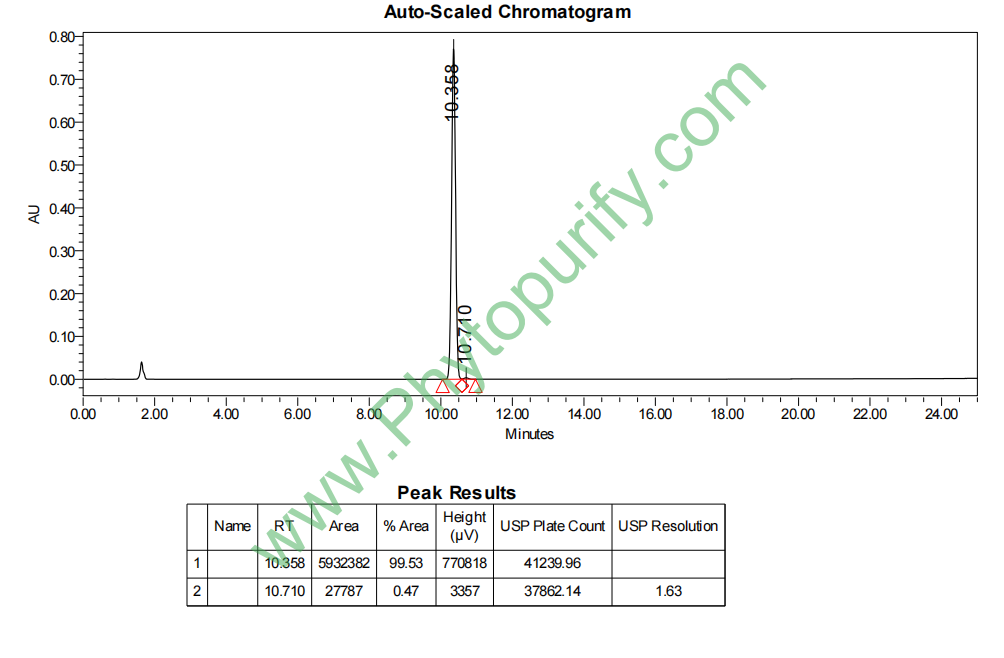
Storage conditions:Short-term storage at 2~8℃, long-term storage at -20 ~ -80℃
98.9000
3.4015
.2696
.0599
3.7630
39.4120
Low
91.9042
2.5077
Yes
No
No
No
Yes
Yes
2.4
Yes
No
Yes
Yes
Aristolochic Acid B (AAII), CAS number 475-80-9, is one of the main members of the Aristolochic Acid (AAs) family of compounds. Aristolochic acid compounds are mainly derived from Aristolochiaceae plants and have been widely used in traditional herbal medicine as anti-inflammatory, diuretic, and weight loss ingredients in history. However, since the outbreak of the "Chinese Herbal Kidney Disease" (later renamed "Aristolochic Acid Kidney Disease") in the 1990s, the serious toxic side effects of such compounds, especially their strong nephrotoxicity and carcinogenicity, have attracted great attention from the global pharmacology, toxicology, and clinical medicine communities. Aristolochic acid B, as the core component in Aristolochic acid mixtures, has particularly prominent toxic effects. Research has shown that AAII can form stable DNA adducts both in vitro and in vivo, with clear genotoxicity and mutagenicity, and is a key pathogenic factor leading to diseases such as renal interstitial fibrosis and urothelial carcinoma. In recent years, with the development of molecular biology technology, the study of its mechanism of action has been continuously deepened, involving multiple key targets and signaling pathways. This article aims to systematically review the chemical properties, plant sources, pharmacological (toxicological) activities, molecular mechanisms of action, pharmacological evaluation, and related clinical risks of aristolochic acid B, in order to provide scientific references for a comprehensive understanding of its duality (potential activity and significant toxicity) and subsequent related research.
Aristolochic acid B is a nitrophenanthrene derivative, with the systematic chemical name 3,4-methylenedioxy-10-nitro-1-phenanthrene carboxylic acid. Its core structure is a phenanthrene ring, which is replaced by a carboxyl group at position 1, connected by a methylenedioxy bridged ring at positions 3 and 4, and connected to a nitro group at position 10. This unique structure is the material basis for its biological activity and toxicity.
Its basic physicochemical properties are as follows:
- Molecular formula: C₁₇H₁₁NO₇
- molecular weight: 311.2490 g/mol
- Lipid water partition coefficient (LogP): 3.4015. This value indicates that aristolochic acid B has a moderately high lipophilicity, which facilitates its penetration of cell membranes but may also lead to its accumulation in adipose tissue.
- Topological Polarity Surface Area (TPSA)98.9000 Å ². A higher TPSA value reflects the presence of polar groups such as nitro, carboxyl, and ether bonds in the molecule, which have a significant impact on its solubility and intermolecular interactions.
- Water solubility: 0.0599 mg/mL。 It belongs to the category of slightly soluble to poorly soluble in water, which is consistent with its LogP value. In practical research, organic solvents such as DMSO are often used as solubilizers.
- Blood-brain barrier permeability Predicted as low. This is mainly attributed to its larger molecular weight and higher polar surface area, which limits its ability to freely pass through the blood-brain barrier, suggesting that its neurotoxicity may not be the main focus.
- HERG inhibition risk Predicted as no. Indicating that aristolochic acid B may not directly inhibit hERG potassium channels at conventional concentrations, resulting in a lower risk of cardiac QT interval prolongation.
- Ames test The value is 2.4 (usually referring to the recovery mutation rate, depending on the specific experimental conditions). This data further confirms its direct mutagenic potential, which is a direct manifestation of its genetic toxicity.
Aristolochic acid B is relatively unstable under light and alkaline conditions, and its nitro group can be reduced during in vivo metabolism, which is a key step in its activation and toxicity.
Aristolochiaceae B is widely present in various plants of the Aristolochiaceae family, especially in the Aristolochiaceae genus(Aristolochia)And Asarum genus(Asarum)Plants. Common plants containing aristolochic acid include Guanmu Tong(Aristolochia manshuriensis)Widely defend oneself(Aristolochia fangchi)Qingmu Fragrance(Aristolochia debilis)Aristolochia, Aristolochia(Aristolochia contorta)And some Asarum(Asarum Spp.) variety. These plants have a history of application in traditional medical systems in Asia, Europe, and the Americas.
The extraction and separation of aristolochic acid B usually follow the conventional process of natural product chemistry:
1. Extract Crush the dried plant roots, stems, and other parts, and use organic solvents for reflux extraction or cold soaking. Common solvents include methanol, ethanol, acetone, or their aqueous solutions to fully extract aristolochic acid components with a wide range of polarities.
2. Rough classification The extract is concentrated under reduced pressure to obtain a paste, which is then preliminarily enriched using solvent partitioning (such as partitioning between aqueous and organic phases (such as ethyl acetate, chloroform) at different pH values). Aristolochic acid compounds, due to their carboxyl groups, dissolve as salts in alkaline aqueous phase and can be extracted by organic solvents under acidic conditions, thereby separating from a large number of impurities.
3. Separation and Purification Further use column chromatography technology for fine separation. Silica gel column chromatography is commonly used to separate various components using gradient elution systems such as chloroform methanol or petroleum ether ethyl acetate. High performance liquid chromatography (HPLC), especially preparative HPLC, is the final key step in obtaining high-purity aristolochic acid B monomer. C18 reverse phase chromatography columns are commonly used, with methanol water or acetonitrile water (containing a small amount of formic acid or acetic acid to adjust pH) as the mobile phase.
4. appraisal The purified compound was structurally confirmed by nuclear magnetic resonance (NMR, including ¹ H and ¹ ³ C NMR), mass spectrometry (MS), ultraviolet spectroscopy (UV), and chromatographic behavior (such as HPLC retention time) compared to standard samples.
Due to the strong toxicity of aristolochic acid B, all extraction, separation, and experimental operations must be carried out under strict safety protection conditions to avoid personnel contact and environmental pollution.
The pharmacological activity research of aristolochic acid B mainly focuses on its toxicity, especially nephrotoxicity, genotoxicity, and carcinogenicity. The traditional notion of anti-inflammatory, analgesic, and other "therapeutic effects" has been overshadowed by its unacceptable toxicity risks, and modern research mainly regards it as a typical toxic model compound.
It is worth noting that very few studies have explored the possible immunomodulatory or anti-inflammatory effects of aristolochic acid compounds at extremely low concentrations, but these studies are controversial and their therapeutic window is extremely narrow, unable to offset their enormous toxicity risks. Therefore, major global drug regulatory agencies have banned or strictly restricted the use of medicinal herbs and preparations containing aristolochic acid.
The toxic mechanism of aristolochic acid B is complex and involves multiple steps and targets. Its core lies in the covalent binding with biomolecules (especially DNA) after metabolic activation, which triggers sustained genetic damage and cellular stress response.
Metabolic activation and DNA adduct formation:
Key molecular targets and pathways:
The toxicity of aristolochic acid B is not limited to DNA damage, but also involves interference with multiple cellular processes. Based on the provided target information, its functional network can be summarized as follows:
Association with acute lymphoblastic leukemia (ALL):
Although the carcinogenicity of aristolochic acid B is mainly associated with urothelial carcinoma, studies have also found its DNA adducts present in other tissues. The target lists provided (such as NOTCH1, BCL2, MCL1) are all key molecules in the pathogenesis of ALL. There is a hypothesis that systematic exposure to aristolochic acid B may increase the risk of hematopoietic malignancies (such as ALL) by forming DNA adducts and interfering with key targets (such as inducing NOTCH1 gene and disrupting apoptosis balance). This provides a new perspective for understanding its systemic carcinogenic effects, but more epidemiological and experimental evidence is needed to support it.
From the perspective of modern drug development, the pharmacological properties of aristolochic acid B are extremely poor, and its pharmacokinetic characteristics are closely related to its toxicity.
Therefore, aristolochic acid B has no possibility of being developed as a therapeutic drug. The current research focus is on elucidating its toxicokinetics for risk assessment and exploring its application as a tool drug in constructing animal models of specific types of DNA damage or renal fibrosis.
Aristolochic acid B and its source plants There is no prospect for clinical treatment anymore Regulatory agencies worldwide, such as the US FDA, European EMA, and China's National Medical Products Administration, have issued warnings, restrictions, or bans on the use of medicinal and proprietary medicines containing aristolochic acid. Its' clinical application 'has completely shifted towards Toxicological monitoring, risk assessment, and public health protection field
Future research prospects should focus on the following aspects:
Aristolochic acid B is a nitrophenanthrene compound isolated from traditional medicinal plants, and its research process is a typical negative example from "potential drugs" to "clear toxins". Its strong nephrotoxicity, genetic toxicity, and carcinogenicity stem from the covalent binding of active nitrogen ions formed after metabolism in the body to DNA, and involve extensive interference with DNA repair, cell apoptosis, and key signaling pathways. Although research on its molecular targets, including some proteins associated with acute lymphoblastic leukemia, has expanded our understanding of its systemic toxicity, this does not change its nature as a Class I human carcinogen. Its poor pharmacokinetic parameters and unacceptable safety risks completely shut down its potential as a therapeutic drug. Current and future research should strive to thoroughly reveal the mysteries of its toxicity, develop monitoring and intervention methods, and draw profound lessons from it, strengthen scientific scrutiny and strict supervision of potential toxic components in traditional herbs, in order to ensure public medication safety. The story of aristolochic acid B warns us that nature does not equate to safety, and the development of natural products must be based on rigorous and systematic pharmacological and toxicological evaluations.
