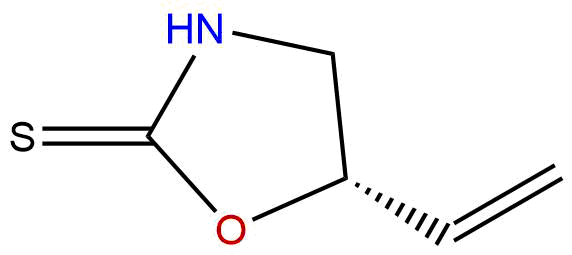


Product name: (S)-Goitrin
Synonym name:(-)-Goitrin; (-)-5-Vinyl-2-oxazolidinethione;(S)-5-Vinyloxazolidine-2-thione;(S)-5-Vinyloxazolidine-2-thione
Catalogue No.: BP5138
Cas No.: 500-12-9
Formula: C5H7NOS
Mol Weight: 129.177
Botanical Source:
Type of Compound: Miscellaneous
Purity: 95%~99%
Analysis Method: HPLC-DAD or/and HPLC-ELSD
Identification Method: Mass, NMR
Packing: Brown vial or HDPE plastic bottle
Storage: Store in a well closed container, protected from air and light. Put into refrigerate or freeze for long term storage.
Whenever possible, you should prepare and use solutions on the same day. However, if you need to make up stock solutions in advance, we recommend that you store the solution as aliquots in tightly sealed vials at -20℃. Generally, these will be useable for up to two weeks.
The product could be supplied from milligrams to grams
Inquire for bulk scale.
For Reference Standard and R&D, Not for Human Use Directly.
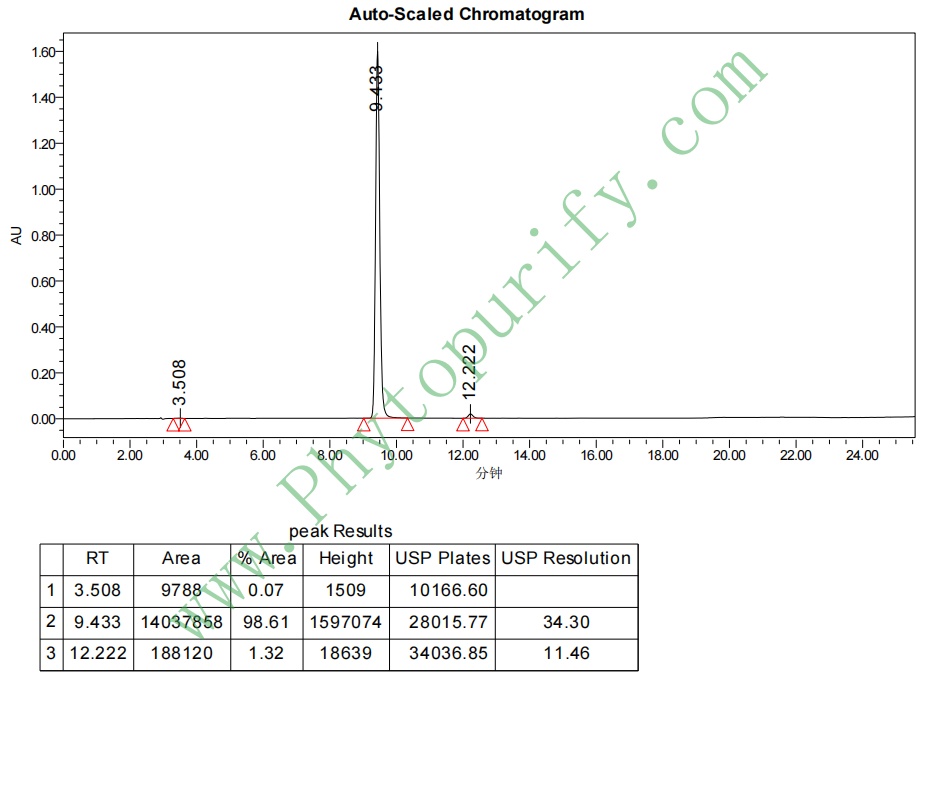
HPLC of (-)-Goitrin
Storage conditions:Short-term storage at 2~8℃, long-term storage at -20 ~ -80℃
21.2600
.6841
.6831
7.2594
3.1261
16.1135
High
44.8933
4.7029
No
Yes
Yes
No
Yes
No
0.6
Yes
Yes
Yes
Yes
(S) Gaoyichun (S) - Koitrin), chemical name 5-vinyl-1,3-oxazolidine-2-thione, is a natural small molecule compound with an S configuration, molecular formula C6H9NOS, molecular weight 129.1840. As one of the important active ingredients of traditional Chinese medicine Isatis indigotica Fort., (S) - Guaoychun has received widespread attention in the field of natural product pharmacology in recent years due to its unique chemical structure and significant biological activity. This compound not only exhibits antiviral activity, especially in respiratory viruses such as influenza and coronavirus, but also has pharmacological effects against hyperthyroidism. In addition, as a plant metabolite, the biosynthetic pathway and stereochemical properties of (S) - Gaoyichun are of great significance for understanding plant secondary metabolism.
This review aims to systematically summarize the chemical structure and physicochemical properties, plant sources and extraction methods, pharmacological activity and mechanism of action, pharmacological evaluation and pharmacokinetic characteristics of (S) - Gaoyichun, and explore its clinical application prospects and future research directions, providing theoretical basis and research guidance for the deep development of this compound.
(S) - Gao Yichun belongs to oxazolidine thioketone compounds, which contain a five membered 1,3-oxazolidine ring in their structure, with a vinyl side chain and a thioketone group attached to the ring. Its stereochemical characteristic is the S configuration, which contrasts with its enantiomer (R) - goitrin, which exhibits certain differences in biological activity. The molecular formula is C6H9NOS, with a molecular weight of 129.1840, showing a smaller molecular weight advantage, which is beneficial for the absorption and distribution of drugs in vivo.
In terms of physical and chemical properties, the LogP value of (S) - Gao Yichun is 0.6841, indicating that it has moderate lipid solubility, which ensures good cell membrane permeability and maintains a certain degree of water solubility (7.2594 mg/mL), facilitating its dissolution and transport in body fluids. The polar surface area (TPSA) is 21.26 Å ², and lower TPSA values are typically associated with better cell membrane permeability. Its blood-brain barrier penetration ability is high, indicating that the compound may have potential central nervous system effects. The negative result of hERG channel inhibition experiment indicates a low risk of cardiac toxicity. The Ames test result is 0.6, indicating no significant mutagenicity and good safety.
In summary, (S) - Gao Yichun has excellent medicinal chemical properties, laying a solid foundation for its subsequent pharmacological research and drug development.
(S) Gaoyichun mainly exists in the traditional Chinese medicinal herb Isatis indigotica Fort. Isatis indigotica Fort is the dried root of the cruciferous plant and is a traditional Chinese medicine for clearing heat and detoxifying. It is widely used in the treatment of antiviral and anti-inflammatory diseases. Banlangen contains various bioactive ingredients, such as indigo carmine, indigo, glucosinolates, and their metabolites (S) - guaiachun.
(S) The extraction of Gao Yichun usually adopts the method of water extraction combined with organic solvent separation. Firstly, after crushing the roots of Isatis indigotica, they are extracted with water or ethanol aqueous solution. After concentration, the extract is separated and purified using liquid-liquid extraction or column chromatography techniques. In recent years, ultrasound assisted extraction and microwave-assisted extraction technologies have also been introduced to improve extraction efficiency and purity. During the purification process, reverse phase high performance liquid chromatography (RP-HPLC) is widely used for the qualitative and quantitative analysis of (S) - Gao Yichun, ensuring the accuracy of its structural identification and content determination.
In addition, considering the structural similarity between (S) - guaiachun and its enantiomer (R) - goitrin, the application of chiral separation techniques such as chiral chromatography columns is particularly crucial for obtaining high-purity (S) - guaiachun. Related studies have shown that different extraction processes and geographical environments of the source plants have a significant impact on the content of (S) - Gaoyichun, providing a reference for quality control and standardized production of Banlangen.
(S) The pharmacological activity research of Gao Yichun mainly focuses on its antiviral, anti hyperthyroidism, and anti-inflammatory effects.
As one of the active ingredients of Banlangen, (S) - Gaoyichun exhibits significant antiviral activity. In vitro experiments have shown that the compound has inhibitory effects on various respiratory viruses, including influenza virus, coronavirus (such as SARS-CoV-2), and respiratory syncytial virus (RSV). Its antiviral mechanism may involve multiple stages of the virus replication cycle, such as inhibiting virus protein synthesis, blocking virus invasion into cells, and regulating host immune response. Animal model studies further confirm that (S) - Gaoyichun can alleviate lung inflammation and tissue damage caused by viral infections, demonstrating good therapeutic potential.
(S) - Gao Yichun has been found to have anti hyperthyroidism activity due to its similarity in structure with thyroid synthesis related thiometabolites. Preclinical studies have shown that this compound can inhibit excessive synthesis and secretion of the thyroid gland, alleviate thyroid enlargement and related symptoms. Its mechanism of action may be related to inhibiting thyroid peroxidase (TPO) activity and affecting thyroid hormone synthesis. Compared with traditional anti thyroid drugs, (S) - Gaoyichun has lower toxic side effects, demonstrating its potential for development as a new type of anti thyroid drug.
Partial studies have revealed that (S) - Gaoyichun has immunomodulatory and anti-inflammatory effects. It can inhibit the expression of inflammatory mediators such as TNF - α and IL-6, alleviate inflammatory reactions, and promote tissue repair. In addition, (S) - Gao Yichun also has a certain impact on immune cell function, which may enhance the body's disease resistance by regulating T cell and macrophage activity.
In summary, (S) - Gaoyichun exhibits multi-target and multi mechanism pharmacological activity as a natural product, providing a theoretical basis for its application in antiviral and related disease treatment.
(S) The pharmacological mechanism of action of Gao Yichun is relatively complex, involving multiple molecular targets and signaling pathways.
Research has shown that (S) - Gaoyichun can interfere with key steps in the lifecycle of viruses. Firstly, it may inhibit virus attachment and entry into host cells by binding to viral surface proteins. Secondly, (S) - Gao Yichun can inhibit viral RNA synthesis and protein translation, reducing viral replication efficiency. In addition, the compound may also activate the host's antiviral immune response, such as inducing the expression of interferon (IFN) and related antiviral genes, enhancing the antiviral ability of cells.
Molecular docking and bioinformatics analysis suggest that (S) - Gaoyichun may act on the main proteases (such as 3CLpro) and RNA dependent RNA polymerase (RdRp) of the virus, blocking the virus replication process by inhibiting the activity of these key enzymes.
(S) - Gao Yichun blocks the key step of thyroid hormone synthesis by inhibiting thyroid peroxidase (TPO) activity. TPO catalyzes the coupling reaction between thyroid iodide oxidation and tyrosine iodide, and is the core enzyme in thyroid hormone biosynthesis. Inhibiting TPO activity can reduce the synthesis of thyroid hormones T3 and T4 and alleviate symptoms of hyperthyroidism. In addition, (S) - Gao Yichun may alleviate cell damage caused by peroxides by regulating the redox state within thyroid cells.
(S) - Gao Yichun can downregulate the nuclear factor kappa B (NF - κ B) signaling pathway, inhibit the expression of pro-inflammatory cytokines such as TNF - α, IL-1 β, and IL-6, and alleviate inflammatory reactions. Meanwhile, the compound may activate anti-inflammatory signaling pathways, such as regulating T cell (Treg) function, promoting immune homeostasis. In addition, (S) - Gao Yichun has a regulatory effect on macrophage polarization, promotes the differentiation of M2 anti-inflammatory macrophages, and enhances tissue repair ability.
In summary, (S) - Gao Yichun exerts its wide-ranging pharmacological effects through multi-target and multi pathway synergistic effects.
(S) - Gao Yichun has shown good potential in developing medicinal properties. Its molecular weight is 129.1840, which conforms to Lipinski's rule. The LogP value is 0.6841, indicating moderate lipid solubility and facilitating oral absorption. TPSA 21.26 Å ² is relatively low, indicating good cell membrane penetration ability. The water solubility is 7.2594mg/mL, ensuring sufficient bioavailability. The high penetration ability of the blood-brain barrier suggests potential applications for central nervous system diseases. The hERG channel inhibition was negative and the Ames test results were good, indicating a low risk of cardiac and genetic toxicity.
In terms of pharmacokinetics, existing animal experiments have shown that (S) - Gaoyichun is rapidly absorbed after oral administration, with a moderate plasma half-life and wide distribution, especially enriched in target tissues such as lungs and liver. Its metabolism is mainly carried out through the liver enzyme system, and the safety of its metabolites still needs further research. The main excretion pathways are urine and bile. The in vivo dynamic characteristics support its development as an oral medication.
However, the bioavailability of (S) - Gaoyichun is greatly affected by the first pass effect, and future research should focus on optimizing the formulation and improving the administration route to enhance its clinical application value.
Based on the multiple pharmacological activities of (S) - Gaoyichun, especially its potential for antiviral and anti hyperthyroidism effects, this compound has broad prospects for clinical application.
Currently, respiratory virus infections are occurring frequently worldwide, especially in the context of the new coronavirus epidemic, making it urgent to develop safe and effective antiviral drugs. (S) As a natural product, Gao Yichun has broad-spectrum antiviral activity and good safety, making it suitable for further development as an antiviral drug. In the future, nanocarrier technology can be combined to improve its in vivo stability and targeting, enhancing therapeutic efficacy.
Patients with hyperthyroidism have certain resistance and side effects to existing drugs. As a new candidate for anti thyroid drugs, (S) - Gao Yichun has low toxicity and good efficacy, and it is worth conducting preclinical and clinical trials to verify its safety and effectiveness.
Given its immunomodulatory and anti-inflammatory effects, (S) - Gaoyichun may play an adjuvant therapeutic role in autoimmune diseases, chronic inflammation, and related metabolic disorders. Future research can expand its potential applications in these fields.
Although (S) - Gaoyichun exhibits various pharmacological activities, its mechanism of action has not been fully elucidated, and clinical research data is lacking. Relevant toxicology and pharmacokinetic studies still need to be deepened. In the future, we should strengthen structural optimization, formulation development, and multi center clinical trials to promote its transition from laboratory to clinical application.
In addition, combining modern molecular biology and computational pharmacology techniques to deeply analyze its target network and signaling pathways will help enhance its efficacy and safety, and promote it as an important representative of the new generation of natural medicines.
(S) As an important active ingredient in Banlangen, Gaoyichun has shown extensive potential in antiviral, anti hyperthyroidism, and immune regulation applications due to its unique chemical structure and significant biological activity. Its good pharmacological parameters and safety provide favorable conditions for further drug development. In the future, through systematic pharmacological mechanism research, pharmacokinetic optimization, and clinical validation, (S) - Gao Yichun is expected to become an important breakthrough in the development of natural product drugs, bringing new hope for the treatment of related diseases. The field of natural product pharmacology should continue to pay attention to and deepen research on (S) - Gao Yichun, and promote its clinical translation.
