


Product name: Ginkgolide B
Synonym name: 7-Deoxyginkgolide C
Catalogue No.: BP0647
Cas No.: 15291-77-7
Formula: C20H24O10
Mol Weight: 424.402
Botanical Source: Ginkgo biloba L.
Physical Description:
Type of Compound: Diterpenoids
Purity: 95%~99%
Analysis Method: HPLC-DAD or/and HPLC-ELSD
Identification Method: Mass, NMR
Packing: Brown vial or HDPE plastic bottle
Storage: Store in a well closed container, protected from air and light. Put into refrigerate or freeze for long term storage.
Whenever possible, you should prepare and use solutions on the same day. However, if you need to make up stock solutions in advance, we recommend that you store the solution as aliquots in tightly sealed vials at -20℃. Generally, these will be useable for up to two weeks.
The product could be supplied from milligrams to grams
Inquire for bulk scale.
Description:
Ginkgolide B has potent neuroprotective, anti-arrhythmias, anti-inflammatory and anti-apoptotic effects, it might be a promising drug on inhibiting platelet function and reducing inflammation in atherosclerosis.Ginkgolide B retards the proliferation and development of mouse embryonic stem cells (ESCs) and blastocysts in vitro and causes developmental injury in vivo.
References:
Cutan Ocul Toxicol. 2015 Mar;34(1):53-60.
Inhibitory effects of the platelet-activating factor receptor antagonists, CV-3988 and Ginkgolide B, on alkali burn-induced corneal neovascularization.
Platelet-activating factor (PAF) has been found in various ocular tissues; the activity of PAF depends on the binding to its specific receptor, PAF-receptor. We investigated the therapeutic effects of PAF-receptor antagonists (CV-3988 and Ginkgolide B) on alkali burn-induced corneal neovascularization (CNV).
METHODS AND RESULTS:
CNV was induced by applying a 0.2 N sodium hydroxide (3 µl, NaOH) solution directly on mice corneas. CV-3988 (1 mM/10 µl) and Ginkgolide B (1 mM/10 µl) were administered topically on the corneas three times daily for three consecutive days. CNV was evaluated under a slit-lamp microscope. Corneas were processed for histological, immunohistochemical and reverse transcription polymerase chain reaction analysis. Human umbilical vein endothelial cells were used for the migration and tube formation assay. Application of CV-3988 and Ginkgolide B inhibited CNV caused by alkali burn. CV-3988 and Ginkgolide B attenuated the expression of PAF-receptor mRNA. Alkali injury induced a massively increased intraocular mRNA expression of an angiogenic factor in cornea tissues, whereas these increments were attenuated by the application of CV-3988 and Ginkgolide B.
CONCLUSIONS:
CV-3988 and Ginkgolide B reversed opacity and neovascularization in alkali burn-induced corneas. Our findings suggest that CV-3988 and Ginkgolide B may be therapeutically useful in the treatment of CNV and inflammation.
Eur J Pharmacol. 1989 May 19;164(2):293-302.
Ginkgolide B protects isolated hearts against arrhythmias induced by ischemia but not reperfusion.
The effect of Ginkgolide B (BN 52021), a specific platelet-activating factor (PAF) antagonist, applied in doses of 1.5, 3.0, 6.0 X 10(-5) and 1.2 X 10(-4) mol/l, in comparison to that of metoprolol (10(-5) mol/l) and diltiazem (10(-7) mol/l), two widely used antiarrhythmic agents, on ischemia- and reperfusion-induced arrhythmias and heart functions, such as heart rate (HR), coronary flow (CF), aortic flow (AF), left ventricular developed pressure (LVDP), its first derivative (LVdp/dtmax), and left ventricular end-diastolic pressure (LVEDP) in isolated working rat hearts was examined.
METHODS AND RESULTS:
BN 52021 caused a dose-related protection against dysrhythmias, such as ventricular fibrillation, ventricular tachycardia, and premature ventricular beats induced by ischemia (30 min ligation of the left anterior descending coronary artery). The antiarrhythmic effect of BN 52021 given in a dose of 6.0 X 10(-5) mol/l was comparable to that of diltiazem and superior to the activity of metoprolol. None of the drugs influenced reperfusion-induced rhythm disturbances. BN 52021 did not alter heart functions, while metoprolol reduced (LVEDP only, and diltiazem increased CF, decreased AF, LVDP, and LVdp/dtmax during regional ischemia, indicating a negative inotropic effect. The antiarrhythmic effect of BN 52021 appears to be related to an antagonism of an increase in slow calcium influx induced by PAF in myocardial cells.
CONCLUSIONS:
Similarly to the mechanism of action of established antiarrhythmic drugs, BN 52021 can presumably prevent the re-entry mechanism involved in the development of ischemia-induced rhythm disturbances.
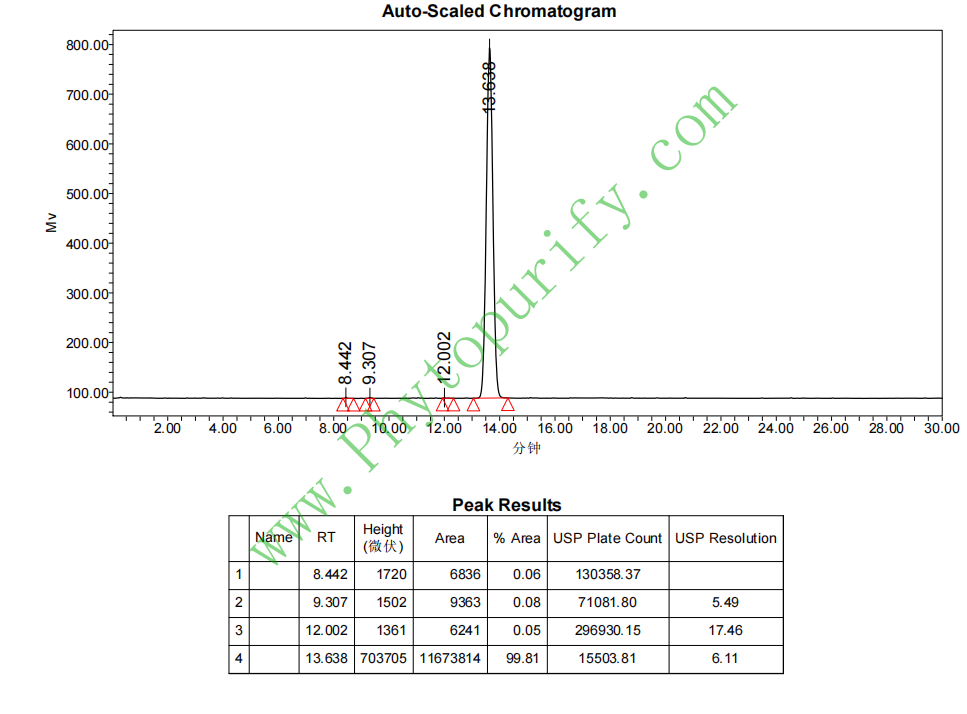
HPLC of Ginkgolide B
Storage conditions:Short-term storage at 2~8℃, long-term storage at -20 ~ -80℃
148.8200
.1576
.1577
.4612
1.1572
5.5609
Low
23.5671
6.1865
Yes
No
No
No
Yes
No
0.9
Yes
No
Yes
Yes
Ginkgo biloba(Ginkgo biloba L.), As a living fossil in the plant kingdom, its medicinal value has a history of thousands of years. Modern pharmacological research has revealed that the core bioactive components of Ginkgo biloba leaf extract are terpenoid lactones and flavonoid glycosides. Among them, ginkgolide compounds have attracted much attention due to their unique and powerful pharmacological effects. Ginkgolide B (BN-52021) is one of the most active members of the ginkgolide family, with a CAS number of 15291-77-7. As a highly oxidized diterpenoid lactone, ginkgolide B was initially discovered as a highly efficient and specific antagonist of platelet activating factor (PAF) receptors, which opened the curtain on its extensive pharmacological research. Subsequent studies have continuously expanded its biological significance, confirming that ginkgolide B exhibits significant activities in antioxidant, anti-inflammatory, anti apoptotic, and neuroprotective aspects. Especially in the field of central nervous system diseases, its ability to penetrate the blood-brain barrier has shown great potential in the treatment of diseases such as cerebral ischemia, Alzheimer's disease, and Parkinson's disease. This article aims to systematically review the chemical properties, pharmacological activities, molecular mechanisms of action, medicinal properties, and clinical application prospects of ginkgolide B, in order to provide comprehensive scientific references for the in-depth development and transformation research of this natural product.
The molecular formula of ginkgolide B is C20H24O10, with a molecular weight of 424.4020. Its chemical structure is highly complex and unique, consisting of six pentagonal rings (including a spiro [4,4] nonane skeleton, a tetrahydrofuran ring, and three gamma lactone rings) fused together to form a cage like polycyclic system. This rigid "cage shaped" structure is the material basis for its biological activity and makes it extremely rare in nature.
From the analysis of physical and chemical properties, the lipid water partition coefficient (LogP) of ginkgolide B is 0.1576, indicating its hydrophilicity, which is related to the abundance of multiple polar oxygen atoms (carbonyl, hydroxyl) in the molecule. Its topological polar surface area (TPSA) is as high as 148.82 Å ², further confirming its strong polarity characteristics. The water solubility data is 0.4612 mg/mL, which belongs to the category of slight solubility, which to some extent limits its bioavailability. Preliminary predictions of drug efficacy indicate that it has no significant inhibitory effect on hERG channels (hERG inhibition: No), suggesting a low potential risk of arrhythmia; The Ames test result is 0.9, indicating a low risk of mutagenicity and providing preliminary support for its safety. Of particular note is that although its TPSA is high, existing data indicates that its blood-brain barrier permeability is "low". However, a large number of in vivo and in vitro studies have confirmed that it can indeed enter the central nervous system to exert its effects, which may be related to its special transport mechanism or structural rigidity. The specific mechanism still needs to be further explored.
Ginkgolide B specifically originates from the root bark and leaves of Ginkgo biloba trees, with leaves being the main raw material for industrial extraction. The content of ginkgolides in plants is extremely low (usually less than 0.1%), and they coexist with structurally similar ginkgolides A, C, J, M, etc., making the acquisition of high-purity ginkgolide B a technical challenge.
The traditional extraction method mainly relies on organic solvents (such as acetone, methanol, ethanol water mixed system) reflux extraction or percolation to obtain crude extracts rich in terpenoids and flavonoids. Subsequently, ginkgolide B monomer was obtained through a series of separation and purification steps, mainly including:
1. liquid-liquid extraction Preliminary enrichment using the distribution differences of ginkgolides between specific organic solvents (such as ethyl acetate) and water.
2. column chromatography This is the core purification step. Silica gel column chromatography is commonly used, with gradient elution using chloroform methanol, ethyl acetate petroleum ether, and other solvents in different ratios. Reverse phase silica gel (such as C18) column chromatography is also widely used in later refining.
3. recrystallization Utilizing the difference in solubility of ginkgolide B in specific solvents such as methanol water and acetone water, repeated crystallization is carried out to obtain high-purity products.
In recent years, modern separation technologies have been introduced to improve efficiency and yield, such as High-speed countercurrent chromatography HSCCC, due to its advantages of irreversible adsorption and high recovery rate, has become an effective means of separating ginkgolide homologues;Preparation type high-performance liquid chromatography Prepr HPLC is the ultimate guarantee for obtaining chromatographic grade purity. In addition,biosynthesis and Plant cell culture Technology as an alternative source is currently being explored to achieve sustainable and controllable production, but it is still in the laboratory research stage with high costs.
The pharmacological activities of ginkgolide B are extensive and in-depth, mainly covering the following aspects:
Antiplatelet activation and cardiovascular protection As a classic PAF receptor antagonist, ginkgolide B can competitively block the binding of PAF to its receptor, thereby inhibiting a series of pathophysiological processes such as PAF induced platelet aggregation, neutrophil activation, increased vascular permeability, and bronchial constriction. This has significant value in the treatment of asthma, shock, ischemia-reperfusion injury (such as myocardial infarction, stroke), and other conditions.
Neuroprotective effect This is the most promising research direction for ginkgolide B. It has shown strong protective effects in various neural injury models:
Anti inflammatory and immune regulation In addition to the PAF pathway, ginkgolide B can also inhibit key inflammatory signaling pathways such as nuclear factor kappa B (NF - κ B) and mitogen activated protein kinase (MAPK), downregulate the expression of inflammatory mediators such as tumor necrosis factor - α (TNF - α), interleukin-1 β (IL-1 β), and cyclooxygenase-2 (COX-2), and thus play a role in systemic inflammation and neuroinflammation.
Antioxidant and anti apoptotic effects Ginkgolide B can enhance the cell's own antioxidant defense system, such as upregulating the expression of nuclear factor E2 related factor 2 (Nrf2) and its downstream heme oxygenase-1 (HO-1) proteins. At the same time, it exerts anti apoptotic effects by regulating the Bcl-2/Bax ratio, inhibiting the caspase cascade reaction.
Antitumor activity Preliminary studies have shown that ginkgolide B has inhibitory and pro apoptotic effects on certain tumor cells, such as liver cancer, lung cancer, and glioma cells. Its mechanism involves cell cycle arrest, induction of apoptosis, and inhibition of invasion and metastasis. However, research in this area is still in the preclinical stage.
The multiple pharmacological activities of ginkgolide B stem from its diverse regulation of complex cellular signaling networks. The mechanism of action and key molecular targets can be summarized as follows:
Direct antagonism of PAF receptor (PTAFR)This is its most clear and classic target. Ginkgolide B competitively binds to G protein coupled PAF receptors, blocking abnormal activation of downstream phospholipase C (PLC)/protein kinase C (PKC), MAPK and other pathways.
Regulating cell survival and apoptosis pathways:
Intervention in Alzheimer's disease-related pathological pathways:
Activate endogenous protective system:
Regulating kinases and transcription factors:
In summary, ginkgolide B forms a powerful cellular protective network through the synergistic action of multiple targets and pathways.
Despite the excellent pharmacological activity of ginkgolide B, its medicinal properties still face some challenges.
Pharmacokinetic properties Animal studies have shown that ginkgolide B is rapidly but incompletely absorbed orally, with a relatively low absolute bioavailability (about 10% -20%), which may be related to its high polarity and poor water solubility. It is widely distributed in the body due to its ability to penetrate the blood-brain barrier and reach effective concentrations in the central nervous system. The metabolism of ginkgolide B in the body is mainly through renal excretion, with some being excreted through bile. Liver metabolism (such as CYP450 enzyme system) has relatively limited effects, which reduces the potential risk of complex drug interactions. Its plasma half-life is approximately 2-4 hours in animal models.
Challenges and optimization strategies for drug development:
1. Solubility and permeability Moderate water solubility and membrane permeability are the main factors limiting its oral bioavailability.
2. Formulation improvement Current research directions include preparation Phospholipid complex、Cyclodextrin inclusion complex、Solid dispersion and nano-formulation(such as liposomes, nanoparticles, micelles). These technologies can effectively improve its solubility and stability, promote intestinal absorption, and thus enhance bioavailability.
3. Structural modification By chemically modifying the hydroxyl and lactone ring sites of ginkgolide B, a series of derivatives are synthesized to improve its physicochemical properties and pharmacokinetic behavior while maintaining its activity. Some semi synthetic derivatives with higher activity or better water solubility have been reported in previous studies.
4. Prodrug strategy Designing prodrugs that can be converted into active parent drugs in the body is another way to improve their absorption and targeting.
In terms of safety, based on existing data (such as no hERG inhibition, Ames negative) and long-term clinical experience with Ginkgo biloba leaf extract, ginkgolide B itself shows a good safety window. However, as a highly active drug monomer, its long-term toxicity and safety in specific populations still require systematic preclinical and clinical research evaluations.
The clinical application prospects of ginkgolide B are broad, mainly focusing on the fields of cardiovascular, cerebrovascular and neurological diseases:
Future research prospects include:
* In depth mechanism exploration Using omics techniques (proteomics, metabolomics) and gene editing tools to more accurately depict its functional network and discover new targets.
* Development of a new delivery system Focus on developing intelligent nano drug delivery systems that can efficiently target diseased brain areas or blood vessels, such as nano formulations based on blood-brain barrier penetrating peptides or inflammation targeting ligands.
* Combination therapy strategy Exploring the synergistic effect of ginkgolide B with existing standard therapeutic drugs such as acetylcholinesterase inhibitors for AD and levodopa for PD, in order to improve efficacy and reduce side effects.
* High quality clinical research Promote rigorously designed, large sample, multi center randomized controlled clinical trials to obtain conclusive evidence of efficacy and safety, ultimately achieving a leap from "natural products" to "innovative drugs".
Ginkgolide B, as a modern medicinal treasure excavated from ancient ginkgo trees, its unique cage like chemical structure endows it with extraordinary multi-target pharmacological activity. The research process from the initial PAF receptor antagonists to candidate drugs that have shown broad prospects in neuroprotection, anti-inflammatory and antioxidant fields reflects the depth and breadth of natural product research. Although there are still challenges in terms of bioavailability in drug development, these obstacles are gradually being overcome through the cross fusion of modern pharmaceutical, medicinal chemistry, and molecular biology technologies. With the continuous elucidation of its mechanism of action and the continuous advancement of clinical translational research, ginkgolide B is expected to provide a new, multi mechanism synergistic treatment option for patients with cardiovascular and neurodegenerative diseases in the future, demonstrating the enduring vitality and important value of natural products in innovative drug development.
