


Product name: Hesperidin
Synonym name:
Catalogue No.: BP0725
Cas No.: 520-26-3
Formula: C28H34O15
Mol Weight: 610.565
Botanical Source: Found in most citrus fruits and other members of the Rutaceae, also in Mentha longifolia, Vernonia, Anthurium, Xanthoxylum spp. and many others. First oranges in 1828
Physical Description: Powder
Type of Compound: Flavonoids
Purity: 95%~99%
Analysis Method: HPLC-DAD or/and HPLC-ELSD
Identification Method: Mass, NMR
Packing: Brown vial or HDPE plastic bottle
Storage: Store in a well closed container, protected from air and light. Put into refrigerate or freeze for long term storage.
Whenever possible, you should prepare and use solutions on the same day. However, if you need to make up stock solutions in advance, we recommend that you store the solution as aliquots in tightly sealed vials at -20℃. Generally, these will be useable for up to two weeks.
The product could be supplied from milligrams to grams, up to kilograms
Inquire for bulk scale.
Descriptions:
Hesperidin, a bioflavonoid, is an abundant and inexpensive by-product of Citrus cultivation, has antioxidant, anti-inflammatory, hypolipidemic, vasoprotective and anticarcinogenic and cholesterol lowering actions; can improves the health of capillaries by reducing the capillary permeability; can inhibit following enzymes: phospholipase A2, lipoxygenase, HMG-CoA reductase and cyclo-oxygenase. [1]
Hesperidin supplementation and diosmin individually or in combination, is effective in inhibiting the development of oesophageal cancer induced by MNAN, such inhibition might be related to suppression of increased cell proliferation caused by MNAN in the oesophageal mucosa.[2]
Hesperidin contributes to the vascular protective effects of orange juice.[3]
Hesperidin has beneficial effects on bone and lipids, can inhibit bone loss in ovariectomized mice (OVX), an animal model of postmenopausal osteoporosis.[4]
Hesperidin improves biomarkers of oxidative stress and has a hypocholesterolemic effect in an animal model of diet-induced hypercholesterolemia.[5]
References:
[1] Garg A, Garg S, Zaneveld L J D, et al. Phytotherapy Research Ptr, 2001, 15(8):655-69.
[2] Tanaka T, Makita H, Kawabata K, et al.Carcinogenesis, 1997, 18(4):761-9.
[3] Morand C, Dubray C, Milenkovic D, et al. Am J Clin Nutr, 2011, 93(1):73-80.
[4] Chiba H, Uehara M, Wu J X, et al.J Nutr, 2003, 133(6):74-75.
[5] Mostafa M, El-Shafey, Mohamed F. Int J Pharma Sci. 2014, 4(3): 554-55.
[6] Han S, Mok S Y, Kim H M, et al. ??????, 2011, 38(2):295-299.
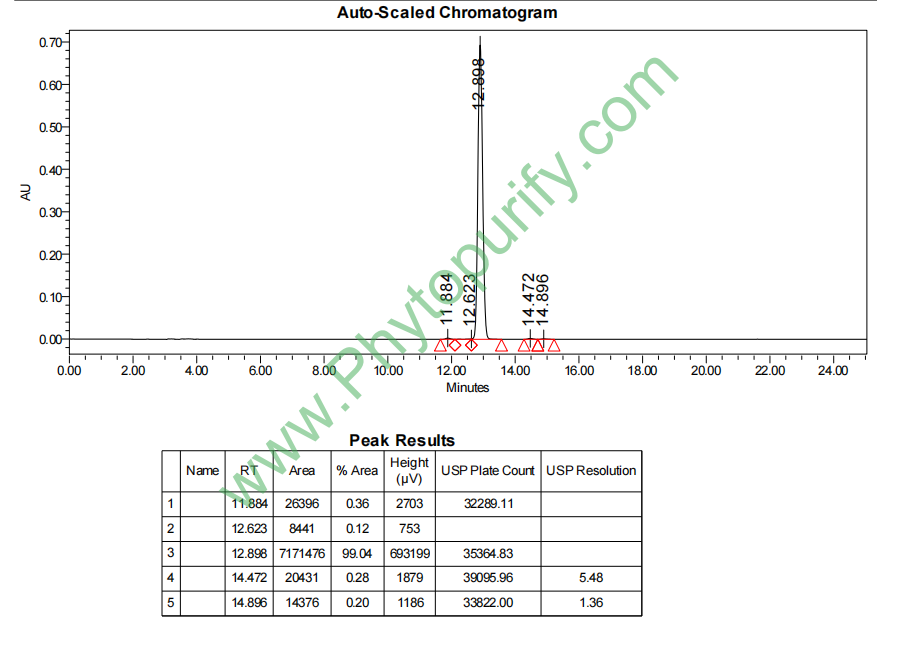
HPLC of Hesperidin
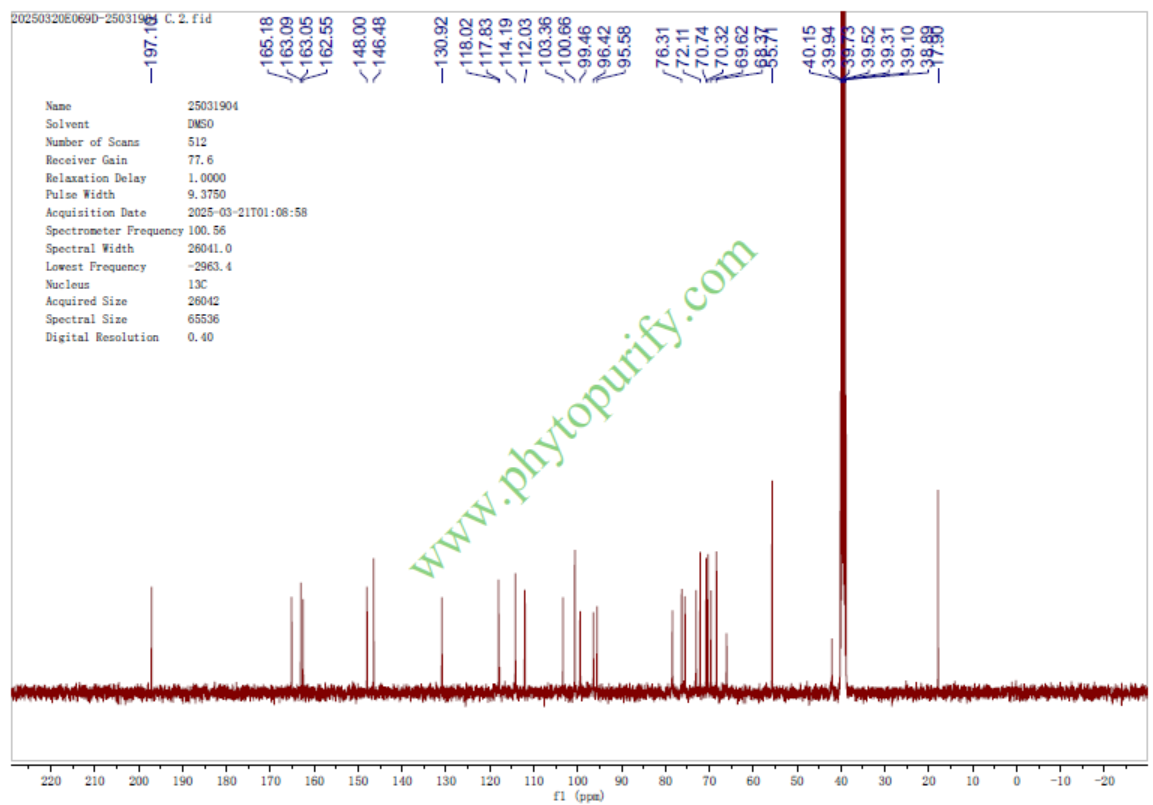
NMR of Hesperidin
Storage conditions:Short-term storage at 2~8℃, long-term storage at -20 ~ -80℃
234.2900
.0051
-.0283
5.4518
.5672
.1311
Low
72.8564
4.8179
No
No
No
No
No
No
0.0
Yes
No
No
No
In the field of natural product chemistry and pharmacology research, citrus fruits have attracted much attention due to their rich bioactive components. Among them, the flavanone compound Hesperidin (CAS number: 520-26-3), as an important plant secondary metabolite, exhibits extensive and profound biological effects. Hesperidin, also known as hesperidin-7-rutinoside, is one of the most abundant flavanone glycosides in citrus plants, especially found in large quantities in the peel, white bark, and flesh. Since its discovery, its pharmacological activity research has continued to deepen, expanding from its initial vitamin P-like activity (maintaining normal vascular permeability and fragility) to multiple fields such as antioxidant, anti-inflammatory, anti-tumor, anti allergic, cardiovascular protection, and neuroprotection. Modern pharmacological research has revealed that the core function of hesperidin is closely related to its strong antioxidant capacity. It can counteract oxidative stress damage by regulating the antioxidant defense system centered on nuclear factor E2 related factor 2 (NRF2/NFE2L2), which is a common pathological basis for various chronic diseases such as aging, cardiovascular disease, neurodegenerative diseases, and cancer. This article aims to systematically review the chemical structure, plant origin, pharmacological activity, molecular mechanism of action, pharmacological characteristics, and clinical application prospects of hesperidin, in order to provide comprehensive scientific references for the deep development and utilization of this natural product.
The chemical name of hesperidin is 5,7,3 '- trihydroxy-4' - methoxyflavanone-7-rutinoside, with a molecular formula of C28H34O15 and a molecular weight of 610.5650. Its structure is composed of the glycoside hesperetin and a disaccharide (rutin, i.e. α - L-rhamnose - (1 → 6) - β - D-glucose) linked by glycosidic bonds. This glycosidic structure significantly affects its physicochemical properties.
From the analysis of physical and chemical properties, hesperidin is a light yellow or off white crystalline powder. Its calculated lipid water partition coefficient (LogP) is about 0.0051, indicating that it has relatively balanced hydrophilic and lipophilic properties, but is more inclined towards hydrophilicity. Its topological polar surface area (TPSA) is as high as 234.29 Å ², which is mainly attributed to the numerous hydroxyl and sugar structures in the molecule, resulting in strong polarity. Correspondingly, its water solubility prediction value is about 5.45 mg/mL, which belongs to the range of slightly soluble to soluble. In actual experiments, its solubility in water is limited, but its solubility is better in dilute alkaline solution, dimethyl sulfoxide (DMSO) or pyridine. These parameters collectively determine the absorption and distribution characteristics of hesperidin in the body. If its blood-brain barrier permeability is predicted to be "low", it may be difficult for it to enter the central nervous system in the form of a prototype drug.
Hesperidin is widely present in the fruits, peels, flowers, and leaves of citrus plants in the Rutaceae family, and is the most important flavanone glycoside in citrus fruits. Its content varies depending on the citrus variety, part, maturity, and geographical environment. Usually, the content in the skin and white skin (sponge layer) is much higher than that in the flesh. For example, sweet oranges (Citrus sinensis), lemons (Citrus limon), grapefruits (Citrus paradisi), and broad skinned oranges (Citrus reticulata) are all abundant sources of hesperidin. In industry, citrus processing by-products (such as skin residue) are important economic raw materials for extracting hesperidin.
There are various methods for extracting hesperidin, including solvent extraction (commonly using methanol, ethanol, acetone, or their aqueous solutions for heating reflux or extraction), and alkaline extraction and acid precipitation (utilizing their characteristics of dissolving under alkaline conditions and precipitating under acidic conditions). Modern extraction technology is dedicated to improving efficiency, reducing solvent consumption, and maintaining activity, mainly including:
1. Ultrasonic assisted extraction The use of ultrasonic cavitation effect to destroy plant cell walls, accelerate solvent penetration and component dissolution, has the advantages of short time, high efficiency, and low temperature.
2. Microwave assisted extraction By microwave heating, the temperature inside the cell rapidly increases, the pressure increases, and the cell ruptures, thereby promoting the release of target components.
3. Supercritical fluid extraction CO2 is commonly used as an extractant, and its solubility can be changed by adjusting temperature and pressure. This method has no solvent residue and good selectivity, but the equipment cost is high, and often requires the addition of entrainers (such as ethanol) to improve the extraction rate of polar components.
The extracted crude product usually needs to be further separated and purified by methods such as macroporous adsorption resin column chromatography, silica gel column chromatography, and preparative high-performance liquid chromatography (HPLC) to obtain high-purity hesperidin.
A large number of in vitro and in vivo studies have confirmed that hesperidin has a wide range of pharmacological activities, with its core being a powerful antioxidant effect, which has led to various protective effects.
Antioxidant damage activity This is the most fundamental and crucial activity of hesperidin. It can directly remove various reactive oxygen species (ROS) and reactive nitrogen species (RNS), such as superoxide anions, hydroxyl radicals, hydrogen peroxide, and peroxynitrite anions. More importantly, it can exert indirect antioxidant effects by upregulating the endogenous antioxidant enzyme system in cells (see mechanism section below), protecting cells from oxidative stress-induced DNA damage, lipid peroxidation, and protein denaturation.
anti-inflammatory activity Hesperidin can effectively inhibit inflammatory reactions. In various acute and chronic inflammation models, such as carrageenan induced rat paw swelling and lipopolysaccharide (LPS) - stimulated macrophage models, hesperidin can significantly reduce levels of pro-inflammatory mediators, including tumor necrosis factor - α (TNF - α), interleukin-1 β (IL-1 β), IL-6, prostaglandin E2 (PGE2), and nitric oxide (NO). Its anti-inflammatory effect is closely related to the inhibition of inflammatory signaling pathways such as nuclear factor kappa B (NF - κ B) and mitogen activated protein kinase (MAPK).
Cardiovascular protective activity Hesperidin has multiple benefits for the cardiovascular system. It can improve endothelial function, promote the production of nitric oxide (NO), thereby relaxing blood vessels and lowering blood pressure; It has a lipid-lowering effect and can reduce serum total cholesterol, triglycerides, and low-density lipoprotein cholesterol (LDL-C) levels; It can also inhibit platelet aggregation and prevent thrombosis. Animal experiments show that hesperidin has protective effects on atherosclerosis and myocardial ischemia reperfusion injury.
Antitumor activity Research shows that hesperidin can inhibit the proliferation and promote apoptosis of many cancer cell lines (such as breast cancer, colon cancer, lung cancer, prostate cancer, etc.). The mechanism involves inducing cell cycle arrest (often in G1 or G2/M phase), activating the mitochondrial apoptosis pathway, and inhibiting the expression of cell invasion and metastasis related proteins (such as matrix metalloproteinases MMPs). In addition, its antioxidant and anti-inflammatory properties also help prevent the occurrence of cancer.
Neuroprotective activity Despite low blood-brain barrier permeability, hesperidin and its metabolites still exhibit neuroprotective potential. In animal models such as Alzheimer's disease, Parkinson's disease, and cerebral ischemia-reperfusion injury, hesperidin can improve cognitive and motor function, and alleviate neuronal damage. The mechanism may be related to reducing oxidative stress and neuroinflammation, inhibiting acetylcholinesterase activity, and reducing β - amyloid deposition.
Antiallergic activity Hesperidin can inhibit degranulation of mast cells and histamine release, thereby reducing allergic reactions. It can also regulate the Th1/Th2 immune balance and inhibit the production of immunoglobulin E (IgE).
The various pharmacological activities of hesperidin, especially its core antioxidant damage effect, are mainly achieved through the regulation of a series of key molecular targets, among which the NRF2/KEAP1 signaling pathway occupies a central position.
The core regulatory role of NRF2/NFE2L2 pathway In the basal state, the transcription factor NRF2 (encoded by the NFE2L2 gene) binds to its cytoplasmic inhibitory protein KEAP1 and is degraded by ubiquitination. When antioxidants such as hesperidin are present, they may dissociate and stabilize NRF2 by directly interacting with specific cysteine residues of KEAP1 or by generating slight redox perturbations, causing conformational changes in KEAP1. Stable NRF2 translocates to the nucleus, forms heterodimers with small Maf proteins, binds to antioxidant response elements (ARE), and initiates gene transcription of downstream phase II detoxifying enzymes and antioxidant proteins. The key targets upregulated by hesperidin include:
Other related pathways:
The analysis of pharmacological parameters shows that hesperidin has certain advantages and challenges as a drug candidate molecule.
To enhance its pharmacological properties, researchers are exploring various strategies, including: 1) developing prodrugs or structural modifications to improve lipid solubility and stability; 2) Using nano delivery systems (such as liposomes, nanoparticles, micelles) to improve their solubility, protect them from premature degradation, and enhance targeting; 3) Used in combination with absorption enhancers.
Hesperidin, as a multi-target and multifunctional natural active substance, has shown broad application prospects in the prevention and treatment of various chronic diseases.
Future research prospects should focus on:
* In depth mechanism exploration Using omics technologies (proteomics, metabolomics) and gene editing techniques, systematically elucidate its role in complex disease networks.
* Relationship between metabolism and activity Clarify the specific active contributions of different metabolites and confirm the true in vivo active forms.
* Development of a new delivery system Vigorously develop efficient and targeted nano drug delivery systems to address the issues of low bioavailability and insufficient accumulation of target tissues.
* High quality clinical research Conduct large-scale, multicenter, randomized double-blind clinical trials to confirm its efficacy and safety in specific diseases, providing solid evidence for drug registration.
* Structural Optimization and Synthetic Biology Production of highly active and bioavailable hesperidin derivatives through chemical modification or synthetic biology techniques.
Hesperidin, as a natural treasure gifted by citrus plants, has a unique chemical structure and a wide range of significant pharmacological activities. From directly clearing free radicals to systematically activating the body's antioxidant defense system through core pathways such as NRF2, from anti-inflammatory and cardiovascular protection to anti-tumor and neuroprotection, the multi-target action characteristics of natural products reflect their unique advantages in dealing with complex diseases. Despite facing challenges such as low bioavailability in drug development, these bottlenecks are gradually being overcome with the rapid development of modern pharmacy, nanotechnology, and molecular pharmacology. In the future, through continuous deepening of basic research and continuous innovation in translational applications, hesperidin is expected to develop from an important dietary ingredient into a biologically active molecule with significant value in multiple fields such as functional foods, drugs, and cosmetics, contributing more to human health. In depth research on it will also provide valuable paradigms and inspirations for the development of other natural products.
