


Product name: 5-O-Demethylnobiletin
Synonym name: 5-Hydroxy-3′,4′,6,7,8-pentamethoxyflavone
Catalogue No.: BP0088
Cas No.: 2174-59-6
Formula: C20H20O8
Mol Weight: 388.372
Botanical Source: Citrus reticulata Blanco
Physical Description:
Type of Compound: Flavonoids
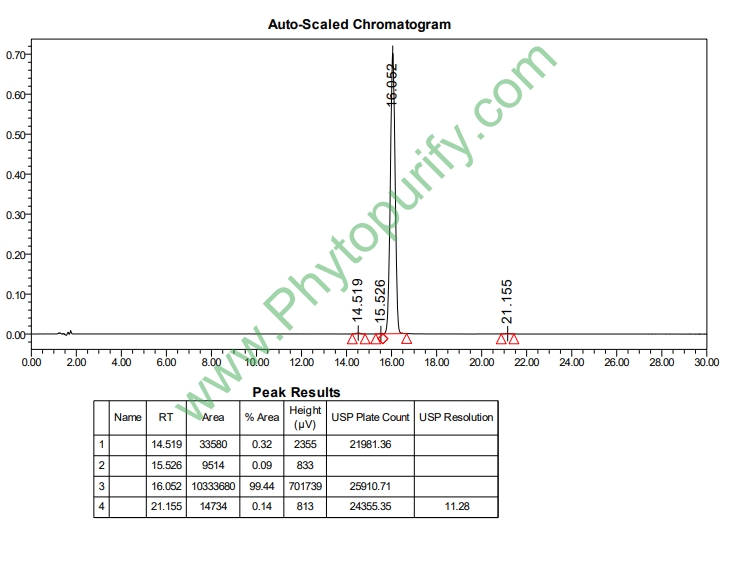
Purity: 95%~99%
Analysis Method: HPLC-DAD or/and HPLC-ELSD
Identification Method: Mass, NMR
Packing: Brown vial or HDPE plastic bottle
Storage: Store in a well closed container, protected from air and light. Put into refrigerate or freeze for long term storage.
Whenever possible, you should prepare and use solutions on the same day. However, if you need to make up stock solutions in advance, we recommend that you store the solution as aliquots in tightly sealed vials at -20℃. Generally, these will be useable for up to two weeks.
The product could be supplied from milligrams to grams
Inquire for bulk scale.
Description:
5-O-Demethylnobiletin has anti-inflammatory activity, it may act through a direct inhibition of 5-LOX, without affecting the expression of COX-2.
References:
Planta Med. 2006 Feb;72(2):136-42.
Anti-inflammatory activity of 5-O-demethylnobiletin, a polymethoxyflavone isolated from Sideritis tragoriganum.
METHODS AND RESULTS:
We have studied the effect of 5-O-Demethylnobiletin( 1) on both the inflammation of mouse ears induced by repeated application of 12- O-tetradecanoylphorbol 13-acetate (TPA) and the acute mouse paw oedemas induced by carrageenan and phospholipase A (2) (PLA (2)), and determined its activity on 5-lipoxygenase (5-LOX) and elastase release/activity. Compound 1 reduced the oedema formation, cell infiltration, and tissue damage in the inflammation induced by TPA in mouse ears, along with the acute oedema induced by carrageenan in mouse paws and the acute PLA (2)-induced oedema in mouse paws. The flavone inhibited leukotriene B (4) formation in rat neutrophils and elastase release in human neutrophils, but did not reduce the expression of cyclooxygenase-2 (COX-2) in murine RAW 264.7 macrophages.
CONCLUSIONS:
These experimental results suggest that 1 may act through a direct inhibition of 5-LOX, without affecting the expression of COX-2.
HPLC of 5-O-Demethylnobiletin
Storage conditions:Short-term storage at 2~8℃, long-term storage at -20 ~ -80℃
100.8600
3.1200
3.1200
Low
null
No
No
No
Unknown
No
Unknown
No
5-O-Demethylnobiletin (CAS number: 2174-59-6) is a multi methoxy flavonoid compound mainly isolated from citrus peel. As an important member of the flavonoid family, demethylated tangerine peel extract has attracted widespread attention in the field of natural product pharmacology in recent years due to its unique chemical structure and significant biological activity. Especially in terms of anti-inflammatory effects, demethylated tangerine peel extract exhibits excellent activity, selectively inhibiting 5-lipoxygenase (5-LOX) without affecting the expression of cyclooxygenase-2 (COX-2). This characteristic makes it potentially valuable for the treatment of inflammation related diseases. In addition, demethylated tangerine peel extract is associated with molecular targets in various diseases such as endometriosis, suggesting that it may play an important role in drug development for gynecological diseases.
This article provides a systematic review of the chemical structure and physicochemical properties, plant sources and extraction methods, pharmacological activity and mechanism of action, pharmacological evaluation and pharmacokinetic characteristics of demethylated tangerine peel extract. Combined with its potential prospects in clinical applications, it aims to provide scientific basis and theoretical support for the in-depth research and drug development of this natural product.
Demethylated tangerine peel extract belongs to the class of multi methoxy flavonoids, with a molecular formula of C21H20O7 and a molecular weight of 388.37. Its core structure is the flavonoid skeleton, which is characterized by demethylation of the 5-hydroxy group to form 5-hydroxy substituted polyoxomethoxyflavones. The LogP value of this compound is approximately 3.12, indicating moderate lipid solubility, which is beneficial for membrane penetration and bioavailability. Its topological polar surface area (TPSA) is 100.86 Å ², indicating a good balance between polarity and non polarity, making it suitable for interacting with various biological targets.
Demethylated tangerine peel extract contains 8 hydrogen bond receptors, indicating that it may form stable complexes through hydrogen bonds when binding with proteins. Its blood-brain barrier permeability is low, indicating that the compound mainly acts on peripheral tissues and reduces potential side effects on the central nervous system. In addition, demethylated tangerine peel extract has a low risk of hepatotoxicity and cardiotoxicity, and has no hERG channel inhibitory activity, demonstrating good safety characteristics.
Demethylated tangerine peel extract mainly exists in the peel of citrus plants, especially Citrus reticulata Blanco and its related varieties. Chuanchenpi, as a traditional Chinese medicinal herb, has always been used to regulate the spleen and stomach, regulate qi and phlegm, and its rich content of multi methoxy flavonoids provides important natural compound resources for pharmacological research.
The common methods for extracting demethylated tangerine peel extract include solvent extraction, liquid-liquid distribution, and chromatographic separation techniques. Generally, ethanol or methanol is used as the extraction solvent, and the extraction efficiency is improved by ultrasound assisted extraction or reflux extraction. After concentration, the extract is separated and purified using silica gel column chromatography or high-performance liquid chromatography (HPLC). In recent years, supercritical fluid extraction and membrane separation technologies have also been applied to improve extraction purity and yield. The purified demethylated tangerine peel extract was structurally identified by mass spectrometry and nuclear magnetic resonance (NMR) to ensure the purity and structural accuracy of the compound.
The pharmacological activity of demethylated tangerine peel extract mainly focuses on anti-inflammatory effects, and also involves potential biological functions such as antioxidant, anti-tumor, and neuroprotective effects.
Numerous in vitro and in vivo studies have shown that demethylated tangerine peel extract has significant anti-inflammatory effects. The main mechanism is to directly inhibit the activity of 5-lipoxygenase (5-LOX), with an IC50 value of approximately 0.1 μ M, demonstrating extremely strong enzyme inhibition ability. 5-LOX is a key enzyme in the biosynthesis of leukotrienes, mediating the production of inflammatory mediator leukotriene B4 (LTB4), which plays an important chemotactic and activating role in inflammatory responses. Demethylated tangerine peel extract significantly reduces the formation of LTB4 in rat neutrophils by inhibiting 5-LOX, thereby alleviating inflammatory response.
In addition, demethylated tangerine peel extract can also inhibit the release of elastase in human neutrophils, with an IC50 of approximately 0.35 μ M, reducing tissue damage and inflammation spread. It is worth noting that this compound has no significant effect on the expression of COX-2, avoiding the common gastrointestinal side effects of traditional nonsteroidal anti-inflammatory drugs (NSAIDs).
In addition to anti-inflammatory effects, research on the antioxidant, anti-tumor, and neuroprotective properties of demethylated tangerine peel extract is gradually increasing. Its multi methoxy structure endows it with excellent free radical scavenging ability, which helps alleviate oxidative stress-related cell damage. In tumor models, demethylated tangerine peel extract exhibits the potential to inhibit cancer cell proliferation and induce apoptosis, particularly in certain hormone related tumors. In terms of neuroprotective effects, preliminary studies suggest that it may slow down the progression of neurodegenerative diseases by regulating neuroinflammatory and oxidative stress pathways.
The main mechanism of action of demethylated tangerine peel extract is to directly inhibit the activity of 5-LOX enzyme, block the synthesis of leukotriene inflammatory mediators, and thus exert anti-inflammatory effects. 5-LOX, as a key enzyme in inflammatory response, plays a crucial role in regulating the activity of mediators such as leukotriene B4 (LTB4). LTB4 not only promotes the chemotaxis and activation of neutrophils, but also participates in the pathological processes of various inflammatory diseases.
In disease models such as endometriosis, demethylated tangerine peel extract has potential associations with multiple molecular targets, including monoamine oxidase A (MAOA), estrogen receptor beta (ESR2), ATP binding cassette transporter B1 (ABCB1), DNA repair enzyme APEX1, ATP binding cassette transporter G2 (ABCG2), xanthine oxidase (XDH), estrogen receptor alpha (ESR1), adenosine receptor A3 (ADORA3), and telomerase reverse transcriptase (TERT). These targets involve multiple signaling pathways such as hormone regulation, cell apoptosis, oxidative stress, and drug transport, suggesting that demethylated tangerine peel extract may exert its therapeutic effects through multi-target synergistic regulation.
In addition, demethylated tangerine peel extract had no significant effect on COX-2 expression, indicating that its anti-inflammatory mechanism differs from traditional NSAIDs and has the advantage of selectively inhibiting 5-LOX, reducing the risk of side effects caused by COX-2 inhibition.
Demethylated tangerine peel extract exhibits ideal characteristics in terms of medicinal properties. Its molecular weight is 388.37, which conforms to Lipinski's "drug similarity rule". The LogP value of 3.12 shows moderate lipophilicity, which is beneficial for cell membrane penetration and in vivo distribution. The TPSA is 100.86 Å ², indicating that it has moderate polarity and is conducive to binding to target proteins.
In terms of safety, demethylated tangerine peel extract has low risks of hepatotoxicity and cardiotoxicity, and has no hERG channel inhibitory activity, reducing safety hazards such as arrhythmia. The low permeability of the blood-brain barrier reduces the risk of central nervous system toxicity, but also limits its therapeutic potential for central nervous system diseases. The results of Ames mutagenicity test are not yet clear, and further experiments are needed to verify its genetic toxicity.
Pharmacokinetic studies have shown that demethylated tangerine peel extract is well absorbed orally, but its metabolic pathways and bioavailability still require systematic research. Preliminary data suggests that the compound may be widely metabolized through liver metabolic enzymes, and the activity and safety of metabolites still need to be further explored. In the future, through structural modification and formulation optimization, it is expected to improve its pharmacokinetic performance and enhance its clinical application value.
As a multi methoxy flavonoid, demethylated tangerine peel extract has shown broad application prospects in the treatment of inflammatory diseases, especially gynecological diseases such as endometriosis, due to its selective inhibition of 5-LOX anti-inflammatory mechanism. The pathological mechanism of endometriosis is complex, involving multiple signaling pathways such as hormone imbalance, inflammatory response, and cell apoptosis. Demethylated tangerine peel extract, through multi-target regulation, is expected to become a new safe and effective therapeutic candidate drug.
In addition, its antioxidant and anti-tumor activities provide possibilities for its application in fields such as tumors and neurodegenerative diseases. In the future, combining modern drug design technology, optimizing its structure and formulation, enhancing its bioavailability and targeting, will help promote the clinical translation of demethylated tangerine peel extract.
However, the clinical research on demethylated tangerine peel extract is still in its infancy and lacks systematic clinical trial data. In the future, clinical evaluation of its pharmacokinetics, safety, and efficacy should be strengthened, and indications and medication plans should be clarified. Meanwhile, in-depth analysis of its molecular mechanism and functional network will provide theoretical support for its clinical application.
As a multi methoxy flavonoid derived from citrus plants, demethylated tangerine peel extract has become a hot topic in natural product pharmacology research due to its significant anti-inflammatory activity and good safety. The unique mechanism of selectively inhibiting 5-LOX without affecting COX-2 expression provides new ideas for the development of novel anti-inflammatory drugs. Combining its potential effects with various disease-related targets, demethylated tangerine peel extract has important application prospects in the treatment of complex diseases such as endometriosis.
In the future, further systematic pharmacokinetic and clinical studies are needed to optimize its drug properties and efficacy evaluation, and promote the clinical application of demethylated tangerine peel extract from the laboratory. With the deepening of research, demethylated tangerine peel extract is expected to become an important representative of natural product drug development, bringing new breakthroughs to the treatment of inflammation and related diseases.
