


Product name: Nobiletin
Synonym name: 3'4'5,6,7,8-Hexamethoxyflavone
Catalogue No.: BP1001
Cas No.: 478-01-3
Formula: C21H22O8
Mol Weight: 402.399
Botanical Source: Citrus reticulata Blanco
Physical Description:
Type of Compound: Flavonoids
Purity: 95%~99%
Analysis Method: HPLC-DAD or/and HPLC-ELSD
Identification Method: Mass, NMR
Packing: Brown vial or HDPE plastic bottle
Storage: Store in a well closed container, protected from air and light. Put into refrigerate or freeze for long term storage.
Whenever possible, you should prepare and use solutions on the same day. However, if you need to make up stock solutions in advance, we recommend that you store the solution as aliquots in tightly sealed vials at -20℃. Generally, these will be useable for up to two weeks.
The product could be supplied from milligrams to grams
Inquire for bulk scale.
Description:
Nobiletin, a citrus flavonoid isolated from citrus peels like in tangerine, which has anti-inflammatory and anti-tumor activities, it could be a potential protective agent for the prevention and treatment of restenosis after angioplasty. Nobiletin downregulated the expression of inducible nitric oxide synthase (iNOS) and cyclooxygenase 2 (COX-2), suppressed cell viability through AKT pathways.
References:
Tumour Biol. 2014 Dec;35(12):11903-11.
Nobiletin suppresses the proliferation and induces apoptosis involving MAPKs and caspase-8/-9/-3 signals in human acute myeloid leukemia cells.
Nobiletin, a compound isolated from citrus fruits, is a polymethoxylated flavone derivative that was shown to have anti-inflammatory and anticancer activities in various solid tumors. The anticancer effect of Nobiletin on nonsolid tumor remains unclear.
METHODS AND RESULTS:
Herein, the molecular mechanisms by which Nobiletin exerts its anticancer effects on acute myeloid leukemia (AML) cells were investigated. The results showed that Nobiletin suppressed cell proliferation in various types of AML cell lines. Moreover, Nobiletin induced cell-cycle arrest of HL-60 AML cells at the G0/G1 phase by suppressing extracellular signal-regulated kinase (ERK) activity. Furthermore, Nobiletin effectively induced apoptosis of HL-60 cells through caspase-8, caspase-9, and caspases-3 activation concomitantly with a marked induction of p38 mitogen-activated protein kinase (MAPK) activation, but without affecting expression levels of Bcl-2, Bax, or Bid.
CONCLUSIONS:
Taken together, our results suggest that Nobiletin inhibited HL-60 cell proliferation through inducing cell-cycle arrest and apoptosis and could serve as a potential additional chemotherapeutic agent for treating AML.
Expert Opin Ther Targets. 2015 Mar;19(3):307-20.
Nobiletin inhibits invasion and migration of human nasopharyngeal carcinoma cell lines by involving ERK1/2 and transcriptional inhibition of MMP-2.
Nasopharyngeal carcinoma (NPC) is known for its high incidence of neck lymph node metastasis, which represents poor prognosis. Nobiletin is a citrus polymethoxyflavonoid that suppresses tumor growth and metastasis, both of which depend on angiogenesis in previous studies. However, the effect of Nobiletin on human NPC cells metastasis has not been clearly clarified.
METHODS AND RESULTS:
In this study, we determine the effects of Nobiletin on the migration and invasion in NPC cells. Nobiletin significantly inhibited migration/invasion capacities of HONE-1 and NPC-BM cell lines. The results of gelatin zymography and western blotting revealed that the activities and protein levels of the MMP-2 were inhibited by Nobiletin. Nobiletin also showed that inhibits phosphorylation of ERK1/2. Tests of the real-time PCR and promoter assays evaluated the inhibitory effects of Nobiletin on MMP-2 expression in human NPC cells. Nobiletin inhibits MMP-2 expression, up-regulating tissue inhibitor of metalloproteinase-2 and down-regulation of the transcription factors of NF-κB and activator protein 1 (AP-1) signaling pathways. Finally, an administration of Nobiletin effectively suppressed the tumor formation and metastasis in the NPC xenograft model in vivo.
CONCLUSIONS:
Nobiletin may have potential use as a chemo-preventive agent against nasopharyngeal cancer metastasis.
Biochem Pharmacol. 2003 Jun 15;65(12):2065-71.
Novel anti-inflammatory actions of nobiletin, a citrus polymethoxy flavonoid, on human synovial fibroblasts and mouse macrophages.
We previously reported that Nobiletin (5,6,7,8,3',4'-hexamethoxy flavone), a citrus polymethoxy flavonoid, effectively interferes with the production of promatrix metalloproteinase (proMMP)-9/progelatinase B in rabbit synovial fibroblasts [J. Rheumatol. 27 (2000) 20].
METHODS AND RESULTS:
In this paper, we further examine the effects of Nobiletin on the production of cyclooxygenases (COXs), prostaglandin (PG) E(2), and proinflammatory cytokines in human synovial fibroblasts and the mouse macrophage J774A.1 cell line. Nobiletin suppressed the interleukin (IL)-1-induced production of PGE(2) in human synovial cells in a dose-dependent manner (<64 microM). Additionally, it selectively downregulated COX-2, but not COX-1 mRNA expression. Nobiletin also interfered with the lipopolysaccharide-induced production of PGE(2) and the gene expression of proinflammatory cytokines including IL-1alpha, IL-1beta, TNF-alpha and IL-6 in mouse J774A.1 macrophages. In addition, Nobiletin downregulated the IL-1-induced gene expression and production of proMMP-1/procollagenase-1 and proMMP-3/prostromelysin-1 in human synovial fibroblasts.
CONCLUSIONS:
In contrast, production of the endogenous MMP inhibitor, TIMP-1, was augmented by Nobiletin. These anti-inflammatory actions of Nobiletin are very similar to those of anti-inflammatory steroids such as dexamethasone, and the upregulation of TIMP-1 production is a unique action of Nobiletin. Therefore, these results further support the notion that Nobiletin is likely to be a candidate for characterization as a novel immunomodulatory and anti-inflammatory drug.
Mol Nutr Food Res. 2015 May;59(5):829-42.
Citrus nobiletin ameliorates experimental colitis by reducing inflammation and restoring impaired intestinal barrier function.
Inflammatory bowel disease is a chronic inflammatory disorder of the gastrointestinal tract. Citrus Nobiletin can exert robust anti-inflammatory effects in vivo and in vitro. We evaluated the impact of Nobiletin on the excessive inflammatory response and impaired barrier function in a rodent colitis model.
METHODS AND RESULTS:
Colitis was established by infusion with 1 mL 2,4,6-trinitrobenzene sulfonic acid (TNBS) dissolved in ethanol (40% v/v) in rats at a 125 mg/kg dose. Caco-2 cell monolayer exposed to LPSs is used as a culture model for intestinal permeability measurements. Nobiletin decreased rat epithelial proinflammatory cytokines and mediators production. Nobiletin restored impaired barrier function in colitic rats and Caco-2 monolayer. Nobiletin decreased protein expressions of Akt, nuclear factor-kappa B (NF-κB), and myosin light chain kinase (MLCK) isolated from rat intestinal epithelial tissue and Caco-2 cell, respectively. PI3K inhibitor or siRNA targeting of either Akt or NF-κB mitigated the impact of Nobiletin on MLCK expression and barrier function in Caco-2 monolayer, respectively.
CONCLUSIONS:
Nobiletin exerted anti-inflammatory effects in TNBS-induced colitis through the downregulation of inducible nitric oxide synthase (iNOS) and cyclooxygenase 2 (COX-2) expression. Nobiletinrestored barrier function, which had been damaged after TNBS administration, through the inhibition of the Akt-NF-κB-MLCK pathway.
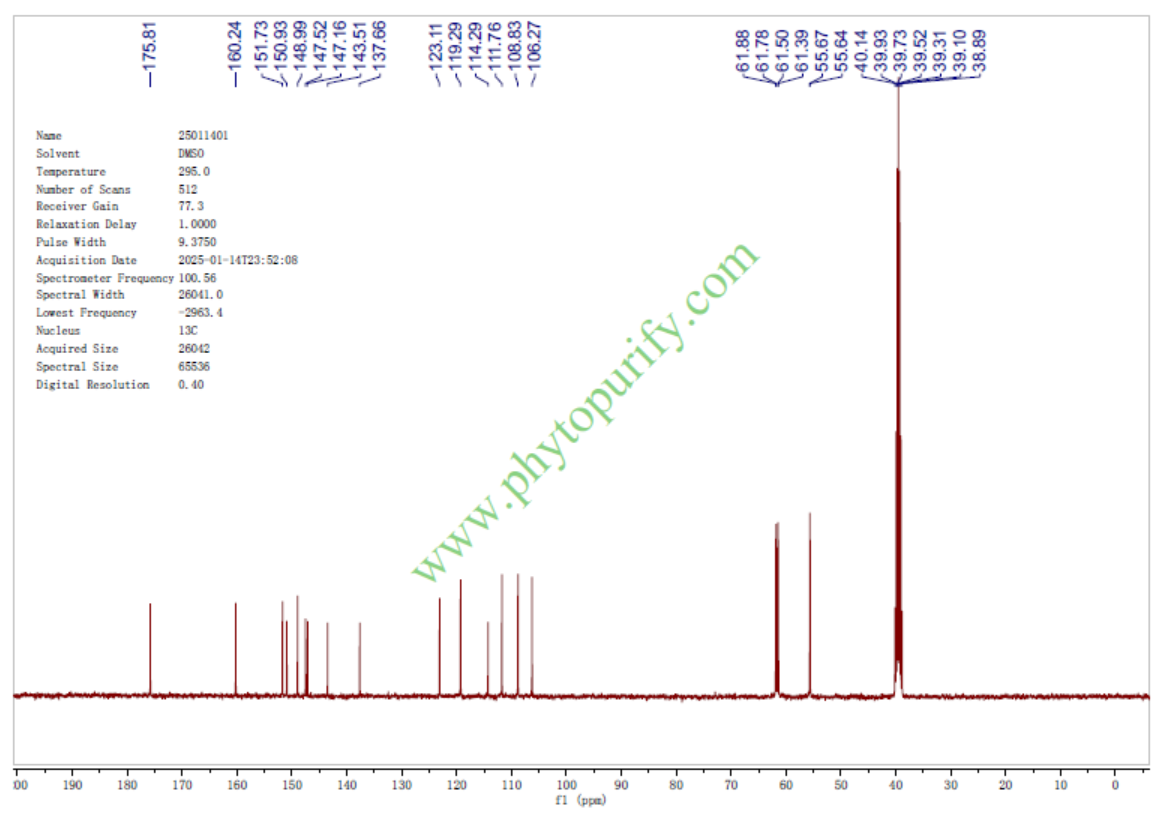
NMR of Nobiletin
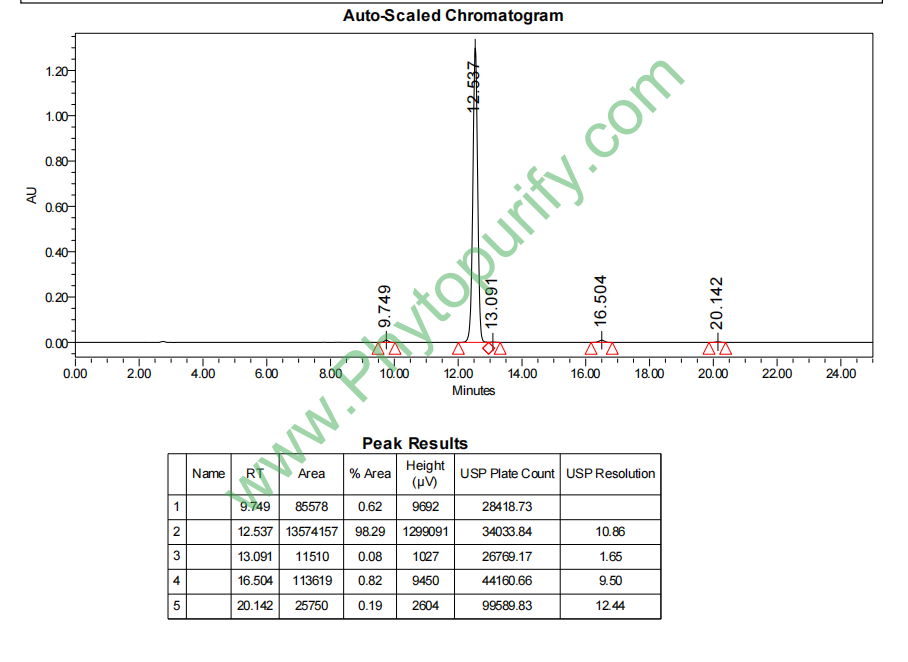
HPLC of Nobiletin
Storage conditions:Short-term storage at 2~8℃, long-term storage at -20 ~ -80℃
85.5900
2.6151
2.6149
.0043
2.7001
34.4981
High
84.5600
2.4505
Yes
No
Yes
No
Yes
No
0.6
No
No
No
Yes
Natural products have always been an important source of drug discovery and development, especially in the treatment of complex diseases such as cancer and neurodegenerative diseases, exhibiting unique chemical diversity and biological activity. Among numerous natural products with pharmacological potential, Nobiletin, as a source from the citrus genus(Citrus)Polyoxyflavone (PMF) from plant peels has received widespread attention in recent years. Chuanchenpi extract is not only famous for its application history in traditional medicine, but also for its multiple pharmacological effects, including significant anti-inflammatory, antioxidant, anti-tumor, and neuroprotective activities, making it a hot molecule in modern pharmacological research. Its unique chemical structure endows it with bioavailability and target binding properties that are different from ordinary flavonoids, especially exhibiting unique advantages in regulating nuclear receptors and intervening in cellular signal transduction networks. This review aims to systematically summarize the chemical properties, natural sources, pharmacological activities, molecular mechanisms, pharmacological evaluation, and clinical application prospects of Chenpi extract, in order to provide comprehensive scientific references for the in-depth research and future development of this natural product.
Nobiletin, chemical name 5,6,7,8,3 ', 4' - Hexamethoxyflavone, molecular formula C ₂ ₁ H ₂ ₂ O ₈, molecular weight 402.3990 g/mol. Its core structure is the flavonoid nucleus, namely 2-phenylchromen-4-one. However, unlike most flavonoid compounds, naringin has six methoxy (- OCH ∝) groups attached to its A and B rings, located at positions 5, 6, 7, 8, 3 ', and 4', respectively. The highly methoxylated structural feature is the key distinguishing factor from other flavonoids such as quercetin and apigenin, and it is also the structural basis for its unique pharmacological activity.
In terms of physical and chemical properties, Chenpi extract exhibits typical lipid solubility characteristics. Its calculated lipid water partition coefficient (LogP) is 2.6151, indicating that it has strong lipophilicity and is easy to penetrate biological membranes. This characteristic is highly correlated with its high blood-brain barrier (BBB) permeability, providing a structural basis for its neuroprotective effects. Its topological polar surface area (TPSA) is 85.5900 Å ², which is at a moderate level and meets the general rules for oral medication. However, the water solubility of Chenpi extract is extremely poor, with a measured or calculated water solubility value of only 0.0043 mg/mL, which constitutes the main bottleneck of its low oral bioavailability. In terms of stability, the presence of methoxy groups enhances the chemical stability of the flavonoid skeleton, making it less susceptible to rapid degradation by gastrointestinal enzymes or liver metabolic enzymes, but also increasing the complexity of its metabolic transformation. It is worth noting that Chenpi extract has a low risk of inhibiting hERG potassium channels (hERG inhibition: No), and the Ames test result is 0.6, indicating a low risk of genetic toxicity. This provides preliminary safety assurance for its candidate drug.
Chenpi extract is mainly found in the Rutaceae citrus genus of the Rutaceae family(Citrus)The peel of plants is one of the most abundant poly (methoxy) flavonoids in citrus fruits. It has a wide range of sources, including sweet oranges(Citrus sinensis)Sour Orange(Citrus aurantium)Citrus fruits(Citrus reticulata)The skin of the fruit and its variants (such as Camellia sinensis, Dahongpao, etc.). Among them, young citrus fruits (commonly known as "Citrus aurantium") and mature peel (Chenpi) are the traditional medicinal sources of Chenpi extract. Different varieties, origins, harvest seasons, and processing methods (such as drying and aging) can all affect the content of Chenpi extract. Generally speaking, the content of naringin in mature fruit peels is higher than that in young fruits, while in aged "tangerine peel", the content of naringin is relatively stable and higher.
The method of extracting tangerine peel extract is mainly based on its lipid solubility characteristics. Traditional methods include solvent extraction, which often uses methanol, ethanol, ethyl acetate, or their mixed solvents for cold soaking or hot reflux extraction. Due to its good solubility in ethanol and the safety and non toxicity of ethanol, ethanol reflux extraction is the most commonly used method in industry. Modern extraction techniques are widely used to improve extraction efficiency and purity. For example, ultrasound assisted extraction (UAE) utilizes cavitation effect to destroy cell walls, accelerate solvent permeation, significantly shorten extraction time, and improve yield. Microwave assisted extraction (MAE) achieves efficient extraction by generating heat through the rapid vibration of polar molecules in a microwave field. In addition, supercritical fluid extraction (SFE), especially using carbon dioxide as a solvent, is used to prepare high-purity Chenpi extract due to its advantages such as green color, no solvent residue, and good selectivity. The crude extract after extraction usually needs to undergo further separation and purification steps, such as silica gel column chromatography, polyamide column chromatography, high performance liquid chromatography (HPLC), or high-speed countercurrent chromatography (HSCCC), to obtain Chenpi extract monomers with a purity of over 98%.
The pharmacological activity spectrum of Chenpi extract is extremely broad, covering multiple aspects such as anti-tumor, anti-inflammatory, antioxidant, neuroprotective, cardiovascular protection, and metabolic regulation.
1. Antitumor activity
Chenoretin has shown significant anticancer potential in a variety of tumor models, including breast cancer, lung cancer, liver cancer, colorectal cancer, stomach cancer, prostate cancer and melanoma. Its anti-tumor mechanism is multi-target and multi pathway. Firstly, Chenpi extract can induce apoptosis in tumor cells by upregulating the expression of pro apoptotic proteins (such as Bax, Bad) and downregulating anti apoptotic proteins (such as Bcl-2, Mcl-1), activating the caspase cascade of the mitochondrial pathway. Secondly, it can inhibit the proliferation of tumor cells by blocking the cell cycle in G0/G1 or G2/M phases, which is associated with downregulation of cell cycle proteins (Cyclin D1, Cyclin B1) and cyclin dependent kinases (CDK4, CDK2). In addition, Chenpi extract also exhibits strong anti angiogenic activity by inhibiting the expression of vascular endothelial growth factor (VEGF) and its receptor (VEGFR), as well as downregulating the stability of hypoxia inducible factor-1 α (HIF-1 α), thereby blocking the nutritional supply to tumors. In terms of anti metastasis, Chenpi extract can inhibit the activity of matrix metalloproteinases (MMP-2, MMP-9), reduce the degradation of extracellular matrix, and thus inhibit the invasion and migration of tumor cells.
2. Anti inflammatory and antioxidant activity
Chenpi extract is a potent anti-inflammatory and antioxidant. In the inflammatory response, it can significantly inhibit the production of nitric oxide (NO), prostaglandin E2 (PGE2), and pro-inflammatory cytokines (such as TNF - α, IL-6, IL-1 β) in macrophages induced by lipopolysaccharide (LPS). Its mechanism is closely related to the inhibition of nuclear factor kappa B (NF - κ B) and the activation of signal transduction and transcription activator 3 (STAT3). In terms of oxidative stress, Chenpi extract can directly scavenge free radicals and activate the nuclear factor E2 related factor 2 (Nrf2)/antioxidant response element (ARE) signaling pathway, upregulating the expression of a series of antioxidant enzymes such as superoxide dismutase (SOD), glutathione peroxidase (GPx), and heme oxygenase-1 (HO-1). Research has confirmed that Chenpi extract can reduce the levels of reactive oxygen species (ROS) in differentiated C2C12 myotubes, suggesting its protective role in muscle atrophy or oxidative damage associated with metabolic diseases.
3. Neuroprotective activity
One of the most notable activities of Chenpi extract is its protective effect on the nervous system, particularly in improving cognitive function and memory. It has been identified as an agonist of retinoic acid associated orphan receptors (RORs), particularly ROR alpha and ROR gamma. By activating RORs, Chenpi extract can regulate circadian rhythm genes (such as Bmal1、Clock)By expressing it, it can improve the circadian rhythm disorder caused by aging or pathological conditions, thereby alleviating memory loss. In the Alzheimer's disease (AD) model, naringin can reduce the aggregation and deposition of β - amyloid protein (A β), inhibit the excessive phosphorylation of tau protein, and alleviate neuroinflammatory responses. In addition, its high blood-brain barrier permeability allows it to directly act on the central nervous system, exerting anti apoptotic and neurotrophic effects, and protecting hippocampal neurons from damage.
4. Other pharmacological activities
Chenoretin also showed cardiovascular protection, such as lowering blood pressure, improving vascular endothelial function, and inhibiting the formation of atherosclerotic plaque; In terms of metabolic regulation, it can improve insulin resistance, lower blood sugar and lipid levels; In addition, it also has activities such as anti osteoporosis, liver protection, and antibacterial.
The pharmacological activity of Chenpi extract originates from its interactions with various cellular signaling pathways and molecular targets. The core mechanism can be summarized as follows:
1. Nuclear receptor regulation
Chuanchenpi extract is an agonist of RORs (ROR α, ROR γ). RORs belong to the nuclear receptor superfamily and play a crucial role in regulating circadian rhythms, immune responses, metabolism, and neurogenesis. Chuanchenpi extract promotes its binding to co activators by binding to the ligand binding domain of RORs, thereby enhancing downstream target genes (such as Bmal1)The transcription. This mechanism is at the core of improving memory and regulating biological rhythms.
2. Inhibition of signal transduction pathways
- STAT3 pathway Chuanchenpi extract can directly or indirectly inhibit the phosphorylation of STAT3 (Tyr705 site), prevent its dimerization and nuclear translocation, thereby downregulating its target genes, including anti apoptotic proteins (Bcl-2, Mcl-1, Survivor), cell cycle regulatory protein (Cyclin D1), and vascular endothelial growth factor (VEGF). This is one of the key mechanisms of its anti-tumor activity.
- NF - κ B pathway Chuanchenpi extract inhibits the activity of I κ B kinase (IKK), prevents the phosphorylation and degradation of I κ B α, and thus suppresses the nuclear translocation and transcriptional activity of NF - κ B. This explains its powerful anti-inflammatory effect.
- MAPK pathway Chuanchenpi extract can regulate the phosphorylation levels of mitogen activated protein kinase (MAPK) family members such as ERK, JNK, and p38 MAPK. Under different cellular backgrounds, it may activate or inhibit these pathways, thereby affecting cell proliferation, differentiation, and apoptosis. For example, in tumor cells, it often inhibits the activation of ERK and JNK.
- PI3K/Akt/mTOR pathway Chuanchenpi extract inhibits the phosphorylation of PI3K and Akt, thereby suppressing the activity of downstream mTOR and inducing autophagy and apoptosis in tumor cells.
3. Epigenetic regulation
Chuanchenpi extract has been found to inhibit the activity of histone deacetylase (HDAC), especially HDAC1 and HDAC3, thereby increasing the acetylation level of histones, altering chromatin structure, and promoting tumor suppressor genes (such as...)p21、p53)The expression.
4. Direct target binding
In addition to indirectly regulating signaling pathways, Chenpi extract can also directly bind to certain proteins. For example, it has been reported as an inhibitor of topoisomerase I (TOP1) and topoisomerase II alpha (TOP2A), which stabilizes DNA topoisomerase complexes, causing DNA damage and inhibiting tumor cell proliferation. In addition, it can interact with estrogen receptor α (ESR1) and aromatase (CYP19A1) to play an anti hormone dependent breast cancer activity.
5. Regulation of redox balance
Chuanchenpi extract activates the Nrf2/ARE pathway, upregulates the expression of a series of antioxidant enzymes, and directly clears ROS to maintain intracellular redox homeostasis. Reducing ROS levels in C2C12 myotubes is a manifestation of this mechanism.
Although Chenpi extract has a wide range of pharmacological activities, its medicinal properties face significant challenges, mainly due to its extremely poor water solubility and oral bioavailability.
1. Analysis of pharmacological parameters
According to Lipinski's Five Rules, the molecular weight of Chenpi extract (402.4) is slightly higher than 500, and LogP (2.62) meets the requirements, but the number of hydrogen bond donors (0) and hydrogen bond acceptors (8) are both within an acceptable range. However, its water solubility (0.0043 mg/mL) is much lower than the ideal value (>0.1 mg/mL), which directly leads to poor oral absorption. Its high blood-brain barrier permeability is a double-edged sword. Although it is beneficial for neuroprotection, it may also increase the risk of central nervous system side effects. The negative results of hERG inhibition and Ames test provide preliminary support for its safety.
2. Pharmacokinetic characteristics
The oral bioavailability of Chenpi extract is extremely low, typically below 5% in rats and humans. The main reasons include:
- Poor solubility Difficult to dissolve in gastrointestinal fluids, limiting absorption.
- First pass metabolism Although methoxylation provides some resistance to certain metabolic enzymes, naringin still undergoes extensive phase II metabolism in the intestine and liver, mainly undergoing demethylation (producing mono - and di demethylated metabolites) and glucuronidation/sulfation binding reactions. Although these metabolites may retain some activity, they overall reduce the exposure of the prototype drug.
- Outward transportation carrier: Chenoretin may be the substrate of P-glycoprotein (P-gp) and breast cancer resistance protein (BCRP). The expression of these efflux transporters on the top side of intestinal epithelial cells will pump them back into the intestinal cavity, further reducing absorption.
3. Improvement strategy
To enhance the medicinal properties of Chenpi extract, researchers have developed various strategies:
- nano-formulation Such as liposomes, polymer nanoparticles, solid lipid nanoparticles, nanoemulsions, etc., can significantly improve their water solubility, encapsulation efficiency, and oral bioavailability.
- Phospholipid complex Form complexes with phospholipids to enhance their lipid solubility and transmembrane ability.
- Cyclodextrin inclusion complex Using β - cyclodextrin and its derivatives to encapsulate Chenpi extract, improving its solubility and stability.
- Prodrug design Introducing phosphate, amino acid, or sugar groups into the hydroxyl sites of Chenpi extract to improve its water solubility, and releasing the active ingredient through enzymatic interpretation in vivo.
- Eutectic technology Forming drug eutectic with suitable eutectic forming materials to improve their solubility and dissolution rate.
Chenpi extract, as a multi-target and multifunctional natural product, has shown great clinical potential in multiple disease fields.
1. Anti tumor therapy
Given its ability to simultaneously inhibit proliferation, induce apoptosis, resist angiogenesis, and prevent metastasis, Chenpi extract is expected to be used as a chemotherapy sensitizer or adjuvant therapy drug, in combination with existing chemotherapy drugs such as cisplatin, paclitaxel, and doxorubicin, to enhance efficacy and reduce side effects. Especially its inhibition of key oncogenic pathways such as STAT3 and NF - κ B makes it uniquely valuable in the treatment of refractory or drug-resistant tumors. The results of preclinical studies on breast cancer (through ESR1 and CYP19A1), liver cancer and colorectal cancer are encouraging.
2. Neurodegenerative diseases
Chuanchenpi extract improves memory loss, anti A β aggregation, and anti neuroinflammatory properties, making it a potential candidate drug for neurodegenerative diseases such as Alzheimer's disease (AD) and Parkinson's disease (PD). Its function as an ROR agonist to regulate circadian rhythm provides a new approach for treating cognitive disorders related to circadian rhythm disorders. At present, preliminary clinical trials have explored the effects of Chenpi extract on patients with mild cognitive impairment (MCI).
3. Metabolic diseases and inflammation
Its anti-inflammatory and antioxidant activities, as well as its role in improving insulin resistance and dyslipidemia, make it a promising candidate for the treatment of metabolic inflammatory diseases such as type 2 diabetes, non-alcoholic fatty liver disease (NAFLD) and atherosclerosis.
4. Challenges and Future Directions
Despite its broad prospects, the clinical translation of Chenpi extract still faces challenges. The primary issue is its extremely low bioavailability, which requires reliance on advanced drug delivery systems to address. Secondly, although its multi-target nature brings extensive activity, it may also lead to off target effects and potential drug drug interactions. Future research should focus on:
- Develop efficient and safe nano formulations To achieve targeted delivery and sustained release.
- Thoroughly elucidate its in vivo metabolite profile Clarify the active metabolites and their contributions.
- Conduct high-quality preclinical toxicology research Evaluate the safety of long-term medication.
- Design rigorous clinical trials Verify its efficacy and safety in specific indications such as AD and specific cancers.
- Explore structural optimization By synthesizing analogues or derivatives, pharmacokinetic properties can be improved while retaining activity.
Chuanchenpi extract, a polymethoxyflavone derived from citrus peel, has become a shining pearl in the field of natural product pharmacology due to its unique chemical structure and multi effect pharmacological activity. From improving memory, anti-inflammatory and antioxidant effects to multi pathway anti-tumor effects, its mechanism of action involves multiple levels such as nuclear receptor regulation, inhibition of key signaling pathways, and epigenetic modifications. Although its poor water solubility and oral bioavailability pose major obstacles to drug development, modern drug delivery technologies and structural modification strategies provide the possibility to address this issue. With a deeper understanding of its molecular targets and pharmacokinetics, as well as continuous advances in formulation technology, Chenpi extract is expected to move from laboratory research to clinical applications, playing an important role in the treatment of tumors, neurodegenerative diseases, and metabolic diseases. In the future, interdisciplinary collaborative research will be the key to driving the clinical value of this natural product.
