


Product name: Artesunate
Synonym name: Butanedioic Acid; Artesunic acid; Asumax; Cosunate; Dihydroqinghasu hemsuccinate; Gsunate Forte; Plasmotrim; Plasmotrin; Qinghaozhi; Saphnate
Catalogue No.: BP0198
Cas No.: 88495-63-0
Formula: C19H28O8
Mol Weight: 384.425
Botanical Source: Artemisia annua L.
Physical Description:
Type of Compound: Sesquiterpenoids
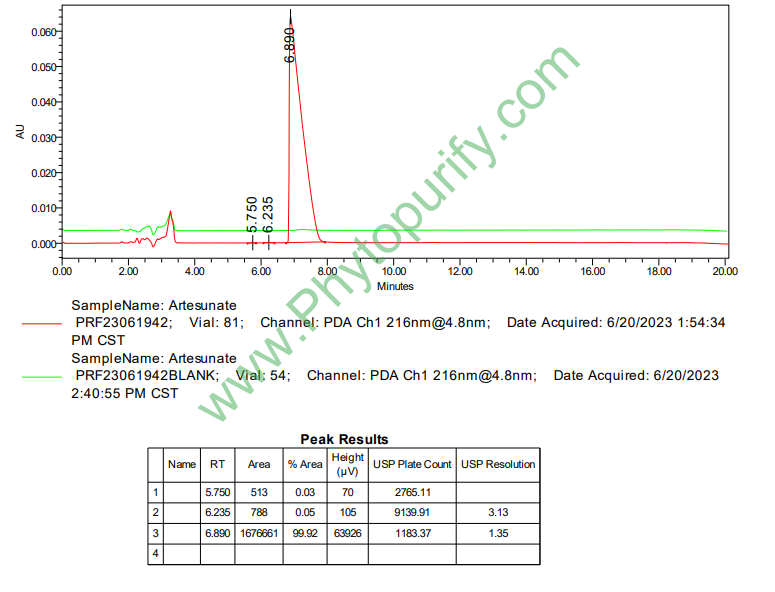
Purity: 95%~99%
Analysis Method: HPLC-DAD or/and HPLC-ELSD
Identification Method: Mass, NMR
Packing: Brown vial or HDPE plastic bottle
Storage: Store in a well closed container, protected from air and light. Put into refrigerate or freeze for long term storage.
Whenever possible, you should prepare and use solutions on the same day. However, if you need to make up stock solutions in advance, we recommend that you store the solution as aliquots in tightly sealed vials at -20℃. Generally, these will be useable for up to two weeks.
The product could be supplied from milligrams to grams
Inquire for bulk scale.
Chengdu Biopurify Phytochemicals Ltd. is a leading company in the research, development, manufacture and marketing of High Quality Phytochemicals and Extracts(especially Active Ingredients from Traditional Chinese Medicine,TCM), Natural Active Pharmaceutical Ingredients worldwide.
The main services:
A. Supply active ingredients and reference standards of TCM, from mgs to kgs scale
B. Custom extraction and purification, target Herb Active Ingredients
C. Custom synthesis and semi-synthesis for Natural Active Ingredients
D. CR(contract research), CM(contract manufacture) and PD(process development) services from lab scale, pilot scale to commercial scale(GMP is also available)
E. TCM compounds library for drug screen,more than 3000 compounds available, many of them are rare and unique.
HPLC of Artesunate
Storage conditions:Short-term storage at 2~8℃, long-term storage at -20 ~ -80℃
100.5200
2.3792
-.1645
.1394
1.7929
3.9349
Low
84.9265
5.6678
Yes
No
No
No
No
No
0.9
Yes
No
No
No
Malaria, an ancient infectious disease, remains a major global public health challenge to this day. In the long struggle between humans and malaria parasites, the emergence of artemisinin and its derivatives derived from traditional Chinese medicine is undoubtedly a milestone breakthrough in the history of anti malaria. Artesunate (CAS number: 88495-63-0), as an important water-soluble semi synthetic derivative of artemisinin, has been developed since the 1970s. With its fast acting, efficient, and low toxicity characteristics, it has become a first-line drug for the treatment of severe malaria, saving millions of lives worldwide. However, the pace of scientific exploration has never stopped. With the deepening of research, the pharmacological connotation of artemether has far exceeded its original intention of anti malaria. A large number of preclinical studies have shown that artemether exhibits a wide range of multiple biological activities such as anti-tumor, anti-inflammatory, and immune regulation. Its mechanism of action involves inducing ferroptosis, inhibiting key signaling pathways (such as STAT3, NF - κ B), and other aspects, making it a star molecule in the "old drug new use" strategy. Of particular note is that its unique peroxide bridge structure endows it with a "Trojan horse" like mode of action - relying on iron activation to generate free radicals, which not only kills iron rich malaria parasites, but also provides new ideas for targeted treatment of tumor cells with iron metabolism abnormalities. This article aims to provide a systematic review of the chemical properties, pharmacological activities, molecular mechanisms of action, drug properties, and broad application prospects of artemether beyond anti malaria. In particular, by combining its potential targets, it explores the possibility of artemether in new fields such as metabolic diseases such as hypercholesterolemia, in order to provide a comprehensive academic perspective for the deep development and clinical translation of this important natural product derivative.
The chemical name of artemisinin ester is dihydroartemisinin 12- α - succinate, which is a semi synthetic derivative of artemisinin obtained by structural modification. Its parent nucleus artemisinin is a sesquiterpene lactone with a peroxide bridge bond. The key step in the synthesis of artemisinin ester is to reduce the carbonyl group (C-12 position) on the artemisinin lactone ring to a hydroxyl group to obtain dihydroartemisinin, which is then esterified with succinic anhydride to form a semi amber ester. In clinical practice, the sodium salt form with better water solubility, namely artemether sodium, is commonly used.
Structurally, artemether retains the 1,2,4-trioxane ring system of artemisinin core, which contains a key peroxide bridge (- O-O -), which is the chemical basis for its pharmacological activity. Compared with artemisinin, the introduction of succinate groups greatly improves the water solubility of the molecule. Its molecular weight is 384.4250, and the calculated LogP value is 2.3792, indicating that the molecule has a certain degree of lipophilicity, but the presence of ester bonds gives it amphiphilic properties. The topological polar surface area (TPSA) is 100.5200 Å ², reflecting the number of hydrogen bond acceptors in the molecule. The measured value of its water solubility is about 0.1394 mg/mL, which is slightly soluble but far superior to artemisinin, making it suitable for intravenous injection and emergency treatment of critically ill patients. Preliminary evaluation of its drug properties shows that its blood-brain barrier permeability is low, which to some extent limits its direct effects on central nervous system diseases, but may also reduce the risk of central side effects. The hERG channel inhibition experiment was negative, indicating a low risk of cardiac toxicity. The Ames test result is 0.9 (usually considered to be potentially mutagenic positive if>1.5), indicating a low risk of genetic toxicity.
Artemisinin is not directly derived from plants, but is semi synthesized from artemisinin extracted from plants through multiple chemical reactions. The source plant is Artemisia annua L. in the Asteraceae family. Artemisia annua is widely distributed worldwide, but its artemisinin content is greatly influenced by geographical environment, climate, harvesting period (usually the bud stage), and variety. China is the main producer of Artemisia annua and a core country for the research, development, and production of artemisinin and its derivatives.
The traditional extraction method of artemisinin mainly uses organic solvent method. After crushing the dried Artemisia annua whole plant, low polarity solvents such as petroleum ether, gasoline, or hexane are usually used for low-temperature leaching or reflux extraction to remove impurities such as chlorophyll and wax. Subsequently, artemisinin was extracted and purified by recrystallization using its good solubility in polar solvents such as methanol, ethanol, or acetone. Modern technology is constantly being optimized by introducing supercritical CO ₂ extraction technology, which has the advantages of high extraction efficiency, no solvent residue, and low operating temperature that is conducive to protecting thermally unstable peroxide bridges. It has become an important choice for industrial production.
After obtaining high-purity artemisinin, it enters the semi synthetic stage of artemisinin ester: first, under the action of a reducing agent (such as sodium borohydride), the carbonyl group at the C-12 position of artemisinin is selectively reduced to a hydroxyl group, generating dihydroartemisinin; Then, dihydroartemisinin undergoes esterification reaction with succinic anhydride in the presence of alkaline catalyst (such as pyridine) to produce artemisinic acid; Finally, it forms a salt with sodium hydroxide to obtain water-soluble sodium artemether. The entire synthetic route is mature and efficient, which is a key technology to ensure the global supply of antimalarial drugs.
The pharmacological activity research of artemether has expanded from the initial anti malaria field to multiple dimensions such as anti-tumor, anti-inflammatory, immune regulation, antiviral, etc., demonstrating remarkable pleiotropy.
1. Anti malaria activity: This is the most classic and irreplaceable core activity of artemether. It has a strong killing effect on the red phase schizonts of malaria parasites, takes effect quickly, and can quickly reduce the protozoal burden of malaria patients. It is equally effective against chloroquine resistant and multidrug-resistant Plasmodium falciparum, thanks to its unique mechanism of action - relying on the ferrous ions released by the malaria parasite's digestion of hemoglobin to activate the peroxide bridge, generate free radicals, and then alkylate and destroy the malaria parasite's protein and membrane structure. Artemisinin is a potent inhibitor of Plasmodium efflux protein 1 (EXP1), which plays a key role in the parasite's glutathione metabolism and drug detoxification. Inhibiting EXP1 can enhance its cytotoxicity.
2. Antitumor activity: Artesunate significantly inhibits proliferation and induces apoptosis/death in a variety of tumor cell lines (such as lung cancer, breast cancer, leukemia, colon cancer, etc.). According to research reports, its IC50 for small cell lung cancer cell line H69 is less than 5 μ M, indicating strong in vitro activity. More notably, artemether has shown "selective toxicity" to cancer cells in many studies, with much less damage to normal cells than to cancer cells. This selectivity may be related to cancer cells typically having higher levels of iron uptake and metabolism. In addition to its direct cytotoxic effect, artemether can also inhibit tumor angiogenesis, reverse tumor multidrug resistance, and suppress tumor invasion and metastasis.
3. Anti inflammatory and immune regulatory activity: Artemisinin can inhibit the production of various pro-inflammatory factors such as TNF - α, IL-1 β, IL-6. In the BV2 microglial cell model, it can effectively prevent neuroinflammatory reactions by interfering with the NF - κ B and p38 MAPK signaling pathways. In addition, it can regulate the function of immune cells such as T cells and dendritic cells, demonstrating therapeutic potential in experimental models of autoimmune diseases and organ transplant rejection.
4. Potential anti hypercholesterolemia activity: Although there is relatively little literature directly studying the relationship between artemether and hypercholesterolemia, its potential value can be inferred based on its known molecular targets and action network. For example, artemether is an inhibitor of STAT3, and the STAT3 signaling pathway is involved in regulating liver lipid metabolism. Its overactivation is associated with fatty liver and hyperlipidemia. More importantly, artemether is an activator of nuclear factor E2 related factor 2 (NFE2L2/Nrf2) through an indirect mechanism. Activation of Nrf2 can upregulate a range of antioxidant and cell protective genes, and may affect the expression of lipid metabolism related genes. In addition, it may indirectly regulate cholesterol homeostasis by affecting the activity of key cholesterol synthesis and transport targets such as liver X receptors (NR1H3/LXR α, NR1H4/FXR) and HMG CoA reductase (HMGCR). This provides new theoretical clues for the application of artemether in the field of metabolic diseases.
The multiple pharmacological activities of artemether stem from its complex and interconnected mechanism of action network, with the core being the peroxide bridge in its chemical structure.
1. Iron dependent free radical activation mechanism ("Trojan Horse" mechanism): This is the cornerstone of the cytotoxic effect of artemether. After artemether enters the cell, its peroxide bridge is cleaved by divalent iron ions (Fe ² ⁺), producing highly active carbon center free radicals and reactive oxygen species (ROS). In malaria parasites, Fe ² ⁺ comes from the products of digesting hemoglobin in their food vacuoles; In tumor cells, the higher expression of transferrin receptor and intracellular iron pool levels are utilized. The generated free radicals can covalently modify and destroy proteins, lipids, and nucleic acids, leading to cellular dysfunction and death. This mechanism is particularly closely related to the popular "iron death" in recent years - an iron dependent regulatory cell death mode characterized by the accumulation of lipid peroxides. Artemisinin has been proven to be an effective inducer of ferroptosis.
2. Inhibition of key signaling pathways:
* STAT3 pathway: Signal transducer and activator of transcription factor 3 (STAT3) is an important oncogenic transcription factor. Artemisinin can inhibit the phosphorylation (activation) of STAT3 and the expression of downstream target genes (such as Bcl-2, Cyclin D1, VEGF), thereby suppressing tumor cell proliferation, survival, angiogenesis, and promoting apoptosis.
* NF - κ B pathway: Nuclear factor kappa B is the core regulatory factor of inflammatory response. Artemisinin inhibits the degradation of I κ B α or nuclear translocation of p65 subunit, blocking the activation of NF - κ B and downregulating the expression of a series of pro-inflammatory cytokines and chemokines, which is the main molecular basis of its anti-inflammatory effect.
* Other pathways: It also includes inhibiting signaling pathways related to tumor growth and inflammation, such as Wnt/β - catenin, MAPK (such as p38), PI3K/Akt/mTOR, etc.
3. Specific molecular targets:
* Output protein 1 (EXP1): In malaria parasites, EXP1 is one of the main targets of artemisinin based drugs. Artemisinin binds to EXP1 and inhibits its function, disrupting the redox balance of parasites.
* Topoisomerase I (TOP1): Studies have shown that artemether may interfere with the function of TOP1, affecting DNA replication and repair, contributing to its anti-tumor effect.
* Metabolism and nuclear receptor targets (associated with hypercholesterolemia): The effect of artemether may indirectly affect multiple lipid metabolism regulatory points:
* ABCA1: Involved in cholesterol reverse transport, its expression is regulated by nuclear receptors such as LXR. Artemisinin may regulate its expression by affecting related pathways.
* NR1H3(LXRα)/NR1H4(FXR): Key nuclear receptors regulating bile acid synthesis, cholesterol excretion, and fatty acid synthesis. The antioxidant stress response of artemether may interact with these receptors through pathways such as Nrf2.
* HMGCR: The rate limiting enzyme for cholesterol synthesis. The ROS and cellular stress induced by artemether may affect its activity or expression.
* HIF1A: Hypoxia inducible factors play a central role in tumor and metabolic adaptation. Artemisinin may affect the stability of HIF-1 α by consuming intracellular iron or generating ROS.
As a drug that has been on the market for decades, the pharmacological characteristics and pharmacokinetic behavior of artemether have been extensively studied.
Pharmacodynamics: After intravenous or intramuscular injection of sodium artemether, it rapidly hydrolyzes into the active metabolite dihydroartemisinin (DHA). Its plasma half-life is extremely short (about 0.5 hours), while the half-life of DHA is about 1-2 hours. Therefore, artemether has a fast onset of action, but it needs to be administered multiple times a day to maintain effective blood drug concentration. When administered orally, artemether is rapidly absorbed in the gastrointestinal tract, but there is a significant first pass effect with moderate bioavailability. Artemisinin and its metabolites are widely distributed in the body, but as mentioned earlier, their blood-brain barrier permeability is relatively low. Metabolism is mainly through liver hydrolysis and glucuronidation, and metabolites are excreted through bile and urine.
Advantage:
1. Efficient and quick acting: The key advantage of rapid onset of antimalarial effects and saving lives.
2. High security: Long term clinical use has confirmed that it has good tolerability at therapeutic doses and a low rate of serious adverse reactions. Low risk of cardiac toxicity (hERG inhibition).
3. Good water solubility: Its sodium salt form is suitable for making injections for the rescue of critically ill patients.
4. Multi target effect: This provides the possibility of using old drugs to treat complex diseases such as cancer.
Challenges and limitations:
1. Short half-life: Frequent medication administration is required, which affects patient compliance and causes significant fluctuations in blood drug concentration.
2. Bioaccumulation limitations: Oral absorption and first pass effects affect the stable performance of its therapeutic effect.
3. Poor blood-brain barrier permeability: Limited its direct therapeutic effect on brain tumors or central nervous system diseases.
4. Potential drug resistance: In the treatment of malaria, there have been reports of resistance to artemisinin based drugs alone, and the World Health Organization recommends the use of artemisinin based combination therapies (ACTs). Long term use may also face resistance issues in tumor treatment.
5. Toxicity at high doses: In preclinical tumor research, high doses may cause bone marrow suppression, neurotoxicity, etc., and the treatment window should be carefully determined.
To overcome these limitations, new drug delivery systems are being developed, such as liposomes, nanoparticles, polymer micelles, etc., aimed at improving their stability, targeting, prolonging circulation time, and enhancing their ability to cross biological barriers.
The clinical application of artemether has shown great potential to expand from the single field of anti malaria to oncology, inflammatory diseases, and even metabolic diseases.
1. Anti malaria: As the preferred intravenous drug for severe malaria, especially cerebral malaria, its position is stable. The future focus will be on ensuring its accessibility globally, monitoring and responding to the emergence of drug resistance, and optimizing combination therapy regimens.
2. Tumor treatment: This is the most active field of "old medicine new use" of artemether. At present, a large number of phase I/II clinical trials have evaluated the safety and preliminary efficacy of artemether monotherapy or in combination with radiotherapy, chemotherapy, and targeted drugs for the treatment of various solid tumors and hematological tumors. Its combination with iron death induction therapy is a cutting-edge direction. Future research needs to clarify the optimal dosage, administration regimen, and biomarkers (such as tumor iron status, GPX4 levels, etc.) for different types of tumors in order to achieve precise treatment. Incorporating it into the strategy of tumor immunotherapy is also worth exploring.
3. Inflammation and autoimmune diseases: Based on its clear inhibitory activity on pathways such as NF - κ B, artemether has shown therapeutic effects in animal models of rheumatoid arthritis, systemic lupus erythematosus, inflammatory bowel disease, and neurodegenerative diseases such as Alzheimer's disease. Repositioning it for these chronic inflammatory diseases has broad development prospects.
4. Exploratory prospects for metabolic diseases such as hypercholesterolemia: This is an imaginative new direction. Artesunate may have beneficial effects on oxidative stress and inflammation, two core links of atherosclerosis, by activating Nrf2 antioxidant pathway and inhibiting STAT3 inflammatory pathway. Although there is insufficient evidence to directly regulate classic lipid metabolism targets such as ABCA1, HMGCR, LXR, etc., their systemic antioxidant and anti-inflammatory effects may improve metabolic inflammatory states and indirectly regulate lipid metabolism disorders. Future research needs to directly verify its effects on reducing lipid and anti atherosclerosis in hypercholesterolemia animal models or related cell models, and clarify whether and how it works through the above potential targets. If confirmed, artemether may provide a novel mechanism of action for the treatment of metabolic syndrome.
5. Development of new formulations: Developing long-acting sustained-release formulations, tumor targeted delivery systems (such as folate modification and transferrin receptor targeting), and dosage forms to improve brain delivery will be key technical support for enhancing its clinical efficacy and expanding its application scope, in response to its pharmacokinetic shortcomings.
Artemisinin, the anti malaria hero who emerged from the treasure trove of traditional Chinese medicine, is shining brightly beyond its original mission under the analysis and reshaping of modern science and technology. It is not only an efficient antimalarial drug molecule, but also a pharmacological tool with unique chemical activity and multi-target action characteristics. From inducing ferroptosis to inhibiting key signaling pathways, from killing malaria parasites and tumor cells to regulating inflammation and potential metabolic disorders, the action profile of artemether is becoming increasingly clear and rich. Despite facing many challenges such as pharmacokinetic optimization, resistance mechanisms, and precise treatment strategies on the road to expanding into new indications, its excellent safety record, clear molecular mechanism of action, and enormous preclinical potential make it a highly valuable candidate in the "old drugs for new use" strategy. In the future, through in-depth translational medicine research, rational clinical trial design, and advanced drug delivery technology, artemether is expected to open up new horizons in oncology, immune inflammation, and even metabolic disease treatment, continuing to make important contributions to human health and perfectly interpreting the scientific legend from ancient wisdom to modern innovation.
