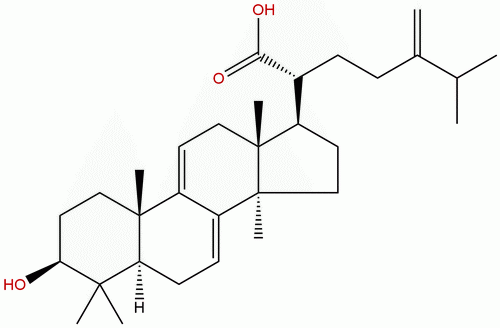


Product name: Dehydroeburicoic acid
Synonym name: Dehydroeburicoic acid
Catalogue No.: BPF2740
Cas No.: 6879-05-6
Formula: C31H48O3
Mol Weight: 468.722
Botanical Source:
Physical Description:
Type of Compound: Triterpenoids
Purity: 95%~99%
Analysis Method: HPLC-DAD or/and HPLC-ELSD
Identification Method: Mass, NMR
Packing: Brown vial or HDPE plastic bottle
The product could be supplied from milligrams to grams
Inquire for bulk scale.
For Reference Standard and R&D, Not for Human Use Directly.
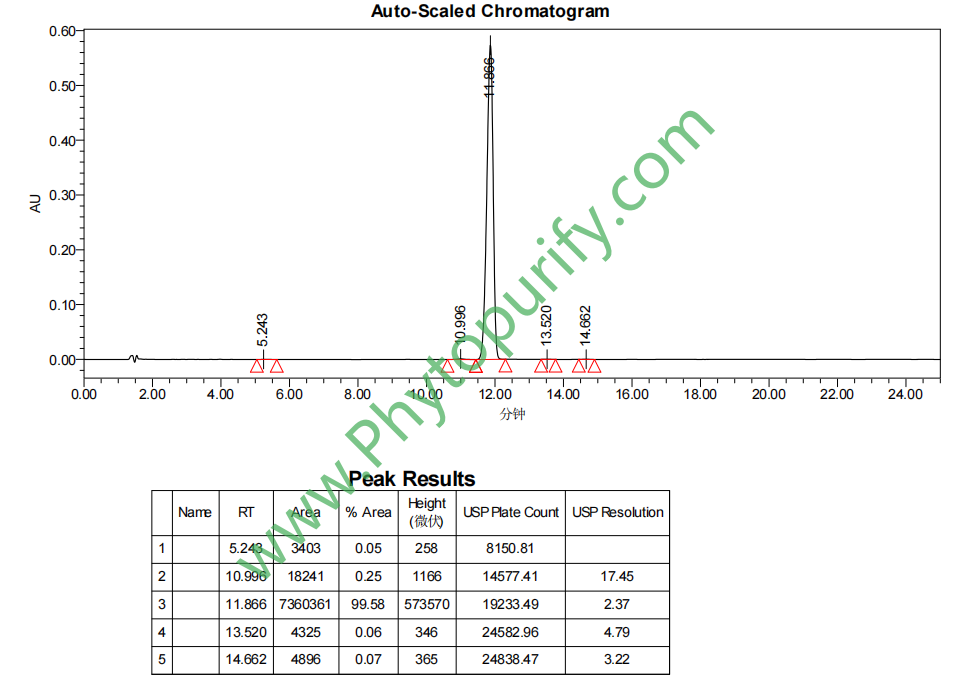
HPLC of Dehydroeburicoic acid
Storage conditions:Short-term storage at 2~8℃, long-term storage at -20 ~ -80℃
57.5300
7.1317
5.1931
.0028
4.4096
7.7182
High
93.3703
4.9351
No
No
Yes
No
No
No
0.0
No
No
Yes
No
Natural products, as an important source of drug discovery, play an irreplaceable role in the long history of human struggle against diseases. Among numerous natural active molecules, triterpenoids have attracted much attention due to their structural diversity and wide range of biological activities. Dehydroeburicic acid (CAS number: 6879-05-6) is a naturally occurring triterpenoid acid compound belonging to the bile acid family, mainly derived from certain higher fungi and plants. The molecular formula of this compound is C ∝₁ H ₄₈ O3, with a molecular weight of 468.7220. Its unique chemical structure endows it with multiple biological functions.
Dehydroebric acid was first introduced from Poria cocos(Poria cocos)It was isolated and identified from medicinal fungi, and subsequently discovered in various natural sources. In recent years, with the deepening of research on natural product chemistry and pharmacology, the activities of dehydroepiric acid in anti-tumor, anti-inflammatory, antioxidant, antibacterial, and metabolic regulation have gradually been revealed, demonstrating its potential as a lead compound or candidate drug. However, the physicochemical properties of this compound, such as poor water solubility (only 0.0028 mg/mL) and high lipid solubility (LogP of 7.1317), pose challenges to its drug development.
This article will provide a systematic review of the research progress of dehydroepiric acid from the aspects of chemical structure and physicochemical properties, plant sources and extraction methods, pharmacological activity research, mechanism of action and molecular targets, drug evaluation and pharmacokinetics, clinical application prospects and prospects, in order to provide reference for the in-depth research and development of this compound.
Dehydroembric acid belongs to the tetracyclic triterpenoid class, and its basic skeleton is lanostane structure. The compound molecule contains three methyl substituents, one carboxyl functional group, and multiple double bond systems. Specifically, its structural features include: A/B rings are trans fused, B/C rings are trans fused, and C/D rings are also trans fused; C-3 is substituted with a hydroxyl group; Connect a carboxyl containing side chain at position C-17; There is a conjugated double bond system in the molecule, which may be the structural basis for its UV absorption and certain biological activities.
From the perspective of stereochemistry, dehydroepidecanoic acid has multiple chiral centers, and its absolute configuration is crucial for its biological activity. The difference between this compound and eburicic acid in the same family is the addition of a double bond in the molecule, hence the name 'dehydrogenation'. This slight difference in structure may lead to significant differences in biological activity between the two.
The physicochemical properties of dehydroepiric acid are as follows:
- molecular weight:468.7220 Da
- Lipid water partition coefficient (LogP)7.1317 indicates that the compound has extremely high lipid solubility and very low solubility in aqueous phase
- Topological Polarity Surface Area (TPSA)57.53 Å ², mainly contributed by carboxyl and hydroxyl groups
- Water solubility:0.0028 mg/mL, Belonging to insoluble compounds
- Blood-brain barrier permeability High, indicating that the compound may have central nervous system activity
- HERG inhibition Negative, indicating a low risk of cardiac toxicity
- Ames test: 0.0, indicating no obvious mutagenicity
These parameters indicate that dehydroepiric acid has typical lipid soluble natural product characteristics. A high LogP value makes it easy to penetrate biofilms, but it also brings about issues of poor water solubility and low bioavailability in drug formation. Its high blood-brain barrier permeability suggests potential for central nervous system targeting, and good hERG and Ames safety data provide favorable conditions for its further development.
Dehydroembric acid mainly comes from higher fungi, especially certain species in the Polyporaceae and Ganodermataceae families. The main sources reported include:
Poria cocos(Poria cocos)Poria cocos is a traditional Chinese medicinal herb and an important source of dehydroabietic acid. The mycelium of Poria cocos is rich in various triterpenoid compounds, among which dehydroabietic acid is one of the active ingredients.
Ganoderma lucidum(Ganoderma lucidum)Lingzhi, as a famous medicinal fungus, contains abundant triterpenoids, including dehydroepidic acid and its derivatives.
Other fungi As follows:Fomitopsis pinicola、Laetiporus sulphureus Wood decay fungi have also been reported to contain this compound.
Certain higher plants In recent years, research has found that some higher plants, such as Salvia Trace amounts of dehydroepiric acid are also present in plants, but fungi remain its main source.
The extraction of dehydroabietic acid usually adopts organic solvent extraction method combined with modern chromatographic separation technology. The typical extraction process is as follows:
(1) Raw material pretreatment Dry fungal fruiting bodies or sclerotia are crushed and sieved through a 40-60 mesh sieve.
(2) Solvent extraction Common extraction solvents include ethanol, methanol, or chloroform methanol mixed solvents. Generally, cold soaking or reflux extraction methods are used, with extraction temperature controlled at 40-60 ℃, extraction time of 2-4 hours, and repeated extraction 2-3 times.
(3) Concentration and preliminary purification The extract is concentrated under reduced pressure to obtain a paste, which is then subjected to liquid-liquid extraction. Usually, solvents such as petroleum ether, ethyl acetate, and n-butanol are used for fractional extraction, and dehydroepiric acid is mainly enriched in the ethyl acetate extraction site.
(4) Chromatographic separation:
- Silica gel column chromatography Using chloroform methanol or petroleum ether acetone gradient elution
- Reverse phase column chromatography ODS column, methanol water system elution
- Preparation HPLC C18 reverse phase column, acetonitrile water or methanol water system, detection wavelength 210-254 nm
(5) Structural identification Structural confirmation was performed using NMR (¹ H, ¹ ³ C, DEPT, HMBC, HSQC), MS (ESI-MS, HR-MS), as well as UV, IR and other spectroscopic techniques.
In recent years, green extraction techniques such as supercritical fluid extraction (SFE) and microwave-assisted extraction (MAE) have also been applied to the extraction of dehydroabietic acid, with advantages such as high extraction efficiency and low solvent consumption.
One of the most extensively studied directions is the anti-tumor activity of dehydroepidacic acid. In vitro experiments have shown that the compound has inhibitory effects on various tumor cell lines:
hepatocellular carcinoma cells Dehydroembric acid can significantly inhibit the proliferation of liver cancer cell lines such as HepG2 and Huh7, with an IC50 value in the range of 10-50 μ M. The mechanism involves inducing cell cycle arrest in the G0/G1 phase and promoting apoptosis.
Breast cancer cells: It is cytotoxic to breast cancer cells such as MCF-7 and MDA-MB-231, and can inhibit cell migration and invasion.
lung cancer cells It has inhibitory effects on non-small cell lung cancer cells such as A549 and H1299, and can induce endoplasmic reticulum stress and autophagic cell death.
Colorectal cancer cells It has an inhibitory effect on the proliferation of cell lines such as HT-29 and HCT116, and can produce a synergistic effect when combined with chemotherapy drugs such as 5-fluorouracil.
It is worth noting that dehydroepiride has relatively low toxicity to normal cells and exhibits a certain degree of selectivity, which provides a safety basis for its anti-tumor application.
Dehydroembric acid exhibits significant anti-inflammatory effects in various inflammatory models:
Inhibit inflammatory mediators Can reduce the production of inflammatory factors such as nitric oxide (NO), prostaglandin E ₂ (PGE ₂), tumor necrosis factor - α (TNF - α), and interleukin-6 (IL-6) in macrophages stimulated by low-fat polysaccharides (LPS).
Regulating the inflammatory signaling pathway By inhibiting the activation of NF - κ B and MAPK signaling pathways, the expression of inflammation related genes is reduced.
Anti inflammatory effect in the body In the carrageenan induced foot swelling model, acetic acid induced capillary permeability increase model, and adjuvant arthritis model, dehydroepiride showed significant anti-inflammatory effects.
Dehydroembric acid has a certain ability to scavenge free radicals. The DPPH radical scavenging experiment, ABTS ⁺ radical scavenging experiment, and iron ion reduction ability (FRAP) experiment all confirmed its antioxidant activity. This compound can upregulate the activity of antioxidant enzymes such as superoxide dismutase (SOD) and glutathione peroxidase (GSH Px), and reduce the level of malondialdehyde (MDA), thereby alleviating oxidative stress damage.
Dehydroembric acid has inhibitory effects on various pathogenic microorganisms:
- Gram positive bacteria Regarding Staphylococcus aureus(Staphylococcus aureus)Bacillus subtilis(Bacillus subtilis)Has inhibitory effect, with MIC values ranging from 50-200 μ g/mL
- fungus Regarding Candida albicans(Candida albicans)Cryptococcus neoformans(Cryptococcus neoformans)Waiting for pathogenic fungi to exhibit antifungal activity
- Anti tuberculosis activity There are reports showing that dehydroepiric acid has an effect on Mycobacterium tuberculosis(Mycobacterium tuberculosis)Has moderate inhibitory effect
In recent years, research has found that dehydroepidacic acid has also shown potential in metabolic regulation:
- Hypoglycemic effect Can improve insulin resistance, promote glucose uptake, and lower blood sugar levels
- Hypolipidemic effect Reduce serum total cholesterol (TC) and triglyceride (TG) levels, regulate lipid metabolism disorders
- Hepatoprotective effect It has a protective effect on carbon tetrachloride induced liver injury, can reduce transaminase levels, and alleviate hepatic steatosis
Dehydroembric acid, as a natural triterpenoid acid, involves multiple molecular targets and signaling pathways in its mechanism of action. The currently clear targets of research include:
NF - κ B signaling pathway Dehydroembric acid can inhibit the phosphorylation and degradation of I κ B α, prevent the nuclear translocation of NF - κ B p65 subunit, and thus suppress the transcription of downstream inflammatory genes.
MAPK signaling pathway This compound can regulate the phosphorylation levels of ERK, JNK, and p38 MAPK, affecting cell proliferation, differentiation, and apoptosis.
PI3K/Akt/mTOR pathway By inhibiting Akt phosphorylation and regulating downstream mTOR signaling, it affects cell growth and metabolism.
Apoptosis related proteins Upregulation of pro apoptotic proteins such as Bax and Bad, downregulation of anti apoptotic proteins such as Bcl-2 and Bcl xL, activation of caspase-3/9, and induction of mitochondrial pathway apoptosis.
Cell cycle regulatory protein Downregulation of cell cycle related proteins such as Cyclin D1, CDK4, and CDK6 leads to cell cycle arrest.
Based on existing research, the mechanism of action of dehydroepiric acid can be summarized into the following levels:
(1) Antitumor mechanism:
-Inducing apoptosis: through mitochondrial pathway and death receptor pathway
-Inhibition of proliferation: through cell cycle arrest
-Inhibition of angiogenesis: downregulation of VEGF expression
-Inhibition of metastasis: Inhibits MMP-2/9 activity and reduces extracellular matrix degradation
-Reversal of drug resistance: inhibition of P-glycoprotein (P-gp) function
(2) Anti inflammatory mechanism:
-Inhibition of inflammatory signaling pathways: NF - κ B, MAPK, JAK/STAT
-Reduce the production of inflammatory mediators: NO, PGE ₂ TNF-α、IL-1β、IL-6
-Regulating immune cell function: inhibiting macrophage M1 polarization and promoting M2 polarization
(3) Antioxidant mechanism:
-Directly eliminate free radicals
-Activate the Nrf2/ARE pathway and upregulate the expression of antioxidant enzymes
-Chelate transition metal ions to reduce Fenton reactions
(4) Metabolic regulation mechanism:
-Activate AMPK signaling to improve energy metabolism
-Regulating PPAR γ activity and improving insulin sensitivity
-Inhibit HMG CoA reductase and regulate cholesterol synthesis
The biological activity of dehydroabietic acid is closely related to its chemical structure. Preliminary structure-activity relationship (SAR) studies indicate that:
-Acylation or oxidation of C-3 hydroxyl group can significantly alter activity
-Side chain carboxyl groups are crucial for the interaction with target proteins
-The double bond system in molecules affects electron distribution and molecular conformation
-The number and position of methyl substituents affect lipid solubility and membrane permeability
Based on the physicochemical properties and preliminary pharmacological data of dehydroepiric acid, its pharmacological evaluation is as follows:
Advantage:
-Has multiple pharmacological activities and a clear mechanism of action
-Low toxicity to normal cells and good selectivity
-HERG inhibition negative, low risk of cardiac toxicity
-Ames test negative, no mutagenicity
-The blood-brain barrier has high permeability and potential for targeting the central nervous system
challenge:
-Very poor water solubility (0.0028 mg/mL), affecting oral bioavailability
-Excessive lipid solubility (LogP 7.13) may lead to tissue accumulation
-The molecular weight is relatively large (468.72 Da), which may affect membrane permeability
-Containing carboxyl groups, may affect gastrointestinal absorption and metabolic stability
At present, there is insufficient systematic research on the pharmacokinetics of dehydroepiride, but based on its physicochemical properties and preliminary experimental data, the following characteristics can be inferred:
absorb Oral absorption may be poor, mainly limited by water solubility and molecular size. High lipid solubility may promote lymphatic absorption, but overall bioavailability may be low.
distribution Due to its high lipid solubility and blood-brain barrier permeability, this compound may be more distributed in adipose tissue, liver, and brain tissue. The plasma protein binding rate may be high.
Metabolism The main metabolic pathways may include:
-Carboxyl glucuronic acid binding reaction
-Sulfation or methylation of hydroxyl groups
-Oxidative degradation of side chains
-Reduction reaction of double bonds
excretion It may be mainly excreted through bile and partially excreted through the kidneys. Due to its high molecular weight, bile excretion may be the main pathway.
In response to the challenges of the pharmacological properties of dehydroepiride, the following drug delivery strategies can be considered:
Based on existing pharmacological activity research, dehydroepiric acid has potential application prospects in the following disease fields:
Despite the various pharmacological activities exhibited by dehydroepidacic acid, there are still many challenges from basic research to clinical application. Future research should focus on the following directions:
(1) In depth mechanism research:
-Using omics techniques (proteomics, metabolomics) to systematically reveal their functional networks
-Identification of direct target through chemical proteomics
-Study its synergistic effect and molecular mechanism with existing drugs
(2) Pharmacokinetic optimization:
-Conduct systematic ADME research to clarify the fate within the body
-Develop suitable drug delivery systems to improve bioavailability
-Design prodrugs or similar substances to improve drug properties
(3) Safety evaluation:
-Conduct long-term toxicity studies to evaluate the safety of chronic medication
-Study its impact on drug metabolizing enzymes (CYP450) and evaluate the risk of drug interactions
-Conduct research on reproductive toxicity and developmental toxicity
(4) Structural modification and structure-activity relationship:
-Systematic study on the effects of structural modifications on activity and drug formation
-Design and synthesize derivatives with higher activity and better selectivity
-Exploring pharmacophore fusion strategies with known drugs
(5) Clinical translational research:
-Validate drug efficacy in appropriate animal models
-Conduct preliminary preclinical toxicology studies
-Explore combination therapy options with existing drugs
Dehydroembric acid, as a natural triterpenoid acid compound, is derived from traditional medicinal fungi such as Poria cocos and Ganoderma lucidum. It has multiple pharmacological activities including anti-tumor, anti-inflammatory, antioxidant, antibacterial, and metabolic regulation. Its mechanism of action involves multiple signaling pathways such as NF - κ B, MAPK, PI3K/Akt, and exerts biological effects by regulating cell apoptosis, proliferation, inflammatory response, and metabolic balance. This compound has good safety characteristics (hERG inhibition negative, Ames test negative), but its physicochemical properties such as poor water solubility and high lipid solubility pose challenges to its pharmacological properties.
With the continuous development of natural product chemistry, pharmacology, and drug delivery technology, dehydroepiandroic acid is expected to overcome its pharmacological barriers through strategies such as structural modification and formulation optimization, and become a candidate drug with clinical application value. Future research should focus on identifying its direct target of action, optimizing pharmacokinetic properties, evaluating long-term safety, and exploring clinical indications, in order to promote the transition of this natural active molecule from the laboratory to clinical applications and contribute to human health.
The research process of dehydroabietic acid fully reflects the value of natural products in drug discovery, and also demonstrates the opportunities and challenges faced in the process of transforming natural active molecules into clinical drugs. I believe that with the cross disciplinary integration and technological progress, dehydroepiric acid and its derivatives will play a greater role in precision medicine and drug development.
