Introduction/Overview
Liver cancer is one of the malignant tumors with the highest incidence rate and mortality worldwide. Its occurrence and development involve complex molecular network regulation. Despite continuous advancements in surgery, radiotherapy, chemotherapy, and targeted therapy, the prognosis of liver cancer patients is still not ideal, with issues such as high recurrence rates, strong drug resistance, and significant treatment side effects. Therefore, searching for highly efficient and low toxicity novel lead compounds for anti liver cancer from natural products has always been an important direction in drug development. Dehydreburicic acid monoacetate (CAS number: 77035-42-8), as a lanostane type triterpenoid compound isolated from traditional medicinal fungi, has attracted much attention in recent years due to its significant pharmacological activity in various tumor models, especially liver cancer. Its unique chemical structure enables it to act on multiple key signaling pathways and molecular targets closely related to the occurrence and development of liver cancer, such as BCL2, STAT3, HIF1A, etc., demonstrating the potential for multi-target and multi-path intervention. The purpose of this article is to systematically review the chemical properties, plant sources, anti liver cancer pharmacological activity, mechanism of action, drug evaluation, and clinical application prospects of dehydroporous ethyl ester, in order to provide comprehensive scientific references for the in-depth research and development of this compound.
Chemical structure and physicochemical properties
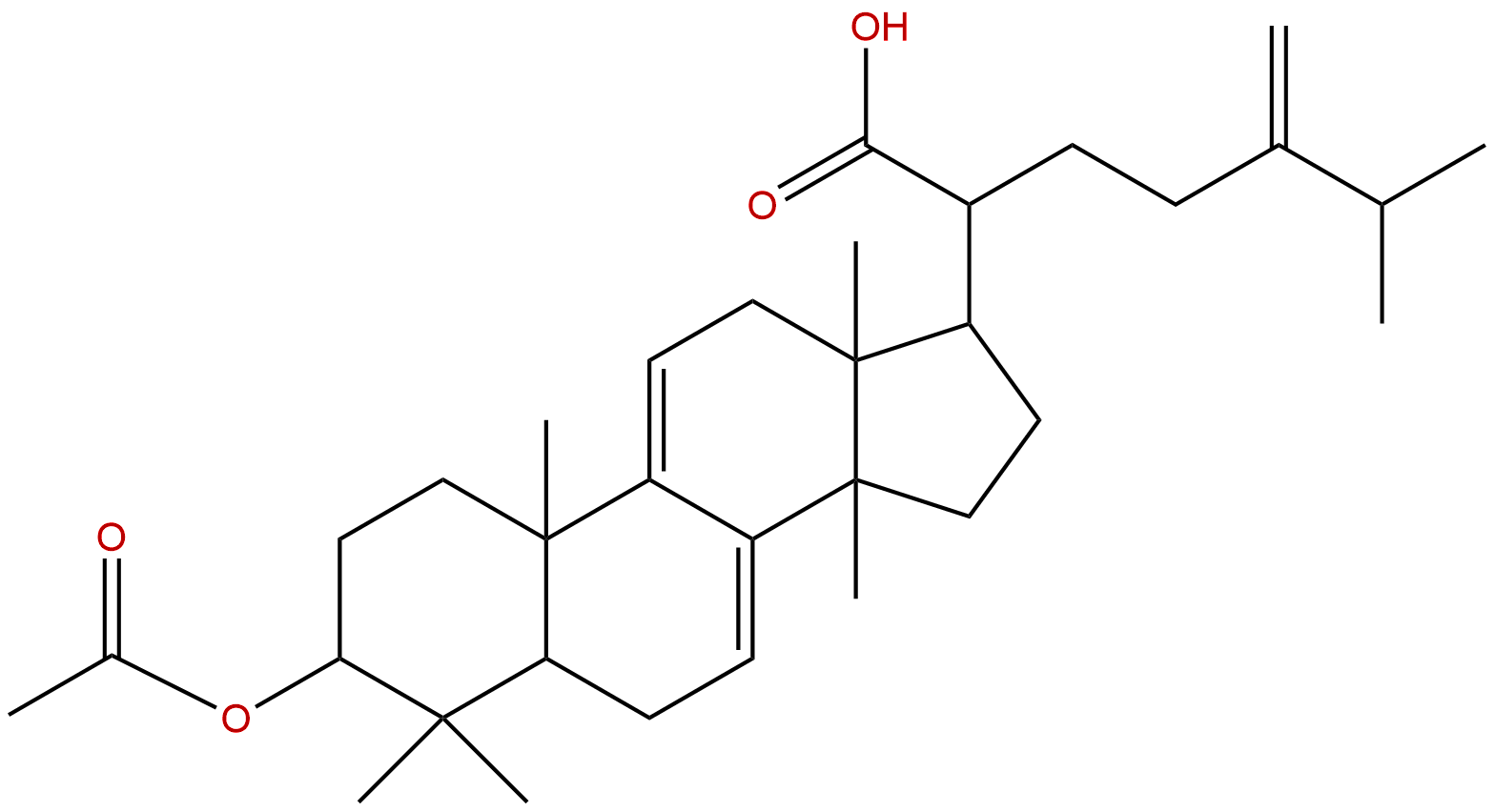
The molecular formula of dehydroporous ethyl ester is C32H46O5, with a molecular weight of 510.7590. Its chemical structure belongs to the lanostane type tetracyclic triterpenoid compounds and is a derivative of Eburicoic acid. Specifically, it has Δ 8,9 unsaturated double bonds (dehydrogenation feature) on the parent nucleus structure and forms monoacetate on specific hydroxyl groups on the side chains or parent nucleus. This structural modification usually affects its lipid solubility and biological activity.
From the perspective of pharmacological parameters, this compound exhibits typical natural triterpenoid characteristics. Its calculated LogP value is as high as 7.6006, indicating that it has extremely strong lipophilicity. Consistent with this, its predicted water solubility is extremely low, only 0.0021 mg/mL, indicating that solubilization techniques such as cyclodextrin inclusion, nanoformulation, or prodrug modification may be needed in formulation development to improve its bioavailability. Its topological polar surface area (TPSA) is 63.6 Å ², which is relatively small and consistent with the characteristics of high membrane permeability molecules. It is worth noting that the predictive model shows a high blood-brain barrier permeability, which may be a potential advantage for the treatment of central nervous system related diseases, but also suggests that attention should be paid to possible neurological side effects when administering it systemically. In the early safety warning indicators, the compound did not show significant hERG potassium channel inhibition risk (predicted as "no"), and the Ames test predicted a value of 0.0, indicating a low potential mutagenic risk and providing preliminary positive signals for further safety evaluation.
Plant sources and extraction methods
Dehydroacetate ethyl ester mainly comes from various large medicinal fungi in the Polyporaceae and Ganoderma families. Among them, the most famous source is the mycelium of the traditional Chinese medicine "Poria cocos", but it belongs to the Ganoderma genus(Ganoderma)Fungi, such as Ganoderma lucidum(G. lucidum)And Zizhi(G. sinense)It has also been found in the fruiting body and spore powder. In addition, some genera of dental fungi(Fomes)The genus of Firmicutes(Fomitopsis)Fungi are also a potential source of this compound.
Its extraction and separation usually follow the conventional process of natural product chemistry. Firstly, the dried fungal material is crushed and subjected to cold soaking or heating reflux extraction using organic solvents such as methanol, ethanol, or chloroform methanol mixed solvents. After concentration, the crude extract is obtained. The crude extract is then subjected to liquid-liquid partition extraction using solvents such as ethyl acetate or n-butanol to enrich triterpenoid components. Further purification mainly depends on a variety of chromatographic techniques, including normal phase silica gel column chromatography, reverse phase C18 column chromatography, gel chromatography (such as Sephadex LH-20) and high performance liquid chromatography (HPLC). The chemical structure can be ultimately identified by nuclear magnetic resonance (NMR, including 1H-NMR and 13C-NMR), mass spectrometry (MS), and comparison with literature data. In recent years, in order to obtain a larger number of compounds for activity research, semi synthetic methods have also been applied, that is, using more abundant amounts of tartaric acid or related triterpenes as precursors, and preparing dehydrotartaric acid ethyl ester through chemical modifications such as dehydration and acetylation.
Pharmacological activity research
Numerous in vitro and in vivo pharmacological studies have confirmed that dehydroporous ethyl ester has a wide range of anti-tumor activities, with a particularly prominent effect on liver cancer.
In vitro anti liver cancer activity This compound exhibits significant proliferation inhibition and cytotoxicity against various human liver cancer cell lines (such as HepG2, Huh7, SMMC-7721, Hep3B), with a half maximal inhibitory concentration (IC50) typically at the micromolar (μ M) level. Its function is not limited to inhibiting cell proliferation, but can also effectively induce apoptosis in liver cancer cells, manifested as cell morphological shrinkage, chromatin condensation, phosphatidylserine eversion, and activation of caspase-3/9. In addition, studies have found that it can block the cell cycle of liver cancer cells, usually by blocking them in the G0/G1 or G2/M phase, thereby inhibiting their mitosis. In addition to its direct killing effect, this compound can also inhibit the migration and invasion ability of liver cancer cells, indicating its potential for anti-tumor metastasis.
In vivo anti liver cancer activity In nude mouse transplant tumor models (such as subcutaneous inoculation of HepG2 or Huh7 cells), intraperitoneal injection or gavage of dehydroporous ethyl ester can dose dependently inhibit tumor growth, and the effect is comparable to certain clinical chemotherapy drugs. Importantly, at effective doses, its toxic effects on the body weight and major organs (such as the heart, liver, and kidneys) of mice are relatively small, demonstrating a good therapeutic window. These in vivo experiments provide direct evidence for its anti liver cancer efficacy.
Other pharmacological activities In addition to its anti liver cancer effect, this compound has also been reported to have anti-inflammatory, antioxidant, antibacterial (especially antifungal), and immunomodulatory activities. These activities may complement their anti-tumor effects, as chronic inflammation and immune suppression are important components of the tumor microenvironment.
Mechanism of action and molecular targets
The anti liver cancer effect of dehydroporous ethyl ester involves the regulation of multiple key signaling pathways and molecular targets, reflecting the characteristic of multi-target action of natural products. According to the provided target information, its mechanism of action can be summarized as follows:
- Inducing cell apoptosis This compound can downregulate the expression of anti apoptotic protein BCL2, disrupt mitochondrial membrane potential, promote cytochrome C release, and activate endogenous apoptotic pathways. Meanwhile, it can inhibit the phosphorylation and activation of transcription factor STAT3. STAT3 is a key oncogenic protein that is continuously activated in liver cancer. Its inhibition leads to downregulation of downstream pro survival genes (such as Mcl-1 and Bcl xL), further promoting apoptosis.
- Inhibition of proliferation and angiogenesis By inhibiting the activity of MAPK1 (ERK2) and PIK3CA (PI3K catalytic subunit), this compound blocks the core pathways of MAPK/ERK and PI3K/Akt that promote cell proliferation and survival. In addition, it can downregulate the expression of hypoxia inducible factor HIF1 α. HIF1 α is activated in hypoxic areas of tumors and is a key factor in regulating gene expression such as vascular endothelial growth factor (VEGF) and promoting tumor angiogenesis. Inhibiting HIF1 α can effectively cut off the blood supply to tumors.
- Inhibition of nuclear factor kappa B (NF - κ B) signaling pathway This compound can inhibit the activity of IKBKB (IKK β), thereby preventing the degradation of NF - κ B inhibitory protein I κ B and preventing the transcription factor RELA (p65) from entering the nucleus to activate target genes. Inhibition of the NF - κ B pathway helps to reduce the expression of a range of pro-inflammatory, anti apoptotic, and pro invasive genes.
- Interference with DNA metabolism and telomere maintenance Research has shown that this compound may act as an inhibitor of topoisomerase I (TOP1) and topoisomerase II alpha (TOP2A), interfering with DNA replication and transcription, leading to DNA damage. Meanwhile, its potential inhibitory effect on telomerase reverse transcriptase (TERT) may weaken the telomere maintenance ability that liver cancer cells rely on for unlimited proliferation.
- Multi target synergistic effect These targets do not act in isolation. For example, the STAT3 and NF - κ B pathways have a cross-talk in liver cancer, jointly maintaining inflammation and survival signals. The PI3K/Akt and MAPK pathways also interact with each other. Dehydroacetate ethyl ester simultaneously acts on these targets, which can produce synergistic anti-tumor effects and may help overcome the resistance problem that single target drugs are prone to.
Evaluation of drug properties and pharmacokinetics
Although dehydroporous ethyl ester exhibits excellent pharmacological activity, its drug properties, especially pharmacokinetic properties, are the key bottleneck determining its successful development as a drug.
Absorption, distribution, metabolism, excretion (ADME)As mentioned earlier, the extremely high LogP value and low water solubility are the main obstacles to its oral absorption, which may lead to low bioavailability. The prediction of high blood-brain barrier permeability suggests that it may have a high distribution in the central nervous system and needs to be given attention in toxicology research. At present, there is limited publicly available data on the pharmacokinetics of this compound system. Based on its structure, it is speculated that it may undergo extensive phase I metabolism (such as cytochrome P450 enzyme mediated oxidation) and phase II binding metabolism (such as glucuronidation) in vivo, which may lead to its rapid clearance. Its excretion pathway may mainly be through bile and feces.
Formulation strategy In order to improve its drug efficacy, advanced drug delivery systems are a necessary research and development direction. For example, preparing it into nanocrystals, liposomes, polymer micelles, or solid dispersions can significantly improve its solubility and dissolution rate, thereby improving oral absorption. Preparing water-soluble prodrugs (such as phosphate esters or amino acid esters) through chemical modification is also a feasible strategy.
Preliminary evaluation of safety Based on computational predictions, the absence of hERG inhibition and Ames mutagenicity risk is a positive signal. However, a comprehensive preclinical safety evaluation (including acute toxicity, chronic toxicity, genetic toxicity, reproductive toxicity, etc.) has not been systematically reported, which is a necessary step towards preclinical development. Its multi-target mechanism of action may bring therapeutic advantages, but it may also increase the risk of off target effects and unpredictable toxicity, which requires careful observation in animal models.
Clinical application prospects and prospects
As a natural triterpenoid compound with multi-target anti liver cancer activity, dehydroporous ethyl ester has broad clinical application prospects, but the road ahead is long and full of challenges.
Potential application directions:
1. Monotherapy or combination therapy for liver cancer It is expected to be developed as a new type of anti liver cancer drug, especially suitable for patients who are resistant or not suitable for existing targeted drugs such as sorafenib. Given its multi-channel inhibitory properties, when used in combination with existing chemotherapy drugs or other targeted drugs, it may produce synergistic effects and reduce drug resistance.
2. Chemotherapy prevention of liver cancer Its anti-inflammatory and antioxidant activities suggest that it may be used for chemoprevention in populations at high risk of liver cancer, such as patients with cirrhosis.
3. Other cancer treatments Its targets (such as STAT3 and NF - κ B) play an important role in a variety of solid tumors and hematomas, so its application value in breast cancer, lung cancer, colorectal cancer, etc. is also worth exploring.
Future research focus and challenges:
1. In depth mechanism research It is necessary to use chemical biology methods such as affinity fishing, molecular docking and kinetic simulation, CRISPR screening, etc. to more accurately verify its direct target and clarify the specific details of its multi-target network regulation.
2. Optimization of drug properties in the system This is the current core challenge. It is necessary to conduct systematic pharmacokinetic research and focus on pharmaceutical innovation to address its water solubility and bioavailability issues.
3. Comprehensive preclinical development Complete pharmacological, pharmacokinetic, and toxicological evaluations that meet drug registration requirements, determine the safe and effective dosage range, and provide sufficient data for clinical trial applications (IND).
4. Research on structural modification and analogues Using it as the parent nucleus, structural optimization is carried out with the aim of enhancing activity, improving water solubility and metabolic stability, and discovering derivatives with greater potential for development.
Conclusion
Dehydroacetate ethyl ester is a lanostane type triterpenoid compound found in medicinal fungi with significant anti liver cancer activity. It exhibits multidimensional and multi-level pharmacological effects in inhibiting liver cancer cell proliferation, inducing apoptosis, anti angiogenesis, and anti metastasis by acting on multiple key targets such as BCL2, STAT3, PIK3CA, HIF1A, RELA, etc. Although its extremely low solubility and unclear pharmacokinetic properties are currently the main obstacles to its development, its unique multi-target mechanism and good preliminary safety prediction bring enormous development potential. Future research should focus on using modern medicinal chemistry and pharmacy methods to overcome its physical and chemical shortcomings, and promote its transformation process through systematic preclinical evaluation. With the continuous deepening of research, dehydroporous ethyl ester is expected to become a highly valuable lead compound in the field of anti liver cancer drug development, bringing new therapeutic hope to liver cancer patients.