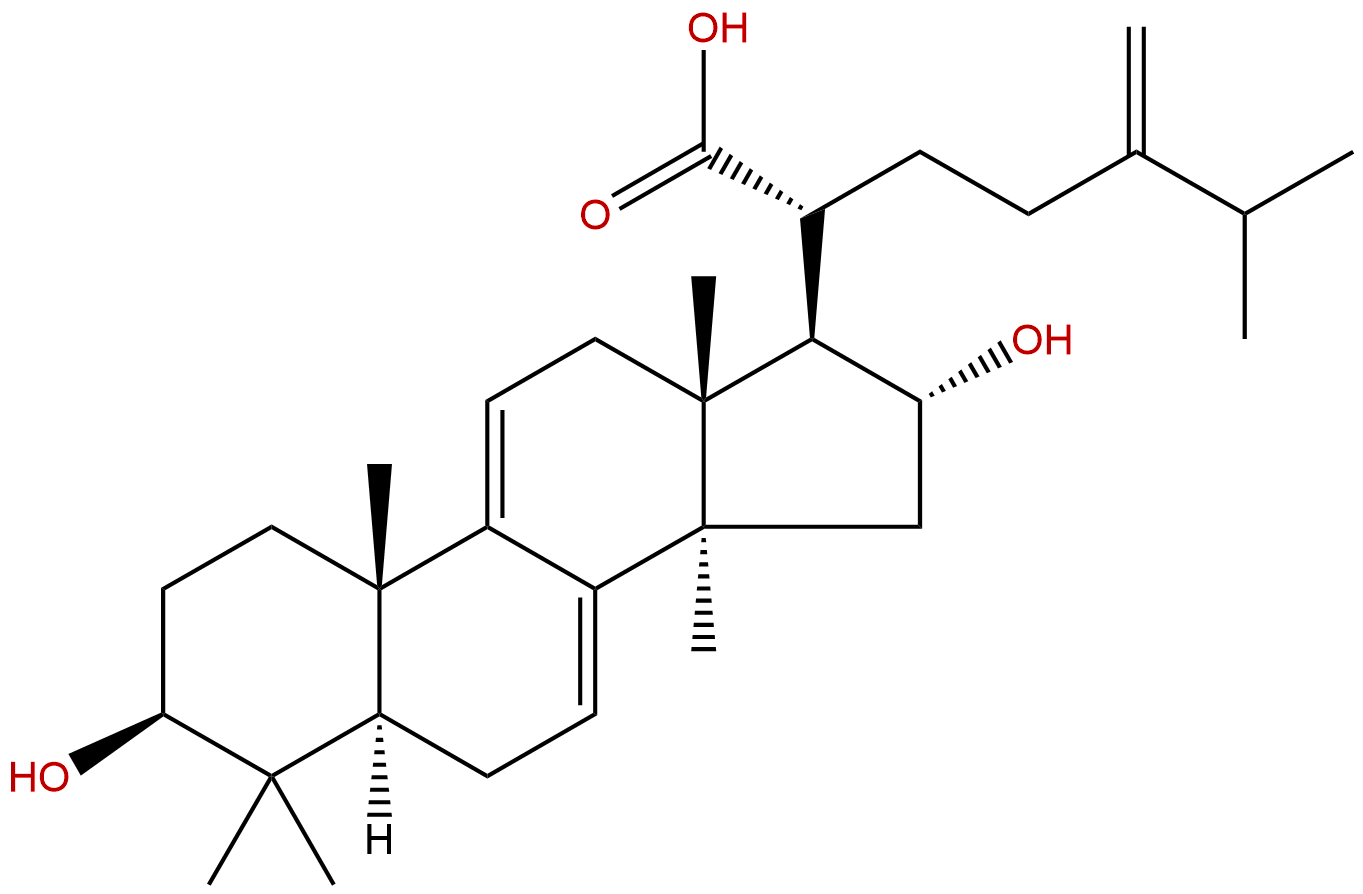


Product name: Dehydrotumulosic acid
Synonym name:
Catalogue No.: BP1794
Cas No.: 6754-16-1
Formula: C31H48O4
Mol Weight: 484.721
Botanical Source: Daedalea dicknsii; Trametes dicknsii
Physical Description: Powder
Type of Compound: Triterpenoids
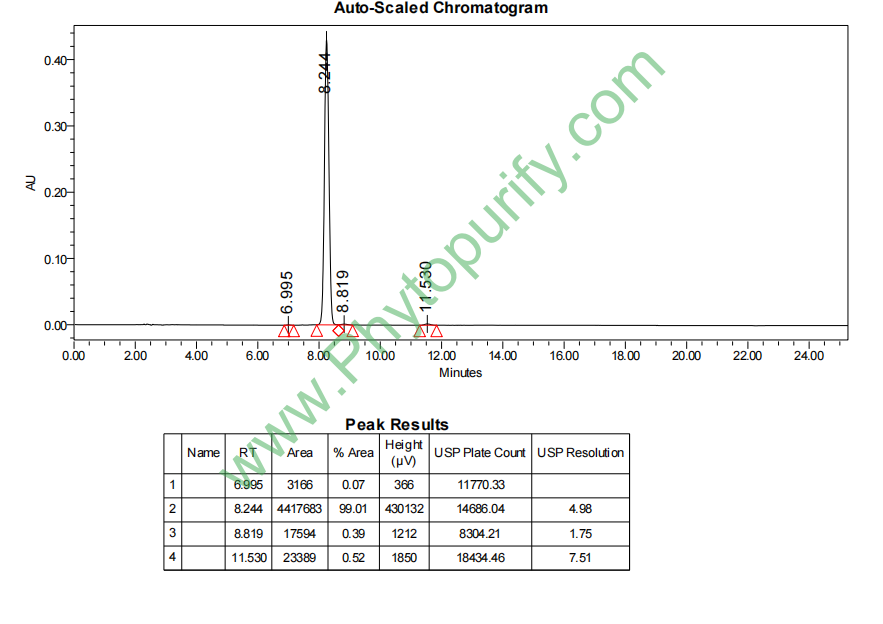
Purity: 95%~99%
Analysis Method: HPLC-DAD or/and HPLC-ELSD
Identification Method: Mass, NMR
Packing: Brown vial or HDPE plastic bottle
The product could be supplied from milligrams to grams. Inquire for bulk scale.
We provide solution to improve the water-solubility of compounds, thereby facilitating the variety of activity tests and clinic uses.
For Reference Standard and R&D, Not for Human Use Directly.
HPLC of Dehydrotumulosic acid
Storage conditions:Short-term storage at 2~8℃, long-term storage at -20 ~ -80℃
77.7600
5.9044
4.0678
.0098
2.6545
8.1017
Low
91.2910
5.1401
No
No
Yes
No
No
No
0.0
No
No
Yes
No
Natural products, as an important source of drug discovery and development, have played an irreplaceable role in the long history of human fight against diseases. Among them, the medicinal fungus Poria cocos(Poria cocos As a treasure of traditional Chinese medicine, (Schw.) Wolf has a history of more than two thousand years of application. Its nature is sweet, light, and flat, and it can regulate the heart, lungs, spleen, and kidney meridians. It has the effects of promoting diuresis and dampness, strengthening the spleen and calming the heart. It is commonly used to treat conditions such as edema and oliguria, phlegm and thirst, spleen deficiency and food deprivation, loose stools and diarrhea, restlessness, palpitations and insomnia. Modern pharmacological research reveals that the pharmacological activity of Poria cocos stems from its complex chemical composition, mainly including polysaccharides, triterpenoid acid compounds, etc. Among the numerous triterpenoid acid components, dehydrotumulosic acid (DTA, CAS: 6754-16-1), as one of the characteristic active ingredients of Poria cocos, has attracted much attention in recent years due to its significant activities in anti-tumor and immune regulation, especially in the treatment research of malignant tumors such as non-small cell lung cancer (NSCLC), showing great potential.
Non small cell lung cancer (NSCLC) is one of the malignant tumors with the highest incidence rate and mortality in the world. Although its treatment methods have made continuous progress, it still faces severe challenges such as chemotherapy resistance, drug resistance in targeted treatment and limited response rate of immunotherapy. Therefore, searching for novel lead compounds from natural products that can intervene in tumor occurrence and development through multiple targets and pathways, and overcome drug resistance, has important scientific significance and clinical value. As a structurally unique tetracyclic triterpenoid acid, the pharmacological activity research of dehydrofumaric acid is gradually expanding from traditional diuretic and sedative effects to modern medical frontiers such as anti-tumor, anti-inflammatory, and neuroprotective effects. The purpose of this article is to systematically review the chemical structure, plant sources, pharmacological activities, especially the mechanism of action and molecular targets against non-small cell lung cancer, and evaluate and prospect its pharmacological properties and clinical application prospects, in order to provide comprehensive academic references for the in-depth research and development of this compound.
Dihydrofumaric acid is a lanostane type tetracyclic triterpenoid acid compound. Its molecular formula is C31H48O4 and its molecular weight is 484.7210. Its core structure consists of four fused rings A, B, C, and D, belonging to the 8 (9) - ene lanostane skeleton. Compared with other triterpenoid acids in Poria cocos, such as Pachymic acid and Tumulosic acid, dehydrofumaric acid has a double bond (Δ ⁸⁽⁹⁾) between positions C-7 and C-8, and is usually connected to a hydroxyl group at position C-3 and a carboxyl group at position C-21, which are the key functional groups for its biological activity. This unique structure gives it a specific spatial conformation and electronic distribution, which affects its interaction with biomolecules.
Based on the analysis of physicochemical parameters related to drug properties, dehydrogenated humic acid exhibits typical hydrophobic characteristics of natural triterpenoids. Its lipid water partition coefficient (LogP) is 5.9044, indicating that the compound has high lipophilicity, which is beneficial for its penetration of cell membranes, but may also lead to extremely poor water solubility (only 0.0098 mg/mL). Its topological polar surface area (TPSA) is 77.7600 Å ², relatively moderate, mainly derived from carboxyl and hydroxyl groups in the molecule. These physical and chemical properties collectively determine its poor solubility and permeability, and it belongs to Class II or IV compounds (low solubility) in the Biopharmaceutical Classification System (BCS). In addition, the predictive model shows that its ability to cross the blood-brain barrier (BBB) is low, suggesting that its direct effect on central nervous system diseases may be limited, but it may also reduce potential neurotoxicity. In the early safety screening, the hERG inhibition risk was negative, and the Ames test (prediction) result was 0.0, indicating a low potential risk of arrhythmia and genetic toxicity, providing preliminary safety evidence for its further development.
Dehydrated humic acid mainly comes from the dried sclerotia of the porous fungal family Poria cocos. Poria cocos is mainly distributed in East Asian countries such as China, South Korea, and Japan, with Yunnan, Anhui, Hubei, Henan, and other regions being the main production areas in China. Its active ingredients are mainly enriched in the cortex of the sclerotia (traditionally known as "Poria cocos skin"), but the interior of the sclerotia (traditionally known as "Poria cocos chunks" or "white Poria cocos") also contains a considerable amount.
The extraction of dehydrogenated humic acid usually adopts organic solvent extraction method combined with modern separation and purification technology. The standard procedure is as follows:
1. Preprocessing and Extraction Crush the dried Poria cocos mycelium and first degrease it with petroleum ether or n-hexane to remove fat soluble impurities. Subsequently, extraction is carried out using medium polarity solvents, commonly including methanol, ethanol, ethyl acetate, or mixed solvents of different proportions (such as 95% ethanol). Reflux extraction or ultrasound assisted extraction are commonly used methods to improve extraction efficiency.
2. Coarse separation The extract is concentrated under reduced pressure to obtain a paste. The extract is often preliminarily separated by solvent partitioning method (such as extraction with petroleum ether, ethyl acetate, and n-butanol in sequence), and dehydroxyluric acid is mainly enriched in the ethyl acetate extraction site.
3. Refining and Purification The ethyl acetate fraction is further separated and purified using various chromatographic techniques, including silica gel column chromatography (often using petroleum ether ethyl acetate or chloroform methanol gradient elution), reverse phase silica gel column chromatography (such as ODS, using methanol water system elution), and high performance liquid chromatography (HPLC, preparative or semi preparative). By comparing with standard samples using thin-layer chromatography (TLC) or high-performance liquid chromatography, and combining with spectroscopic techniques such as nuclear magnetic resonance (NMR) and mass spectrometry (MS) for structural identification, high-purity dehydrogenated fumaric acid is ultimately obtained.
In recent years, some green extraction techniques such as supercritical CO ₂ extraction and microwave-assisted extraction have also been explored for the extraction of triterpenes from Poria cocos. These methods have the advantages of high efficiency and low solvent residue, but the cost is relatively high.
Dihydrofumaric acid exhibits a wide range of pharmacological activities, and its research has extended from traditional efficacy verification to modern disease treatment fields.
Antitumor activity This is currently the most highly anticipated activity of dehydroxylomolic acid. Numerous in vitro studies have shown that it has inhibitory effects on proliferation and induces apoptosis in various tumor cell lines, with particularly significant activity in non-small cell lung cancer cells such as A549, H460, and H1299. Its function is not limited to cytotoxicity, but can also inhibit the migration and invasion of tumor cells, indicating its potential for anti metastasis. In addition, the study also found that dehydrothumonic acid can enhance the sensitivity of some chemotherapy drugs (such as cisplatin, docetaxel), and reverse the phenomenon of multidrug resistance (MDR) mediated by P-glycoprotein (P-gp/ABCB1) and breast cancer resistance protein (BCRP/ABCG2), which provides a new idea for solving the problem of clinical chemotherapy resistance.
Immune regulatory activity The traditional efficacy of Poria cocos, "strengthening the spleen and calming the heart," is closely related to its modern immunomodulatory effects. Research has shown that dehydrofumaric acid can regulate the function of immune cells such as macrophages and T lymphocytes. For example, it may exert anti-inflammatory effects by inhibiting the production of pro-inflammatory cytokines (such as TNF - α, IL-6) in excessive inflammatory responses. This immune regulatory property may synergize with its anti-tumor effect, enhancing the anti-tumor immune response by improving the tumor microenvironment.
Anti inflammatory and antioxidant activity Dehydrosomic acid can inhibit the production of nitric oxide (NO) and prostaglandin E2 (PGE2) in inflammatory response models induced by lipopolysaccharides (LPS), and its mechanism is related to the inhibition of the expression of inducible nitric oxide synthase (iNOS) and cyclooxygenase-2 (COX-2). At the same time, it can activate the key factor Nrf2 (encoded by the NFE2L2 gene) of the cellular defense system, upregulate the expression of downstream antioxidant enzymes (such as HO-1, NQO1), thereby enhancing the cell's ability to resist oxidative stress.
Neuroprotective activity Preliminary research suggests that dehydroxyluric acid may have a protective effect on the nervous system. The mechanism may be related to the inhibition of excessive phosphorylation of tau protein (encoded by MAPT gene), alleviation of neuroinflammation, and antioxidant stress, providing potential candidate molecules for the study of neurodegenerative diseases such as Alzheimer's disease.
Diuretic and hepatoprotective activity As one of the material foundations for the water promoting and moisturizing effects of Poria cocos, dehydroxyluric acid has been proven to have a certain diuretic effect. Meanwhile, research has also shown that it has a protective effect on chemical liver injury, which may be related to anti-inflammatory and antioxidant mechanisms.
For non-small cell lung cancer, the mechanism of action of dehydrotumulic acid has been revealed to be a multi-target and multi pathway actor, mainly involving the following key targets and signaling pathways:
Inducing cell apoptosis and autophagy:
Inhibit tumor invasion and metastasis:
Reverse multidrug resistance (MDR):
Regulating oxidative stress and inflammatory microenvironment:
Other potential targets There are studies suggesting that dehydrofumaric acid may affect targets related to immune cell function, such as LCK (lymphocyte specific protein tyrosine kinase), which corresponds to its immune regulatory activity. However, its specific role in the tumor immune microenvironment still needs further exploration.
In summary, dehydrotumulic acid forms a multidimensional anti-tumor network by synergistically targeting multiple key targets such as AMPK, STAT3, BCL2, ABC transporters, MMPs, etc., which gives it unique advantages in combating highly heterogeneous and drug-resistant NSCLC.
Despite its excellent pharmacological activity, dehydrofumaric acid faces challenges in drug liking, mainly due to its inherent physicochemical properties.
Prediction and Challenges of Absorption, Distribution, Metabolism, and Excretion (ADME):
Current status of pharmacokinetic research At present, there are relatively few reports on the in vivo pharmacokinetic studies of dehydroxyluric acid system. Limited animal experiments (usually administered via intraperitoneal injection or gavage) suggest that the in vivo exposure may be lower and the elimination may be faster. Establishing sensitive and accurate analytical methods (such as LC-MS/MS) for determining drug concentrations in biological samples is a prerequisite for comprehensively evaluating their pharmacokinetic characteristics.
Formulation strategy The development of new drug delivery systems is crucial to overcome the bottleneck of drug development. For example:
The research on dehydrofumaric acid is currently in an important stage of transition from preclinical to clinical use, with broad application prospects but also full of challenges.
As a lead compound for anti-tumor drugs:
Potential in other disease areas In addition to tumors, its application in chronic inflammatory diseases (such as arthritis and colitis), neurodegenerative diseases, and metabolic diseases (through the AMPK pathway) is also worth exploring.
Challenges faced and future research directions:
As the active ingredient of traditional Chinese medicine Poria cocos, dehydroxyluric acid is a model of combining modern research on the material basis of traditional Chinese medicine with innovative drug discovery. From the ancient concept of "promoting diuresis and moistening" to the modern concept of "multi-target anti-tumor", its value has been constantly re recognized and enhanced with the deepening of scientific research. Current research has fully demonstrated that dehydrotumulic acid exhibits multiple pharmacological effects in the treatment of malignant tumors such as non-small cell lung cancer, including inhibition of proliferation, induction of apoptosis, anti metastasis, and reversal of drug resistance, by acting on multiple key targets such as AMPK, STAT3, BCL2, and ABC transporters. It has clear potential to be developed into a novel anti-tumor lead compound or drug adjuvant.
However, the pharmaceutical challenges posed by its inherent physicochemical properties cannot be ignored. Future research should focus on interdisciplinary collaboration, integrating methods from medicinal chemistry, pharmacy, pharmacology, and clinical medicine. On the one hand, it should delve into the molecular details of its biological effects, while on the other hand, it should focus on addressing bottleneck issues such as solubility and bioavailability. With the continuous deepening of research and the development of technology, dehydrofumaric acid is expected to move from the laboratory to clinical practice, providing a new treatment option derived from traditional wisdom for cancer patients, especially drug-resistant NSCLC patients, and also providing valuable reference paths for modern research on other natural products.
