Introduction/Overview
Natural products, as an important source of drug discovery, play an irreplaceable role in the history of human disease treatment. Among them, triterpenoids have always been a hot topic in medicinal chemistry and pharmacology research due to their structural diversity and wide range of biological activities. Poria cocos, as a medicinal fungus in traditional Chinese medicine with the effects of promoting diuresis and dampness, strengthening the spleen and calming the heart, has attracted much attention for its pharmacological active substance basis. Dehydropachymic acid (CAS: 77012-31-8) is a lanostane type triterpenoid acid with a unique tetracyclic triterpenoid skeleton isolated from Poria cocos. In recent years, studies have found that dehydroferulic acid exhibits significant anti-inflammatory and anti-tumor activities. It is particularly noteworthy that it exhibits selectively enhanced cytotoxicity in cellular environments with impaired autophagy lysosome pathways, providing new ideas for drug design targeting specific pathological states such as tumors and neurodegenerative diseases. This article aims to systematically review the chemical structure, sources, pharmacological activities, mechanisms of action, pharmacological properties, and clinical application prospects of dehydroferulic acid, in order to provide comprehensive scientific references for the in-depth research and development of this compound.
Chemical structure and physicochemical properties
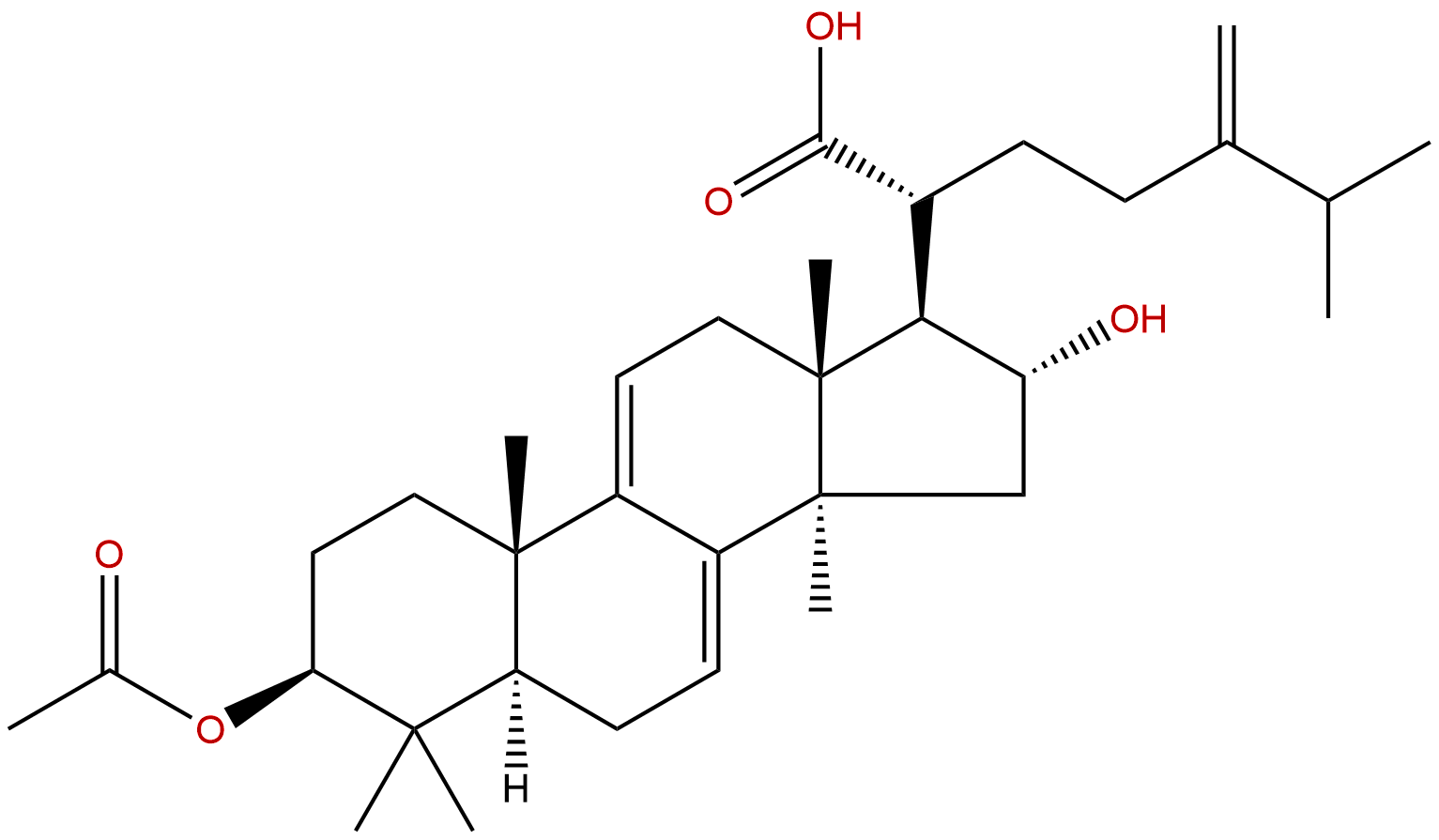
Dihydrofulvic acid is a lanostane type tetracyclic triterpenoid compound. Its molecular formula is C33H50O5 and its molecular weight is 526.7580. Its core structure consists of four rings A, B, C, and D, belonging to the 8 (9) - ene lanostane skeleton. Compared with another major triterpenoid acid in Poria cocos - Poria cocos acid, dehydrogenated Poria cocos acid is usually carbonyl or hydroxyl at the C-3 position, and has specific dehydrogenation modifications on the side chain and ring, which gives it a unique spatial conformation and electronic distribution, which is the key factor affecting its biological activity.
From the perspective of physicochemical parameters related to drug properties, dehydroferulic acid exhibits typical hydrophobic characteristics. Its lipophilic water partition coefficient (LogP) is 6.2757, indicating that the compound has a high degree of lipophilicity. Consistent with this, its water solubility is extremely low, only 0.0065 mg/mL, which poses a major challenge for its dissolution, absorption, and delivery in vivo. Its topological polar surface area (TPSA) is 83.83 Å ², which is relatively moderate, but its high LogP value dominates its physicochemical behavior. Preliminary pharmacological risk assessment shows that the compound has no significant inhibitory effect on hERG potassium channels, indicating a low potential risk of cardiac toxicity; The Ames test result is negative (0.0), indicating no mutagenicity in this testing system. However, its blood-brain barrier permeability is predicted to be 'low', which may limit its direct effects on central nervous system diseases, but may also reduce potential central side effects. These physical and chemical properties are important basis for subsequent formulation improvement and structural optimization.
Plant sources and extraction methods
Dehydroalfonic acid mainly comes from the dried sclerotia of Poria cocos, a fungus in the family Poriaceae. Poria cocos mainly parasitizes the roots of pine trees and is mainly produced in East Asian regions such as China, South Korea, and Japan. Its sclerotia are rich in various active ingredients such as triterpenoid acids and polysaccharides, among which dehydroferulic acid is one of its characteristic triterpenoid components.
The extraction of dehydroferulic acid from Poria cocos usually follows the conventional process of natural product separation. Firstly, organic solvents such as methanol, ethanol, or ethyl acetate are used for reflux extraction or ultrasound assisted extraction of Poria cocos powder to maximize the extraction of lipophilic triterpenoid components. Subsequently, crude extract was obtained by vacuum concentration. The crude extract needs to be further separated and purified, often using methods such as silica gel column chromatography, reverse phase column chromatography (such as ODS), high performance liquid chromatography (HPLC), or preparative thin layer chromatography. Solvent systems often use different ratios of petroleum ether ethyl acetate, chloroform methanol, or water methanol/acetonitrile gradient elution. Modern technologies such as high-speed countercurrent chromatography are also applied to the efficient preparation and separation of triterpenoids due to their irreversible adsorption advantages. The optimization goal of the extraction process is to improve the yield and purity of dehydroferulic acid while maintaining its biological activity. It should be noted that differences in the extraction source, place of origin, harvest season, and sclerotic part may lead to variations in the content of dehydroferulic acid.
Pharmacological activity research
A large number of in vitro and in vivo pharmacological studies have shown that dehydroferulic acid has various biological activities, among which anti-inflammatory and anti-tumor activities are the most prominent.
1. Anti inflammatory activity: Dihydrofulvic acid has shown strong anti-inflammatory effects in various inflammatory models. In the lipopolysaccharide (LPS) - induced macrophage (such as RAW264.7) inflammation model, dehydroferulic acid can dose dependently inhibit the excessive production of nitric oxide (NO) and prostaglandin E2 (PGE2). In a rat arthritis model induced by carrageenan or Freund's complete adjuvant, oral administration of dehydroferulic acid can significantly reduce paw swelling, improve joint pathological damage, and lower the levels of pro-inflammatory cytokines in serum and joint fluid. Its anti-inflammatory effect is closely related to the regulation of key inflammatory signaling pathways.
2. Antitumor activity: Dehydropachymaranic acid showed growth inhibition and apoptosis inducing effects on a variety of human tumor cell lines, including lung cancer, liver cancer, breast cancer, colon cancer and gastric cancer cells. Of particular note is that research has revealed that dehydroferulic acid exhibits significantly enhanced cytotoxicity in cells with autophagy lysosome dysfunction. This "synthetic lethal" effect suggests that dehydroferulic acid may act through a mechanism dependent on lysosomal function, and when this pathway is impaired, cells become more sensitive to it, providing a potential strategy for selectively targeting tumor cells (many tumors have autophagy lysosome abnormalities).
3. Other activities: In addition, the study also reported that dehydroferulic acid has potential activities such as neuroprotection, antioxidant, and anti fibrosis. For example, in Alzheimer's disease cell models, it may exert a protective effect by reducing oxidative stress and inflammatory response.
Mechanism of action and molecular targets
The multiple pharmacological activities of dehydroferulic acid stem from its regulation of multiple key signaling nodes and molecular targets within cells. Existing research, particularly in the field of anti arthritis, has revealed its complex network of action.
Core pathway: NF - κ B signaling pathway
Nuclear factor kappa B (NF - κ B) is the core transcription factor in inflammatory response. Dehydroalfonic acid has been proven to effectively inhibit the activation of NF - κ B. Under inflammatory stimulation, inhibitor I κ B is phosphorylated and degraded, leading to NF - κ B (such as p65/p50 heterodimers) entering the nucleus to initiate gene transcription. Dihydrofulvic acid can inhibit the phosphorylation and degradation of I κ B α, thereby preventing p65 nuclear translocation. This directly leads to the inhibition of transcription of a series of pro-inflammatory cytokine genes downstream.
Key targets and effector molecules:
1. Inflammatory cytokines: Dihydrofulvic acid can significantly downregulate the expression and secretion of tumor necrosis factor - α (TNF - α), interleukin-1 β (IL-1 β), and interleukin-6 (IL-6). These cytokines are the main mediators of tissue damage in chronic inflammatory diseases such as arthritis.
2. Inflammatory enzymes:
* Cyclooxygenase-2 (COX-2/PTGS2): Dihydrofulvic acid inhibits the expression of COX-2, thereby reducing the synthesis of inflammatory mediator PGE2, which is an important mechanism of its anti-inflammatory and analgesic effects.
* Matrix metalloproteinases (MMPs): In arthritis, MMP-3 and MMP-13 are key enzymes that degrade the extracellular matrix of articular cartilage cells, such as collagen and proteoglycans. Dihydrofulvic acid can inhibit the expression of MMP-3 and MMP-13 induced by IL-1 β or TNF - α, thereby protecting cartilage from damage.
3. Autophagy lysosome pathway (ALP): As mentioned earlier, the cytotoxic effect of dehydroferulic acid is closely related to the autophagy lysosome functional status of cells. The specific mechanism has not been fully elucidated, but it may involve interfering with lysosomal acidification and function, leading to the accumulation of toxic substances (such as damaged proteins and organelles) within the cell, ultimately triggering cell death. In cells with normal ALP function, this pathway can partially compensate for the pressure of drugs; In ALP damaged cells, this compensatory failure leads to high sensitivity of cells to dehydroferulic acid.
In summary, dehydroferulic acid synergistically inhibits the NF - κ B-driven inflammatory network through multi-target action, and may exert selective cytotoxic effects by interfering with lysosomal function, collectively forming the pharmacological basis for its anti-inflammatory and anti-tumor effects.
Evaluation of drug properties and pharmacokinetics
Although dehydroferulic acid has shown good biological activity in vitro, its medicinal properties face challenges mainly due to its unfavorable physicochemical properties.
Pharmacokinetic characteristics: Due to its high lipid solubility and low water solubility, the oral bioavailability of dehydroferulic acid may be low. Limited animal pharmacokinetic studies suggest that this compound may undergo extensive metabolism in vivo after oral absorption, such as hydroxylation, oxidation, and glucuronidation in phase I and phase II reactions. Its high LogP value indicates a larger distribution volume, which may be prone to accumulation in fat rich areas such as adipose tissue. The main pathways of excretion may be through bile and feces. Systematic pharmacokinetic studies (including detailed parameters of absorption, distribution, metabolism, and excretion) are still relatively lacking, which is a gap that must be filled in order to move towards drug development.
Challenges and optimization strategies for drug development:
1. Solubility and permeability: The extremely low water solubility is the primary obstacle limiting its absorption in the body. Strategies to improve solubility include: making salts (although their acidity may be weak), using solubilization techniques (such as cyclodextrin inclusion, nanocrystals, liposomes, micelles, etc.), or preparing amorphous solid dispersions.
2. Structural modification: Optimizing its structure through medicinal chemical methods, while retaining the pharmacophore, introducing polar groups to reduce LogP value, improve water solubility and pharmacokinetic properties, is a commonly used strategy. For example, pre esterification modification of its carboxyl group may enhance oral absorption and subsequently hydrolyze into active active active ingredients in vivo.
3. Formulation design: Developing suitable dosage forms is crucial. For local diseases such as arthritis, the development of transdermal patches or sustained-release formulations for intra-articular injection can be considered to increase local drug concentration, reduce systemic exposure and side effects.
Clinical application prospects and prospects
As a natural triterpenoid with a unique mechanism of action, dehydroferulic acid has clinical application prospects mainly focused on the following fields:
1. Anti inflammatory and immune disease treatment: Based on its powerful multi-target anti-inflammatory effect, dehydroferulic acid is the most promising new drug for the treatment of chronic inflammatory diseases such as rheumatoid arthritis and osteoarthritis. It has a dual effect of inhibiting pro-inflammatory cytokines and cartilage degrading enzymes, which is superior to traditional nonsteroidal anti-inflammatory drugs (only relieving symptoms). Compared with biological agents such as anti TNF - α antibodies, its oral potential and multi-target properties have certain advantages.
2. Anti tumor therapy: Its selective toxicity to cells with impaired autophagy lysosome pathways provides a new "synthetic lethality" strategy for tumor therapy. Future research can focus on screening specific tumor types with defects in the ALP pathway (such as certain cancers carrying lysosome related gene mutations), and using dehydroferulic acid or its derivatives as candidate drugs for precision medicine. It can also be used in combination with known lysosome function inhibitors (such as chloroquine) to explore synergistic anti-tumor effects.
3. Neurodegenerative diseases: Given the critical role of autophagy lysosome dysfunction in diseases such as Alzheimer's disease and Parkinson's disease, as well as the regulatory ability of dehydroferulic acid on this pathway, its neuroprotective potential deserves further exploration.
Future research direction outlook:
* In depth mechanism research: Clarify the specific molecular targets of the interaction between dehydroferulic acid and lysosomes (such as V-ATPase, specific lysosomal membrane proteins, etc.), and elucidate the precise mechanism of their differential effects in ALP normal and deficient cells.
* System drug optimization: Conduct comprehensive preclinical pharmacokinetic and toxicological evaluations. By rational structural modification and advanced delivery systems, the problems of water solubility and bioavailability can be solved.
* Explore combination therapy: Evaluating the combined effect of dehydroferulic acid and existing anti-inflammatory or anti-tumor drugs may result in synergistic effects, reducing their respective doses and toxicity.
* Conduct clinical research: After completing sufficient preclinical research, gradually advance human clinical trials to verify its safety and effectiveness.
Conclusion
Dihydrofulvic acid, as an important active triterpenoid component in Poria cocos, has shown great potential for development in anti-inflammatory and anti-tumor fields due to its unique chemical structure and multi-target pharmacological effects. Its most significant feature is the correlation between pharmacological activity and autophagy lysosome functional status, which provides novel ideas for precise intervention targeting specific pathological states. However, its inherent physicochemical property defects are the main bottleneck restricting its conversion into drugs. Future research needs to integrate multidisciplinary forces such as natural product chemistry, pharmacology, pharmacy, and medicinal chemistry. Based on a deep understanding of its molecular mechanism, efforts should be made to improve its drug properties through structural optimization and dosage form innovation. With the continuous deepening of research, dehydroferulic acid is expected to develop from a promising lead compound into an innovative drug for treating inflammatory diseases and certain types of tumors, demonstrating the sustained vitality of natural products in modern drug development.