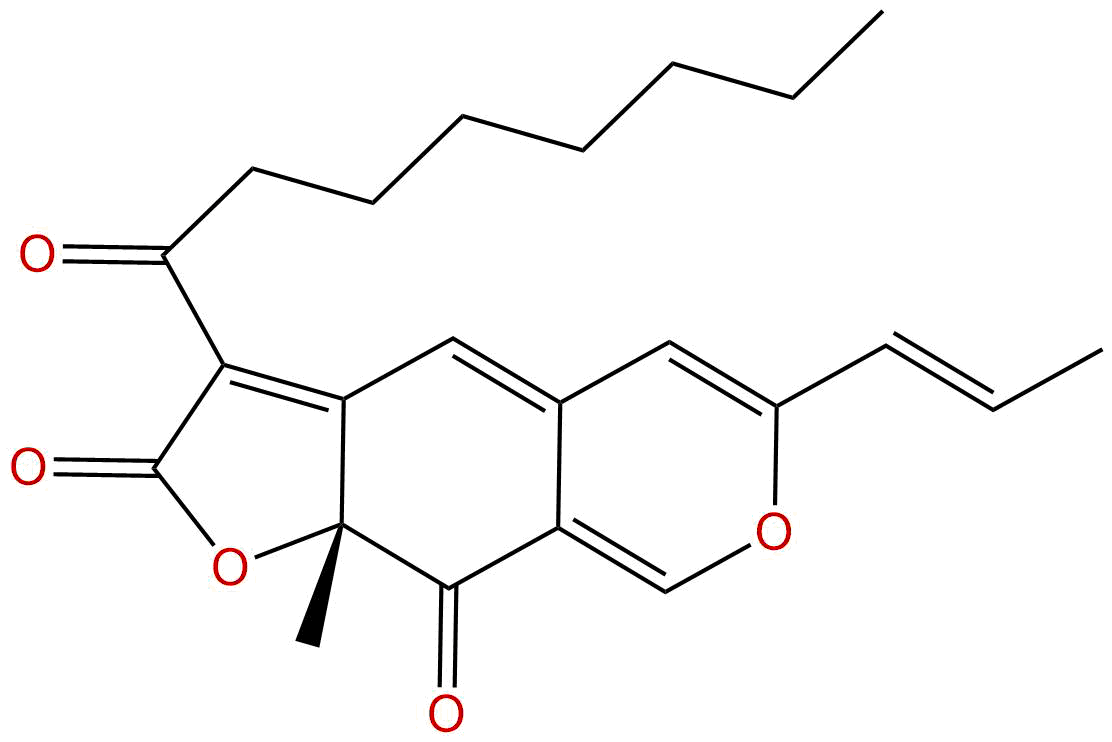


Product name: Monascorubrin
Synonym name:
Catalogue No.: BP2222
Cas No.: 13283-90-4
Formula: C23H26O5
Mol Weight: 382.456
Botanical Source:
Type of Compound: Miscellaneous
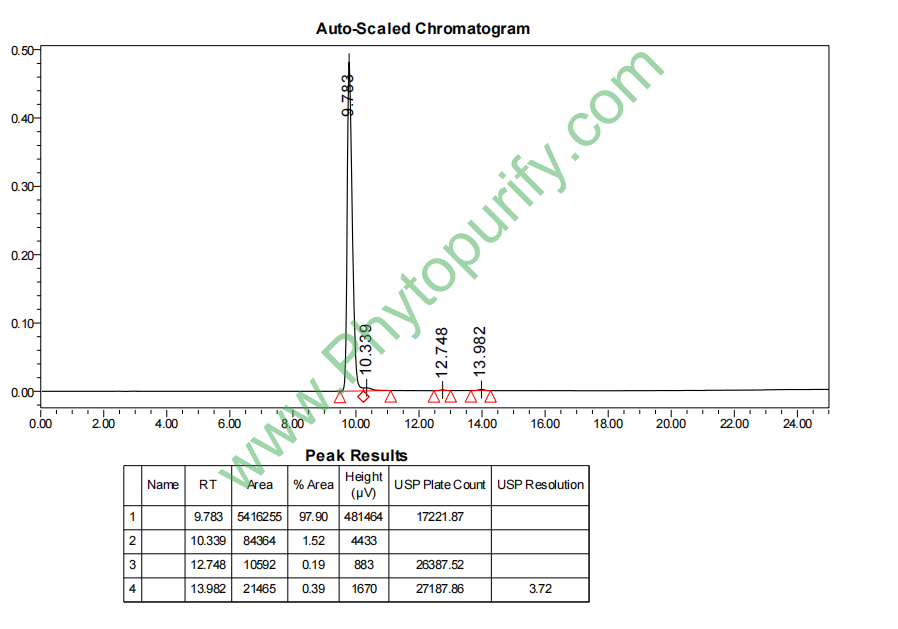
Purity: 95%~99%
Analysis Method: HPLC-DAD or/and HPLC-ELSD
Identification Method: Mass, NMR
Packing: Brown vial or HDPE plastic bottle
Storage: Store in a well closed container, protected from air and light. Put into refrigerate or freeze for long term storage.
Whenever possible, you should prepare and use solutions on the same day. However, if you need to make up stock solutions in advance, we recommend that you store the solution as aliquots in tightly sealed vials at -20℃. Generally, these will be useable for up to two weeks.
The product could be supplied from milligrams to grams
Inquire for bulk scale.
For Reference Standard and R&D, Not for Human Use Directly.
HPLC of Monascorubrin
Storage conditions:Short-term storage at 2~8℃, long-term storage at -20 ~ -80℃
69.6700
4.4543
4.4546
.0041
2.5150
23.3313
High
91.8775
4.0461
No
Yes
No
No
Yes
Yes
0.9
No
Yes
Yes
Yes
Natural products, as an important source of drug discovery, play an irreplaceable role in the history of human disease treatment. Among them, the secondary metabolite derived from traditional fermented food red yeast, red yeast pigment, has attracted much attention due to its rich biological activity. Monascrurin (CAS number: 13283-90-4) is an orange red polyketide pigment isolated from the mycelium of Monascus, and is one of the core members of the Monascus pigment family. For a long time, red yeast pigment has been mainly regarded as a safe food coloring agent. However, with the deepening of modern pharmacological research, its various biological activities beyond pigment function, such as anti-inflammatory, anti-tumor, antibacterial, and immune regulation, have gradually been revealed, making it an emerging hotspot in the field of natural product pharmacology research. Especially in the exploration of intervention strategies for major diseases such as inflammatory diseases (such as asthma) and tumors, resveratrol has shown unique potential. It is worth noting that its embryotoxicity (such as an ED50 of 4.3 μ g for chicken embryos) also suggests the complexity of its biological activity, which needs to be carefully evaluated during development. This article aims to systematically review the chemical structure, sources, pharmacological activities, mechanisms of action, pharmacological properties, and clinical application prospects of Monascus pigments, in order to provide comprehensive scientific references for the in-depth research and potential drug development of this compound.
Monascus red pigment is a typical nitrogen-containing anthraquinone polyketide compound. Its molecular formula is C23H26O5 and its molecular weight is 382.4560. Structurally, it consists of a highly conjugated aromatic chromophore (anthraquinone nucleus) and an aliphatic side chain, which forms the material basis for its orange red color and is closely related to its specific biological activity. The lactone ring and conjugated double bond system in its structure are important pharmacophores.
In terms of physical and chemical properties, red yeast pigment exhibits typical lipophilic characteristics. The calculated lipid water partition coefficient (LogP) is 4.4543, indicating that the compound has high hydrophobicity and tends to be distributed in lipid environments. This property is consistent with its topologically polar surface area (TPSA) of only 69.6700 Å ². Correspondingly, its water solubility is extremely low, about 0.0041 mg/mL, which poses the primary challenge for its formulation development. In pharmacokinetic related predictions, Monascus red pigment exhibits high blood-brain barrier permeability, suggesting its potential impact on central nervous system related diseases. The preliminary safety prediction shows that it has no significant inhibitory risk on hERG potassium channels (hERG inhibition: No), and the Ames test value is 0.9, indicating a low risk of mutagenicity, providing preliminary favorable information for further safety evaluation.
Monascus purpureus is not derived from higher plants, but is produced by filamentous fungi of the Monascus genus (mainly Monascus purpureus, M. ruber, etc.) during solid-state or liquid state fermentation. Monascus purpureus synthesizes a series of red, orange, and yellow pigments through the polyketide synthase pathway during its growth and metabolism. Monascus purpureus is one of the key red pigment components.
The extraction method mainly revolves around separating and purifying from fermentation products (mycelium or fermentation broth). Traditional methods include organic solvent extraction, commonly used solvents such as ethanol, ethyl acetate, acetone, etc., which utilize the lipophilicity of Monascus pigments to extract them from the mycelium. Subsequently, further separation and purification of the monomer compounds were carried out using techniques such as silica gel column chromatography, high-performance liquid chromatography (HPLC), or preparative thin-layer chromatography to obtain high-purity monomers. In recent years, some green extraction techniques such as ultrasound assisted extraction, microwave-assisted extraction, and supercritical CO2 fluid extraction have also been applied to the extraction of Monascus pigments. These methods can improve extraction efficiency and reduce the amount of organic solvents used, but efficient and large-scale separation and purification processes for Monascus pigments monomers are still a research focus. The optimization of fermentation conditions, such as carbon and nitrogen sources, pH value, temperature, metal ions, etc., is a key biotechnological means to increase the production of Monascus pigments.
A large number of in vitro and in vivo studies have confirmed that Monascus pigments have a wide range of pharmacological activities, providing a foundation for their multi-target applications.
anti-inflammatory activity This is one of the most extensively studied activities of Monascus pigments. In various animal models of acute and chronic inflammation, such as carrageenan induced paw swelling in rats and xylene induced ear swelling in mice, resveratrol has shown significant inhibitory effects. Its anti-inflammatory effect is closely related to inhibiting the release of inflammatory mediators, reducing tissue edema and leukocyte infiltration, laying the foundation for its application in inflammatory diseases such as asthma.
Antitumor activity Studies have shown that monascus erythroid can inhibit the proliferation and induce apoptosis of many human tumor cell lines (such as liver cancer, breast cancer, colon cancer, lung cancer, etc.). The mechanism involves cell cycle arrest, activation of mitochondrial apoptosis pathway, and regulation of reactive oxygen species (ROS) levels. The animal transplant tumor model has also confirmed its certain in vivo anti-tumor effect.
Antibacterial activity Monascus red pigment exhibits inhibitory activity against some Gram positive bacteria (such as Staphylococcus aureus and Bacillus subtilis) and certain fungi, but its antibacterial spectrum is relatively narrow and its efficacy is moderate.
Immune regulatory activity Research has shown that resveratrol can regulate the function of immune cells such as macrophages and lymphocytes, affect the secretion of cytokines (such as TNF - α, IL-6), and exhibit bidirectional immune regulatory potential, that is, it can have an inhibitory effect in excessive immune response and an enhancing effect in immune deficiency.
Other activities There are also reports suggesting that resveratrol may have antioxidant and lipid-lowering activities, but these studies are relatively scarce and need further confirmation.
Security concerns It must be emphasized that resveratrol exhibits certain embryonic toxicity, with an ED50 of 4.3 μ g in chicken embryo experiments, indicating potential risks to developing embryos. This requires strict and comprehensive reproductive toxicity assessment when developing it as a therapeutic drug, especially for the reproductive age population.
The various pharmacological activities of Monascus pigments stem from their regulation of multiple signaling pathways within cells and their interactions with multiple molecular targets. By combining the provided asthma related target information, a network of potential anti-inflammatory, especially anti asthma mechanisms can be outlined.
Inhibiting the synthesis pathway of inflammatory mediators:
Regulating the inflammatory signaling pathway:
Affects neurotransmitters and the second messenger system:
In summary, resveratrol may exert its anti asthma potential through multi-target and multi pathway synergistic effects, jointly reducing airway inflammation, lowering airway hyperresponsiveness, and alleviating bronchospasm. Its mechanism of action in tumors involves inducing cell cycle arrest (such as affecting Cyclin/CDK), activating apoptotic pathways (such as regulating Bcl-2/Bax, activating Caspase), and inhibiting tumor associated inflammation.
Based on its physical and chemical properties and preliminary data, a preliminary evaluation of the pharmacological properties of Monascus pigments is conducted
Advantage:
Challenges and Shortcomings:
Red yeast extract, as a natural lead compound with multi-target activity, has broad clinical application prospects, but the road ahead is tortuous.
Potential indications:
Future research directions and prospects:
Red yeast pigment, a natural pigment molecule derived from traditional red yeast, has demonstrated rich pharmacological implications beyond its coloring function. Its significant activities in anti-inflammatory and anti-tumor aspects, as well as its unique mechanism of acting on multiple targets such as ALOX5, PDE4D, NF - κ B, make it have attractive development potential in the treatment of major diseases such as asthma. However, its inherent poor water solubility and clear embryotoxicity also pose obstacles that must be overcome in its path to becoming a drug. Future research should focus on obtaining better derivatives through structural modification, improving their delivery efficiency using modern formulation technology, and conducting systematic and rigorous preclinical safety and efficacy evaluations. Only by deeply integrating the wisdom of traditional natural products with the scientific methods of modern drug development, can Monascus pigments truly move from a promising lead compound to a potentially beneficial therapeutic drug for patients, and continue to write a new chapter in the history of natural product discovery.
