


Product name: Ginsenoside Rf
Synonym name:
Catalogue No.: BP0663
Cas No.: 52286-58-5
Formula: C42H72O14
Mol Weight: 801.024
Botanical Source: Panax ginseng (ginseng)
Physical Description: White powder
Type of Compound: Triterpenoids
Purity: 95%~99%
Analysis Method: HPLC-DAD or/and HPLC-ELSD
Identification Method: Mass, NMR
Packing: Brown vial or HDPE plastic bottle
Storage: Store in a well closed container, protected from air and light. Put into refrigerate or freeze for long term storage.
Whenever possible, you should prepare and use solutions on the same day. However, if you need to make up stock solutions in advance, we recommend that you store the solution as aliquots in tightly sealed vials at -20℃. Generally, these will be useable for up to two weeks.
The product could be supplied from milligrams to grams, up to kilograms
Inquire for bulk scale.
Descriptions:
GinsenosideRf, as an effective natural product, induces G2/Mphase cell cycle arrest and apoptosis in human osteosarcoma MG-63 cells through the mitochondrial pathway, suggests that it may have a therapeutic effect on human osteosarcoma.[1]
Ginsenoside Rf(Rf) , a trace component of ginseng root, produces antinociception in mice; Ginsenoside Rf potentiates U-50,488H-induced analgesia and inhibits tolerance to its analgesia in mice.[2,3]
Ginsenoside Rf regulates voltage-dependent Ca(2+) channels through pertussis toxin (PTX)-sensitive G proteins in rat sensory neurons, suggests that Rf can act through a novel G protein-linked receptor in the nervous system. [4]
Ginsenoside Rf induces CYP3A4 and MDR1 gene expression through constitutive androstane receptor- and pregnane X receptor-mediated pathways. [5]
Ginsenoside Rf significantly reduces the production of IL-1β, IL-6, TNF-α, NO, and ROS, which are most highly activated in inflammatory bowel disease (IBD), and suppresses TNF-α/LPS-induced NF-κB transcriptional activity; suggests that ginsenoside Rf has potent intestinal anti-inflammatory effects that could be used to treat diseases such as IBD.[6]
References:
[1] Shangguan W J, Li H, Zhang Y H. Oncol Rep, 2014, 31(1):305-13.
[2] Mogil J S, Shin Y H, Mccleskey E W, et al. Brain Res, 1998, 792(2):218-28.
[3] Nemmani K V S, Ramarao P. Life Sci, 2003, 72(7):759-68.
[4] Choi S, Jung S Y, Ko Y S, et al. Mol Pharmacol, 2002, 61(4):928-35.
[5] Li Y, Wang Q, Yao X, et al. Eur J Pharmacol, 2010, 640(1-3):46-54.
[6] Ahn S, Siddiqi M H, Aceituno V C, et al. Immunl Invest, 2016,45(5):439-49.
[7] Zang P, Zhang P, Gao Y, et al. J Med Plant Res, 2011, 5(23):5513-6.
HPLC of Ginsenoside Rf
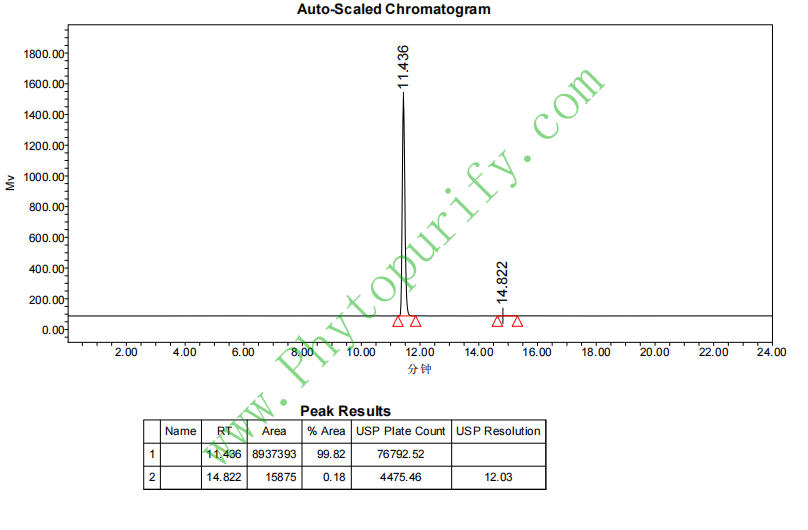
Storage conditions:Short-term storage at 2~8℃, long-term storage at -20 ~ -80℃
239.2200
2.5284
2.5284
.0749
.5454
.2061
Low
64.5000
6.0077
No
No
No
No
No
No
0.0
Yes
No
No
No
As a treasure of traditional medicine, ginseng (Panax ginseng C.A. Mey.) owes its pharmacological activity mainly to a unique class of triterpenoid saponins - ginsenosides. Among the hundreds of identified ginsenosides, ginsenoside Rf (CAS: 52286-58-5) is receiving increasing attention due to its unique chemical structure and significant biological activity. Although present in minimal amounts in ginseng roots, Rf exhibits pharmacological properties distinct from other major saponins such as Rg1 and Rb1, particularly demonstrating great potential in the field of neuroprotection. With the intensification of population aging, the burden of neurodegenerative diseases such as Alzheimer's disease and Parkinson's disease is becoming increasingly heavy, and the development of new, efficient, and low toxicity therapeutic drugs has become an urgent task. The characteristic of ginsenoside Rf exerting neuroprotective effects through multiple targets and pathways makes it an attractive candidate molecule. This article aims to systematically review the chemical structure, plant origin, pharmacological activity, mechanism of action, pharmacological evaluation, and clinical application prospects of ginsenoside Rf, in order to provide comprehensive scientific references for the in-depth research and development of this compound.
Ginsenoside Rf belongs to the dammarane type tetracyclic triterpenoid saponin, with a molecular formula of C42H72O14 and a molecular weight of 801.0240. The core Damatane skeleton is replaced by hydroxyl groups at positions 3 β, 6 α, 12 β, and 20 (S) -. Its structural specificity lies in the fact that the hydroxyl group at the 6 α - position is connected to a disaccharide chain (β - D-glucopyranosyl - (1 → 2) - β - D-glucopyranoside), and a double bond is introduced between C-24 and C-25, which distinguishes it from other ginsenosides (such as Rg1, which is a monosaccharide chain at the C-6 position and has no double bond). This unique glycosylation pattern and double bond structure may be closely related to its specific biological activity and receptor binding properties.
From the analysis of physical and chemical properties, its calculated lipid water partition coefficient (LogP) is 2.5284, indicating that it has a certain degree of lipophilicity, but not highly hydrophobic. Its topological polar surface area (TPSA) is as high as 239.2200 Å ², mainly attributed to the abundant hydroxyl and glycosyl oxygen atoms in the molecule, indicating strong molecular polarity. The water solubility value is 0.0749 (usually measured in mg/mL or log mol/L), indicating low solubility in water and belonging to insoluble compounds. These physical and chemical parameters collectively determine their absorption and distribution characteristics in the body, and are key factors that must be considered when developing formulations.
Ginsenoside Rf is mainly found in plants of the Panax genus in the Araliaceae family ginseng(Panax ginseng, also known as Asian ginseng or Korean ginseng) and Japanese ginseng A trace saponin component in the roots of Panax japonicum. There are significant differences in its content among different varieties, origins, growth years, and parts (main roots, lateral roots, and fibrous roots), usually much lower than major saponins such as Rb1 and Rg1. Therefore, obtaining high-purity Rf directly from natural plants in large quantities faces challenges.
Its extraction and separation usually follow the general process of total ginsenosides and require high-resolution separation techniques. The standard steps are as follows:
1. Extract Dry ginseng root powder was subjected to reflux extraction or ultrasound assisted extraction using methanol, ethanol, or ethanol water solution to obtain crude extract.
2. enrichment The crude extract was subjected to column chromatography using macroporous adsorption resins (such as D101, AB-8), and eluted with a gradient of water and different concentrations of ethanol to enrich the saponin sites.
3. Separation and purification The enriched saponin fraction needs to be finely separated using repeated column chromatography techniques. Commonly used normal phase chromatography materials include silica gel, reverse phase materials such as ODS (C18), and high performance liquid chromatography (HPLC) or medium pressure liquid chromatography (MPLC). Given the low content of Rf and its difficulty in separating from structurally similar compounds such as Rg1, preparative high-performance liquid chromatography (Prep HPLC) is currently the most effective method for obtaining high-purity ginsenoside Rf.
4. appraisal The purified compound was structurally confirmed by techniques such as mass spectrometry (MS) and nuclear magnetic resonance (NMR, including 1H-NMR and 13C-NMR).
In addition, using microbial transformation or synthetic biology methods to biotransformation abundant saponins (such as Rg1) as precursors is a promising alternative strategy for obtaining ginsenoside Rf.
Although the pharmacological activity research of ginsenoside Rf started relatively late, it has been revealed to have significant effects in multiple aspects, with a focus on neuroprotection.
Neuroprotective effect This is the most highly regarded activity of ginsenoside Rf. Rf has shown efficacy in improving cell viability, reducing neuronal apoptosis, alleviating oxidative stress, and improving cognitive impairment in various in vitro cell models (such as beta amyloid induced PC12 cell injury, glutamate excitotoxic injury neuronal models) and in vivo animal models (such as Alzheimer's disease transgenic mice, cerebral ischemia-reperfusion injury rat models). Its strength of action is sometimes even better than some common ginsenosides.
Antitumor and Induced Apoptosis Research shows that ginsenoside Rf can inhibit the growth and induce apoptosis of some tumor cell lines (such as liver cancer and breast cancer cells). Its pro apoptotic effect is closely related to regulating the expression of apoptosis related proteins.
Calcium channel regulation Early studies have indicated that ginsenoside Rf can inhibit N-type voltage-gated calcium ion channels (N-type Ca2+channels). This channel is widely distributed in the central nervous system and participates in neurotransmitter release and neuronal excitability regulation. Its inhibition may help alleviate neuronal damage caused by calcium overload, which is of great significance in cerebral ischemia and neurodegenerative diseases.
Other potential activities Based on its structural similarity with ginsenosides, it is speculated that Rf may also have auxiliary neuroprotective activities such as anti-inflammatory and antioxidant stress, but more direct evidence is needed to support this.
The neuroprotective effect of ginsenoside Rf is not achieved through a single target, but involves a complex network, and its mechanism of action is related to the interaction of multiple key molecular targets:
Inhibition of β - amyloid (A β) pathway One of the core pathological features of Alzheimer's disease is the deposition of A β. Rf may be down regulatedβ - secretase 1 (BACE1) Reduce the expression or activity of A β and decrease its production. Meanwhile, it may have an impact Starch like precursor protein (APP) The processing process tilts towards non starch derived pathways.
Regulating tau protein phosphorylation Overphosphorylation of tau protein to form neurofibrillary tangles is another major pathological feature. Rf may inhibit Glycogen synthase kinase-3 β (GSK3B) The activity of tau protein, or activation of phosphatase, reduces the abnormal phosphorylation level of tau protein.
Antioxidant stress and activation of endogenous defense Rf can activate Nuclear factor E2 related factor 2 (NFE2L2/Nrf2) Signal pathway. Nrf2 is the central regulator of cellular antioxidant response, and its activation can upregulate the expression of various phase II detoxifying enzymes and antioxidant proteins, thereby enhancing the ability of neurons to resist oxidative damage.
Anti apoptotic and pro survival pathways:
Direct ion channel effect As mentioned earlier, for N-type calcium channel Direct inhibition helps stabilize neuronal membrane potential, reduce pathological calcium influx and excitotoxicity.
In summary, ginsenoside Rf forms a multidimensional neuroprotective network by synergistically acting on multiple signaling pathways such as APP/ACE1, GSK3B/tau, Nrf2 antioxidant, Bcl-2/CASP9 apoptosis, SIRT1, and MAPK.
Based on the provided pharmacological parameters and existing research, the preliminary evaluation of the pharmacological properties of ginsenoside Rf is as follows:
At present, there are very limited research reports on the pharmacokinetics of ginsenoside Rf system. Key parameters such as absolute bioavailability, major metabolic pathways, and elimination half-life urgently need to be revealed through standardized preclinical and clinical studies.
The clinical application prospects of ginsenoside Rf mainly revolve around neurological diseases, but it also faces many challenges and opportunities.
Potential application directions:
1. Adjuvant or combination therapy for Alzheimer's disease (AD)With its multiple mechanisms of action (anti A β, anti tau phosphorylation, antioxidant, anti apoptosis), Rf is expected to be developed as a disease modifier for AD, and may produce synergistic effects when combined with existing symptomatic treatment drugs (such as cholinesterase inhibitors).
2. Parkinson's disease (PD)Its antioxidant and anti apoptotic properties, as well as its promotion of neuronal survival, may be beneficial for the protection of dopaminergic neurons in PD.
3. Neural repair after cerebral ischemia/stroke By inhibiting calcium overload, reducing oxidative damage and inflammatory response, Rf may be used for neuroprotective treatment after acute stroke.
4. Other Its preliminary activity in anti-tumor is also worth further exploration in specific types of cancer.
Challenges and Future Prospects:
1. Resources and Supply The extremely low natural content restricts research and development. We should vigorously develop in the future Chemical synthesis, semi synthesis, or synthetic biology methods To achieve large-scale and sustainable production of Rf.
2. Pharmacokinetic optimization We must focus on solving it Low solubility and low blood-brain barrier permeability The problem. The development of a new drug delivery system is a key breakthrough.
3. Deep exploration of mechanisms The existing mechanism research still mostly stays at the level of phenotype and pathway, and needs to be further elucidated Direct molecular target(possibly membrane receptors, enzymes, or signaling proteins) and precise structure-activity relationships.
4. Clinical translational research It is urgent to carry out standardized preclinical efficacy evaluation (validated in animal models closer to human diseases) and systematic safety evaluation to lay a solid foundation for clinical trials.
5. Compound and combination therapy As a natural product ingredient, exploring its reasonable compatibility with other neuroprotective drugs or other saponins in ginseng may leverage the comprehensive advantages of multi-component and multi-target.
Ginsenoside Rf, as a unique and highly active trace component in ginseng, is gradually emerging from numerous saponins. Its multi-target and multi pathway mechanism of action in neuroprotection provides new ideas and candidate molecules for addressing the global health challenge of neurodegenerative diseases. Although significant challenges still exist in terms of natural sources, medicinal properties (especially brain delivery), and deep mechanisms of action, these obstacles are expected to be gradually overcome with the continuous advancement of modern isolation techniques, synthetic biology, drug delivery systems, and molecular pharmacology research. In the future, through interdisciplinary collaboration and in-depth systematic research from basic to clinical levels, ginsenoside Rf is expected to transform from a traditional herbal ingredient into a modern drug with clear molecular mechanisms and clinical value, contributing to the cause of human neurological health.
