


Synonym name: Myristin; Glycerol trimyristate; Trimyristin
Catalogue No.: BP0678
Cas No.: 555-45-3
Formula: C45H86O6
Mol Weight: 723.177
Botanical Source: nutmegs and other seed fats rich in myristic acid
Purity: 95%~99%
Analysis Method: HPLC-DAD or/and HPLC-ELSD
Identification Method: Mass, NMR
Packing: Brown vial or HDPE plastic bottle
Can be supplied from milligrams to grams.
For Reference Standard and R&D, Not for Human Use Directly.
Inquire for bulk scale.
HPLC of Glycerol tritetradecanoate
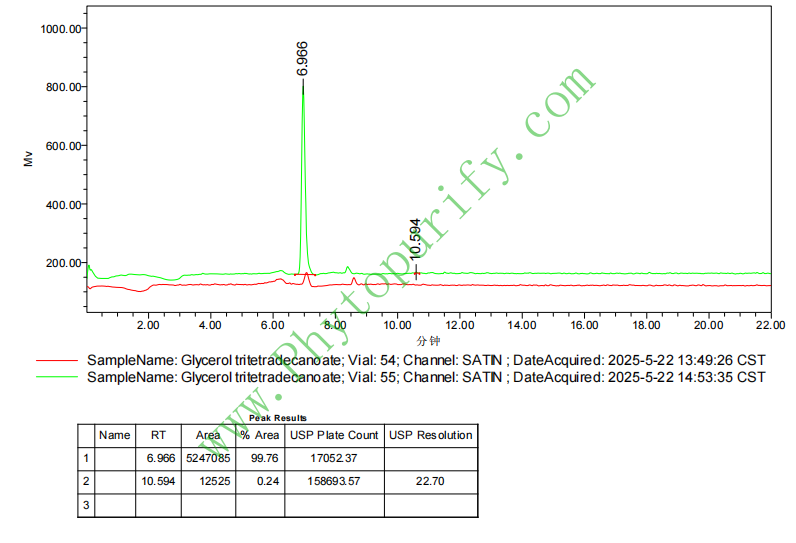
Storage conditions:Short-term storage at 2~8℃, long-term storage at -20 ~ -80℃
78.9000
13.6630
13.6630
.0001
2.0394
2.2035
High
96.4360
2.4369
Yes
No
No
Yes
No
No
0.0
No
No
No
No
Glycerol tritetradeccanoate, also known as Trimyristin, is a natural triglyceride compound formed by esterification of glycerol with three molecules of myristic acid (fourteen carbon saturated fatty acid). Its CAS number is 555-45-3 and its molecular weight is 723.1770. As an important component of natural lipids, myristic acid triglycerides are not only widely present in various plant oils, especially in nutmeg oil, but also widely studied in pharmacology and materials science due to their unique chemical properties and biological activities. In recent years, with the high incidence of metabolic diseases, especially obesity, the role of natural lipid compounds in regulating energy metabolism and lipid metabolism has gradually been revealed. As a potential regulatory factor, the pharmacological activity and mechanism of action of myristic acid triglycerides have become a research hotspot.
This article aims to systematically review the chemical structure, physicochemical properties, plant sources, and extraction methods of myristic acid triglycerides, with a focus on their pharmacological activity and molecular targets in metabolic diseases such as obesity. It explores their pharmacological properties and pharmacokinetic characteristics, and looks forward to their clinical application potential, providing theoretical basis and reference for further research and development.
The molecular formula of myristic acid triglycerides is C45H86O6, which is structurally formed by the ester bond between one molecule of glycerol and three molecules of myristic acid. Its chemical structure has typical triglyceride characteristics, and all three long-chain fatty acids are saturated fourteen carbon fatty acids (CH3- (CH2) 12-COOH), making it highly hydrophobic and lipophilic. Its molecular weight is 723.1770, and its LogP value is as high as 13.6630, indicating its strong lipid solubility and hydrophobicity, with extremely low water solubility (0.0001), which has an important impact on its bioavailability and in vivo distribution.
From the perspective of physical and chemical properties, myristic acid triglyceride is a colorless or light yellow solid with high melting point and good thermal stability. It is commonly used for sample preparation and gel formation of polyacrylamide gel electrophoresis. Its topological polar surface area (TPSA) is 78.9 Å ², indicating the presence of a certain number of polar groups in its molecule, but the overall structure is still dominated by hydrophobic groups.
It is worth noting that myristic acid triglycerides have high blood-brain barrier permeability, suggesting that they may affect central nervous system function. At the same time, it has hERG channel inhibitory activity, indicating potential risks of cardiac toxicity and requiring special attention in drug development. The Ames test result is negative, indicating that it does not have significant genetic toxicity.
Triglycerides of myristic acid are widely present in various plant oils, especially in the seed oil of Myristica fragrans, which is the most abundant with a content of up to 20% -25%. In addition, coconut oil, palm kernel oil, and seed oil of certain tropical plants also contain a certain amount of Trimyristin.
The traditional extraction method mainly adopts solvent extraction technology, using organic solvents such as hexane, ether or chloroform methanol mixed solvents to extract plant seed oil, and then separating and purifying Trimyristin through cooling crystallization method. Modern extraction techniques such as supercritical CO2 extraction have gradually become the mainstream method for extracting myristic acid triglycerides due to their high efficiency, environmental friendliness, and strong selectivity. This method not only maintains the structural integrity of the compound, but also avoids residual organic solvents, improving the purity and safety of the extract.
In addition, enzymatic hydrolysis and esterification techniques have also been applied to the preparation and modification of myristic acid triglycerides, achieving directed transfer or modification of fatty acid chains through specific lipase catalysis, expanding their applications in medicine and functional materials.
As a natural lipid compound, the pharmacological activity research of myristic acid triglycerides mainly focuses on metabolic regulation, anti-inflammatory and neuroprotective aspects. Especially in the prevention and treatment of obesity and related metabolic syndrome, it shows potential value.
Anti obesity and metabolic regulation effects
Triglycerides of myristic acid exert anti obesity effects by regulating lipid metabolism and energy balance. Research has shown that this compound can activate the AMPK (5 'AMP activated protein kinase) signaling pathway, promote fatty acid oxidation, inhibit fat synthesis, and thus reduce fat accumulation. In addition, its regulatory effect on SIRT1 (silencing information regulatory factor 2-related enzyme 1) helps improve insulin sensitivity and energy metabolism, and alleviate obesity related metabolic disorders.
anti-inflammatory effect
Triglycerides of myristic acid regulate the TLR2 (Toll like receptor 2) signaling pathway, inhibit the release of inflammatory factors, and alleviate chronic low-grade inflammation. Obese patients often have chronic inflammation, and the anti-inflammatory effect of myristic acid triglycerides can help alleviate obesity related inflammatory reactions and their complications.
Neuroprotective and analgesic effects
Due to its high blood-brain barrier permeability, myristic acid triglycerides may affect central nervous system function. Research has found that it can regulate the TRPV1 (transient receptor potential vanillic acid receptor 1) channel, participate in pain transmission and neuroinflammatory responses, and demonstrate potential neuroprotective and analgesic effects.
Other functions
Triglycerides of myristic acid may also exert multiple biological effects by regulating signaling molecules such as PTPN1 (protein tyrosine phosphatase 1B) and PRKCA (protein kinase C alpha), affecting cellular metabolism and signal transduction.
Although pharmacological research on myristic acid triglycerides is still in its preliminary stage, its multi-target and multi pathway mechanism of action provides a theoretical basis for the development of new metabolic disease treatment drugs.
The pharmacological effects of myristic acid triglycerides involve multiple molecular targets, mainly focusing on key proteins and signaling pathways that regulate energy metabolism, lipid metabolism, and inflammatory response.
AMPK(PRKAA1)
AMPK is a core regulatory factor in cellular energy metabolism, and activation of AMPK can promote fatty acid oxidation, inhibit fat synthesis and gluconeogenesis. Triglycerides of myristic acid activate AMPK, enhance mitochondrial function, increase energy expenditure, and improve obesity related metabolic abnormalities.
SIRT1
SIRT1 is an NAD+- dependent deacetylase involved in regulating metabolic homeostasis and inflammatory response. Triglycerides of myristic acid can promote SIRT1 activity, regulate lipid metabolism gene expression, improve insulin resistance, and alleviate obesity related metabolic disorders.
PTPN1
PTPN1 is a tyrosine phosphatase that negatively regulates insulin signaling, and inhibiting its activity helps improve insulin sensitivity. Triglycerides of myristic acid may enhance insulin signaling and improve glucose and lipid metabolism by inhibiting PTPN1.
TRPV1
The TRPV1 channel is involved in pain perception and inflammatory response, while myristic acid triglycerides exert neuroprotective and anti-inflammatory effects by regulating TRPV1 activity.
TLR2
TLR2 is a key receptor in the immune system that regulates inflammatory responses. Triglycerides of myristic acid alleviate obesity related chronic inflammation by inhibiting TLR2 mediated inflammatory signaling.
Other targets
Triglycerides of myristic acid may also act on molecules such as ABCB1 (P-glycoprotein), FEN1 (invertase 1), PRKCA (protein kinase C alpha), LPAR1 (lysophosphatidic acid receptor 1), ENPP2 (nucleotidase phospholipase D), regulate cellular metabolism, membrane transport, and signal transduction, and participate in various physiological and pathological processes.
In summary, myristic acid triglycerides exhibit complex and diverse biological functions by synergistically regulating metabolic and inflammatory pathways through multiple targets.
The pharmacological evaluation of myristic acid triglycerides shows that they have certain advantages and challenges.
Physical and chemical properties and bioavailability
High lipid solubility (LogP=13.6630) gives it good solubility in a lipid environment, but extremely low water solubility (0.0001) limits its oral absorption and in vivo distribution. High blood-brain barrier permeability suggests that it can enter the central nervous system and has neuropharmaceutical potential, but it also increases the risk of central toxicity.
safety evaluation
A negative Ames test indicates no significant genetic toxicity, but a positive hERG channel inhibition suggests a potential risk of prolonged QT interval in the heart, requiring strict cardiac safety monitoring in drug development.
Pharmacokinetic characteristics
At present, there is relatively little systematic pharmacokinetic research on myristic acid triglycerides. Based on its structure, it is speculated that in vivo metabolism may involve lipase mediated hydrolysis, releasing myristic acid and glycerol, followed by fatty acids entering the β - oxidation pathway. Its high lipid solubility may lead to accumulation in adipose tissue, affecting half-life and distribution volume.
Formulation development challenges
Due to poor water solubility, new drug delivery systems such as liposomes, nanoparticles, and solid dispersions are needed to improve bioavailability. Meanwhile, it is necessary to optimize the dosage form to reduce the risk of cardiac toxicity and ensure safety.
In summary, myristic acid triglycerides have certain potential for drug development, but it is necessary to overcome limitations in solubility and safety and conduct systematic pharmacokinetic and toxicological studies.
As a natural lipid compound, myristic acid triglycerides have shown promising application prospects in the prevention and treatment of obesity and metabolic syndrome. It provides new ideas for the development of new metabolic disease treatment drugs by regulating lipid metabolism and inflammatory response through multiple targets and pathways.
Metabolic disease treatment
Myristic acid triglyceride can be used as an activator of AMPK and SIRT1, regulate energy metabolism, improve insulin resistance, and has potential anti obesity and anti diabetes effects. In the future, modern drug delivery technology can be combined to develop oral or injectable formulations for adjuvant therapy of metabolic diseases.
Neurological disorders
Its high blood-brain barrier permeability and ability to regulate TRPV1 channels make it potentially valuable for neuroprotection, analgesia, and neuroinflammatory diseases. Explore its role in the management of neurodegenerative diseases and chronic pain.
Anti inflammatory and immune regulation
By inhibiting TLR2 mediated inflammatory signaling, myristic acid triglycerides have the potential to be used for the treatment of chronic inflammatory diseases, especially obesity related inflammatory states.
Combination therapy strategy
Combined with other metabolic regulating drugs or natural products, myristic acid triglycerides can exert a synergistic effect, improve therapeutic efficacy, and reduce the dosage and side effects of monotherapy.
Safety and Formulation Optimization
Future research needs to focus on addressing the cardiotoxicity risks associated with hERG inhibition and developing safer derivatives or formulations. At the same time, improve the drug delivery system to enhance its bioavailability and targeting.
In summary, as a natural product, myristic acid triglycerides have broad development prospects in the field of metabolic diseases, but systematic preclinical and clinical studies are still needed to verify their safety and effectiveness.
As a natural triglyceride compound, myristic acid triglycerides have shown significant pharmacological potential in the prevention and treatment of obesity and related metabolic diseases due to their unique chemical structure and multi-target regulatory ability. It participates in energy metabolism, lipid regulation, and inflammatory response by activating multiple signaling pathways such as AMPK, regulating SIRT1, and inhibiting TLR2, and has multiple biological effects.
Although its high lipid solubility and low water solubility limit its bioavailability and pose potential risks of cardiac toxicity, modern drug delivery technologies and structural modifications have the potential to overcome these challenges and achieve its clinical application. In the future, we should strengthen in-depth research on its pharmacokinetics, safety, and mechanism of action, and promote its transformation into a new type of metabolic disease treatment drug.
In summary, as an important object of pharmacological research on natural products, myristic acid triglycerides have broad scientific research and clinical development value, and deserve continuous attention and in-depth exploration.
