


Synonym name:
Catalogue No.: BP0974
Cas No.: 607-91-0
Formula: C11H12O3
Mol Weight: 192.214
Botanical Source: Illicium anisatum, dill, nutmeg, parsley and many other essential oils
Purity: 95%~99%
Analysis Method: HPLC-DAD or/and HPLC-ELSD
Identification Method: Mass, NMR
Packing: Brown vial or HDPE plastic bottle
Can be supplied from milligrams to grams.
For Reference Standard and R&D, Not for Human Use Directly.
Inquire for bulk scale.
HPLC of Myristicin
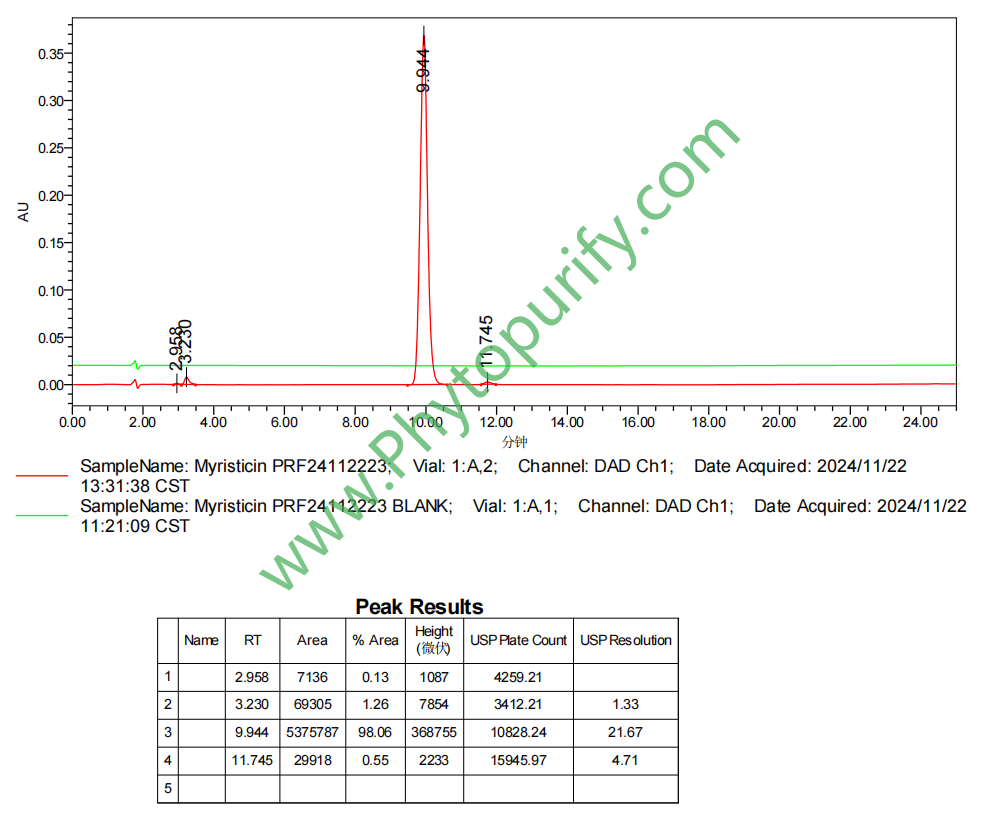
Storage conditions:Short-term storage at 2~8℃, long-term storage at -20 ~ -80℃
27.6900
2.2883
2.2885
.0939
7.6150
76.7804
High
81.0212
2.3306
Yes
Yes
Yes
No
Yes
Yes
0.6
No
Yes
Yes
Yes
Myristicin (CAS number: 607-91-0) is a naturally occurring aromatic compound in various plant essential oils, particularly known for its abundant content in Myristica fragrans essential oil. As a natural product with multiple biological activities, nutmeg ether has attracted widespread attention in both traditional herbal medicine and modern pharmacological research. Its unique chemical structure endows it with multi-target pharmacological effects, including serotonin receptor antagonism, monoamine oxidase (MAO) inhibition, anti-cancer, antibacterial, anti-inflammatory, and induction of cell apoptosis functions.
In recent years, with the in-depth analysis of the pharmacological mechanisms of natural products, nutmeg ether has shown potential clinical application value in fields such as tumor suppression, neural regulation, and anti infection. Especially in the treatment research of digestive system malignant tumors such as gastric cancer, nutmeg ether exhibits significant anti proliferative effects by regulating the EGFR/ERK signaling pathway. In addition, nutmeg ether has good oral bioavailability and blood-brain barrier penetration ability, indicating its potential application in central nervous system diseases. However, the abuse of nutmeg ether may also lead to hallucinations and organ damage, and safety issues cannot be ignored.
This article will systematically review the chemical structure and physicochemical properties, plant sources, and extraction methods of nutmeg ether, with a focus on its pharmacological activity and mechanism of action, exploring its pharmacological and pharmacokinetic characteristics, and finally looking forward to its clinical application prospects and development directions. The aim is to provide theoretical basis and research references for natural product pharmacology and new drug development.
Myristicin, with a molecular formula of C11H12O3 and a molecular weight of 192.2140, belongs to the phenylpropanoid class of compounds. Its chemical structure is characterized by a benzene ring connected to a side chain containing methoxy and methylenedioxy (1,3-dioxy) structures, specifically 5-methoxy-3,4-methylenedioxyphenylpropenyl methyl ether. The methylene dioxy group in the structure endows it with strong electron donor properties, affecting its interaction with biological targets.
In terms of physical and chemical properties, the LogP value of nutmeg ether is 2.2883, indicating its moderate lipid solubility, which is beneficial for penetrating cell membranes and the blood-brain barrier. Its polar surface area (TPSA) is 27.69 Å ², indicating low molecular polarity, further supporting its good membrane permeability. Low water solubility (0.0939 mg/mL) suggests limited solubility in aqueous phase, but is suitable for improving bioavailability through liposomes or nanocarriers. Nutmeg ether does not exhibit hERG channel inhibitory activity, reducing the risk of cardiac toxicity. The Ames test result is 0.6, indicating low genotoxicity and a certain level of safety.
In summary, the chemical structure and physicochemical properties of nutmeg ether provide a molecular basis for its multi-target pharmacological effects and oral biological activity, and also provide important references for its drug design and formulation development.
Nutmeg ether mainly exists in the seeds and essential oils of Myristica fragrans, and is one of the main active ingredients of this essential oil. In addition to nutmeg, nutmeg ether can also be detected in the volatile oils of other aromatic plants such as parsley (Petroselinum crispum), pepper (Piper nigrum), and certain spice plants, but the content is much lower than nutmeg.
The traditional method of extracting nutmeg ether mainly relies on distillation and solvent extraction techniques. The commonly used extraction processes include steam distillation and organic solvent extraction:
steam distillation Distillation of volatile oil from nutmeg seeds using water vapor, followed by separation of the oil phase through a separatory funnel. This method is easy to operate and suitable for industrial scale production, but some components may undergo thermal degradation due to high temperatures.
Solvent Extraction Method Extract nutmeg powder using organic solvents such as ethanol, ether, or petroleum ether, and then concentrate it by rotary evaporation to obtain essential oil. This method is mild and can effectively retain thermosensitive components, making it suitable for laboratory and high-purity extraction.
Supercritical CO2 extraction In recent years, supercritical carbon dioxide extraction technology has been widely used for natural product extraction due to its high efficiency, solvent-free residue, and environmental friendliness. This technology can extract nutmeg ether at lower temperatures while maximizing its activity.
The extracted essential oil is usually analyzed and quantified by gas chromatography-mass spectrometry (GC-MS), and the content of nutmeg ether can reach 30% -40%, which is the main component of the essential oil.
Nutmeg ether has shown significant effects in various pharmacological activities, covering multiple fields such as neural regulation, anti-tumor, antibacterial, and anti-inflammatory.
Nutmeg ether, as a serotonin receptor antagonist and weak monoamine oxidase (MAO) inhibitor, has the potential to regulate central nervous system function. Its targets include 5-hydroxytryptamine transporter protein (SLC6A4), 5-hydroxytryptamine receptor 2A (HTR2A), 5-hydroxytryptamine receptor 1A (HTR1A), and gamma aminobutyric acid receptor subunits (GABRA1, GABRB2, GABRG2), which are involved in regulating emotions, anxiety, sleep, and sedation.
Animal experiments have shown that nutmeg ether has a certain sedative and hypnotic effect, which may be achieved by enhancing GABA mediated inhibitory nerve conduction and regulating the serotonin system. In addition, the MAO inhibitory effect of nutmeg ether promotes the accumulation of monoamine neurotransmitters, further enhancing its neural regulatory function.
However, when the dosage is too high, nutmeg ether can cause hallucinations and cognitive impairment, indicating that its neural activity has a bidirectional regulatory characteristic and should be used with caution.
Nutmeg ether exhibits anti proliferative and apoptosis inducing abilities in various cancer cell lines. Especially in gastric cancer cells, nutmeg ether inhibits the epidermal growth factor receptor (EGFR) and its downstream ERK signaling pathway, blocks cell cycle progression, and suppresses tumor cell proliferation and migration.
In vitro studies have shown that nutmeg ether can induce apoptosis in cancer cells, regulate the expression of Bcl-2 family proteins, activate the caspase pathway, and promote programmed cell death. In addition, its antioxidant and anti-inflammatory properties also contribute to the inhibition of oncogenes in the tumor microenvironment.
Nutmeg ether exhibits inhibitory activity against various Gram positive and negative bacteria, especially against common pathogenic bacteria such as Staphylococcus aureus and Escherichia coli. Its antibacterial mechanism may be related to interference with bacterial cell membrane structure and inhibition of key enzyme activity.
In terms of anti-inflammatory effects, nutmeg ether can inhibit the expression of inflammatory mediators such as tumor necrosis factor alpha (TNF - α), interleukin-6 (IL-6), and cyclooxygenase-2 (COX-2), alleviate inflammatory responses, and demonstrate potential anti-inflammatory therapeutic value.
Some studies have also reported that nutmeg ether has antioxidant, antiplatelet aggregation, and liver protective effects, but the relevant mechanisms still need further clarification.
The multi-target mechanism of action of nutmeg ether is the molecular basis for its diverse pharmacological effects. The main mechanisms of action can be summarized as follows:
Nutmeg ether, as a serotonin receptor antagonist, mainly acts on 5-HT2A and 5-HT1A receptors, regulating neurotransmitter release and receptor activity, affecting mood, anxiety, and sleep. By inhibiting SLC6A4 (serotonin transporter), myricetin enhances serotonin concentration in synaptic cleft and promotes neural signal transmission.
Nutmeg ether exhibits weak inhibitory effects on MAO, blocking the metabolism of monoamine neurotransmitters such as dopamine, serotonin, and norepinephrine, increasing their concentration between neurons, and improving neurological function.
In tumor cells, nutmeg ether inhibits cell proliferation and migration by suppressing EGFR kinase activity, blocking the EGFR/ERK signaling pathway. This pathway is a key driving factor for the occurrence and development of various tumors, and nutmeg ether achieves anti-cancer effects by intervening in this signaling axis.
In addition, nutmeg ether regulates the expression of apoptosis related proteins (such as Bax, Bcl-2) and activates the caspase cascade, inducing programmed cell death in tumor cells.
Nutmeg ether achieves antibacterial effects by disrupting the integrity of bacterial cell membranes and inhibiting the activity of key metabolic enzymes. Its anti-inflammatory effect involves inhibiting the NF - κ B signaling pathway, reducing the expression of inflammatory factors, and alleviating tissue inflammatory damage.
Nutmeg ether has good pharmacological parameters, supporting its development as a potential drug candidate molecule.
After oral administration, nutmeg ether has high bioavailability and good blood-brain barrier penetration ability, making it suitable for the treatment of neurological diseases. Its metabolism in the body is mainly carried out through the liver cytochrome P450 enzyme system, and the metabolites need further identification.
Overall, nutmeg ether has great potential for drug development, but further systematic evaluation of its toxicological properties and pharmacokinetic parameters is needed.
Nutmeg ether has shown broad application prospects in multiple disease fields due to its multi-target and multifunctional pharmacological properties
Neuropsychiatric disorders Its serotonin receptor regulation and MAO inhibition make it a potential candidate for antidepressant, anti anxiety, and sedative hypnotic drugs. In the future, structural optimization can be used to enhance selectivity and safety, and reduce the risk of hallucinations.
tumor therapy The anti proliferative and pro apoptotic effects of nutmeg ether on gastric cancer and other solid tumors provide new ideas for its anti-cancer drug development. Combining targeted drugs or chemotherapy drugs may enhance therapeutic efficacy and reduce toxic side effects.
Anti infection and anti-inflammatory: Its antibacterial and anti-inflammatory activities make it have the potential of adjuvant treatment in infectious diseases and inflammatory diseases, especially suitable for the development of natural antibacterial agents or anti-inflammatory drugs.
Formulation development and administration route Given its poor water solubility and potential neurotoxicity, future research should focus on the development of novel delivery systems such as nanocarriers and liposomes to enhance bioavailability and targeting, and reduce adverse reactions.
Safety and Toxicology Research The hallucinogenic and organ toxicity risks of nutmeg ether need to be taken seriously. The toxicological evaluation of the system and the study of dose-response relationships are key to clinical translation.
In summary, nutmeg ether, as a multifunctional natural product, has the potential to become a new drug lead compound. In the future, it is necessary to strengthen the molecular level analysis of its mechanism of action, optimize its structure, improve pharmacokinetics and safety evaluation, and promote its clinical application.
Nutmeg ether, as the main active ingredient of nutmeg essential oil, has shown extensive potential in neural regulation, anti-cancer, antibacterial, and anti-inflammatory fields due to its unique chemical structure and multi-target pharmacological activity. Its excellent oral bioavailability and blood-brain barrier penetration ability further enhance its value as a drug candidate molecule.
However, the hallucinogenic and potential toxicity of nutmeg ether also pose challenges to its clinical application, and it is urgent to clarify its therapeutic window and indications through in-depth pharmacological mechanism research, structural optimization, and safety evaluation. In the future, combining modern drug delivery technology and precision medicine strategies, nutmeg ether is expected to become an important research object in the field of natural product pharmacology and a breakthrough point for innovative drug development.
In summary, the multidimensional study of nutmeg ether not only enriches the pharmacological knowledge system of natural products, but also provides new ideas and possibilities for the treatment of related diseases, with important scientific value and application prospects.
